In this video, Evan Lieberman, MSW LICSW LADC, breaks down the differences between clinical services for addiction, for example, treatment and therapy, VS, Community-Based models, for example, the 12-Steps. Sometimes these two camps don't get along and have strong opinions about the other. But from Evan's experience in both worlds, he finds they each have strengths and limitations, which he breaks down in detail.
Evan is Cadre's resident mental health and addiction therapist. He'll be answering questions from other creators, coaches, and from any of our users. Today's question is a really good question.
Today's question is about the difference between the community or social model of addiction recovery versus the clinical model. Both approaches have benefits and limitations. In this video, I'm going to break down the pros and cons of each and then give you my opinion.
With AA alone, there's over 123,000 groups worldwide. Also, it's now up to over 2 million members. It offers a very practical means of self improvement. Research shows that people who go to AA meetings often stay sober.
AA is based on spirituality, not religion. But it doesn't always vibe with people that are like atheist or agnostic. The support given is not from professionals. AA is pretty loosely regulated. That could be a double edged sword.
Some of the modern treatment facilities were originally very connected with the twelve steps. Over time, more and more clinical interventions were interwoven into treatment. Getting medications is also a clinical intervention for addiction.
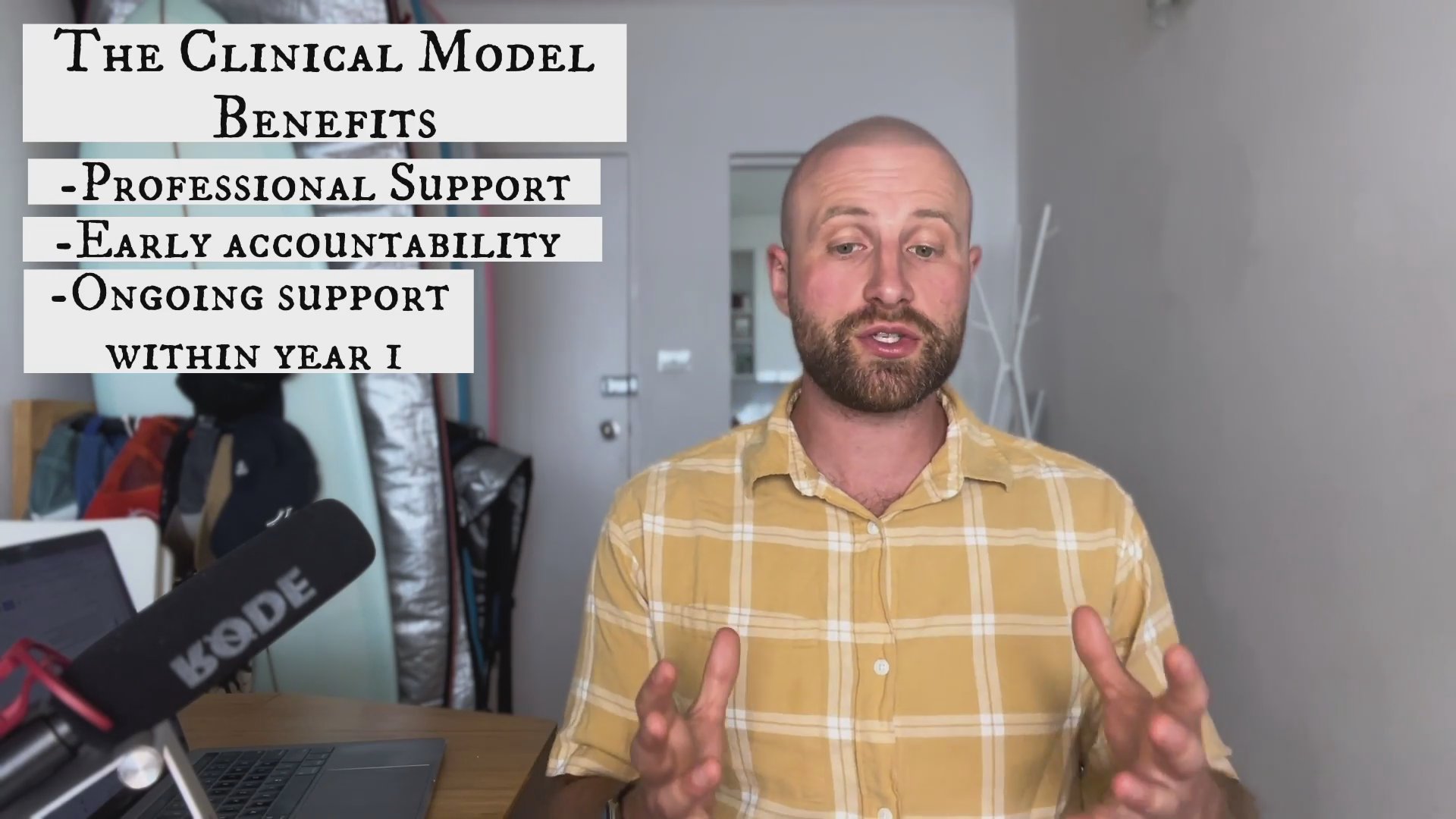
Clinical interventions provide a great deal of accountability at the beginning, when the addict or alcoholic is most vulnerable. By seeing someone who's a trained therapist and addiction and mental health, they're able to go much deeper with you. There are clinical modalities able to prescribe medications that are shown to help for folks with addictions.
The cost of mental health and addiction services is expensive. It's often hard for people to find a therapist or clinician psychiatrist that is properly trained in addiction or mental health disorders. Both have a lot of strengths, yet limitations. Which one of these is better?
What's up, Cadre folks? Evan here, your resident mental health and addiction therapist. And today I'm excited because I'm going to be starting a new series, and that is where I'm directly answering questions from our Cadre family. So other creators, coaches, and from you all, any of our users. So today I got a really good question that I want to share with you. So, today's question comes from another one of our coaches and creators, and that is to describe the difference between the community or social model of addiction recovery versus the clinical model.
So, the community social model he's referring to, like, twelve step programs, and the clinical would be things like treatment centers or therapy. So one of the reasons why this is such a great question, and maybe one of the reasons why he asked it, is because there has been historical animosity between these two camps. Now, that's not always the case, and there are many of us who see the value of both. However, both approaches have benefits and limitations. So, in this video, I'm going to break down the pros and cons of each and then give you my opinion.
And I'll be curious at the end to hear what your opinion is. And if you have experience with either of these models, and if you agree with me, let's go ahead and start with the community based model, mainly the twelve steps. Now, I'm not going to go too deep into the history here, but just know it was started in the 1930s by a man who was a severe alcoholic who struggled to get sober and was basically deemed hopeless by the medical community. And many people who were in this situation were also deemed to be hopeless and beyond reproach.
Now, he found, in the end, that working with other alcoholics, spreading his message and finding strength through spirituality to remove his obsession to drink. And he was able to recover from alcoholism and spread the message. So he and one of the men he spread the message to and also got sober, grew this program called Alcoholics Anonymous. And from there, hundreds and hundreds of different types of twelve step meetings exist for all sorts of different issues, whether it be overeating, gambling, sexual compulsivity, even support for friends and family members of people who are struggling with addiction.
All right, let's start with some of the benefits of twelve step and other community based programming. And number one is it is free. It is completely free. It is also extremely easily accessible. With AA alone, there's over 123,000 groups worldwide. Also, it's now up to over 2 million members. So there's just so much support out there, so many different meetings that you could access at your fingertips. Number two is the fact that it's based on a peer support model. And why that's important is because essentially, those helping the newcomers who are coming in are people that have been through addiction before.
Therefore, the newcomer is better able to relate with that individual who has been through the same thing, and they're able to win their confidence and therefore more likely to listen to them and draw support from them. Number three is that it offers a very practical means of self improvement. There's a lot of deep wisdom in it. For example, utilizing spirituality, identifying things that aren't in your control, doing personal inventory of your strengths and weaknesses to improve. Also cleaning up some of the mess of your past and strengthening your relationships.
And one of the more core tenants, which is helping other people so that you feel better about yourself. Number four, even though AA is not an evidence based clinical intervention, there is a ton of really good research that shows that people who go to AA meetings often stay sober, use less, and have much better outcomes than individuals in the same type of situation who don't go to meetings. Now let's go ahead and talk about some of the downsides or limitations of twelve step meetings. And that is the number one complaint that I get and that people probably have of programs like AA, is that it is based on spirituality.
Now, it's important to note it's spirituality, not religion. But it's pretty hard because the word God is used a lot. Because when the founders started AA, that was their frame of reference for spirituality. Most of them were raised christian. So even though they explicitly say it's not religious, that word is used a lot. And AA is pretty slow to change some of the language they do. But that's because it's such a historic program. So there's some resistance to changing some of that. But it doesn't always vibe with people that are like atheist or agnostic.
And a good amount of people that come into the program are like, probably half of people have reservations about it, but a lot of them find a way to make it work because it's a higher power of their understanding. However, if someone is really resistant to religion or spirituality, they just find it's not the program for them. Number two is that the support given is not from professionals. Now, we talked about some of the upsides of that, but these folks are not professionally trained. And a lot of times people coming into AA or another twelve step program have underlying mental health issues because it is so correlated with addiction.
And these folks are not trained or equipped to handle some of the mental health needs of people coming in the program. And some of the more old school members, even though they probably are not supposed to do that, sometimes give off this vibe of, oh, AA is the answer to all of your problems, which in most cases is not true. Number three is that AA is pretty loosely regulated. Now, there's actually some very good reasons for this, and one of the reasons why it survived, there's not this top down hierarchy or a leader of AA.
It's basically brought together by the traditions and steps. So, basically, if you are someone who wants to start a meeting, you're just supposed to follow those tradition. So, basically a rule set. Now, the issue with this is there's no real AA police. And so what ends up happening is, depending on the meeting you go to, they develop their own cultures, and we talked about how that could be a good thing. However, it's a double edged sword, because somebody could have their own interpretation of the program, and they could be a little bit preachy, even though they're not supposed to be preachy or tell people what they're supposed to do or try to push the higher power or God thing on them, which they're not supposed to do.
But it happens a lot because you have a lot of strong personalities in meetings. So a lot of times that pushes people away. Usually in those cases, I encourage them to find other meetings. But a lot of people put such a bad taste in their mouth, they don't go back, or they don't go back for a while after they get more desperate from using. I'm gonna list one other downside, but it's more of a criticism of AA. But that's because the first step states that we were powerless over our addiction, that our lives have become unmanageable.
And the word powerless just kind of like the word God pushes people away because they feel it's telling them that there's nothing they could do, that they're powerless over their addiction. And that's not really what it means. But a lot of people don't like stating that they're powerless. And in that same vein, people in AA identify as alcoholics. Like, I'm Evan, I'm an alcoholic. And for a lot of people, they don't like labels, and that tends to push them away as well. Now, again, I have some ways that people could look at this or explain the ways that it was intended.
And usually when I'm able to do that, people understand a little bit more, because it's not about being powerless. It's about empowering yourself through admitting there are things outside of your control. And as far as the label goes, basically the intention was to connect with other people. We're here for a common purpose, that we believe that we are struggling with the same thing. However, those two concepts could really push people away. Let's go ahead and shift gears and talk about the clinical model, and that can mean many different things.
For example, going to inpatient treatment, meaning you're living there for 30 days or more, outpatient, you're living at home, but you're going to groups about three days a week for 3 hours on average, and doing things like therapy with an individual counselor, maybe seeing them once a week, and working on issues around addiction and mental health that's associated with it. And then also psychiatry. So getting medications is also a clinical intervention for addiction. Before we move on, I think it's important to note that some of the modern treatment facilities that we have in the treatment approaches were originally very connected with the twelve steps.
In fact, the earliest treatment centers were primarily centered around the twelve steps. But over time, more and more clinical interventions were interwoven into treatment, and there became a little bit of a separation. That's where some of the animosity may have come in. So let's go ahead and talk about the benefits and limitations and downsides to the clinical approach. Let's go ahead and start with clinically based intervention benefits. And the first is that it's delivered by trained professionals.
And this is good because these folks are typically trained in evidence based practices and modalities, and may have more tools in their toolkits to help a variety of different people, whether they are appropriate for the twelve steps or maybe they're not ready, they're able to deal with with more of a spectrum of addiction from the individual coming in who's just starting on having problematic drinking, who may not be appropriate for AA, which is typically best geared for severe addicts and alcoholics.
So they're more prepared to deal with a wide variety and people who may be more acute, meaning people who may have more serious mental health presentations. So this could be a huge benefit. Number two is that clinical interventions may provide a great deal of accountability at the beginning, when the addict or alcoholic is most vulnerable, meaning you leave your original using environment and go to a treatment center where you're surrounded by your peers who are all wanting to do the same thing.
You also have counselors, so other modes of accountability that makes you much less likely to use in those most vulnerable times. Number three, in a similar fashion, you also have interventions that provide a lot of accountability in those earlier stages through things like outpatient treatment where you're going three days a week, sometimes you're getting urine tested, and then you have the accountability of a therapist who you may see once a week. So there is some continuity of care. Number four is that by seeing someone who's a trained therapist and addiction and mental health, they're able to go much deeper with you.
They're able to deal with issues that were underlying your addiction in a much greater way. For example, they could deal with PTSD and trauma, generalized anxiety, other mental health disorders that often accompany addiction. So there could be a real benefit to seeing a therapist and working on some of those issues that a twelve step program may not be able to. Number five is that there are clinical modalities able to prescribe medications that are shown to help for folks with addictions. For example, opioid replacement medications like methadone or suboxone, or anti craving medications like naltrexone.
That works well for alcohol and other substances, not to mention even other types of addictions like gambling or sexual compulsivity, or something like ant abuse, which many people have heard of, which is a medication that kind of makes you sick if you end up drinking on it. So it's kind of a form of accountability in a pill. But anyways, there just happen to be a lot of medications that could be of true benefit to people, especially who are in those early, vulnerable stages, something that aa or twelve step programs just can't do.
Now, let's talk about some of the limitations of clinical interventions. And I was able to identify three major ones. Number one, which is one of the biggest, is the cost, because healthcare in general is expensive. And the same goes for mental health and addiction services. For example, going to an inpatient treatment, if you're paying out of pocket for like a month, could cost around 30, $40,000. And let's go to a lower level of care, like doing individual therapy, and that could cost 100 5200 a session.
And that's just not affordable for most people. However, you can offset those costs if you have adequate insurance, but not everyone has adequate insurance, and it really depends on where you are and what program it is. But sometimes, checking your benefits, you realize that you do have coverage, but for a lot of people, it's just not feasible for them. Number two is that even though we talked about the immense accountability early on in doing something like inpatient treatment or even outpatient treatment, then seeing a therapist once a week.
Well, that's great. In the short term, however, there's not much accountability in the long term. Maybe seeing that therapist once a week, but that's only once a week for an hour, versus doing a twelve step program where it's free. You could do it ongoing and have some of that accountability essentially forever. And number three is that it's often hard for people to find a therapist or clinician psychiatrist that is properly trained in addiction or addiction and mental health disorders. This could be very difficult.
So a lot of people get improper services or they're not served as well as they can be. Psychiatrists especially, but also therapists. A lot of us are extremely full. A lot of people are seeking therapy. There are more people seeking therapy than there are therapists. And even those seeking therapy sometimes have a hard time navigating the system or finding a proper provider that can provide them with those quality services. So now the question is which one of these is better? And as someone who spent both worlds, you may not be surprised to know that I think both very much have a place.
They both have a lot of strengths, yet limitations. And the reason I think both of these can complement each other so well is that the strengths and limitations are polar opposites. Like for example, if you know a couple that they're just completely different personalities, but it just works because one compliments the other and makes up for where the other one struggles. This is where clinical and the community base could really meet. So I find that, let's say in twelve step meetings, when you have members who are not supposed to do this, but if they say, oh no, don't worry about that therapy nonsense or medications, just do this, or on the other end you have a lot of clinicians say, oh, don't do twelve steps, they're not evident, they don't know what they're talking about.
That could be really damaging on both ends versus having people in the twelve steps programs who very many of them have gone to treatment and who have benefited from clinical interventions, a lot of them are in therapy, a lot of them are on medications, times have changed. And the same thing goes with clinical you have some good therapists who have had good experiences with the twelve steps from their clients and may recommend that. And usually when you combine those two things, you just get more of a good thing, you get that benefit.
And I find that folks who really engage in both have much better chance of staying sober and clean in the long term. Well, I hope that answered your question and I hope you got something out of that video. Be sure to comment. Tell me, what has your experience been? What is your opinion? Have you had good experiences with either or bad with either? I want to hear from you and be sure to ask me more questions. If you like videos like this.
Reactions and comments are for members. Joining is free and takes a minute.