Whether it be weight stigma, health issues, or dysregulated eating, grief and loss can often be centered around the relationships we have with ourselves. “If My Plate Could Talk” explores the connections between food, weight, health, and trauma and frameworks for understanding the conversations we have with ourselves, thus begging the question: “If my plate could talk, what would it say to me?”
Doctor Charisse Johnson is a licensed clinical mental health therapist, mindfulness practitioner and author. We've been talking about four types of shadow loss and specifically looking at when we're experiencing loss. What's gone well and where are you in the world?
"We got to give every place love. What's up, Chicago? " "South Jersey, represent Queen City " "I'm going to be in Greenville. So I'll plan a time where we can connect for coffee "
A loss of safety is like a felt sense of safety. But also I want you to think about a loss of emotional safety. Unsafe relationships, a decrease in love and acceptance in your environment are examples. An undercurrent of grief and loss and sadness can show up throughout our body.
Loss of safety, grieving what was what you expected? Feeling disappointed absolutely is going to create a sense of loss and a lost sense of safety. A loss of patience with yourself can create a deep root of low emotional safety. It will impact your self esteem.
So let's move from thought to action. I have three questions that I want you to ask yourself. You have two options. Take a moment, jump a few things into the chat, but then take some time to answer these questions for yourself.
What has been making me feel unsafe lately? Two, how do I view my body when I feel unsafe? And three, what foods do I crave or restrict when Ifeel unsafe? Super valuable questions. Come back next week and do a whole live chat.
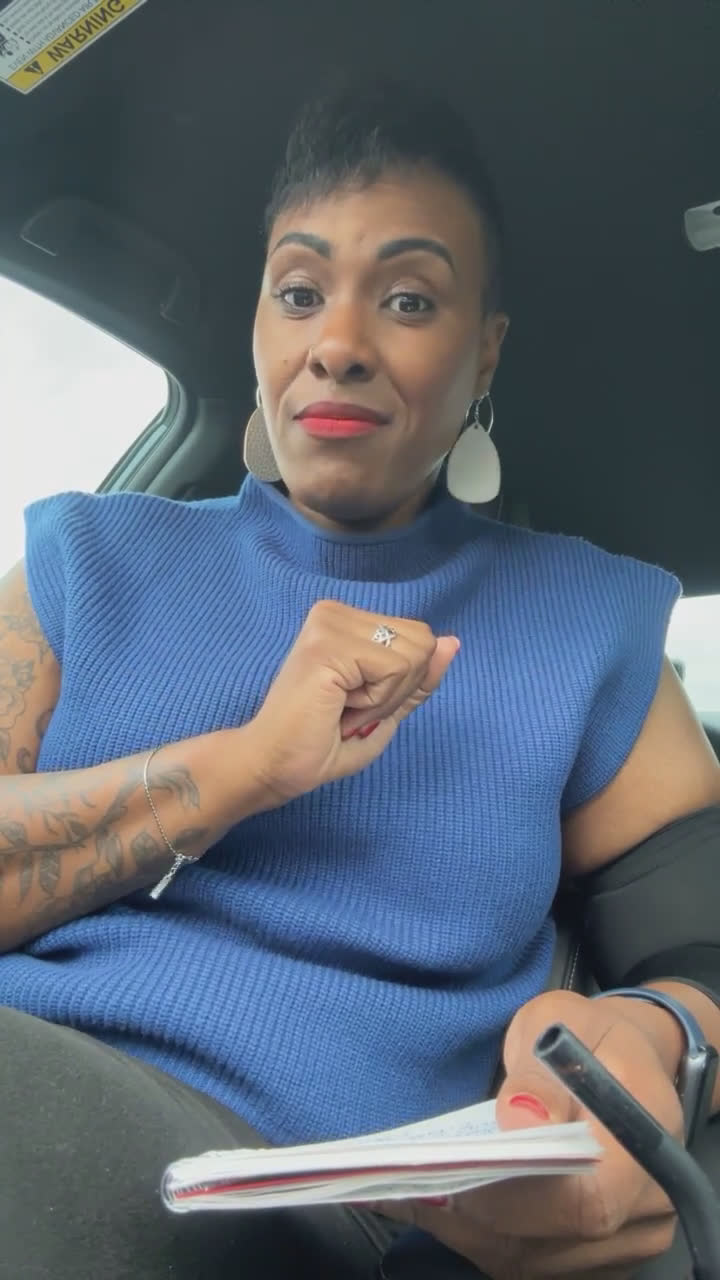
What is up? I hope you're well. It's Friday and here we are on if my plate could talk. It's so good to be back with everyone. As you see, I'm in a different space. I am in the car. So hopefully my signal is strong enough that we will get through this. Let me go ahead and put it out there now. If for some reason this signal is not strong enough, I will come back on this afternoon at 130. But I think it's going to work and I'm excited. Got my notes. I can read my chicken scratch. And we're going to get into it for today.
If this is your first time here, I'm Doctor Charisse Johnson, a licensed clinical mental health therapist, mindfulness practitioner and author. But most of all, most importantly, I'm your Internet therapist BFF. That's how we work around here. And we always start two ways. We always start with a positive mindset, being open to the moment you came and you showed up for a reason. There's something that you're going to get out of today. The other thing that we constantly do is we take time to represent where we're from.
So continue to pop in the chat. What's gone well this week for you, maybe even between the time that we spoke on Wednesday and Friday, because I always want you to know things are going well in your life, even through difficult moments. Something good is happening, but you have to look forward. And when we force our mind to go into that direction, it is so powerful for our entire body, our entire system. So what's gone well and where are you in the world? I'm currently in South Carolina, so I'm repping South Carolina for today.
We've been talking about four types of shadow loss and specifically looking at when we're experiencing loss. Shadow meaning those kind of undercurrent dynamics of loss that aren't often focused on a person specifically and a loss of a person, but everyday dynamics, and then looking at how that loss shows up in what we view about our body and ourselves and how we are viewing what's on our plate. All right, so here's a couple of things that I want to say, but first, what's up, Chicago? What's up, South Carolina?
What's up, Savannah? I think I saw Philly in the house this morning. South Jersey, represent Queen City. I see you. We got to give every place love. What's up, Raleigh? What's up, rep your city. I'm going to be in Greenville. I think I said that in two weeks. So I'm going to plan a time where we can connect for coffee. I know Shelly Shields is in Canada. So what's up, Canada? Okay. The first type of loss we talked about last week, I'm not going to do that one again. You can go back and look at that.
But today I want to talk about a loss of safety. And as we focus on this, when I want you to think of a felt sense of safety, which is going to be subjective for everyone. And that. Madianna. I know that's right. I woke up this morning. That is a bigger gift than we often give credit. A loss of safety is like a felt sense of safety. But also I want you to think about a loss of emotional safety. So here are a few examples of the kinds of things that can create a loss of safety, which is an undercurrent of grief and loss and sadness that can show up throughout our body and throughout our appetite.
As I give you examples, feel free to go back and add to the list. Feeling alone can be a lost sense of safety. And can we acknowledge that you could be surrounded by people. People could look at your life and think, oh, you have a wonderful this and you're involved here and you have all of these things and you still feel alone. That's a lost loss of safety. Feeling like your level of love and acceptance is not the same. So maybe you used to be embedded in a sense of community and you're feeling changes around people that you used to feel to.
So even when you're with friends and you're noticing something's off, I no longer feel safe with them. Things feel different. Unsafe relationships, a decrease in love and acceptance in your environment. This is a big one. The next one. Feeling judged, rejected, belittled or ignored. Overlooked, judged, rejected, belittled, ignored and overlooked. And it doesn't even have to be a situation that is constantly occurring. But I also want you to consider, are there recent or even past moments where you felt this way and you realize, wow, now that you mention it, once I felt that level of judgment and rejection, or I felt ignored.
I haven't felt safe to make connections with people the way I used to. I keep people at arm's length because I don't trust them. A loss of safety, grieving what was what you expected? Feeling disappointed absolutely is going to create a sense of loss and a lost sense of safety. Anxiety and depression can also create a loss of safety. When you feel like everything is about to fall apart, every situation you're going through and experiencing could be catastrophic at any given point, things are uncertain.
Uncertainty creates a loss of safety. When you feel like, I don't know how to manage life, things feel uncontrollable. I keep doing what I've always done, and it doesn't seem like it's enough. That's a lost sense of safety, and it will impact the way you view yourself, your motivation, and how you show up in the world. Here are two more that I want to give you. This next one, it might sting a little. Let me sip a little water before I say it. Loss of patience toward yourself. I'm gonna let that one hit for a moment.
You can have a lost sense of safety because you are impatient with your own self. You are frustrated because you can't get back to the way you were. You can't figure out this season and how to balance it. You are doing the things and going through the motions, but you don't feel like you're doing it the way you should be, or you always have. So that loss of patience with yourself can create a deep root of low emotional safety. And then, as a result, this is the last one. It will impact your self esteem.
And so let's also be honest. There are moments where we don't feel safe, and it actually doesn't have anything to do with anybody else. Our self esteem is not in a good place, or we are not accepting where we currently are and beating ourselves up. So we don't feel comfortable around anyone, and we project. Other people think about us the way we think about ourselves, even though it's purely based on assumption and no facts. I won't even ask you to say it's me if that's you. m. Eric Kirsten, who's another creator here on Cadre, did a live on self esteem that I want you to go listen to.
It's pretty quick, maybe five minutes, that I think is super helpful just to create some context around self esteem, if that's an area where, you know. Yeah, I struggle there so that you can really consider, you know, what you can do in terms of building your self esteem, but really reframing your self esteem in a way that you can build yourself back up. So let's move from thought to action. I have three questions that I want you to ask yourself. You have two options. One, as I ask the questions, if you feel like you know an immediate answer that you're willing to share, pop it in the chat.
Let's get some engagement going. Two, if you feel like, I would rather answer these questions on my own time and really spend some time reflecting on them. Of course, do that. And three, I just made up three, do both. Right? Take a moment, jump a few things into the chat, but then really take some time to answer these questions for yourself. All right. Question number one, what makes me feel unsafe? Right. And if you looked at this as something that you did on a weekly basis to work on this for a few weeks, you would.
You would turn this question into what has been making me feel unsafe lately. Right. So in the moment question is, what makes me feel unsafe? If you want to look at this as a recurring tool, what has been making me feel unsafe lately? That's a beautiful question of awareness. Two, how do I view my body when I feel unsafe? Do you notice any correlations between your body image and how you are talking to yourself and viewing yourself when you don't feel emotionally safe? And if so, what's that picture like?
And question number three, what foods do I crave or restrict when I feel unsafe? I'm going to repeat all three questions. One, what makes me feel unsafe? Or what has been making me feel unsafe? Currently or lately? Two, how do I view my body when I feel unsafe? And three, what foods do I crave or restrict when I feel unsafe? Super valuable questions. And if you have thoughts that come up that you're open to sharing in community, again, pop them in the chat. So if you recognize from what I've just shared, hey, you kind of read my mail a little bit.
I didn't really consider a loss of a felt sense of safety as a trigger for me, as something that is present in my life, something that grieves me, that makes me feel like I am losing life, losing relationships, losing myself, then that is the beauty of awareness. And the next question is typically going to be, so what do I do? So I want to give you one thing to do, and you're going to be like, really? Seriously? But then I'm actually going to come back next week and do a whole live. So it's going to be like a number two a and then two b, because I do want to give you a lot of tools around what to do.
One of the most helpful things that you can do from a neuro biological, emotional standpoint, when you're not feeling safe in your body, your appetite's out of control. The way you're talking to yourself is harsh, is to go outside for a walk. And let me break this down for you. When we walk specifically outside, not on a treadmill not in your peloton. That is a completely different dynamic. The openness and the expansiveness of being outside forces our eyes to go left to right and resetting our peripheral vision.
When we reset our peripheral vision, because we're looking around at the trees, we're looking around at what's around us, we're also then experiencing the fresh air we have, the foot strike and the groundedness that's coming. You are then regulating your nervous system and resetting your emotional center. A lot of times when you feel like there's a loss sense of safety, you also may feel trapped. So being able to get in.
Reactions and comments are for members. Joining is free and takes a minute.