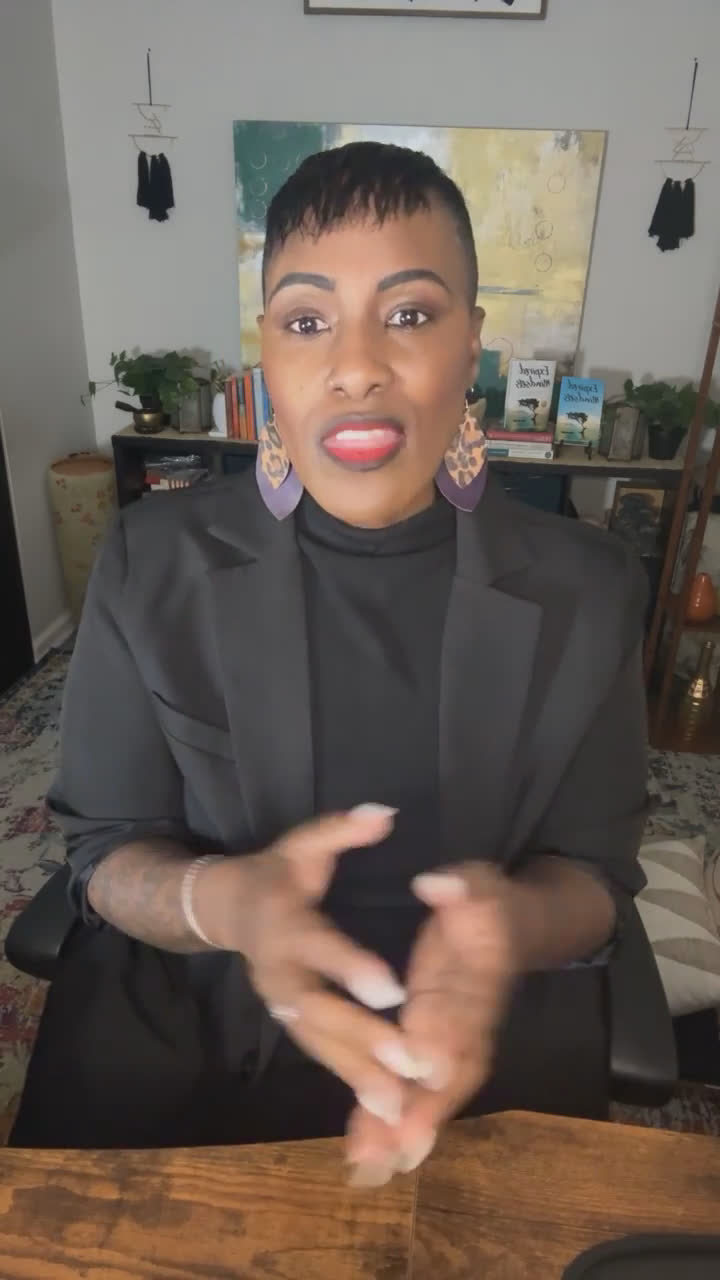
Dr.Charryse provides insight and guidance on how to consciously participate in living a life you don’t need to escape. These engaging and relatable lives emphasize growth mindset, mental health, and the power of choice.
Cadre on Wednesdays focuses on all things mental well being. Every moment is a new opportunity for something to change and shift in your life.
Let's rate your week, meaning zero. And ten, meaning it is going well. And always let me know where you are in the world. Each Wednesday and Friday, I focus on trauma, body image, well being, mental health mindset.
If self responsibility and love is overshadowed by fear, then it completely destroys. Today, we're going to talk seven ways that fear can turn into self gaslighting. Next week, we'll talk about how to befriend fear and the importance and value of fear.
All right, seven ways that fear can turn into self gaslighting. Will you always need everything that I say in the moment? Absolutely not. I always encourage you to write things down so that you have that information for the future.
Seven ways fear can turn into self gaslighting. Negative self talk erodes your self esteem, and it increases your self doubt. There is something very powerful in being able to acknowledge.
Number two, denial of emotions. This is a big one that I see in my people who consider themselves really confident. It is okay for things to be frustrating for you and disappointing for you. People who the world considers strong can be treated very harshly.
Seven ways that fear can turn into self gaslighting, rationalizing harmful behaviors. Number four, memory distortion. Convincing yourself of an alternate reality to a situation to avoid pain and protect your ego.
Take responsibility for things that are not solely your fault. Unfairly blaming yourself also leads to guilt and inadequacy. Ignore your intuition and convince yourself that you are being irrational.
Good morning, dear souls. I hope that you are doing well. Maybe it's not morning when you listen to this. It could be afternoon or evening. Either way. Hello, and welcome to another moment in the quadrasphere. I hope that you are doing well. And if you're not, guess what? Every moment is a new opportunity for something to change and shift in your life. You've come to the right place because here on Cadre on Wednesdays, we focus on all things mental well being. So let's get started by you coming in, letting me know how your week is going.
Let's rate your week, meaning zero. You would just completely skip this week if you could. And ten, meaning it is going well. It's amazing and it's incredible. Hello, Shrendrea. Hello, Audrey. And always let me know where you are in the world. It never gets old. I actually think I might follow up and start doing like a slide or something. Oh, I sound. Oh, I just dated myself a slide. Oh, a graphic. Hello, speak wonder. Hello, Sacramento. What's up? Oh, nice week to a nine. I love it. My week has also been, been like, I would say a ten.
And what's beautiful is there has been some drama to the week, but it's still been a ten because that's possible. Hello, Philly. Hello, South Carolina. So, yes, as I was saying, come in, let me know where you are in the world. What's up, Pa? And I think I'm going to do a graphic. Hello, New York. I love Niagara Falls and just start showing the world where we all exist and how we are in community. That might seem small, but I think it's so important considering everything that we have going on in the world.
What's up, Virginia? Glad your week has been a ten. Hello, Charleston. It's so important to remind the world that all is not lost and that there are still incredible people from all over, from all different backgrounds and nationalities that know how to join in a space and connect and community. What's up, South Jersey? Hello, Michigan. So, I'm doctor Charryse Johnson. If this is your first time here. I'm a licensed clinical mental health therapist, mindfulness practitioner and author. Each Wednesday and Friday, I come to you and we focus on trauma, body image, well being, mental health mindset and all the things.
Thank you. I don't remember where I got these from, but I got a thing for teardrops, as you know, if you've seen me on a regular basis. So last time we were together, we talked about wellness, self responsibility and love. And that when we have self responsibility and love that comes through a lens of compassion as the foundation of what it means for us to be well, that it takes what is considered the burden of personal responsibility and moves it to an opportunity. Shrendria. m. on Friday, I am going to unify things.
m. both days, I'm going to do that. m. m. on Fridays. And that later hour is coming from people who live in different time zones, who are like, I really want to see you, but I don't want to wake up. 04:00. I get it. So we talked wellness, self responsibility, and love, and today I want to shift into something that will destroy your foundation. If self responsibility and love is overshadowed by fear, then it completely destroys. And I like to even think of the word erodes. It kind of creates a level of erosion.
It wears down your ability to operate in, you know, in confidence and encourage. And fear is not a. A mindset that you want to ignore. Fear is something that we all. What's the word? I want to say we all experience at any given point in time, myself included. It's a physical feeling that we don't typically enjoy, but it's an emotion that no matter what we do, it's going to be there. And there's two aspects of fear that I want to get into. This will be a two part series today. I want to get into seven ways that fear can turn into self.
Self gaslighting. Yes, Becky, hide your toes. I was like, I'm not even going to do coffee or any other libation, non alcoholic libation, at that today, because there is enough here, enough excitement. So two parts. Today, we're going to talk seven ways. Seven at seven. Seven ways. Oh, but if I change it to eight, I won't be able to say that I'm so. I am wired today, y'all. Let me bring it down. So today's seven at seven will be seven ways that fear can turn into self gaslighting. And then next week, I will wrap it up into a lighter bow and talk about how to befriend fear and the importance and value of fear.
Why am I doing it that way? Because I want you to always think about the how and the what, you know, of fear, how it shows up, what it might look like, and then you. Are you laughing at me because I said I can't say seven at seven. I'm so silly. But I do love things like that. So it'll just have to be eight and eight, and I'll have to talk really fast. And then next week, we'll get into the why it exists and another part of the what. What you can do about it or how you can shift it. All right, seven ways that fear can turn into self gaslighting.
First, let me give a quick caveat on how this can potentially be valuable for you. Will you always need everything that I say in the moment that I say it? Absolutely not. But you might need it tomorrow. You might need it next week. You might need it in order to encourage another person. You might see these things, these mindsets, these distortions in other people, and then it helps you name them and navigate them in a different way. I say this constantly. I will continue to say it. You cannot wait until the game to learn the plays.
So what that means is you wanna take every opportunity that you have when you're not in immediate crisis, to inform yourself, to educate yourself, to increase your awareness and have it somewhere that you can read it, that you can apply it, so that when crisis comes, you are then able to kind of pull back into your memory, going back into that beautiful part of your prefrontal cortex and saying, oh, I have something in here for this. We've talked about this, and now I have ways of processing it.
So I always encourage you to write things down so that you have that information for the future. Number one, seven ways fear can turn into self gaslighting. Negative self talk. Let's go ahead and start the day with you outing yourself. If you have been in a season over the last four to six weeks, where you have noticed that your self talk is not as healthy as it could be, I just want you to have a moment of confession. We'll have a moment of normalization and solidarity and just say, it is me. It's me.
You just type that in the chat. There's no shame. But there is something very powerful in being able to acknowledge. You know, I do need to let someone in my life know that I don't have to see every day that that is existing and that is what's going on in my head. Let me also add before I get into it, you can be in a really great season of life and still be battling negative self talk. You can do something incredible, and literally, within the next moment, a negative thought will come what seems out of nowhere.
So this is often rooted in fear. Negative self talk, you might be saying things to yourself like, I'm not good enough. I am not worthy. I do not feel capable. And what happens when you stay in a mindset that's centered around negative self talk? It erodes your self esteem, and it increases your self doubt. There's a lot of things in your life that we want to increase, but self doubt is not one of them. And, yes, self talk, when we're also doing something, Audrey, that is physical and challenging, is a real thing, because we begin to doubt ourselves.
We think. We go in thinking, man, I used to be so good at this, or I thought I was really in shape, and then something is always there to keep us humble. Number two, denial of emotions. This is a big one, and this is a big one that I see in my people who consider themselves really confident. And, you know, if you're the person who's like, no, I don't get bothered by much. I just let things roll off of my shoulders. Well, letting things roll off of your shoulders is also a denial of emotions, because you ignore, you minimize, and you convince yourself that things do not bother you as much as they really do, yet you are, at the same time, acting in a way to make sure that people know, no, I'm good.
Well, if we have to act in a way that lets people know I'm good, then typically we have something to prove, which means that we absolutely were bothered by a dynamic or a situation. Some people are very aware of their denial of emotions. Some people go, yes, that's me. I block them. They shut them down. They mute them. But really, I want to just take a moment and get on. All of you strong people who the world believes, everything just, you know, rolls off your shoulder and is not a big deal. And I want to, like, lean in and say this.
It is okay for things to actually be frustrating for you and disappointing for you. People do disappoint you. It is okay for you to admit, even if it's just yourself that didn't feel great, that that hurt. Because one thing that I also see, whether that is professionally and even sometimes in personal circles, is people who the world considers strong can be treated very harshly because the world believes they can take it. Oh, it's not a big deal that someone gave you three times as much to do as someone else.
Oh, it's not a big deal that you have a lot going on and you're being asked for more. And, yeah, that whole dynamic of putting it in the filing cabinet and locking the drawer isn't ideal, because at some point, you're going to need something that's in that filing cabinet, or that filing cabinet is going to get full. And that filing cabinet can become so full and heavy that it tops over and crushes you or hurts someone else. So we always want to make sure that we are going through our files both metaphorically and tangibly, and always having a clean out.
Number three, seven ways that fear can turn into self gaslighting, rationalizing harmful behaviors. In other words, making excuses for yourself or making excuses for other people. You can self gaslight by rationalizing the harm that someone else is doing to you. By allowing how other people treat you to roll off of your shoulders by making excuses. Some of you know, I love word etymology. So I did take a moment and I looked up the definition of harm. It can be used in a lot of different ways. As a noun, as a verb.
I want to focus on harm as a verb. The definition that I pulled out, that I want to share is harm as a verb, have an adverse effect on any behavior, any thought, any mindset that you are constantly allowing to exist that has an adverse effect on you and what you believe about yourself and your confidence is rationalizing harmful behaviors. Let me give you an example. Even saying to yourself, I'm stupid, I'm overreacting, is a harmful behavior. There you have mixed in negative self talk, and you're rationalizing, minimizing a situation by how you speak to yourself.
Number four, memory distortion. Convincing yourself of an alternate reality to a situation to avoid pain and protect your ego. If this is you, or when you're operating in this mindset, you like to shift the way things really happen. Well, no, no, I didn't see it that way. And I'm not talking about, like a situation where two people go. No, we literally have different thoughts on something. This is a situation where you kind of know you were in the wrong, but you also kind of want to protect your ego.
So as a result of that, you kind of change the situation and you create another explanation. You leave a few things out in order to protect what you want to believe about yourself, or you want others to believe about yourself. And that's a hard one. It's really difficult. The other thing that I will say is sometimes we self gaslight by dissociating or suppressing harmful memories. Saying that we don't want to address them or acknowledge them can create memory distortion. Because it doesn't mean that we need to remember every single thing that has happened to us all the time.
Audrey's like, there goes, there goes my toes. But when we create distance around something in our life that is unchecked and unhealthy healed, then as a result of that, we're operating in the present in ways that we don't fully understand. So it can be extremely harmful for us. And it is a way that we gaslight. Gaslight. When it comes to self gaslighting is analogous to self deception. When another person gaslights us, they're deceiving us. They are pretending to be something that they're not. They're pretending to offer something to give crumbs.
So when we self gaslight, that is self deception. And when we take things and go, I'm going to push them out of sight, out of mind, and not worry about it. And then when I do recall that memory, I'm only going to recall the pieces that I want to see and I want to address. That is self deception. That is self gaslighting. I feel some toes that are hurting right now. Lace up your still toe boots. We only have three more. Number five, unfairly blaming yourself. So taking responsibility for things that are not solely your fault.
In any given situation that involves you in life, there will always be context. That means there are definitely things that we can say that, oh, man, that's on me. But there are also a significant number of things that if we look at the full context of a dynamic, we realize that's not true. The other day, I was talking to a woman, and she was just navigating some challenges that she's having with her husband. And so she was, you know, kind of talking about the situation, saying, I'm frustrated. We're not getting anywhere.
And then she immediately went to herself and said, but I've checked out of the situation. I don't feel like I am being the person that I could be. So she went from context of the situation to taking on all the blame for the problems that the entire system was having. Of course, me being the therapist that I am said, let's pause. Let's look at the context. I'm not saying that checking out is always the right thing to do, but sometimes it is the natural thing that we do when we're in a situation and we feel like we're hitting a wall, and the person that we're involved in that situation with or the system that we're involved with is not responding to our efforts.
It is very easy, Audrey, to recognize these things in ourselves, but not, or in others, but not ourselves, because we naturally want to protect our ego. It does not matter. It does not matter who we are. It does not matter how much education we have. I can do it myself. And then I have to go, pause. Let me step back. Or I have people in my life who I can go, I'm going to say this to you, you know, with no chaser, what are you hearing? And it helps create that dialogue. But we also will do these things because they're our defense mechanisms.
There's something that we've done to protect ourselves. So in our mind, this is great. What are you talking about? What's wrong with the way that I'm doing things? It's not so much that it's wrong, but it's not adaptive. Meaning. It's not always going to be helpful for you in every situation. So we have a difficult time or more difficult time seeing it in ourselves because it's something that we've done for a significant amount of time. It is protective to our emotions, to the emotional pain that we don't want to experience.
And it allows us to distance ourselves from things that we're like. I just want to stay happy and joyful and focus on the positive. I don't want to deal with that. So there's that. Unfairly blaming yourself also leads to guilt and inadequacy. So if you're an individual and, you know, man, that's my undertone. Your undertone is that you often feel guilty and inadequate. If we have conversation, if we were to sit down together, one of the things that we would likely find is that you are taking on ownership and blaming yourself for the responses of other people, for situations and dynamics that are not your fault and that you cannot control.
And that is like a one way ticket to anxiety and depression. Number six, dismissal of achievements. If you're an individual and you are amazing, which you all are, but you downplay your success and you attribute it to lucky versus your work ethic or your abilities or your God given gifts. That is a form of self gaslighting. It is not a sign of humility for you to struggle to receive a compliment. It is not a sign of humility for you to struggle to honor how amazing you are. Self deprecation, not humility.
Humility is. You don't expect anyone to walk around and tell you how amazing you are, but you know you are. And if someone says it, you can receive it with kindness without it changing who you are. I'm gonna pause there. I have one more, but I'm gonna pause there. And I want to put a challenge out there to you. I want you to work on being okay with how amazing you are. Seriously. Oh, my gosh. You do this so well. You broke that down so well. You're a wonderful minister. Da da da. Don't say, oh, no, no.
Say thank you. I'm so passionate about what I do, and I've really put in a lot of time and energy to be great, to be excellent, and to do well, and I appreciate you noticing it. Get comfortable with that and trust that it won't change you. And number seven, you ignore your intuition. Seven ways fear can turn into self guilt sliding number seven is you ignore your intuition. You disregard your gut feelings, your discernment, and you convince yourself that you are being irrational. Now, there are moments where we are being irrational, but there's also a process that we can walk through and work through in order to manage that and to navigate that in a different way.
But you need to start off with trusting your discernment and exploring your intuition versus being so quick to reject it. Last thing I want to say about fear is fear is one of the most primary dynamics that destroys our decision making ability. m. darrell Glaze. D E R Y l, did maybe a five or six minute live that talks about your decision. It's so good and I would encourage you to listen to it if you're in a season that you think well, number one, you're always up for learning new creators and providers and getting new content.
But also you do recognize that fear and your decision making often goes hand in hand and you get paralyzed by having to make choices or trying to make the perfect choice. I think there's some great nuggets there. He gives some phenomenal analogies and questions that you can utilize. So check him out. As always, remember that knowledge is not power without application. Your application piece for today is to look at that list of seven ways that fear can turn into self gaslighting and ask yourself, where do you see yourself on this list?
And then take a little time and really work on receiving compliments, believing in who you are and understanding how important that is for allowing your mindset to shift and to grow and to maintain a great source of health and well being. Come back throughout the day, throughout the week, in whatever ways that you want to or need to. And remember that you are enough. You are capable of navigating anything that comes your way today. And I will see you Friday at eight. Oh. Derryl Glaze Deryl. And last name is Glaze.
G l A Z E. m. on May 27. It's called your decision, and I think you're gonna love it. All right. Have a good one, and I'll see you soon.
Reactions and comments are for members. Joining is free and takes a minute.