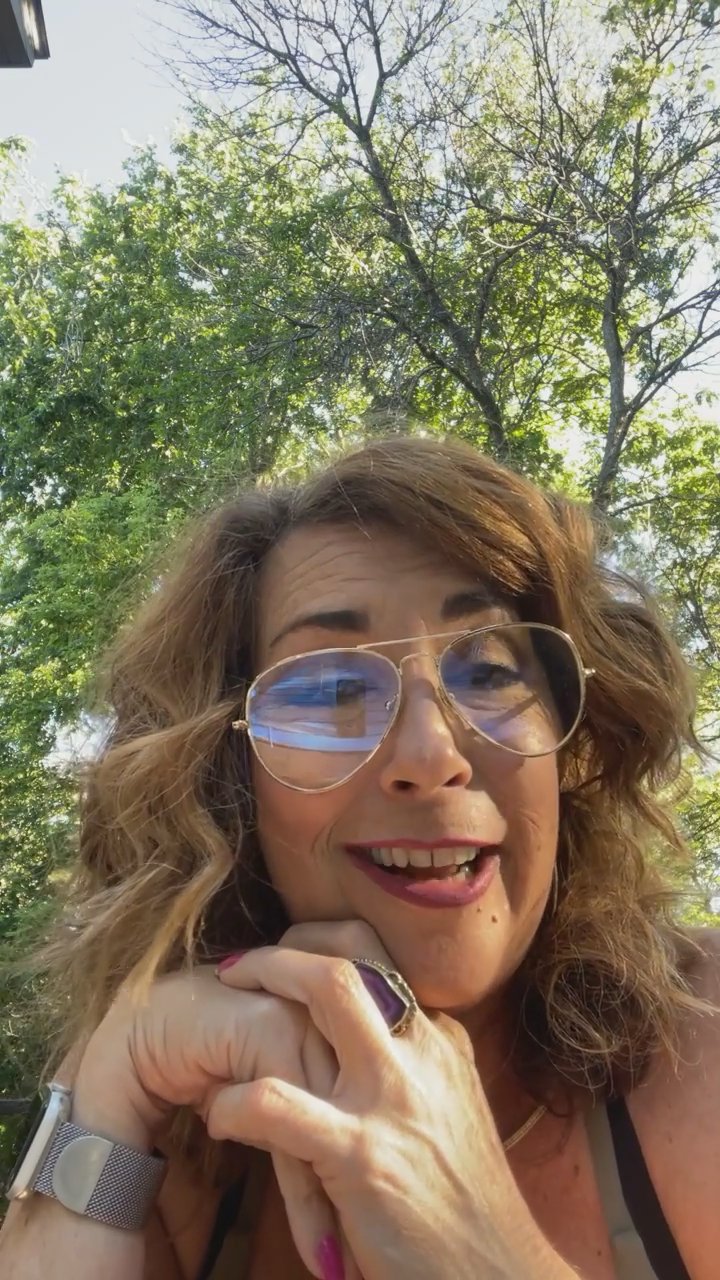
Tiffany Norton chats from a tree-lined suburb while babysitting and links the Pixar film Inside Out to a neurobiology book on primate-like brain behavior, discussing how hunger and emotions shape decisions and empathy.
Tiffany Norton is broadcasting out in the woods. She is helping her friend babysit her two grandkids. Who's joining in?
Shannon: I've been reading a book by a neurobiologist who studies humans, but also primates. He says the inner workings of our own brain are very similar to primates. Shannon: Some people are definitely gonna feel a certain way about this book.
When we're hungry, we are measurably less empathetic to others. How long does empathy go away from a judge? How long? If it's been longer than 2 hours since the judge has eaten. Do you know your odds of getting paroled? Zero.
Make no decisions when you're hungry. Quit prioritizing getting one more email, one more click and one more dopamine. Your job is to listen to your needs. It is free range to go eat a and have snacks tonight. But honor yourself.
On dry July, it's pretty simple. We're just, you know, we're just going to have a drink. Some people think summertime is the hardest time to get sober. But it's the best time. Reach out in the comments.
Hi. Hey, everybody. Hey, it's Tiffany Norton. Welcome back to Comedy Centered. I'm broadcasting out in the woods. Woods. Actually, not really in the woods. I'm in a suburb that just has tall trees, which is cool. It's gonna be kind of a brief one today. I am assisting my friend. We are babysitting. I'm helping my friend babysit her two grandkids. It's been super fun. We're watching in and out, and I've been ordered back to the couch to hurry up and sit back down because the good parts come up in the movie, and I'm gonna miss it, so I don't.
Hi, everybody. Who's joining in? Thanks for coming to Comedy centered. I was just telling everybody joining the feed, I've been admonished out on the patio because I'm missing in and in and out. In and out, I think, is the movie we're watching, the Pixar, the whatever, about the emotions. And I. It's super cute. I've never seen it before. And, hi, Jules. And I'd heard lots about it, and I know it's about, like, the emotions, how your brain works and everything. And I'm like, oh, man, this is, like, a great lead in to the topic I was gonna talk about anyway today, because the beginning scene of that movie they're going through, if you haven't seen it, I hope.
Spoiler alert. I hope I'm not blowing it for you, but at the beginning of the movie, they're showing the inside of the brain and kind of, like, the control center, and, like, this is the emotions, and this is what happens and this and that and the other thing. And it's a great take, you know, and getting the conversation started with kids about, like, what are our emotions and where do they come from and what's going on? Hey, Shannon. Welcome to the. Welcome to live. But so I've been reading this book, and it is fascinating, but, I mean, there's a lot to.
Some people are definitely gonna feel a certain way about this book. Okay. It is called determined. And this gentleman is. He won, I believe it was the MacArthur genius grant. He's kind of a smart cookie, as my grandmother would say. And he is a neurobiologist who studies humans, but also primates. And they've gleaned a lot about how the inner workings of our own brain are very similar, and the hierarchy and the social interactions are very similar to primates. And, of course, we think we're very elevated people.
We're not primates. We're not we're not, you know, we're very. We're very evolved. Well, we are, and, uh, we kind of aren't. And it's interesting because what they found in some of these neurobiological things, sometimes what you think is really you making a decision or something, sometimes you really think is, like, the you, um, that is responding and maybe in, like, a not kind way or an intolerant way of some kind. Um, that can have a lot to do with the fact of whether or not you're hungry. And there's.
I'm. I am. This is a very heavy book, right? And it's, like 500 pages. I'm about 100 pages into it. So, like, I mean, I'm. This is a hot take on it, right? So I encourage you to form your own opinions and read this man's work. But it's fascinating because, basically, our pride, we've maybe in this group of Cadre people, you've heard the term pretty cortex before. It's part of the brain. We spend a lot of time talking about it. It's the decision making. It's kind of the control center, kind of like what they were talking about in the movie.
Well, but the. The. It's. The prefrontal cortex itself isn't just one thing, either. There's two parts. There's the prefrontal cortex that makes the decisions. This is right, this is wrong. This is what we need to do. This is what we got to do. Right? And then there's the part of the prefrontal cortex that's attached to our limbic system, and our limbic system is the part that's checked in with our feelings. Okay? So, a problem is presented to us. Two parts of the PFC start going to work. One is like, all right, what is the practical answer?
What is the easy. What resources do we have? What is the logical conclusion? Which we practically do, right? At the same time, the other part of the PFC is checking in with our limbic system and saying, how do we feel about this decision? Do we feel good about this decision? Do we like this decision? Are we ready to make this decision? And so then the information from that all kind of links back up, and then decisions are, you know, kind of made from there. And there's a lot of other, you know, variants to that, but so this man has done a ton of work because basically he's writing a book, and his perspective is that from a, from a scientific and from a.
And from a biological perspective, he cannot support the concept that free will exists. Okay? That's a big heady thing, but he's saying on a biological level, we can't, we can't see a part in the brain that's an isolated part that overrides everything and does something. Right. Everything affects everything else. There's no one being correct gene or, you know, node in your brain, right. There's none of that. There's none of that. And it's all. What's most important is what has happened to you. 1 second before you had to make the decision, 1 hour before you had to make the decision, one day before you had to make the decision.
And also whatever happened, you know, before, for the rest of your life before you have to make that decision. Right. That all weighs in to our concept of free will. And so to prove this point further, he talks about free want won't. So a free will exists then free won't should exist, right. You should have also the same part that goes, I won't do this, I won't like. And so I know I put a post up earlier talking about whether we would be more tolerant or less tolerant given our inner state. And what he found is, and there's, there's so much research and honestly, you guys, it's, it's really, really, really a great summer readdez.
And he's pretty funny for a genius. He's got some jokes there. I, some of them I have to look up. There's some words I definitely had to look up. I went to a state college. I didn't get a genius grant, but. Yeah, right. So they did part of this, one of the, part of this research, though, and he's, and he's, and he, and he's talking to like philosophers and every, everybody about the brain, this concept of free will, right. And what they found was, okay, so there was this particular study that was done in front of a parole board.
All right? There were judges. A parole board, if you're not familiar, is where you have already served some time in the system, right. And the court can either have you stay in jail for your full term of sentence or they can, you know, they can say, you know what? We think this kid has learned something and we're gonna give them a chance to get out early and, and, you know, get off on some of the term. Right. What was interesting was they found that if the judges of the parole board had eaten a meal within the previous hour, the parole board paroled about 65%, 65% of the people that appeared before it.
So 35 people were told, no, you have to serve your full sentence, or you're going to have to continue until you're eligible for your next parole hearing. Right. And the other 65%, the judges were empathetic and said, yes, you can. You've served your time. You'll probably have to do probation or whatever, but you can go early. Right. So what happens when the judges are hungry? How tolerant are they? How much do they look at that stranger that they don't know in their courtroom who's got the checkered past?
Maybe needs someone to listen to them. Hey, speak, wonder welcome. Maybe needs someone to listen to him and tune in to them and see this person that's before this, this judge and this bench as more than just circumstances, as a person with promise and potential. Right. How long does empathy go away from a judge? How long? 2 hours. If it's been longer than 2 hours since the judge has eaten. So if you're. If you're going before the parole board, and it's 03:00 in the afternoon and lunch was from twelve to one, it's now been 2 hours since your parole board is eaten.
Do you know your odds are of getting paroled? Zero. It drops to zero. Now, how can that be just from being hungry? How can that be? Well, we go back to the PFC. We go back to the prefrontal cortex, right? The prefrontal cortex has the ability to care about us as ourselves, our body, and also others. But when our body is not cared for, we're not necessarily tuned into the PFC area that is attached to, excuse me, our limbic system, our emotional system. So when we're hungry, we are measurably less empathetic to others.
We don't sit there, and if you ask these judges, why did you, why is it every day after 04:00 no one gets paroled, right? A judge would list, you know, reasons, rational reasons. They wouldn't even know they were doing it because. Because we don't have an inside radar of, what are my current hormone levels? What are we depleted in? I mean, it's not Star Trek where we can go and look on the captain's thing and it's like, oh, well, you know, this is the problem in this. In this area. In this area.
And we got to call engineering. We got to get the cooling system kicked in. No, we don't even know we're reacting to any of this stuff. But we are more. We are, we are more impatient, we are less tolerant of strangers. We are. Think about. Think about when you're hungry and you're driving home in traffic. And you are starving and people are cutting you off in traffic. No, those are your neighbors and your friends. And on the morning in, on the way in. Cause you were eating your muffin you got at Starbucks, and you're drinking your coffee, listening to your fun talk radio on the way in, you didn't mind the other people.
They weren't bothering you. You just thought you were a benevolent being. You just thought, oh, look at all these lovely, lovely. Look at all my fellow Minnesotans and Midwesterners that I get to commute with. Oh, hello. Hello. No, you were full. You were full. And when you drove home, you were hungry. And that's why you were. That's why you went a little nuts. That's why you went a little road ragey at the construction merge. And you're like, zipper, zipper merge, my a**. I'm gonna do what I want, you know?
So if we're not. The point being basically, and I do have to get back inside and watch in and out before I see faces looking. You can't see there's a window and I've seen faces looking at me. But if you can't in, like, they talk about in like a. And stuff like halts, right? Hungry, angry, lonely, tired. Don't make decisions when you're hungry. Angry, lonely, tired. Now, this is something you hear a lot in, you know, an a and stuff like that. This is. No, this is real life. Like, actually make no decisions when you're hungry.
It should be the bottom line from this one. I'm not saying gorge yourself. I'm not saying you need a meal every 5 seconds. But quit denying the feeling of being hungry. Quit prioritizing getting one more email, one more click, one more dopamine, hit outside your body and ignore your inside screaming. Because that's sometimes why we come on hinge. That's sometimes why we react in ways we would never really. We would never choose. Right? We. That. Because if free will. Free will would prevent us from doing that, right?
No, man, we are a lot more closer to primates and chimps and things like that than we think we need to eat first. We can't. We can't hold the tribe in our hearts, in our hands when our needs aren't being met yet. And here's the part everybody's gonna hate to hear, because I know I do. That's your job. That's your job. Your job is to do it. Your job is to listen to your needs. I know. Outrageous. I want someone else to meet them. Why can't they just read my mind, meet my needs. Don't you just know I'm hungry and bring me lunch?
Come on. Why do I got to do all this? God, it's a pain. But the reality is, you know, you can't activate and act from autonomy and engage your limbic system. And because here's the thing. What we're really talking about is, how do you do the right thing when the right thing is harder to do the right thing is always harder, it seems like a lot of times. And if it's not harder for you, fantastic. It also might mean that that's something you're already aligned with, so it doesn't seem hard for you.
But that's already something you agree with. Right? But it is hard. It is hard, you know, and especially when we are very reward based and dopamine based, doing the right thing, you know? Like, yeah, you don't know. You could throw that can in the regular garbage can and on the recycling can because the recycling cans will over there, and your car's parked the other way. No one's looking. You know, you could do it. You can. Odds are, though, if you've just had a meal, you're less likely to. You're more likely to walk over and put the recycling can in the place where it blocks.
You're more likely to do the right thing. So if there's no other takeaway than that, it is free range to go eat a and have snacks tonight. But honor yourself. I know I struggle with it a lot because I always used to think, I don't need to eat in the morning. I don't need breakfast. And I'm like, no, actually, I do. I just told myself that. I basically just kept pounding coffee and going on to the next, the next and the next and the next and the next, like a crazy squirrel, you know? And I'm like, no.
And I would say to myself, like, I don't have time for all that. I don't have time for that. Yeah, I absolutely do. In fact, I won't have time for anything else if I don't stop and just do that. So buy some juice. Make yourself a smoothie if you hate cooking, I love string cheese. I don't know, nuts. You don't have to cook. Have something on hand. But, yeah. All right. Oh, my God. This has been such a great one tonight, you guys. Thank you so much. Oh, also, too, before I pop out of dry July, I know that so far it is hashtag Tiffany and team jewels, but if there's anybody else out there, in the cadres fear that's interested in.
We're not committing, we're not saying commit to sobriety for the rest of your life. We're not saying any of that kind of stuff. But if you want to enjoy and join us. Excuse me. On dry July, it's pretty simple. We're just, you know, we're just going to have a drink. Alcohol. We're gonna drink lots of other stuff. Lots of other stuff. And we'll be talking about probably all the other stuff we're gonna drink. But, um, yeah, it's just kind of a. It's kind of a reset. And it is. I. There's dry January.
There's a lot of these things that. Dry July is where I started. That was my first, like, dry experience, my dry challenge, and I found it really helpful. And some people think, oh, my God, summertime is the hardest time to get sober. Uh uh. Best. Best time. Because there's stuff to do. Dry January, nothing. And movies, there's no good movies that come out in January either. You know, award season. It's weird. It's got to come up before the end of the year. But, uh, yeah. So if anybody's interested, um, we're just gonna be meeting up, you know, offering support to anybody else who wants to jump on.
Otherwise, it's gonna be me and Jules having a party every Sunday. But you're always invited, and thanks. Reach out in the comments. Well, if you have any follow up or if you miss the name of the book, it is determined, and I believe the man's name is Robert Chapulski, something like that. And I hope you guys have a wonderful Sunday, a wonderful 4 July weekend, and take care.
Reactions and comments are for members. Joining is free and takes a minute.