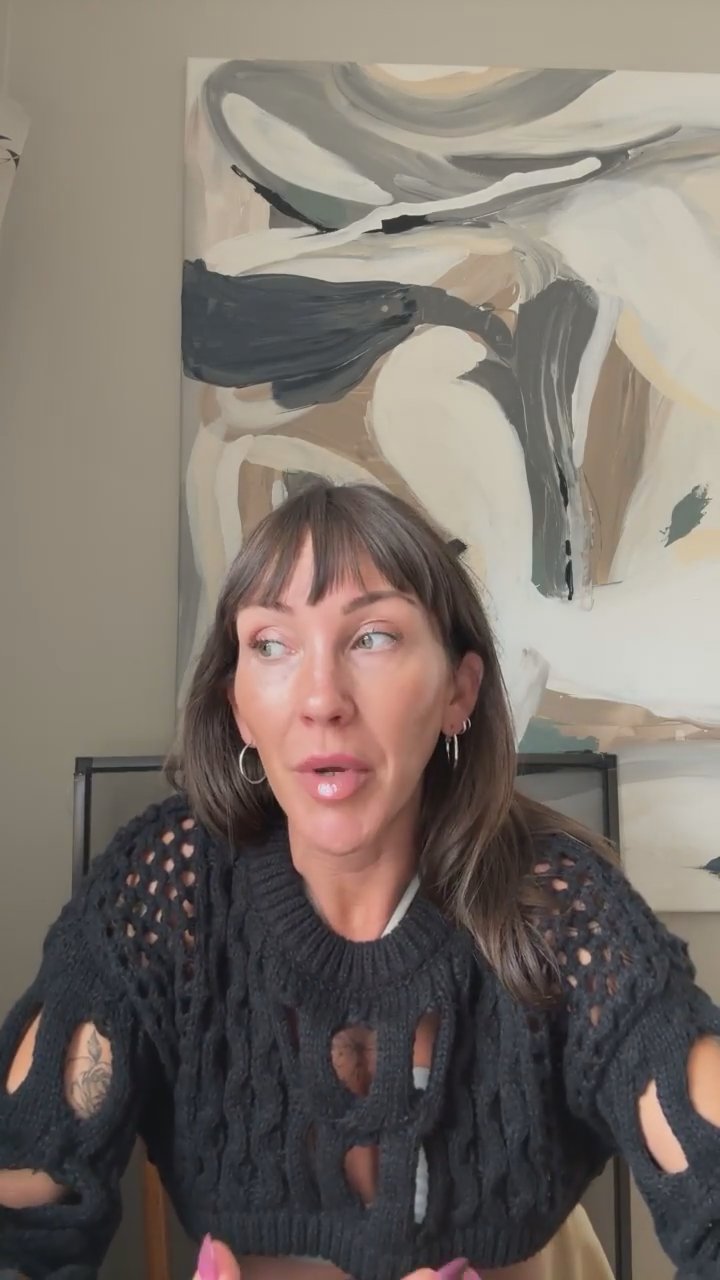
Presenter explores psychological safety, explaining how it differs from physical safety and how it relates to the nervous system. Short practical framing introduces building emotional and social safety during seasonal transitions.
Happy Thursday, cadre crew. Hello, hello, hello, hello. I'm gonna give folks a minute to trickle in. Drink my water, drink your water. Hi, T North. Hello, happy Thursday. Hello, today and for the rest of this month. Yeah, girl is gonna be talking about safety. Hi, Jocelyn. Happy Thursday. So if you haven't noticed already or been notified this month on cadre, all creators or at least most of them will be talking about the concept of safety, which I think is a really important concept to be talking about as we enter not only a new season, but as we enter fall, I think that the transition from summer to fall highlight lever is often a time when folks start to feel like there's a reset or a restart.
And typically that's because historically September is when we go back to school. So I think our brains from from childhood are sort of primed to think about this month as a new beginning. And it also signifies a really big transition for weather for a lot of folks, not for everyone, depending on where you live. But we start to shift into colder and darker times , which means we need to start establishing more ways for us to take care of ourselves as the nights get darker and colder. So I often find that this this particular month can be really, really difficult for a lot of people.
It brings up a lot without us recognizing it or realizing it, and it can be difficult to manage that transition, because there's kind of a lot of things that are moving around. So I think it's really cool that cadre is focusing on safety this month, because safety is a psychological need, and it is it is our base foundation psychological need. So I think it's really great to focus on that this month as a way to build a sort of foundation for ourselves as we move into this next season. So I will be posting videos this month starting today, all about the concept of safety, understanding what psychological safety is, what it feels like to not experience mental or emotional safety, and how we can start to build that for ourselves so that we experience some of that security not only in our bodies, but in our personal lives and our social lives, and then we can start to experience a little bit more calm, especially as we are in this sort of changing season and time.
So today on this life, today on this life, I'm just going to briefly talk about the concept of psychological safety, because I think for a lot of people, it can kind of, it can be a little bit confusing to think about safety in terms of our emotional or mental safety. I think oftentimes when we think of safety, we think of like, is there a threat? Is there danger? Like, is somebody going to break into my house? Am I safe, like, you know, to get on this vehicle or whatever it might be? And while those are all components of safety, psychological safety is really, really different.
So psychological safety has a lot to do with our nervous system, and how we respond in environments when safety is present, and perhaps we experience a sense of not feeling safe. So oftentimes for folks who have experienced any kind of trauma, that can really impede our nervous system and our brain's ability to assess whether something around us is actually safe or not, because those signals can kind of get muddy and mixed up. Oftentimes too, if we grow up in households where there's a lot of chaos, where there's not a lot of consistency, if our physical safety or our emotional safety has actually been harmed, we develop a way or coping mechanisms to protect ourselves from experiencing that pain again, that oftentimes in adulthood can show up in ways, especially in our relationships or around other people, where we're overprotective, and this can cause us to be mistrusting oft entimes in relationships, when things are going well in our lives, we question it or doubt it, perhaps we self-sabotage.
So these are kind of all indications that perhaps we don't experience a lot of psychological safety on a day-to-day basis. If that is the case, it is not your fault, and you are not alone. I have been in a lot of therapy, and I still experience this a lot. I am now though a lot better at noticing when it happens and being able to ask myself, "Okay, am I feeling this anxiety or this sense of unease, or does this feel unfamiliar because it actually is dangerous, or because I'm not used to it, and it's actually healthy ?"
And so I think that that's really the first step in building and creating psychological safety for ourselves, is simply learning to identify the difference between is it safe or is it familiar. So there's a lot of things that we can do in this process. I'm going to post some videos on my profile about this, but there's a lot of things that we can do. I really think that journal ing is a great way to start to just sort of self-identify maybe times in our lives when we have felt unsafe, specifically in childhood, and start to notice maybe some themes as to how that shows up in adulthood.
So for example, for me personally, my dad was incredibly absent emotionally in the fact, in the sense that he didn't often tell me anything. He didn't really tell me if I was doing well, if he was proud of me. He also didn't really give me any feedback if I was not living up to the household expectations. So I had to do a lot of guessing. There was a lot of guesswork that I had to do mentally and emotionally around how my dad felt about me, but also about my performance. I became very performance-focused in terms of my schoolwork and my extracurricular activities, which led me to often feel like I either wasn't doing enough, or why I wasn't good enough, or I wasn't lovable.
It also led me to seek relationships with people specifically men, where my partner was not very vocal and where I did a lot of guesswork because that's what I was used to. But those were not good partners for me because they were not providing me with any kind of emotional safety or space for me to feel like I was safe in a relationship. And yeah, I continued to fall for people who were not available to me. And once I started to kind of learn that pattern and sort of see where that came from, I could recognize I was seeking those things because it was what I was used to.
It was what was familiar, but not because they were safe. So it's really, really helpful to start to identify for ourselves. What are some patterns I noticed in my life that are actually hurting me that are actually maybe unhealthy? And am I seeking these things or subconsciously accepting that these are things that are coming into my life? I don't even want to say asking for it because I think that's, I don't like that when people say that, you're not asking for it. But we might subconsciously seek for those things or find those things attractive or want those things, whether it's a relationship or not, they can be experiences, jobs, et cetera.
And then ask ourselves, is this familiar to me from something in the past? And was that thing in the past actually safe and healthy , or was it not? And this is a really great place to start is in identifying those two differences. Okay, well, look at somebody's comments. Jossen says, "Hi from Vegas. Hello, my dear. Hello." Rachel says, "The hardest." Yes, I'm guessing you're talking about the transition into this time of year. I don't know why I waved my finger at the, oh my god, thank you. Tynor says, "Back after an 11-day Alaskan cruise and then a week of recovering from COVID from the shift, oh my goodness, that sounds brutal.
I hope that the cruise was fun and that you didn't have COVID the whole time." Well, and I hope you're feeling better. Are you traveling again? I feel like you're back. No, I just don't ever sit here. I don't know why. I'm in my living room. I think I normally sit over there, but I switched up. I like to move where I sit for work, because I find that if I change my environment, it forces me to focus. I can't go in autopilot, so I'm just sitting against this painting today. But no, I'm home. There's Milo .
There's my dirty laundry that I have not folded in three days. And here we are. So, all right, my love. Stay tuned today for a video about psychological safety. And in the coming weeks, I will be talking more about this. And make sure you check out other creators who will be talking about this from different lenses, with different perspectives. As always, listen to yourself and what feels good for you and what resonates most. So take what resonates and leave the rest. I am so grateful you are all words.
I am so grateful you're all here. See you next time.
Reactions and comments are for members. Joining is free and takes a minute.