In this video, Evan Lieberman, MSW LICSW LADC, answers a question from a member of the Cadre family about whether caffeine addiction is real. Most of us are likely users of Caffeine, as it's in just about everything. However, many of us consume Caffeine daily to start the day and get us through to various degrees. So, who among us thinks it would be easy to stop drinking coffee, energy drinks, or caffeinated soda? Very few people find it easy or even imagine it would be if they've never tried. However, that does not necessarily mean that it's an addiction. Therefore, in this video, Evan breaks down the differences between addiction and being dependent on a substance. You don't want to miss this one!
The speaker welcomes viewers to the Change O'Clock series and situates this installment as the second leg of his 'tripod' method: making a plan. It explains that this video will cover preparatory actions before the full action stage of change.
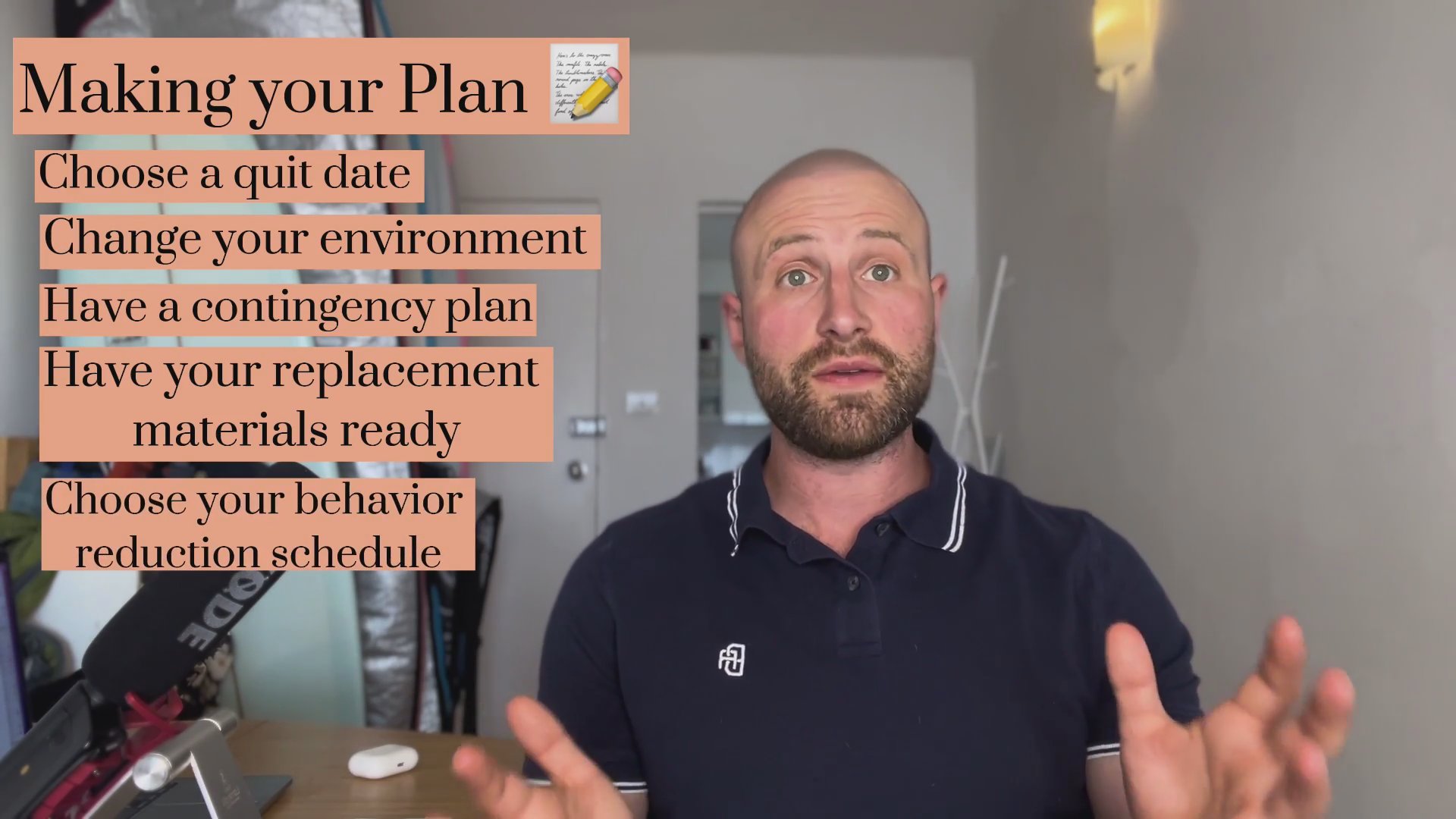
This section explains that inadequate preparation is a primary reason people fail to change, and emphasizes anticipating challenges and having a plan for stressful or emotionally heightened moments. Viewers learn why planning reduces the pull of familiar, comfortable behaviors.
The presenter describes selecting a concrete quit date tied to an event or boundary (vacation, month-end, birthday) to make the change more salient. Examples and reasoning are given to help viewers pick a meaningful start point.
Through a personal story about a Boundary Waters trip and an initial slip, the speaker highlights missed preparation (keeping nicotine accessible) and the importance of not wallowing in shame. He then describes setting a new quit date for a wedding in Mexico, planning aids, and choosing to wean down, which ultimately led to success.
Viewers are invited to grab pen and paper and answer targeted questions about needed materials, replacement behaviors, removing temptations, coping with setbacks, and setting a quit date. These prompts are designed to turn motivation into a practical, actionable plan.
The final section reminds viewers that plans can and should be adjusted as new information (including relapse) emerges, and encourages confidence moving into action. It previews the next video on accountability and sustaining change.
All right folks, welcome back to Change O'Clock, my series on breaking old habits and forming newer and healthier ones in the most effective way possible. And in the last video we talked about enhancing our motivation, finding the motivation within ourselves to make the changes that we know are going to be difficult. And once we have this window of opportunity, now it's time to start taking action. So right now we're not moving into the action stage of change, but we're taking preparatory action.
Now the action stage of change, which we'll talk about next time, is actually stopping the old habit and starting new ones. However, the action we're taking now is in preparation for the ultimate action of stopping whatever it is we're doing. And preparation is extremely important and this video is going to be about why that is. And we're gonna be talking about the second stage of my tripod method of change, which is making a plan. As I mentioned before, one of the number one reasons I find people fall short of making their desired goal of quitting their behavior of choice is that they weren't adequately prepared.
They never made a solid plan. As I also mentioned before, change is difficult. There's no way around it. Challenges are going to come. So it's not about just getting rid of the challenges and hoping that they go away. It's about being prepared for when they come, when you're in times of stress, when you're in an emotionally heightened state, not just acting impulsively, but having a plan for how to deal with it because otherwise it's so tempting to go back to the old behavior, to do what's familiar and do what's comfortable.
I chose a very specific time that I was going to quit nicotine. I like to do it on an event, right? Some big kind of life changing. So it could be anything like a vacation. It could be something like the end of a month, right? Some kind of boundary, some kind of border, right? Whatever you have coming up, right? It could be like your birthday. So any type of event could be really helpful for your mind for whatever reason to have a quit date. So for me, I decided, you know what, I'm going to the Boundary Waters in Minnesota, which is a camping canoeing area for those who don't know.
So this like really big camping trip, I'm going to be no phone in the woods. So it's going to be a completely different environment. I decided, you know what, that would be a good time. Now here's the thing. I went and I did my last nicotine pouch, but we ended up coming home early because of weather and I just fell right back into it. I try not to beat myself up too much. I was under a lot of stress. It was exhausting. I'm paddling all day. I just, and I still had the nicotine. I had other pouches left in my car.
So there's an example too of where I fell short in preparation. I should have gotten rid of that nicotine. I should have had no access to it whatsoever because when times were tough in that moment, the time was tough and I went back and I did the nicotine, but I didn't beat myself up. I know that shame is a big part of relapse. So I just made a new plan. Again, a relapse is information. So I took that information. I made a new plan. I'm like, okay, well, when can I set another quit date? And I said, oh, well, I'm going to my friend's wedding in Mexico.
That would be a good time. I'm going to learn from my mistake. So have my tea, have my toothpicks, have my quit date. I had just enough nicotine to last me so I could wean down. Sometimes that can be very helpful. Some people do like just quitting all at once and it's like a big shock to the system, but just like having that deadline, doing it just like that can be helpful for some people. But in my case, I decided to slowly wean down on the nicotine. I had just enough. I had it planned out of when I was going to do my last one.
I decided once I land in Mexico, that's it. So the last one I'll do on a plane. I had it set. And after that, I was successful. So this is an example of how preparation and how making a plan can be so crucial when you're wanting to make a change to have everything ready in place on hand and convenient. So just like in the last video for leg one where we did that motivation exercise, we're going to do another one today. So I recommend getting out a pen and paper. Feel free to pause this and I'm going to ask you some questions and I want you to write down your answers.
Number one, when you're thinking about your plan of action, what materials do you need, if any, to be successful? Number 2 is what are the replacement behaviors that are going to give you the same reward as the old behavior? Number 3 is how are you going to remove the temptations around you to reduce urges and cravings as you go. Then I want you to ask yourself, what happens if I fall short and go back to the old behavior? How am I going to get back on the horse and return to the plan? Another question you could ask yourself is when is going to be my quit date and how am I going to prepare for when that day comes?
So we talked about how relapse is often part of the stages of change. But again, that is information. And just like motivation, how we talked about that it's dynamic, that it's always changing, well, our plan can be as Our plan does not have to be rigid and be the plan that we set before we make the change. Because as we go into the action steps, whether we relapse or not, we may be realizing things that we never thought of before. Just like any goal you're trying to accomplish or any mission, when you get into the action itself, things come up that you didn't necessarily anticipate.
So it's okay to tweak your plan as new information comes in, even if that new information is a relapse. As I said, folks, I really hope you feel confident in your plan and you're feeling more and more ready to take those initial steps into action. So in the next video, we're going to talk about the third leg of the tripod and that's all about accountability and how we can use that to make lasting change and sustain it over the long term.
Reactions and comments are for members. Joining is free and takes a minute.