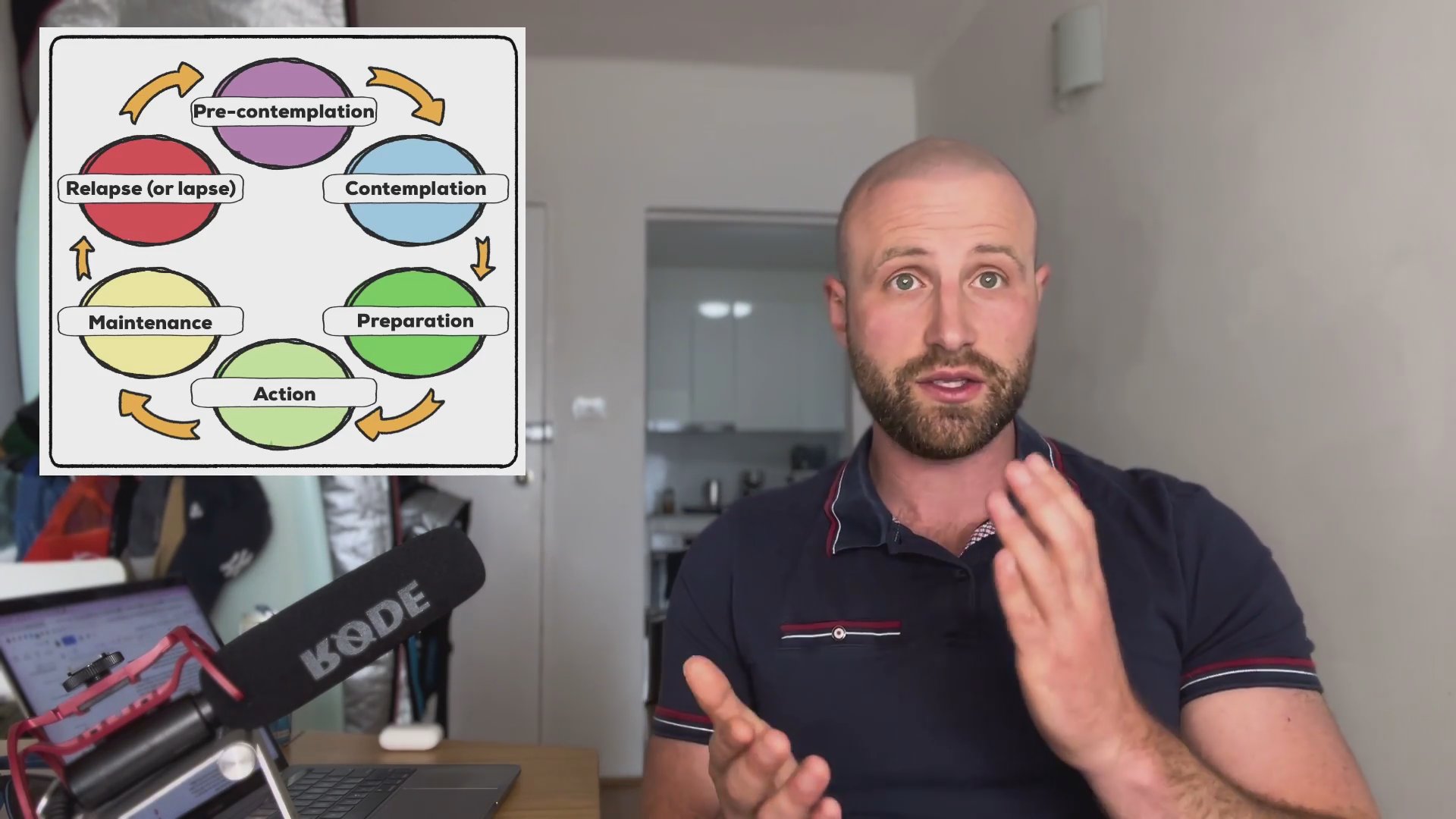
Folks, this is the last main video of the series and perhaps one of the most important. Today I break down the ways you can maintain your change no matter where in the process you are. This video is about avoiding relapse, whether on day one of your change or year 25. Further, I share what you do when a relapse happens and how to minimize the damage or benefit from it!
The host opens the final episode, reviews progress so far, and explains the transition from action to maintenance. Viewers learn that maintenance is a changing mindset over time and get an overview of what this episode will cover.
Relapse is presented as a normal part of the stages of change, with many people experiencing multiple attempts. The presenter emphasizes that relapses provide useful information for adapting one’s plan.
This chapter defines the 'relapse of passion'—dramatic, emotion-driven returns to the behavior common in early recovery—and explains cravings as physiological midbrain responses. It covers typical triggers, why these relapses happen, and how to anticipate critical moments.
The host outlines concrete tactics to survive cravings—calling an accountability person, using a plan, and recognizing cravings are temporary—and stresses the benefit of getting back on track quickly after a slip. Time spent sober still matters and helps build momentum.
The 'relapse of negligence' is described as a maintenance-phase risk where people rationalize a one-time use and fall back into old patterns. The segment warns about complacency, the need to stay prepared for occasional critical moments, and the importance of maintaining motivation.
The presenter recounts personal relapses and hard-earned lessons about not managing certain substances, underscoring gratitude for the learning and the need to stay on guard. The series closes with encouragement to revisit the material and reminders about motivation, planning, accountability, and commitment.
Folks, it's change o'clock and this is the last time I'm going to be able to say those words of the corny title of the series I decided not to change. Anyways, if you've made it to this point, you've done a lot of hard work in letting go of old habits and forming new and healthy ones. So today is our final video and this is going to be about avoiding relapse and how to take these changes that you've made, these difficult, difficult changes and maintain them over the long term. So now that we're in the action stage, we are transitioning into the maintenance stage of change.
And the question is, when does that actually happen? And to be honest, I don't know the answer because for everybody it's different. So what's the difference between I've quit the substance and now I'm maintaining? Now one could argue the second you quit, Maybe you go for a day, whatever. Now you're in maintenance because you're just trying to maintain the change. You've quit. However, I look at maintenance as more of a mindset. What I mean by that is that when you quit on day one, two, three, it's different than what it looks like at one week, three weeks, a month, six months.
It's a very different mindset. It's a different feeling as far as amount of cravings and emotional attachment you have to the behavior. It's very different. So for me with nicotine, I would roughly put it at around a month that I think I went into the maintenance phase because for that first month, I would have pretty regular cravings. Now on day one, two, three, I would have them pretty much whenever I would normally have my cues after a meal or other times in the evening when I wanted to relax.
But really by three weeks, I started noticing I was having very few by a month, two months. Right now I think I'm like 3 months in and I have none. I have no desire to go back. Maybe once in a blue moon, right? So probably around the one to two-month mark, six weeks maybe is when I went into the maintenance phase in my mind because where I'm at now is roughly like what I'm going to be at for the rest of my life if I continue on this path of not doing nicotine. And it's a good place because I feel great.
I don't crave it much anymore. It's not this state of anguish. But for most people with nicotine, they'll tell you that there's just always going to be these temptations. And I believe that to be true, but they're so infrequent. And as we go forward, we're gonna talk about as well what is a relapse and why is it significant? And I believe that there are different types of relapses and we're gonna break those down as well. So those are really important to know the differences of what early relapses look like and what the later stage relapses look like.
So let's dive in. So remember, in the stages of change, surprisingly, relapse is one of the stages because it is so common. Many of you have likely tried to discontinue this behavior of choice you're working on many times. Some people get it on the first try. Sometimes there is something to be said about just doing it once, doing it right. It's not always easy to do, but a lot of times if you're able to do it on your first try, sometimes the subsequent tries, become more difficult because you could feel defeated.
But for a lot of people who quit like serious behaviors they struggle with, it does take them a lot of times because as we've talked about multiple times throughout, relapse is information. When I relapse, it's telling me that my plan needs to be adapted because there's a lot of common reasons why people will relapse and we'll talk about those as well. But first, let's go ahead and talk about the two main types of relapse. These are categories that I roughly made-up, but they'll make sense to most people.
The first type of relapse we're going to talk about is what I call a relapse of passion. So the relapse of passion, I use the word passion because there's emotion involved. So when you think about a chemical dependency relapse and you think about someone going back to the bottle or something like that, usually you get the picture of somebody who's like sitting outside the liquor store and they're like, oh, should I do it? Or they just got broken up with by their partner and they're like, screw it, I'm gonna go drink.
I can't take this anymore, right? It's kind of dramatic in a way. And a relapse of passion can be dramatic and those stereotypical type of relapses do happen. And the relapse of passion typically happens earlier in recovery. And often that does come from an emotional experience like a breakup. Usually it's just some type of stress because these behaviors, these comforting, old, unhealthy behaviors are meant to cope with stress and other negative feelings. And maybe we just did it because it felt good at first, but then it takes on that role in our life to help us as a coping skill to manage stress.
So usually there's a stressful situation going on. Now, one of the other things I like to point out is that often an early recovery from whatever the behavior is, and I use the word recovery just because it's a common one for addiction, and even if you're quitting biting your nails, you could say, okay, I'm in recovery from nail biting, right? Maybe It's an intense word, but we kind of use it interchangeably. For A relapse of passion at the beginning, we often have cravings. And I consider cravings to be an emotion.
And one of the reasons is because it happens in that deeper part of our brain, the older part, the more reptilian, the midbrain. Just like when we're angry, we're in fight or flight mode. Well, the same thing is happening in a craving. We are in that mid, it's a midbrain response. So basically it's a physiological response we're having. We're stressed, we're sad, we're having an intense, uncomfortable emotion. We're just having a plain old craving because I walked down the street, saw a guy smoking a cigarette, he looked pretty happy and it just hit me out of nowhere.
So a lot of people, probably the majority of people who relapse, it's early on, because as I mentioned before, that action stage of change, the early phase of when you actually made the change, is the most difficult part. So the reason that is because we have these relapses of passion. And that's why the plan is so important and for the action stage of change, because we know those are coming. We know those critical moments. And remember that word, we're going to come back to that. The critical moments are going to come and they're going to come frequently.
We know we're walking into a storm. We know we're walking into a battle. We need to have that plan. What do I do when I have a craving? What do I do when I see someone on the street? What do I do if I find a pack of cigarettes I forgot about? You have everything accounted for. And that's really the antidote to the relapse of passion. Picking up the phone and calling someone, that person you're accountable to, just asking for support from your therapist, from a friend when you're having that craving.
Anything to get you through that short period of time of the craving because it feels like forever. When you have that craving, you're in a state of mind that tells you this craving is going to be there forever. I usually say that when you're in a state of craving, you're actually in a state of insanity. And I know that sounds dramatic, but I kind of mean it because when you're in that state of craving, it's like, this is horrible. It's always been horrible. It's always going to be horrible. I'm always going to feel like this.
So therefore I need to go back to that behavior. And once you do, if you succumb and you don't get past that critical moment, now often you're back to square one. We'll talk about as well the different types of relapses and the fact of sometimes we relapse an early or later recovery and we get back on the horse right away. And there's an advantage to doing that, right? But sometimes we fall back in and we're back in for a month, two months, three months and we feel like we are where we were at before.
And that's why it's so important to get back on the horse. Not all relapses are necessarily equal. But no matter what it is, whether it's that early relapse of passion or the later relapse, which we'll talk about, the sooner you can get back to it, the better it is. Because even if you go a week, a month, a year without that substance and you go back, you're not necessarily at square one. It may feel like you are, But that time you spent was valuable, even if it was three days a week. You have that information, where you went wrong, most likely, and you felt the motion, right?
You may have fallen off the bike, but you spent this amount of time riding the bike, you start to get a muscle memory for it. So that's why it's important, whether it's the relapse of passion or the later relapse, to try to get back and readjust your plan and get back as soon as you can. And that way it's going to be easier to get back into that healthy cycle. Now let's talk about the second type of relapse, which is probably my favorite to talk about because it's not really thought about, right?
I talked about how when we think about a chemical dependency relapse, right, of this dramatic fashion, but most relapses don't happen like that. right? The ones in early recovery do. But for the people who get into a later stage of making that change when they get to that maintenance phase, because I forgot to say that, most likely those relapses of passion are happening while you're still in the action stage, right? And as I think about it now, most of the second type of relapse have been holding off telling you the name for whatever reason, probably because I really like it and I want to make it dramatic.
I use the word dramatic A lot. The later stage in the maintenance of change, we have the relapse of negligence. Now I call it the relapse of negligence because you're in that maintenance phase. You're not having cravings all the time. It's not a physiological, emotional reaction. Sometimes it is. I lost a loved one. I lost a job and screw it. I go back. That does happen later on to a lot of people. But usually those later maintenance phase relapses happen out of complacency and you trick yourself to go back and it usually sounds something like, oh, it's going to be different this time.
Here's how or it's not a big deal. I could smoke one cigarette. I could have one drink. It's not a big deal. It is because so many times if that behavior was ingrained and you really, really went deep into it, it's really difficult to go back and manage it. You often fall back into those same patterns. So that's why it's really important in the long term in the maintenance phase that you have to be on guard. When you're in the action stage of change, everything seems so vibrant. intense because you're having these cravings.
You're constantly reminded of what you're doing. So it's a little bit easier to be on guard because it's so difficult. But the problem is, once you're in maintenance, you're kind of lulled into a false sense of security because you're not having those cravings all the time. But what happens, we talked about those critical moments, which are happening quite a bit in early recovery, but as you expand the timetable, right, they're happening one month, two, you're like, you know, you get a handful of them, right?
But then when you get to three months, six months, they happen way more infrequently. Maybe I have one once a month, then twice a year. That's all. So all I have to do is when I have a critical moment, and a critical moment means I'm tempted, And I could go either one of two ways. One of those is I could go back and I could use whatever that behavior is. The second is I could get through it. And the beauty of when you get through it, when you get through a critical moment, you don't know when the next one's gonna come.
It could be another year. So literally by making that one choice, you went another year without going back to the substance or maybe early on you made that choice and you bought yourself five, six days. without going back because you had the skills at your disposal to get through that critical moment, to get through the craving because of the plan that you made. At the end of the day, when you're in the maintenance phase, you just have to be ready, you have to be prepared, you have to know that it's coming.
And one of the most important parts of that is keeping your motivation because if you're not continually highly motivated or moderately motivated, When that critical moment comes, you're more likely to go back. And one of the reasons why I talked about complacency is because it feels so easy. When you're in maintenance, it's not difficult. I don't feel like it's a challenge at all. I mean, I'm very confident that I may damn well go my lifetime without doing nicotine again, because I've learned out of three relapses of complacency that the second I do it, I'm gone for three years.
And so, but each time I fooled myself, maybe I could manage nicotine. But after three times of trying, after long, periods, I learned something. I learned that I just can't do it. I just cannot manage. There's other things I can manage. I could, you know, my eating's pretty good. You know, just for that thing, I cannot manage it. I know for substances, drugs, alcohol, I can't manage it. I haven't done them in 15 years. Right, but for whatever reason, nicotine, it's easier for me to justify in my head.
There's always that voice of justification that is going to come whether it's early or late, and I need to be ready for it. And that's why the relapses I've had, I'm kind of grateful for, even though I would probably wish it didn't happen in some ways, but especially at the time, but I'm grateful for it because now I just, there's no way I'm gonna BS myself. Sure, it could happen, but no time soon am I gonna BS myself and say I can manage it. I've tried with cigars, I've tried with pouches, I've tried with vapes.
It's the same thing every time. I surrender. I'm under no delusion that I could do nicotine in a managed once in a while type of way. And that's why I'm always on guard. And that's why it's maybe taken me three, four times of doing this process to get to a point. And before, these were all valuable experiences. I was successful, right? I went, the first time I went four years, five years. So I'd kind of go on for three or four, off for three or four, on for two. so it's happened a few times where I'll get years of recovery and it's never a strong craving when I go back.
It's A relapse of negligence where I just tell myself it's going to be fine, it's going to be different and I make up a justification as to why. Well folks, this is the end of our journey and I'm really, really proud of you. I mean that from the bottom of my heart. No matter what phase you're in, maybe you're still contemplating, but you've watched this video, you've taken action. If you've made it this far and listened to me ramble on, you have really put effort into moving through the stages of change.
And maybe you're in that maintenance already and you're just trying to learn some skills to maintain throughout and not go back to using your behavior of choice. But either way, I'm super impressed with you. And at any point, come back, watch this series, take notes, go back and remember why motivation, a plan, accountability, and a commitment are so important and that are tools that will help you make these changes last. Because again, at the end of the day, this is about you. It's about your health.
It's about the health of your family, perhaps, but it's all about your well-being. So stay strong. You got this.
Reactions and comments are for members. Joining is free and takes a minute.