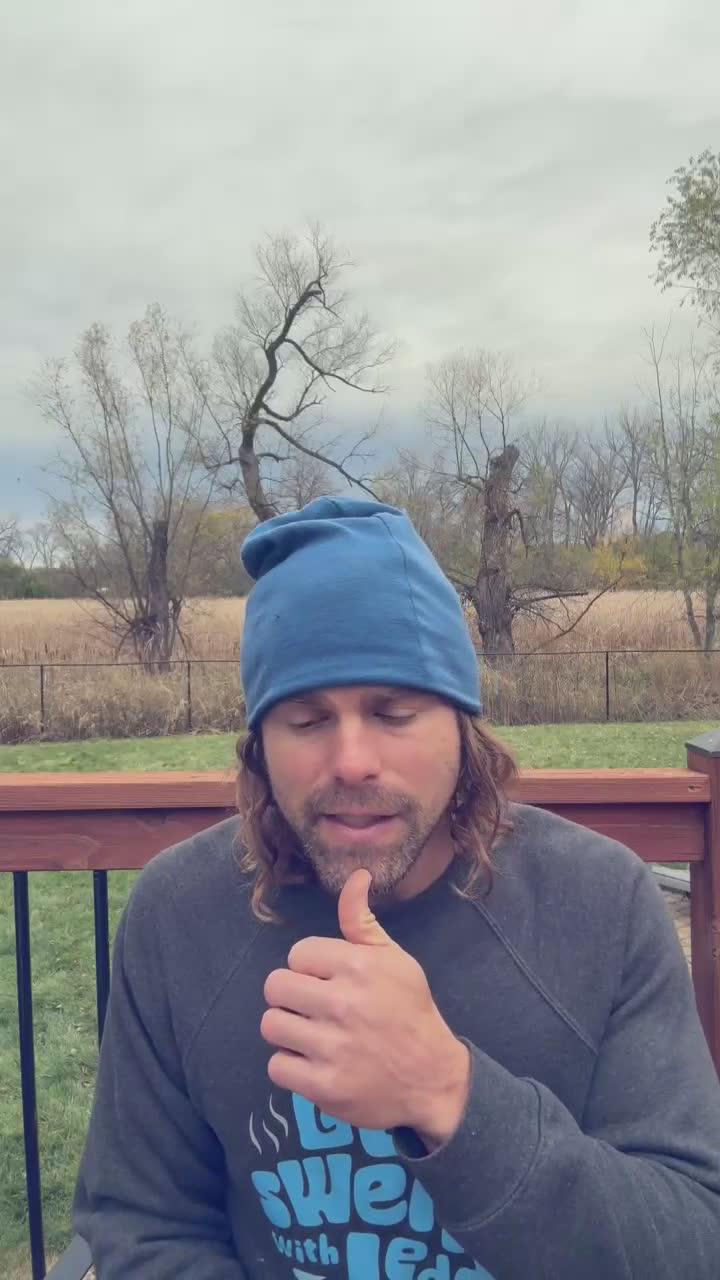
Self Talk - We can control the narrative of our lives by how we talk to ourselves. On 11/11, I’m beginning a series that highlights processes we can utilize to move through all types of pain. From how we talk to ourselves, how we move, what we put into our bodies, how we recharge, the environment we surround ourselves in, and what we can do to heal. All topics are related to my life and demonstrate what I’ve learned that is necessary for me to thrive. These topics are also elements from what I’m trying to bring to life through my community-based wellness experiences with Sessions by LeddWell.
The video opens with casual greetings and an invitation to a community wellness session in Minneapolis. The host clarifies that the talk will focus on a different topic today.
The speaker introduces a multi-week series about daily practices that help navigate life, explaining that mental health can be experienced as physical, emotional, spiritual, or mental pain. He names self-talk as the first topic and emphasizes tracing the origin of struggles before intervening.
The host describes committing to focus, accepting imperfection, and choosing constructive internal responses when goals aren't met. He also highlights practical supports like journaling and coaches to process frustration in the moment.
Using examples like a cold plunge and unfinished to-do lists, the speaker shows how positive self-talk reframes reluctance into opportunity and fosters momentum. He links self-talk to visualization, outlines how to script outcomes for tasks, and explains how that prepares you for creative work.
The host shares his practice of narrating events in a journal at night, recounts a frustrating situation, and reframes it as experience rather than waste. A brief cat cameo humanizes the moment while underscoring how setbacks can refine future decisions.
He explains that an unfortunate outcome prompted motivation to find solutions and inspired the series 'moving through pain' across spiritual, emotional, physical, and mental domains. The closing ties personal response to action and future plans.
Good morning, cadre. Start that again. Good morning, cadre. Couldn't tell if the red light was on there. Hey, Emily, how are you? It's fantastic seeing you at Sessions by Ledwell a few weeks ago. We got one more this Saturday at Thomas Beach for all you Minneapolis sites out there, or Minneapolis. Oh man, should have practiced that one before. Minneapolans. Yeah, we'll go with that. , Thomas Beach, that's not what I am here to talk about today. I figured as we're heading into the darker times of the year, the colder times of the year, I want to begin a series where I am basically talking about all the things that have helped me just navigate life.
And that's like from the moment I wake up to the moment that I go to sleep. And these are all principles of Ledwell and what I'm trying to demonstrate on a community-based level. But I want to talk about all of that on an individual level here. for a string of weeks. We'll see how long this can go. I was doing a little planning this morning and I think it'll be a long stretch, so I'm pretty excited about it. And today I want to start with self-talk, right? And the way that I want to interact on here, it's definitely a mental health component, but I relate mental health issues to pain.
And that can be physical, emotional, spiritual, or mental. And even if it's not physical, like it starts out as a physical thing, it can show up physically in our body. So it's really important to recognize that and understand the origin of whatever struggles that you're going through. Because sometimes you intervene in the wrong way and create a new host of problems. So I'm all about tracing the origin of an injury or pain. And I think that's what this series is going to be all about. But yeah, I want to start with self-talk because for myself, I mentioned earlier this month, this is going to be November.
So I'm going to say no to a lot of things so that I can try to be as focused as possible on the task at hand. And sometimes you're not always going to be perfect. I set out to be as good as possible, but perfection is fleeting and we can't always be perfect. So then when you're not perfect, how do you react? And that starts with how we interact with ourselves. So if let's say I have a goal or something I want to accomplish and it doesn't get accomplished, I don't want to tell myself, oh, you suck, you failed.
Why can't you complete this task? What is wrong with you? know, that's not how I'm going to want to feel. That's not the right way to communicate with myself. So for me, sometimes you do get frustrated, right? But that's where I have the tool that is journaling to kind of sort that stuff out and coaches to chat with to sort that stuff out. But in the very immediate reality of the situation, it's very important to frame how we're communicating with ourselves. So, let's say I wake up today and I want to get into that.
I know I have to get into that cold punch. Well, it could be easy for me to say, I don't want to do that. I'm cold. I'm a little extra tired today. Why do I need to do that? Instead I say to myself, all right, I get to go and jumpstart my day with a challenge right out of the gate. And that challenge is going to instill clarity and focus that I can carry with me throughout my day. So it really starts with that simple framework of how you're communicating with yourself to start the day. And then it maybe goes on to your to-do list.
Maybe you didn't tackle a couple things from the list the day before, and it might prevent you from attacking what you need to get done today. And you could look at that and say, gosh, why am I not completing these tasks? Or I just so frustrated with myself. Like, why can't I, why can't I be proactive? Instead, you can just say to yourself, all right, well, made a good run yesterday, but I'm going to make up for lost time today and going to stay a little extra focused. Maybe we have to make a sacrifice to accommodate for the events that transpired yesterday, but either way, it's all going to get done.
That's a better way of framing a task that may or not have been complete or a list of tasks that might seem daunting. And then it goes throughout the day. Maybe there's going to be times where you just need to say to yourself, all right, let's go. Let's go and make this happen. Let's tackle this. I'm excited about this. Even if you're not excited about it, if you could say those words or bring that energy into your body that is related to positivity, whether it's just a smile or just an energetic tone, that will pay off.
You might not feel it right away, but it's important to continue to support yourself with positive reinforcements, positive self-talk. Self-talk can also lead to visualization. I learned about visualization early on growing up as a hockey player, where if I'm in the locker room, I'm thinking about the good things that I'm going to do the next time I'm out on the ice. And much like self-talk, self-talk can Propel my train of thought. Self-talk can propel good visualization. You know, you say like, all right, I'm going to go and get this done.
I am going to make these two phone calls right away. They're going to go well. And then I'm going to follow up with a couple emails and then I'm going to be done with the tasks that are in my, floating around in my head or something I need to do so that I can concentrate fully on the creative nature of what I'm going to do next. So, right there I just mapped out a successful stretch of duties right there. I told myself what I was going to do. I told myself the outcome and then I motivated myself to get to that creative space where I want to be.
And then let's say we're getting to bed and maybe the day wasn't perfect, but it's important to look at the things that did go well or just reframe how your processing the things that didn't go well. My cat just showed up. I've been waiting for him because I got to go to a meeting downtown afterwards. Roger, I'm glad that you came back, buddy. You want to come and say hello to the camera? So, you know, so if I'm going to bed and right now I'm trying to journal a little bit before going to bed, my favorite thing to do is journal in the morning, but I realize that morning time is the most important for my creative juices to flow.
So I'm trying to break the mold a little bit, do something I don't want to do, right Luke, the hard stuff, and then allow myself the ability to try to come back toward the end of the day and handle things that give me joy in the morning. So I'm trying to flip the script a little bit. So when I'm journaling at night, you know, I'm narrating what's going on. Come here, Roger. I'm narrating, you know, what's going on. And I could say to myself, you know, like yesterday I had a situation that popped up that really rattled my cage.
And I was, distraught. And I was like, man, I am, I was, I told myself that I was down in the dumps. And then I realized what I was doing and then I was like, no, this just means that I need to look for another opportunity because the opportunity that I was looking at wasn't the right one. So instead of dwell on the news that I received and be upset about it, be like, oh, why did this happen? I had a good plan. It was going to work out. Now it's not going to work out. It's frustrating. What a waste of time.
Nothing is a waste. Everything is, everything contributes to experience. So I know I have the experience of navigating situations or outcomes that are not favorable. So, when it comes time to happen again, I can lean on that experience to adjust my framework of thinking. So Instead of being upset, I had to say, what? I'm going to look somewhere else and that will make me look with a more refined lens and I'm going to come out okay. So that particular situation that I just mentioned is what led me to talk about self-talk today and essentially create this series of moving through pain.
spiritual, emotional, physical, mental. So if there's anything that came out of the unfortunate news last night, it's that I woke up, I was motivated to find a solution, and that motivation, that drive to eliminate that We don't want to call it depressive, but I will right now. The depressive state created something great. So now I have this, Roger, we got to stay over here, buddy. I got to go inside. So now I have this plan and I'm going to go and get my cat. And now I've got this plan that
Reactions and comments are for members. Joining is free and takes a minute.