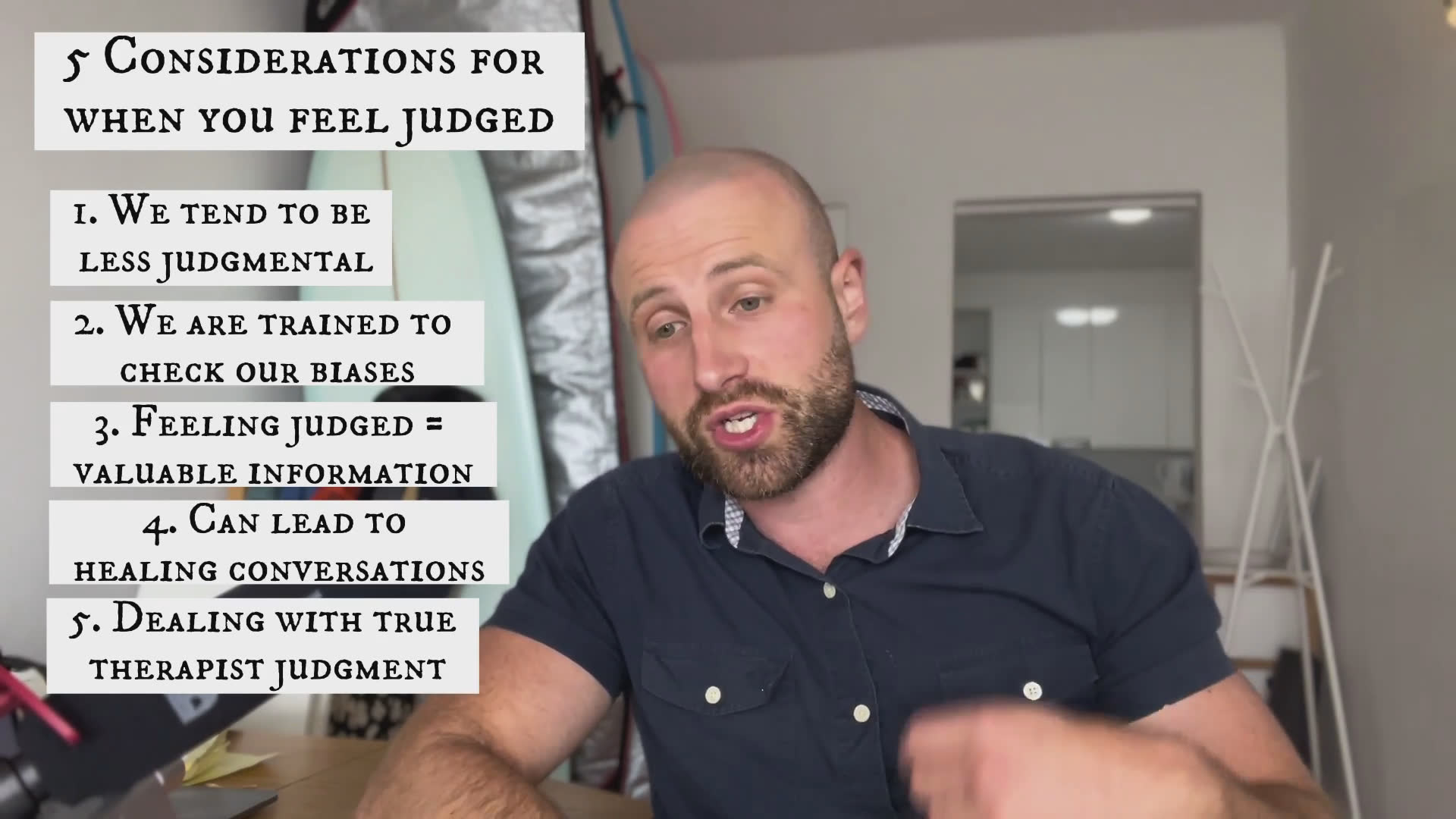
In this video, Evan Lieberman, MSW LICSW LADC, answers a question from a member of the Cadre family. Today he responded to a question that he gets quite often from individuals in therapy: is my therapist judging me? Even though that is a tricky question, it brings up many essential considerations regarding the therapeutic relationship between client and therapist. Of course, feeling like your therapist judges you is not a good feeling, but come learn how, in many cases, it is beneficial for the therapy process.
Evan: Is my therapist judging me? It happens quite a bit. Here are five things to consider about your therapist if they're judging you. In general, us therapists are working with populations that are typically more stigmatized. As therapists, we are trained to put our own biases aside.
There's so much therapeutic gold when a client thinks their therapist is judging them. The last consideration is if your therapist is actually being judgmental. If you feel like the relationship is beyond repair, find another therapist with those values.
What's up, Cadre people? Evan here, your resident mental health and addiction therapist. And this is my series answering questions from the Cadre family. And today we have another question from one of our very own Cadre creators and coaches. And the question is, is my therapist judging me? I cannot state enough. It's come up a few different times. And one of the things as a therapist I like about this most is that it happens quite a bit. Clients think we're judging them, and one of the reasons is when someone comes to therapy, they are emotionally, psychologically at their most vulnerable.
They're exposing things to us that they would never to anybody else. So it's so easy to feel that sense of judgment now, even though that is something we don't want to have happen as a therapist. When it does come up and it is talked about honestly, there's some real good that could come from it. So I'm going to break down five things to consider about your therapist, and if they're judging you and some of the principles around that, remember, these are just very general principles. They don't apply to every single therapist.
Some of us are not always as good as others. How much I love this question. One of the first things to consider is that your therapist likely got into the field in the first place because they are generally a less judgmental person, someone who wants to work with marginalized populations. If they were judgmental, let's say, of people with addictions or other mental health disorders, they probably wouldn't get into the field because they would view it as it's something that is their fault or a moral failing.
In general, us therapists are working with populations that are typically more stigmatized. Now, I know a lot of people, and I've done this myself, where I've worked with people who are sex offenders, people who have offended on a child, people who have even killed other people, often, especially as social workers, find ourselves in those situations. And that could be really difficult. Right. It's hard not to judge. But in those situations, I am trained and have been trained to put that aside and ask myself, how could I be most helpful to this person?
Because if I'm able to do that, if I'm able to help this person improve on who they are as a person, improve their life, then even they're less likely to offend onto someone else. We call this client centered care to hold our clients in constant, positive regard. The next thing to consider is that therapists are human beings. We naturally have biases. We place judgments on things. This is what we do. This is a survival mechanism of evolution. However, we're all of two different minds. We have our immediate reactions, we have our stereotypes, kind of these immediate thoughts that we have that categorize things.
Right. We all have this, but we also have our higher minds where we're able to challenge some of those preconceived notions and stereotypes and automatic thoughts. So again, as therapists, we are trained to put our own biases aside. The next consideration is my favorite, because there's so much therapeutic gold when a client thinks their therapist is judging them. So what do I mean about that? Quite often when a client is feeling judged by their therapist, again, maybe that is the case, maybe their therapist is judging them.
But I find that most of the time, especially in my case, because I know I'm probably not judging them. It's them judging themselves. It's like they are holding up a mirror in front of me, thinking that I am judging them. But it's really the feelings that they have about themselves. And that's why in the therapy room, it said it's like a micro chasm of the real life outside of the therapy office. Right? So we call this the process dimension, where we're basically reenacting different relationships and situations that they have outside of therapy.
And maybe neither of us really know that. So when that comes to mind, when a client actually has the courage to say, hey, I feel like you're judging me, wow, that is really valuable information, because that says so much about how you feel about yourself and what issues you benefit from working on. And in a similar vein, I really recommend that you bring it up with your therapist, even though it could be so uncomfortable. A lot of times, having those discussions in the process dimension, when you're having these vulnerable, real conversations that can actually sometimes be critical of the therapist.
Right. Giving us feedback, that could be important as well. But oftentimes, when it comes to this sense of judgment, it could be so important because if you're able to move past it, your relationship could become stronger. It's called rupture and repair. Just like if you scrape the bottom of your foot, it comes back and heals stronger. And one of the benefits, too, is because it is very likely, if your therapist is even mediocre, that they will tell you that they aren't judging you, and they will tell you that earnestly.
And I find in those situations, usually it brings a sense of relief to clients, because otherwise they're holding onto that and they're going through the therapeutic process believing their therapist is judging them. And they're not getting all the benefits that they could if they had brought that up. The last consideration is if your therapist is actually being judgmental. This is not just projection. They are overtly letting their bias come out or demonstrating they don't have an understanding of what you're going through or your values.
Now, an example that comes up a lot with some of the clients I work with are clients in the LGBTQ community. Now, they often go to therapists who don't have a specialty in this or even just a basic understanding. And a lot of times, a therapist demonstrates that lack of understanding by often asking stupid questions or letting their bias slip out. Now, many therapists, too, and I'm not going to place a judgment on this, are religious based, and some of those religions are not okay with certain morals and behaviors, whether it's sexual practices, LGBTQ, and okay they're going to do them.
I don't agree with that, and I think it is unethical for them to project those values. But even so, even if it's just a mild version of that, that's not the person you should be seeing. So in that case, I recommend if you feel like the relationship is beyond repair, that you can't trust that person, that you go seek and find another therapist with those values. For example, in the LGBTQ case, if you do searches for therapists, you can use that as a keyword. And you could ask your therapist. You could interview your therapist or ask them certain basic screening questions, just like they would do to you to make sure they're the best fit.
A lot of therapists will do consult calls, so go ahead and screen your therapist. Make sure that you all are on the same page as far as values, and you can maybe avoid that happening. So when it comes to the question of does your therapist judge you? The answer is generally no, not in a moral sense. We're our own harshest critics. But remember, if you feel that, if you're getting that sense, it's important to bring it up, because in most cases, they are not actually judging you, it is you judging yourself.
But there are some cases where they might be, and in that case, it's time to move on. That was a great question, and I hope you got something out of that. So remember, in any of my videos or other Cadre creators ask questions. Feel free to put those in the comments, and we may just be able to answer those for.
Reactions and comments are for members. Joining is free and takes a minute.