Let’s talk about safe harbors, caregiving strategies and feeling supported when you’re sailing into unknown waters.
Kathy opens the livestream, explains a second attempt due to technical difficulties, and orients viewers to her location and schedule. She also introduces the theme she plans to discuss: caring for the caregiver.
Using nautical imagery, Kathy describes needing and providing safe harbor for others and shares local anecdotes about Lake Erie and a friend who stayed with her while her husband recovered. She sets the emotional scene for the caregiving story.
Kathy lists concise lessons learned about supporting caregivers, emphasizing listening without fixing, avoiding sharing your own medical stories, and simply being present. She explains why these approaches reduce anxiety and validate the person in crisis.
She gives concrete examples of helpful actions—making decisions for them, offering prepared food, running errands, and handling logistics—explaining how carrying small choices preserves the caregiver’s limited bandwidth. The chapter transitions to a personal reflection using roses.
Kathy shares a personal meditation on marriage anniversaries, moving from wound to scar, and how gratitude reshapes memories. She closes by thanking listeners, encouraging those caregiving, and inviting them back for future conversations.
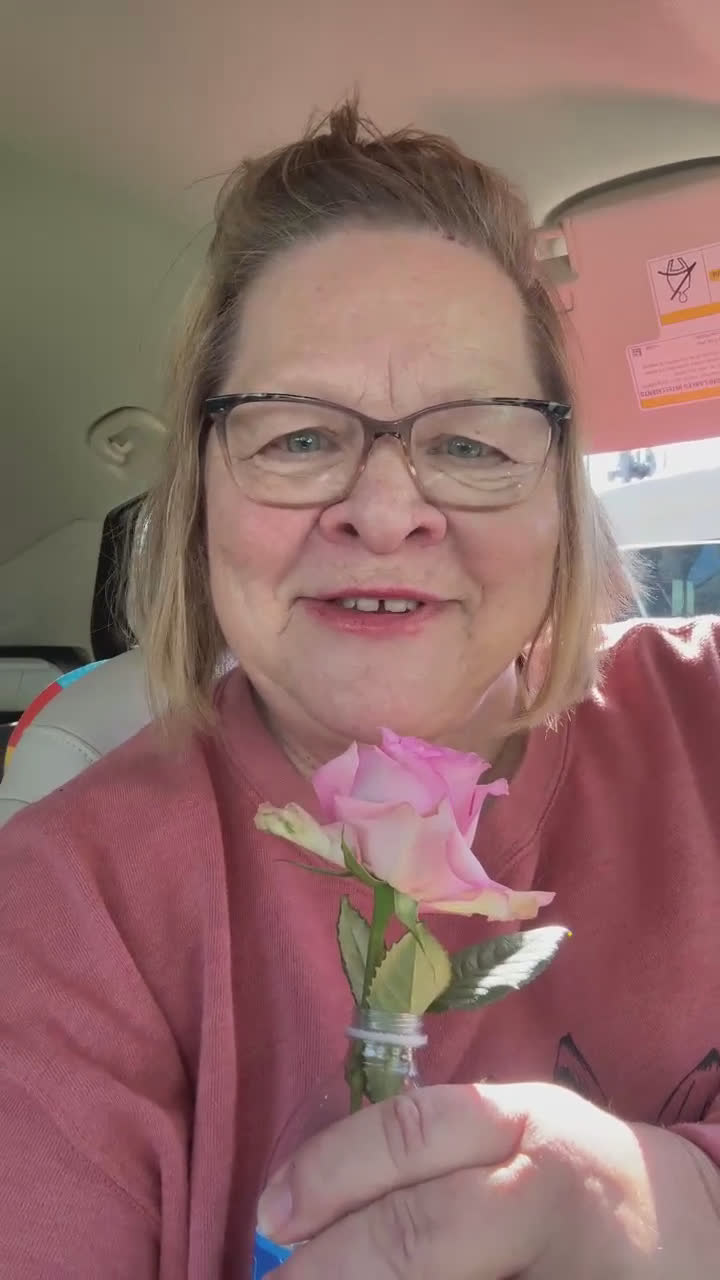
Speak Wonder is in the house. This is my second attempt to get on here live. Some technical difficulties on my end. My name is Kathy and my cadre handle is Speak Wonder and I enjoy coming in to have conversations with you once a week on Thursday. Normally I broadcast from home, which is Erie, Pennsylvania, very close to the beautiful Lake Erie. Today I was helping a friend get her car to the mechanic and then she thanked me by treating me to breakfast, which was really nice. And I brought the centerpiece, one single rose in a vase, very fancy water bottle vase.
I am now at my massage therapist. I recommend massage. I can't recommend it enough. So good for you. Good afternoon. Junk food. Hello. Hello. Welcome in. So I'm in my little car and I'm sort of out of my element as I'm used to doing my quadre live streams from home. But I am out and about today. And normally I broadcast at 1130 Eastern. It's now 1215. And I don't know where you're listening from, but do you observe daylight? Not daylight saving, that's what we're in. Standard time is kicking in this coming weekend.
I was going to say, don't forget to adjust your clocks, but everything now is digital, electronic, and our little smartphones and Androids adjust themselves, pretty much. I still have a battery-powered clock on the wall that I'll have to change. And the happy thing about fall is that spring forward, fall back, we gain an hour, so we get an extra hour of sleep. It is good to see you. Also, Emily's here. Why are you laughing? Because I'm enjoying the prospect of the hour extra sleep, perhaps. I'm out of my element.
I usually have my journal and my notes, so This is on the fly and since I'm living it, I want to talk about caring for the caregiver. That's something I'm doing now. So you're piloting a new body of water today. That's what I'm doing. Thank you for using my imagery of harbor pilots to explain what's happening. I'm piloting a new body of water out of my usual harbor. I'm in an open water area that I'm not familiar with and thus I need you, my harbor pilots, my smaller boats that come alongside and help me in safely to the docks for respite.
Thanks for anchoring me, junk food. I love all things nautical. I just this morning With my friend who dropped her car at the mechanic, after breakfast we went to a place called Lake Erie Variety and it's all local artisans that do beautiful artwork with beach glass. It can be jewelry, it can be framed pictures, and it's all local. And maps of Lake Erie. There's a big map on the wall that they do sell in the store of all the shipwrecks of Lake Erie and where they're located. Caring for the caregiver.
I have a friend who's a longtime friend. I've known her practically forever and her husband. And she called me about a month ago from another town and said, my husband's having surgery in Erie. Could I flop on your couch for the couple of nights so that I don't have to go back and forth to check on him? It's about an hour and a half, which is roughly when I drive to see my mom at her nursing home. And I understand that. I understand driving when you're weary, when you've been sitting with someone all day.
And I said, absolutely, it's a tiny house. I don't have a second bedroom, but I do have a comfy couch and you're welcome to it. Two nights turned into three, three turned into five, and five turned into seven. And she's still here because her husband's back surgery, while it was successful, has rendered him extremely sore and in lots of pain, which was a possibility. And actually with most surgeries, it's a probability. Think about it. In his case, they made two incisions in his lower back and went in, put some sort of cage in, that's what she called it, some sort of stabilizer.
And the end goal is for him to walk again. He's barely into his 60s and he's using a walker and they want to get him walking again. The recovery is far more complicated than the surgery itself. And I said to her, you stay as long as you need to stay. And I'm learning things about being a nurturer to the caregiver. She is very much a caregiver for her husband and will continue to be throughout his recovery and beyond. So I like to provide respite and safe harbor and help the vessel coming into unknown waters to find mooring and a place to sleep, literally.
And since we are dear friends, we talk into the wee hours and we laugh together and she is able to sort of unload her day and process it verbally with me because I'm safe. And so we've been doing that every night and this extended stay has not really surprised me. I thought it might be possible and it's fine. You know, it is absolutely fine. So I've made a little list on these sticky notes of things I've learned about caring for the caregiver. There's only a few here and I'd like to share them with you.
One thing I've learned is to listen and don't fix. One of the best gifts you can give someone who is In my friend's case, in crisis, it has eased up a lot. But in crisis, post-surgery, empathetic for her husband, I want to give her a space where she can just talk. And listening is a gift, truly is a gift. Yes, I get that. That's why all surgeons say 90% success rate, but there is the 10% things can go wrong. He's in that 10%, but he's going to recover. You know, the surgeons are brutally honest and they must be.
I think it's morally wrong to set you up for failure. So they tell you everything. And then when you succeed, that's a plus. Listen, don't fix. Listen not to fix. You know, that's good advice across the board for any situation. As we nurture people, to make recommendations or offer suggestions when truly listening is the best medicine. It's the best emotional Rx. It's the best prescription you can dispense is your willingness to listen. Let them process what's going on. It's incredibly healing. The second thing I wrote down is don't tell your own surgery stories.
How tempting is that? How unbelievably tempting is that to tell our own stories? Once somebody mentions something about a procedure, we want to jump right in and say, well, you should have seen what happened to me. And sometimes that can be reassuring or validating. But I think for the most part, while people are still struggling, and holding space for the person who's in pain, for the most part, I believe it is better not to share because it might add to the anxiety and it takes the emphasis off the one who's suffering, off the one who's struggling.
The three things to be are a good listener, a shoulder to cry on, and just being there for them. You could have done this live, you could have done this. You have traveled this. You have piloted people into safe harbor, my dear. I can see this. Thank you for that. That's basically my cadre. Be a good listener. Be a shoulder to cry on and just be there. And yes, she did have a crying session one night because she had been strong all day, about 12 hours for her husband, who was in deep, serious, dreadful pain.
and the pain was being addressed with medicines but that's also problematic. Even the cure comes with complications. I'm happy to report to you today that a week and a few days out he only needs Tylenol to manage pain and he's in daily physical and occupational therapy. He's learning once again how to move his body and he has an appetite again. So we've come through to the other side. Still don't know the end game, and that's all right. I love your three things, junk food. Be a good listener, be a shoulder to cry on, just be there for them.
The only other thing I could add to that is offer food, but don't say where would you like to eat. Incredibly, that is an extra burden to ask somebody to make another decision. She doesn't know my town. She knows her hometown. She doesn't know mine. So for me to say, Jane, where would you like to go and have a meal? There's this restaurant. There's that one. What do you think? It's actually a burden for someone struggling emotionally to have to make yet another decision. Make the decision for her.
Especially since I know her well. I know she loves salads. And I know she likes fruit on them and I know she likes honey mustard dressing. So I have an advantage in knowing the things that she likes. And I was able to stock my refrigerator with those things so that she could come to my little house and have a meal in privacy, not in a public place, and let her anxieties drain out. Listen, not to fix. Don't tell your own stories. Don't ask your person to make more decisions, even small ones, because they simply don't have, they do not have the bandwidth.
They do not have the bandwidth to carry another burden, even a small decision like where to eat. And then be a friend, be a shoulder, be there, and be a great listener. I just would say I'm taking you out for a bite to eat like where we're going or I will take you out where we are going and say where they're going yeah that's good yeah you don't want to spring things on them I think that's what you're saying uh give some information but also be the one who made the decision I think sometimes people in the throes of caregiving they're the last person on the list to nurture and that's my friend she blew through several meals because she wasn't thinking of herself and she needed to get her nutrition and her protein to be strong for her husband.
And at times when we make those executive decisions, the person caregiving or grieving or trying to figure life out needs you to carry those choices, whether it's food or lodging or Going out to buy sweatpants because they ran out of stuff. Doing a load of laundry. All the things. I'm sure you could add to my list and you have and I thank you for that. It's almost 1230. I think I can go for about another 30 seconds. I have very little material left over because when you come on here we have a conversation and you supply some stuff.
that is conversation worthy. So the reason I have a flower, this is what I'll end with, is last Sunday, October 25th, would have been my 43rd wedding anniversary and I miss my husband. Something Betsy Hodges said here in the Cadre a couple of Tuesdays ago was, talk from the scar, not from the wound. I love that. That's one of her rules of engagement. Speak from the scar, not from the wound. And she went in to kind of explain that a little bit. And it meant so much to me and still does. I miss my husband.
It's been 18 years. A scar suggests healing. It suggests that the wound site has healed. And now you have this reminder that you're healed and that you had a love and it was wonderful. If I were still speaking from the wound that would still be open and raw and rough and sad, deeply sad. Now what I feel when I observe a wedding anniversary or his birthday or Christmas which he loved, now I have a heart filled with gratitude. And so on Sunday I went and bought myself a dozen roses, pinks, a deeper pink and white.
They are gracing my table now and I put this in this water bottle vase to have with my friend getting her car repaired to have at the breakfast table. These roses have lasted since Sunday. Look how beautiful. Still going strong. Kathy, what poem of a rise do you know by heart? Of a rise. What poem of a rise? A rose. A rose by any other name, still a rose. Who said that? That's a famous quote. I'm sure Emily Dickinson wrote a poem about roses. I'm not coming up with one right now, but I will. That's my homework from this week to next.
I'm going to find a poem or invent one myself. About roses. You're the best. We are all walking each other home in some way, shape or form. We're all sailing out into the harbor to help another vessel who's struggling to get in, who needs a safe mooring. who needs your listening ear. To any degree that you are giving care, whether you're helping a friend get her car taken care of or lodging a friend whose husband is recovering from a very difficult surgery, whether you're taking care of a parent, a child, whether it's temporary or long term, You are being a fabulous human being and coming alongside.
Thank you for what you do. Keep on doing it. Come on in here for encouragement. Shannon Paul, Comedy Through the Chaos, she's coming up later on today. And I'm so glad I could connect with you. I had to persevere. You have a great day too, keeping the lighthouse. Yeah. for my friend. You come up with so many gorgeous word pictures in the lake scene. I can be a lighthouse for my friend. What a beautiful picture that is. I imagine a flicker in the housing of the lighthouse calling her in. Yeah. Come on in.
It's safe here. And you can stay as long as you want. Later, we'll have lots of memories from this time, this very difficult time. And I count on watching him walk without his walker. I'm counting on it. I will see you next week in safe harbors as we have more conversations about navigating these waters we are in. We all find ourselves in specific situations and we all help each other. And that's what a harbor pilot does. Take good care. Thank you for being here and thank you for tuning in when I had to change my time two times.
30 my normal time next week. Blessings to you and see you later.
Reactions and comments are for members. Joining is free and takes a minute.