If you’re someone who has struggled with depression, suicidal thoughts, low self-worth, or simply feel like you don’t belong, my hope is that this series will provide you with the wisdom of knowing why we stay alive, the compassion to understand our struggles, and the tools to radically be yourself.
Rachel Havocost: Why is it so hard to experience belonging? She says the reason is because we fear rejection. She says we have to arrive with that fear of rejection as our true selves in order to get it.
So now that we know that belonging is an inherent human need and that there's no shame for wanting to belong, and that by experiencing belonging, we have more creativity, more joy, and more safety to do the things that we want to do in life, why do we struggle so much to access it? Why is it so d*** hard to experience belonging? Hi, my name is Rachel Havocost, and this is the third video in my series, the Courage to live, which are just joining me. I invite you to go back and start at video one and then catch your way up till here so you have all the context.
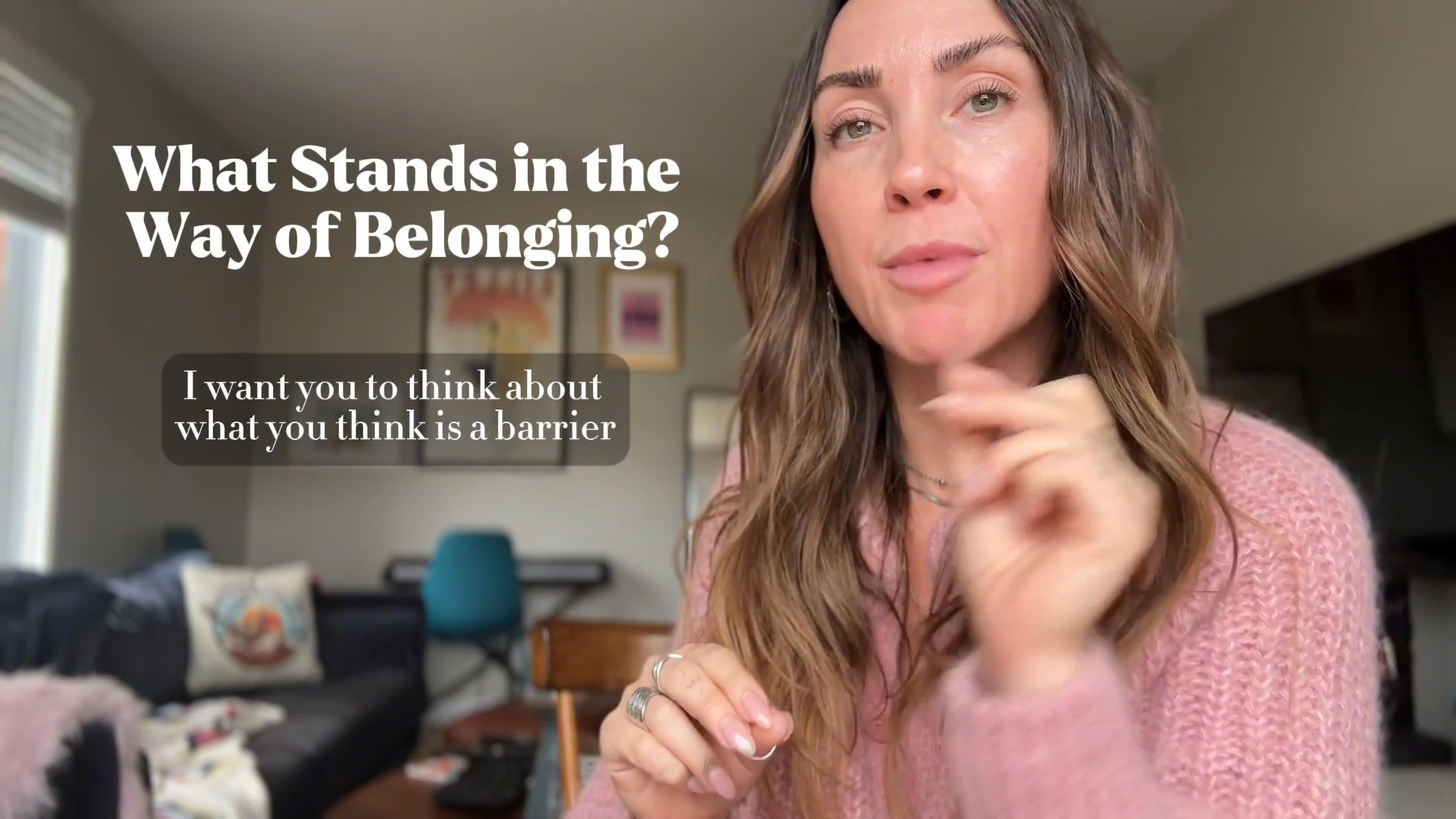
So, in the last video, I asked you to think about what you think is required in order to experience or acquire belonging. Right now, I want you to think about what you think is a barrier. What do you think stands in the way of achieving belonging? So I like to think about my own experiences with belonging and all the things that I did to try and belong in my life. So I think back to when I was, you know, in high school or middle school, and I observed my peers and tried to assess what is everyone else doing, and how do I mimic that so that I can belong to whatever this group is.
So I did a lot of things to try and belong. I changed the way I looked. I changed my hair. I changed the music I listened to. I was people pleasing up the wazoo. I didn't say no when I wanted to say no. And eventually I developed an eating disorder. I morphed myself so much into what I thought would create a sense of belonging that I ended up developing a mental illness. And the reason that this happened is because I was afraid that if I was actually myself, I wasn't going to be accepted. And so instead, I did everything I could to be somebody else.
I did everything I could to mimic what was going on around me so that I could try and fit in and belong. And the result of that is that when I eventually did feel like, okay, maybe I'm fitting in. Maybe I have friends. Maybe now it's safe for me to show them who I truly am. There was confusion and rupture because suddenly I was somebody else. Suddenly I wasn't masking who I was. And then when I experienced rejection for being my actual self, it reinforced the story that it wasn't safe for me to be me.
And so I started repeating the same patterns of trying to camouflage, trying to adapt, trying to change in order to belong, and then continuously, continuously, I would either be rejected when I finally showed up as I was, or I never actually felt like I belonged because I wasn't really being myself. And so the thing about belonging is the reason that we struggle with it is because we fear rejection. And what is rejection? It's the opposite of belonging. It's ostracism, it's exclusion. It's being left out.
So by fearing the thing that is in opposition of what we want, we end up obstructing and challenging the way that we get there. We end up stopping ourselves from actually achieving what we really want because we're afraid of what might happen if we show up and truly ask for it. But the reality is, the more we show up authentically as ourselves and truly as we are with that fear of rejection, because it's still a real fear, because it still could happen. What's going to happen? We're going to get rejected right away and a lot more often.
And when someone truly sees who we are and they accept us and they want to be around us, we experience true belonging. And so it's a lot scarier to show up as ourselves right away. And if what we really want is true belonging, we have to arrive with that fear of rejection as our true selves in order to get it. In the next video, which is going to be the final video of the first part of this series, I'm going to talk about the tools required in order to show up truly as yourself in that fear. See you next time.
Reactions and comments are for members. Joining is free and takes a minute.