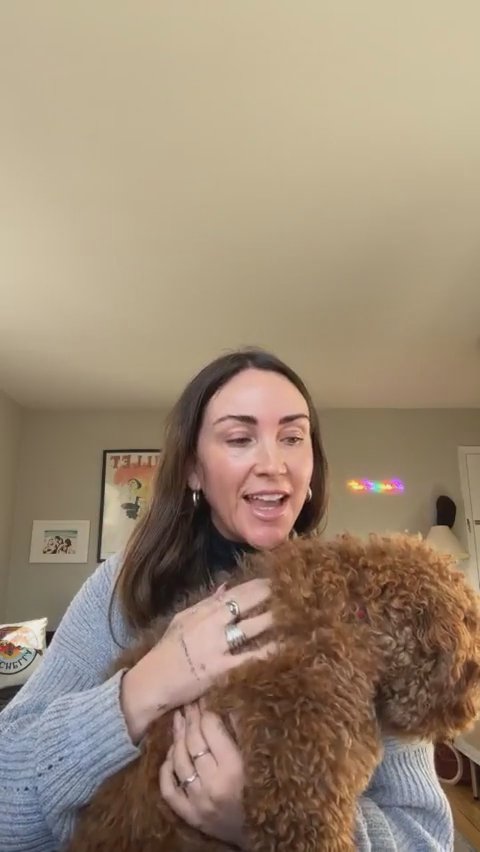
Why do we fear the unknown? Why do we get anxiety about new situations? Why is it so hard to change? In this livestream I'll be talking about why the unfamiliar is so scary, and why our avoidance of it doesn't mean we're broken or bad, it means we are human. I'll also provide tips for how to navigate uncertainty so you can approach change and what's new with less fear, less anxiety, and more ease.
Rachel Bloom is a writer and mental health advocate. She'll be speaking at the Cadre wellness summit next week. If you haven't gotten tickets yet, there is still time.
Garrett Bell: I think wellness is about being human. I think it's about embracing the messy, imperfect, and unsure. When our brains mark something as danger, it goes into fight, flight, freeze. Bell: Why we struggle with uncertainty so much.
Rachel: We are training our brains to have that pause. We're strengthening the part of our brain that takes a moment to come back to the present moment. Newness allows us to experience new things without so much anxiety. So that's my spiel today on uncertainty.
Hi, Padre. Hello, everyone. Happy Wednesday. I'm here with my munchkin, Milo. It's a must needed snuggle day. I'm so happy to be here, and I'm also simultaneously exhausted. So thank you for having grace with me. If I stumble over my words or I'm not as coherent as I normally am, that's why I've got Milo. He's like my security blanket. So we have been preparing, and I say we because Milo has literally been laying on the ground listening to me practice this talk. We've been preparing for the Cadre wellness summit next week, so if you haven't gotten tickets yet, there is still time, and you can go to Cadre's website and find tickets there or just search for it on eventbrite.
I'm going to be speaking along with other wellness experts, and there'll be lots of facilitated activities as well. It should be a really. A really wonderful two days, so. Would love to. Good. See you there. Okay, buddy. I know, I know, I know. If you're new here, hi. I'm so happy you're here. My name is Rachel. I'm a writer and mental health advocate. I've been in therapy for 19 years now for a lot of different mental health diagnoses, and I also have a master's in mental health counseling. And my mission is to really destigmatize mental health and also bring awareness to the reality of what it means to be human.
Because I think a lot of times, especially now, we're seeing a lot in healing culture, which. Milo. Milo. Mommy's on a live stream. He's so silly. He always likes to play with his toys when I'm on a call. Milo, come on, buddy. Come here. Come back into my lap. See, this is. This is you. You and I all having a moment of being in Rachel's room. This is what happens when we're here. We're just gonna exist. So, as I was saying, healing culture has kind of gotten to this point where, and I realize I'm kind of having a tangent.
Hi, speak wonder. Good to see you. A tangent from the topic of this live stream today, which is going to be dealing with uncertainty, which I promise I will get to. And I've noticed that just in general, there's this sort of idea now with healing culture where there's this idea of being healed or, well, where we've reached some attainable top goal, where, you know, I think that there's this notion now that wellness means purity. And I think that that's doing a disservice to us, because I think wellness is about being human.
I think it's about embracing the messy, imperfect, and unsure. And so I really. I love talking about things that are human, like being uncertain about being messy, about being imperfect, because I think that brings us down to earth a little bit and helps folks who are already feeling like they're not good enough in some ways, who've then entered the wellness or healing world and still feel like they're not doing enough. So, number one, I just want to remind you, you're doing enough. You're doing great.
It's okay to rest and take breaks. It's okay if you experience symptoms of a mental health diagnosis that maybe you once had or are still struggling with. It's okay if you don't cope perfectly all the time because you're a person. So I think it's really important to just have those reminders. Yes. Because there is no right way. Ironically, I got divorced during the pandemic, and they. Thank you, Garrett. And it was devastating. It was absolutely devastating to get divorced. And at the same time, there were still so many lessons I learned from my marriage that I've kept with me.
And one of them is, I think, the first month that I met my ex husband. So this was maybe eleven years ago, I was panicking. I was actually thinking about how freaked out I was about what was going to happen in my future. I was in between. I was taking a break from school. I didn't know if I was going to go back to school. I was gonna have a job. And I was freaking out about the future, and I was freaking out about the unknown. And I remember we were driving in his car. He literally pulled the car over and got me out of the car.
And he took both my shoulders. Milo Ruby role playing he took my shoulders and he said, there is no right way. There is only the way you do it. And that became a mantra for me in times of uncertainty. That became a mantra for me the next time I withdrew from. From grad school because of my mental health, and I had no f****** idea what I was gonna do next. It was a mantra for me after I got divorced, and I didn't know what my life was gonna look like, not being his wife, not being married. And so it's become a big mantra for me in times of uncertainty.
And so when I think about uncertainty now and why we struggle with it so much and why so many people struggle with it so much, I like to think about it in terms of our humanity and in terms of our biology and what's true and real for all humans, which is that we have this innate propensity to survive, right? We have this biological need to stay, to literally stay alive. And so our brains do this brilliant, brilliant thing where they help us do that, right? And so one of the things that our brains do is detect the unfamiliar and label it as danger.
So anything new, anything not known, the brain goes, oop, we don't know what that is, which means I don't have evidence of being able to survive or overcome whatever this is, and therefore I'm going to mark that is danger. And anytime our brains mark something as danger, it goes into fight, flight, freeze. So if you've heard of fight, flight, freeze, it's our survival threat response. And so I see something I don't know, my brain goes, oh, unfamiliar, therefore danger, therefore fight against it, run away or freeze.
And this is our brain's and our nervous system's mechanism to stay alive. He only does that when I'm talking. Let's imagine it's like a musical background, so our brains detect the unfamiliar and label it as danger. And oftentimes, if we've experienced trauma or chronic stress, or maybe we weren't supported growing up to try new things, our brains can start to misfire in terms of what we deem unfamiliar. And so we start to. Drums drumroll, please. And so we start to assess everything that's unfamiliar as life threatening, even if it's not life threatening.
And so what happens is things like math tests feel like a fight against a bear or going on a first date feels like I'm about to go jump out of an airplane. So situations that are new and unfamiliar and are normally going to ignite some level of anxiety, get processes the brain as life threatening, rather than simply, this is new and I can still approach it. And so when it comes to, like, giving our brains the opportunity to have that pause and assess in our modern day world whether or not something is actually life threatening or not, because we're not living in scenarios, at least many of us are not, where we have to maybe fight a bear or might have to fight against other people in order to get our food, those survival threats don't need to be on twenty four seven.
And so to allow ourselves to have that pause and that moment where we can cognitively go, is this a life threatening situation or no? And train our brains to notice in the moment whether that is life threatening or not, we can then regulate our nervous systems and not go into that fight, flight, freeze, not go into full panic mode where it feels like our entire bodies are heating up or our heart rate is increasing or our breathing is getting short, or what happens when we have a lot of anxiety and there's a lot of different ways to approach this, but one of the simplest ones and one of the ones that I avoided for so long is mindfulness.
So, mindfulness can be practiced in a variety of ways. And the major thing about mindfulness is focusing on the present moment and focusing on what's real. So finding ways to bring our brains back to the present moment, back to what we can see, touch, taste, feel, hear, bringing it back to anything tangible as a way to signal to our brains all that there is is right now. And right now, I'm safe. And so when we can start to practice mindfulness in times when we're not experiencing something new, so, like, maybe first thing in the morning before our first cup of coffee.
54321. Yes, that is a great mindfulness exercise. Thank you, Rachel. Before having our first cup of coffee or during the day, when we can set aside five minutes, tops, it does not need to be this long, hour long ordeal where we practice a mindfulness activity. So 54321 is a great one. I might get it backwards, but it's essentially, name five things I can see, four things I can hear, three things I can touch, two I can smell, and one I can taste. So it's like an easy way to remember. I'm going to do this five step thing to move through a mindfulness activity.
And by doing that in times when we're not experiencing something new or when we're not already anxious or maybe in that fight flight, freeze response, we are training our brains to have that pause. We're strengthening the part of our brain that takes a moment to come back to the present moment. So that if we are in a situation where we're going on a first date or we have a math test, or we're engaging in something that is still uncertain and is still new, our brains already have the flexibility, the strength, and the muscle memory to go.
Let me pause for a second and focus on what's real. Let me pause for a second and assess what's happening right in front of me. Let me pause for a second and ask, is this life threatening? And just that act of having that pause and having that ability to self regulate can bring us back to the present moment so we don't get into that super panicky state. And what that helps us do is a approach new situations which then familiarizes ourselves with them so that our brain starts to see these situations as, oh, I've done this before.
Yeah, I don't like it. No, it doesn't feel good. I still feel anxious or insecure when I go on a first date, but I know I will survive. It's familiar. I've done it. So by giving ourselves that pause, we allow ourselves to engage with and move toward that new experience and familiarize ourself with it, then the other thing that we can start to do is we can give our brains an opportunity to just simply learn how to regulate so that in times when maybe uncertainty does feel threatening or is really, really harmful, or if we have to grieve a really big loss, or if we have a fire in our home, or if something is truly, truly devastating, we can still honor the grief or the pain or what's happening while staying tethered to the present moment so that it doesn't get worse.
Because oftentimes when we experience something traumatic, our brains. Our brains shut down, and our brains go through this whole process of trying to survive so that other things do not happen, like storing memory or digesting properly, and a whole slew of other things. So if we have the ability and the strength and the muscle memory and the flexibility to remain grounded in the present moment, we can also protect ourselves during those big t trauma moments to help us maybe not necessarily avoid completely or prevent completely, but maybe lessen the impact of those experiences.
So uncertainty is natural in life because the future literally never comes, ever, ever. The future never comes and is always right here, right now. And so our brains do a lot of things to try and protect us from all of that uncertainty. And it's a good thing. It's a survival mechanism, and we're not always in a survival scenario. So being able to give our brains the strength and the flexibility. I know I keep using that word. And the agility. There's another one to navigate. Newness allows us to experience new things without so much anxiety.
It allows us to familiarize ourselves to new things, maybe if we want to try something new and set a goal for ourselves so that we can actually move through the steps of getting to that point, and it can lessen the impact when something really grave does happen. So that's my spiel today on uncertainty. Thank you so much for joining me. m. And I typically talk about things that I'm struggling with or going through or moving through. And I would always love to answer questions that you might have.
So if there's something that you want me to talk about, I'm so happy to try and do that. So just drop something in the comments, and I will try and bring that in to one of Rachel's rooms. Okay, my loves, hope you have a wonderful rest of your Wednesday. Make sure you stay hydrated, get some rest, and don't forget, you're doing enough.
Reactions and comments are for members. Joining is free and takes a minute.