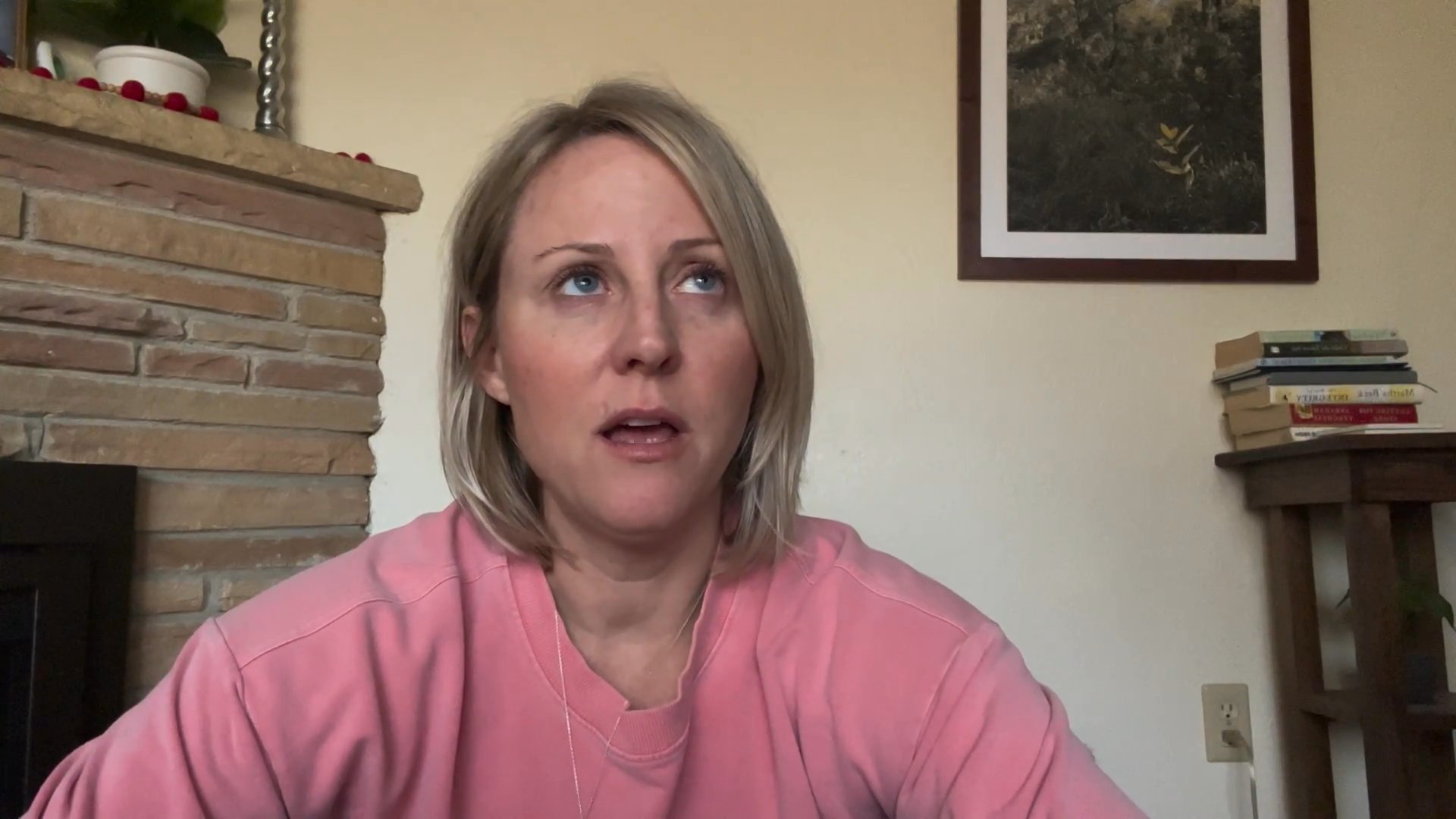
We’ll talk Step 3, Notice, in how to stop living in survival mode. What I learned in 7.5 years of therapy as someone living with anxiety, CPTSD and parenting a child with autism.
Shannon from aloud is a place to talk about the things that aren't necessarily socially taboo. She has anxiety, C PTSD, and a child with autism. Today we are on step three of the five steps to stop living in survival mode.
Step one is to know that how you're living your life isn't working for you. Number two is to say that out loud. Step three is now you have this thing that exists in the world. What if you start to notice what happens?
Hi, Cadre friends. It's Shannon from aloud. It is a Saturday afternoon in beautiful St. Paul. I have strategically positioned my books over here so you can see how well read I am. I'm just kidding. Thanks for being here today. So, I'm Shannon. I'm the founder of aloud. And aloud is a place to talk about the things that aren't necessarily socially taboo to talk about. So no topic is off limits here. I am not a therapist, but I am someone who has been in therapy for seven and a half years. I have anxiety, I have C PTSD, and I parent a child with autism.
And so it's what I've learned. And today we are on step three of the five steps to stop living in survival mode. Again, from my own lived experience. All right, so if you're just joining us, you're welcome to go back and watch steps one and two. But again, today we're going on to step three. Step one, just for a quick review, is to know that something, know that how you're showing up in the world and a way that you are living your life isn't working for you. And so typically, that's something that you just know in your soul is not right.
You're showing up in a way that doesn't reflect who you are. Number two is to say that out loud. And the power in saying it out loud is that once you do, it's out of your head, it's tangible, it's in the world. It's something that can be pushed against. Right? It's solid. It's here, it exists. This exists. You can push against it. So, number three, step three is now you have this thing. I'm going to use this coaster again. Now you have this thing that exists in the world. What if you start to notice what happens?
Because it exists, right? So I'm going to give you an example from my own life. So, one of the things that I shared in my last live was the truth that I said out loud was that the mother, my mother, wasn't necessarily the mother I needed when I was growing up. And so as a result, I did not have the emotional support. I did not have a safe place to develop, which meant that I spent a lot of time in survival mode and I spent a lot of time making sure that others around me were always, always, always okay, so that I could be okay.
Because if they weren't, I wasn't. So once I said that out loud, that my mother wasn't the mother I needed, what that meant for me was that I actually did matter that if that was true, it wasn't that I was inherently bad, but just that I didn't get the messaging that I should have. And so it meant that I could look at myself in a new way. I had this new information to say, I inherently have value. My feelings matter, emotions are okay. All of the things that you might think humans know, and actually they don't know because you get sort of programmed from zero to five.
And, yeah, so if you miss that programming, it's not inherent. So if I said that thing out loud, now, I notice with that new truth what happens because of that. So how I start to notice is, in interpersonal situations, if I take this new knowledge that I have, which is that I matter, and I apply it to my life, notice how it feels, notice how I might start to take up more space if I think I matter versus if I don't notice that, my shoulders might go down a little bit, right? Notice that if I'm in an exchange with someone and they say, hey, what do you want to do tonight?
And before, I very likely would have said, I don't care, what do you want to do? That it's okay for me to now say, hey, I want to go see a movie or I want to go for a walk, and that I can do that and it matters so that their happiness doesn't trump mine. So if you pay attention to that and you notice, you'll start to feel out how this thing that you believe to be true can impact your life, and it can impact your body, your relationships, the choices you make. It can honestly impact everything. So just spend some time noticing.
Write it down. Even just in a moment, just intentionally. Here's my little friend Gilbert. Notice what Gilbert does in a moment. Intentionally. Just stop and say, all right, I'm doing this new thing. How do I feel? Is the reaction from that person different? Do I feel safer? Enter adjective here. And so that's step number three. It's pretty simple. It's not quick. And for someone who likes things to be quick, it can be frustrating because noticing takes time, because you have to do it in life, so you have to do it as you're out there doing things.
But spend a week and notice, and then come back to it and see what happens. And dm me, let me know. But it's really information gathering. So that is step three. Next week, we will talk about step four, which is imagine a world where x blank can exist. And that is taking all the information we learned from the three steps before all how we felt when we noticed it. All the things and saying, what if? This could be the first step into a new life? I'm so glad you're here. I hope this helps. Thank you for joining me.
You're doing a fantastic job being you, and you are inherently good, and we're always here for you. So have a beautiful day, and we will talk to you soon. Thank you, Cadre.
Reactions and comments are for members. Joining is free and takes a minute.