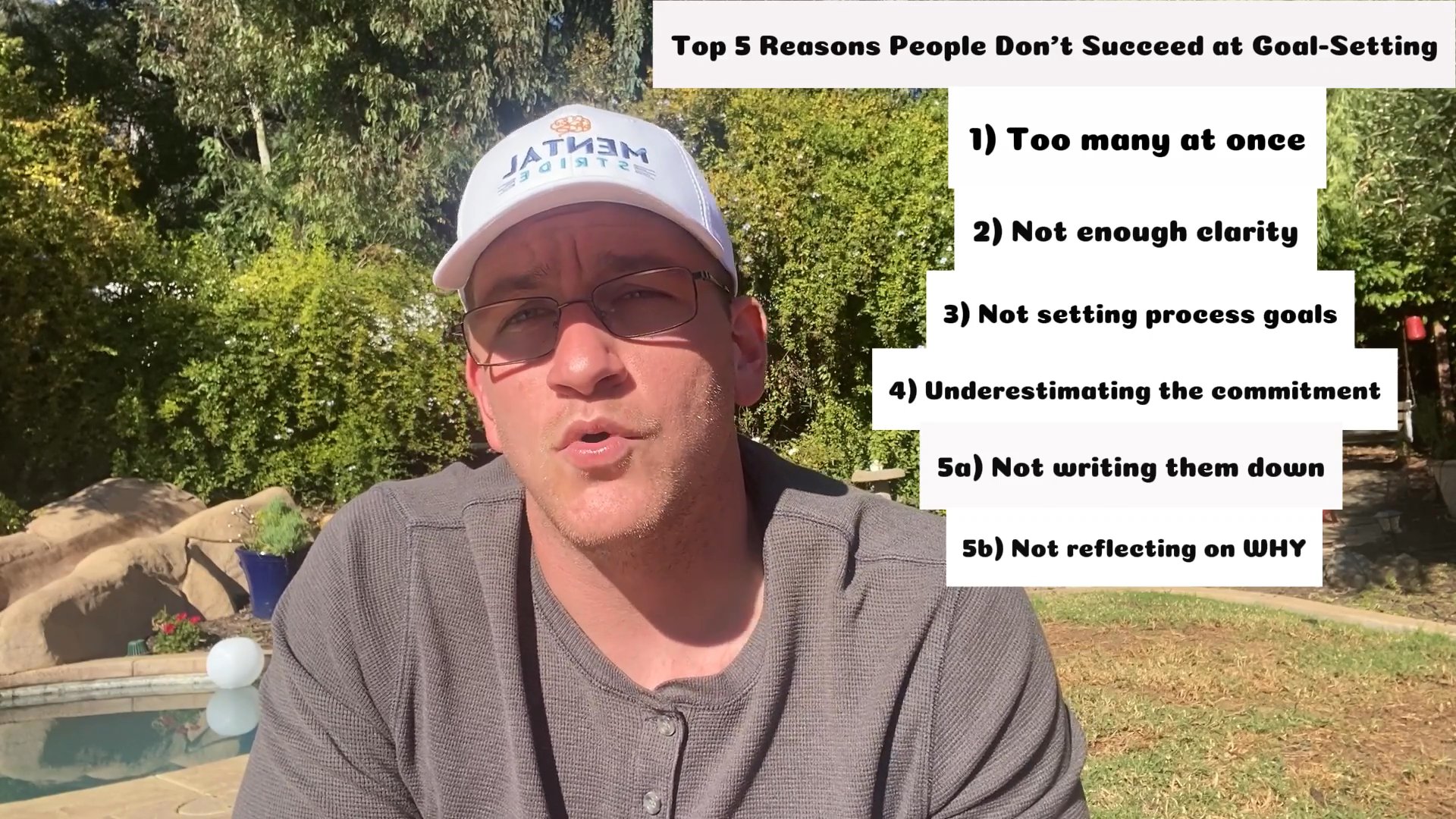
Before we dive into how we can set goals effectively, let's set the foundation of some reasons it does NOT work for people. Check in to see if you can relate to any of these!
About 80% of people, it's estimated, do not set goals for themselves. Of the 20% that do, about 70% of them don't succeed at achieving those goals. Garrett Westwell shares the top five reasons why people fail at goal setting.
I hope those five reasons helped you all understand a little bit more about the process of goal setting. Think about a time that you set a goal, what worked for you, what didn't work. Over the next few weeks, I'm going to be coming up with some great videos and content related to goalsetting.
Goal setting is one of the most popular and most well researched behavior change techniques out there. However, about 80% of people, it's estimated, do not set goals for themselves. And out of the 20% that do, it's estimated that about 70% of them don't succeed at achieving those goals. So why do people suck at setting goals to themselves and going out to achieve those goals? Well, my name is Garrett Westwell, cadres expert in sport and performance psychology. And today we're going to talk about just that, and specifically the top five reasons why people don't succeed.
Lead at goal setting. Number one is setting too many goals too soon. Maybe you're guilty of this, or you've known someone guilty of this who goes out, and then on January 1 they're saying, I want to lose weight. I want to start cooking new recipes, I want to start reading one book a week, and it just becomes overwhelming. It's hard to track progress. Even if you do track your progress again, it's overwhelming and you might start to lose interest and motivation quickly. The better way to go about it is pick the one or two.
Two. If you're feeling ambitious, likely one of your top goals that you can prioritize. Go out and rock those with all your focus and motivation. And when you do that now, you can go until that goal becomes a consistent habit or you succeed at it. Check it off the list. And now you have the momentum, the experience, and the lessons and skills to move forward to that next goal. Number two is not enough clarity. Sometimes we make general or vague goals that we don't really know how to track progress on.
We don't really know if we've succeeded or not. So you want to make them as specific and measurable as possible. For example, if you want to start meditating, what does that mean? Does that mean 1 minute a day? Does that mean 15 minutes a day? Where are you going to do this? How are you going to track your progress with it? Right. And that's how it's really important to be specific and measurable. I work a lot with athletes. Sometimes athletes come with these symptoms, same things. For example, if I'm working with a tennis player, I want to improve my first serve.
Great. What does that mean to you? Right. Let's get more specific. How can we improve, for example, that first serve from 50% into 60%? That's a lot more specific, measurable. We can track the progress and we can go through specific steps in order to make that goal, which leads into our next one. Number three, not setting process goals. What is that? Well, the process is the procedures that lead to the outcome that you want. The outcome is the results. So the outcome we don't really have control over.
For example, let's say your outcome goal is wanting to lose ten pounds. Great. That can be motivating, but you don't really have much control over that. If we could control our outcomes, we would. If athletes could control the outcome, guess what they would do? They would go up, operate the scoreboard and change the score in their favor. Unfortunately, we don't have control over the outcome. We only have control over the process. So in that example of losing ten pounds, the outcome is right there.
The process might be setting a protein goal. Maybe you want to hit 150 grams of protein per day in your diet. Maybe you want to eat two servings of vegetables per day. Maybe there's a movement or exercise goal that you have in mind. Those process goals, as you can see, are a lot more in your control and they're still going to lead to those results or those outcomes that you want. Number four, underestimating the commitment it takes to actually go out and achieve those goals. So there's this great quote recently from Steve Sarkeesian.
He's the head coach of the University of Texas football team. And he said, culture isn't a t shirt you wear, it's not saying culture. On three, I can't just say those things. We have to live those things. And I think that's similar to how we go about setting goals. Maybe for a new year's resolution, it's easy to say them, but it's much harder to live them. So I want you to think about setting short term goals and long term goals to help your motivation and also just kind of map out the process it takes to get there, as well as think about and consider the challenges or the obstacles that you're going to face on that journey towards achieving that goal.
Think about those challenges, think about certain strategies that you can employ during those challenging times. Number five is a two parter because I thought both were super important. And number one is not writing down your goals, and number two being not reflecting on your why for those goals. So writing down your goals is really important and it increases your odds of achieving those goals. There was a recent study from Harvard that actually showed people who write down their goals are one and a half more times likely to achieve those goals.
So 150% chance in increase on achieving those goals sounds pretty great, right? And if some people might say that, oh, but it takes so much time to write down your goals. My response is that if you're not willing to take a few minutes out of your time to write down the goals, how committed are you truly to achieving those goals? So those are super important. And number two, which is kind of similar to that, is not reflecting on your why. Taking time to reflect on your why for that goal reflects your motivation and your values aligned with that goal.
For example, if you want to lose weight, are you doing that to impress people so you can look skinny and look a certain way? Or do you want to, you know, work out and lose weight because you value your physical health? Maybe you value the benefits on your mental health. Maybe you want to be active at an older age. So reflecting on your why is something that you can do when you write down your goals, which are both super important to include here. I hope those five reasons helped you all understand a little bit more about the process of goal setting, and it sets the foundation for us moving forward.
So my call to action for you all is think about a time that you set a goal, what worked for you, what didn't work, whether it be a news resolution of previous years or just a general time where you want to improve your lifestyle, think about those goals again, what worked, what didn't. And then over the next few weeks, I'm going to be coming up with some great videos and content related to goal setting so we can get you some specific strategies that'll help you set and achieve goals like you've never done in your life.
So follow along and we'll set some great goals and of course, achieve them. Thank you.
Reactions and comments are for members. Joining is free and takes a minute.