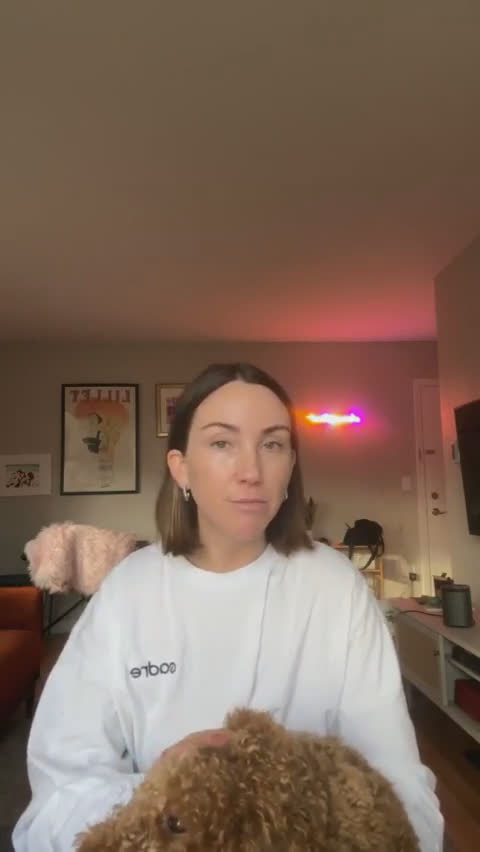
Do you often say yes to too many things? Find yourself canceling or rescheduling calls or plans because you’re too tired, stressed, or running behind? Do you burnout frequently to the point of not finishing what you start? Same! In this livestream let’s talk about how to set better boundaries, provide ourselves ample self-care so we can follow through on our plans, goals, and priorities.
Rachel Havocost is a writer and mental health advocate. She also has a one year old mini golden doodle named Milo who likes to make a ruckus sometimes. Today she talks to you about boundaries and burnout.
There's a huge overlap with mental health and burnout. Oftentimes that comes from an immense need to people please. And so I've had to really learn how to set healthy boundaries. This will help you set up goals that are reasonable and achievable.
Three different tools I use to help avoid burnout. Personal boundaries are boundaries that we don't necessarily communicate with other people. Giving myself 24 hours to make a decision oftentimes allows me to either say yes or no.
Sometimes we take social things off our plate because those don't feel necessary. It's really important to maintain those social engagements because it's really good for our mental health. Boundaries are bridges that help us to either let people in or say, "Right now, I'm not accepting invitations"
Happy Wednesday, Cadre fam. I am very happy to be here today. I hope that today you were notified that I'm going live. I know last week there was a tech snafu, so I went live last week and talked about smart goals. If you missed it, it is recorded and up on my profile. Milo. Milo loves to make noise only when I'm on video calls or going live. So today I am going to talk to you about boundaries and burnout. If you're new here. Hi, I'm Rachel Havocost. I'm a writer and mental health advocate. I've been in therapy for 19 years for my own mental health.
I also have a master's in psychology. My mission is to help people feel less alone, as well as share tips and tools of what has helped me along my journey. I also have a one year old mini golden doodle named Milo who likes to make a ruckus sometimes, which he is doing right now. Give me 1 second. I'm just gonna. Hey, Rachel. Okay, it's working. Also, I love that you cut your hair. Part of the short hair crew. I'm just gonna move Milo so that he's not making noise. Milo, come here, bubba. Come here.
Why don't you come say hi to everyone at Cadre? Hey, munchkin. All right, Milo's gonna help me with my live today. So today I'm gonna talk about burnout and boundaries, because oftentimes there's a huge overlap with mental health and burnout, and that overlap is usually a lack of boundaries. Oftentimes that comes from an immense need to people please. Fear of rejection, not believing that our needs are important, or putting other people's needs first, which can occur for a variety of reasons. And I'm not going to go into that today.
We're just going to kind of talk about how to navigate, how to navigate life so that we have better boundaries and prevent burnout. So I used to, historically, both in my social life and my career life, say yes to everything. And that came from a lot of sources. One was I was afraid of missing out socially. I was afraid of missing out on experiences with my friends. I was also terrified of hurting people's feelings by saying no, and thought that if I said no, that would make me a bad friend. High speak, wonder.
And then in work, I would say yes to everything for similar reasons, but more for the reason of feeling like I didn't have the choice. I didn't feel like I was allowed to say no. And I also felt like if I wanted to be seen as a good employee, I would have to say yes to everything. If I wanted opportunities to move forward, I would have to say yes to everything. And so I very, very frequently I did this in school also. Like, I would put myself on the list to be on every honors roll, try and apply for every scholarship, try and get to the top of my class, try and do every extracurricular thing to be, like, the best student I possibly could.
And let me tell you, I burned out over and over and over and over again. And so I've had to really learn how to set healthy boundaries so that I'm still moving towards my goals and feeling accomplished without burning out. Because a lot of times when I burn out, and I don't know if this is the same for you, when I burn out, I feel a lot of shame. When I burn out, I feel like, oh, I can't do anything. Oh, I can't do what I start, oh, I'm not capable or, you know, I'm never going to be able to do the things I want to do.
And the truth is, I just set the bar too high for myself and I was doing too many things, so of course I couldn't do those things. And that reinforced that belief. So to set myself up to start having beliefs of, no, I can finish what I start, I have to be kind to myself and actually put a load on my plate that's reasonable and doable. So this is just an also a gentle reminder to go back and watch my last live about smart goals, because this will help you kind of frame how to set up goals for yourself that, again, are reasonable and achievable so that you can actually accomplish things you want to.
So today I'm going to talk about three different tools I use, three different boundaries I set to help avoid burnout, both just in social life and in my work life and in school. So these are all personal boundaries. There are different kinds of boundaries. And if you want me to make any videos about the different kinds of boundaries, I'm happy to do that. Personal boundaries are boundaries that we don't necessarily communicate with other people. So they're kind of like self promises. They're things that we've said to ourselves, you know what?
This is a boundary of mine that I'm going to follow internally as a guide. So, you know, one of the things that I like to do is called the pause. And so what that means is anytime I'm asked to do something, whether that's go to a party, go out for dinner, host a workshop, add something to my plate at work, take care of a friend's dog, whatever it might be. When I'm asked to exert my energy and commit to something and participate something, I implement a pause where I give myself, if I can, 24 hours to make a decision.
So historically, I would be really impulsive and spontaneous and say, h*** yes, I'm in. You better believe I'm there, or absolutely, I can do that for you. And that was coming from a genuine place of wanting to do and participate in this thing. Most of the times, I'm not gonna say, h*** yeah unless 99% of me really wants to do something. And I got in such a habit of doing it that I didn't give myself the chance to actually pause and look at my calendar and see if I actually can attend this thing, to look at my schedule and see do I have time to prepare for whatever it is I'm being asked to do, to sit back and think with myself?
Is this something that aligns with me? Is this something that actually would fulfill me and reward me? Giving myself 24 hours to make a decision oftentimes allows me to a either say yes, but from a place of, and this is what I'm able to give instead of giving my all or determine, you know what? I actually don't have room on my. On my plate for this right now. And so, unfortunately, I have to say no. And it also allows me some time to figure out how I'm going to communicate that. Right. So let's say it's someone who's invited me to come to a group dinner on Friday, and it's people I love, people I want to go spend time with.
I might respond and say, hey, let me look at my schedule. Thank you so much for the invite. I'll get back to you as soon as I can. When do you need to know by? Right. So I'm being kind, I'm being communicative. I'm making sure that they feel like I'm, you know, going to be timely with my response in case they need an RSVP. And then I might sit with myself or look at my schedule, and maybe I see, like, oh, my gosh, I have things every single night this week. I have a feeling by Friday I'm going to be exhausted and I'm not going to be able to give myself to this event or to this dinner.
And I might show up grumpy and tired, and that's not going to be good for me or anyone else. And then I can start to ask myself questions, like, if I don't go to this. Are there other opportunities? Will there be other times my friends are going to have dinner? Is this the only time that these people are in town and maybe my only chance to see them? So would it be a good time for me to maybe try and muster up the energy to go so I can start to have this self inquiry and check in with myself and figure out if it's something that I have the bandwidth to say yes to?
And then from there, I make that informed decision, and then I can communicate a yes or a no. And so that little pause gives us permission to check in and figure out, do I have bandwidth so that we can kind of prevent a state of burnout by saying yes to things immediately, immediately, immediately. My second tip to avoid burnout with a boundary is what I like to call the do not disturb. And so this can literally mean setting a time on your phone that's do not disturb. m. m. m. You can set your do not disturb to go at certain times during the day, whatever that might mean, and it's an actual thing you can do with your phone.
Or it can be more of a metaphorical I don't respond to texts between these hours. So in the same vein, I do this with work. So I've told myself I don't answer emails. m.. m.. PST. And I don't answer emails on the weekends. So I don't have a response on my email that says if it's between that time, I'm not responding. But this is a promise I've made with myself. This is a boundary I've set with myself to make sure that I am carving out time where I'm not responding to emails. m. That's about something coming up in the future, it feels really easy to just respond right away, right?
And this does two things. The first thing it does is it creates a precedent for the person who's emailed me that anytime they email me, I'm going to respond right away, which means they feel like they can email me whenever they want to and get a response. This also means that if I stop responding as quickly as I normally do, then they have this idea in their mind that I'm not as responsive as I once said I was. So by having a consistent schedule that I respond to things with and work, I'm creating this precedent that these are the hours I work, and you can communicate with me during those times.
m. But if I'm doing this every time I'm getting an email on the evening or on the weekends, I'm not really giving my brain a full, closed off break away from work. And we need time and distance from things in order to process, in order to recharge. If you think of it like a muscle at the gym, if I'm going in the gym and I'm doing bicep curls for an hour or whatever, I'm tearing that muscle, right? And then I leave the gym, and I need to give that muscle time to repair and get stronger. If I leave the gym and then an hour later, I go home and I do more bicep curls, but, like, I do three, and then an hour later, I do three more, and an hour later, I do three more, I'm not giving that muscle time to rest.
So we need to do the same with our mental capacities and our cognition and our brain. And so that means giving ourselves real ample time away from these things so that we don't burn out and that we get the rest and recharge we need. The last thing I will say is, sometimes we end up with too much on our plate before we can get to a point of, I've prevented that from happening, right? That might happen because we didn't take a pause or there was just more stuff at work going on, or everybody's in town at the same time, and it's the holidays, and we just happen to have more things on our plate.
Plate than we can really tolerate. And so, in this scenario, the way that I like to avoid burnout is by taking unnecessary things off my plate. So what this means is in these periods of times where maybe we have more on our plate, looking at what I'm supposed to be doing or what I have on my plate and going, what can I remove? Knowing that after this period of busy time, I'm going to put it back in, that won't negatively impact my life in a drastic way. So I like to think about, like, when I was in grad school for example, I had more on my plate.
I was working, I was taking care of Milo. I was taking care of myself, taking care of my social life, and I was taking classes and preparing for graduation. So I had more on my plate than normal, which meant in order to not burn out, I had to take something off my plate so that those energy levels were balanced. So I had to think about what can I take off my plate knowing that I'll put it back when grad school is done? That can keep me in balance and won't ruin, you know, or like, won't mess up my life, right?
So obviously I can't take work off my plate because I need to pay my bills, I need to pay for school. I can't take Milo off my plate because I love him and that would be really messed up. I can't take self care off my plate because I got to take care of myself. But there are some things that I do on a daily basis that maybe I can reduce or take off my plate, right? So that might mean maybe I'm not going to the gym as many times a week or for as long. My fitness will stay the same if I'm not working out for a certain amount of time in a month when I bring it back into play, if I don't go to trivia night one time, that's going to be okay, right?
If I don't go to this dinner one night, that's probably going to be okay. What else did I take off my plate? I'm trying to think about tasks, tasks, tasks. I seem to always have tasks. And when I have to think of my tasks, I can't think of them generally, just thinking about things that we think we maybe normally would do on a daily basis but are not necessary for our survival or for keeping up with that time. So oftentimes that does kind of dip into our social life because those don't feel like they're necessary.
So I just want to be mindful and say, try not to take everything social off your life. Don't take sleep off Rachel. Don't take sleep off your plate. Please don't take sleep off your plate. But sometimes we take social things off our plate because those don't feel necessary. And it's really important to maintain those social engagements because it's really good for our mental health and that's really helpful with our rest and recharge. So I hope this was helpful. Boundaries are really hard because oftentimes they're not really, it's not clear and they're not really taught to us very well, but I think that they're really important, and I think they're really different than the way a lot of people describe them.
I don't think of them as walls or ways to keep people out. I think more than anything, I like to think of boundaries. Like, you're a castle, and around a castle, there's a moat. And boundaries are bridges that help us to either let people in or say, you know what? Right now, I'm not accepting invitations. Or if you want to come in, this is the right bridge to take. So it's kind of like a way for us to protect ourselves and protect our fortress while also creating connections in our own way and in ways that feel good and healthy.
So I hope this was helpful. Let me know if you have questions in the comments and if you have any desires for future live streams. Also, look at how cute my Cadre gear is. I love this. I love this shirt. Okay, my dears, I am gonna go take care of myself and set my own lovely little boundary and say it's time for me to end this work day and go do some self care. So I'm so glad you came. It was so good to see you all, and I hope you have a great rest of your Wednesday.
Reactions and comments are for members. Joining is free and takes a minute.