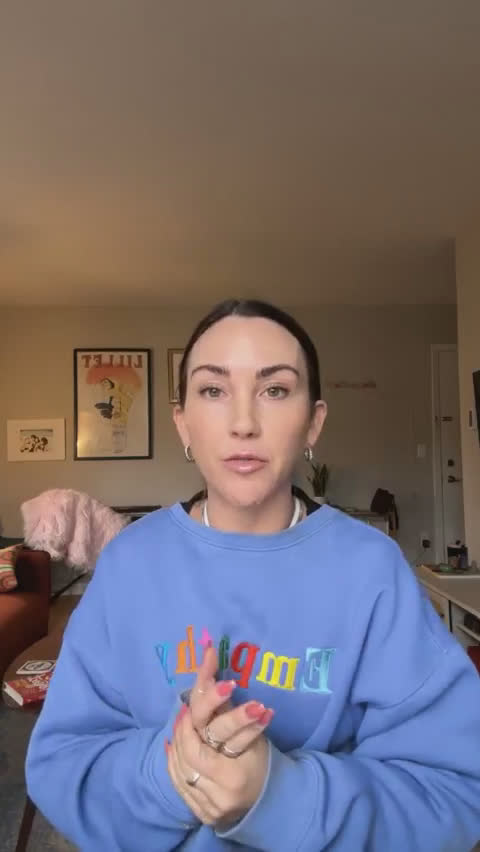
Rachel explores performance anxiety in public speaking and social settings, sharing three practical skills she uses—focusing on consistency over perfection, breaking preparation into small steps, and shifting attention to others in the room.
Normally, I go live at 03:00 p. m. Pacific Standard time. But my schedule is shifting, so I'm gonna start going live at this time. If you have me in your calendar every Wednesday for 03, now's a good time to update it to 02:00.
Today, Rachel will talk about performance anxiety in the context of presenting a speech, a workshop, teaching anywhere where there's public speaking involved. A lot of times, performance anxiety and social anxiety go hand in hand, and the skills can kind of overlap.
A lot of times, performance anxiety stems from perfectionism. Focus on consistency over perfection when it comes to planning for an event. Start focusing on the small building blocks to get there.
We have to overcome both overt and covert avoidance to make friends. By focusing on consistency, we can start with simply showing up places. My second tip with performance anxiety is to focus on the other people in the room.
Hello, Cadre. I am so happy to see you. This Wednesday, it is a. It's a good day. m. Pacific Standard time. , PST, but my schedule is shifting, so I'm gonna start going live at this time. m.. PST. So today I am going to be talking to you about performance anxiety, specifically in the context of presenting a speech, a workshop, teaching anywhere where there's public speaking involved, and also social situations where some social anxiety might. Might come up, because a lot of times, performance anxiety and social anxiety go hand in hand, and the skills can kind of overlap.
So I wanted to kind of touch on both. So, this is something that I'm presently working on both in therapy and personally, because I have several events this year that require me to speak in front of large groups, and that's something that terrifies the crap out of me. I really have a huge fear of public speaking, despite the fact that I have a history of theater. I get really, really anxious when it's me presenting work that I've created. So this is something that I am still working through and I'm not skilled in.
And these are some skills that my therapist has given me that actually a dear friend who is also creator on this app, his name is Garrett. I believe his username is g w e l l e. I wrote it down because I wanted to tell you guys. So, Garrett is actually a. He's a sports psychologist, but he works a lot with performance anxiety because athletes will sometimes struggle with performance anxiety before a game. And so I actually talked to him on the phone, and he gave me some good skills as well. So I'm going to kind of share three things that I'm working on that I also worked on when I did.
I did a talk with Cadre in November, and I used these skills prior to that talk, and they were really effective, so I'm going to use them again, and they also can apply in social scenarios. Let's dive in. Hi, Rachel. Good to see you. All right, so, first thing is focus on consistency over perfection. A lot of times, performance anxiety stems from perfectionism. We want to do things so well that we create these really high expectations for ourselves that are sometimes impossible. And this is something I talk about a lot.
If you've seen me go live. You've heard me talk about setting realistic goals. You've heard me talking about coping with burnout. And a lot of this can root down to perfectionism. So focusing on consistency over perfection when it comes to planning for an event or let's say you're teaching or providing a workshop or doing some kind of speech, focusing on making a plan leading up to the event for how you're going to prepare. So rather than focusing on the end goal, start focusing on the small building blocks to get there.
So, for example, that might mean, okay, if I have six weeks to prepare for something, I'm going to use week one to make a draft and brainstorm what I want to say. I'm going to use week two to write an outline of what I want to say. I'm going to use week three to solidify a draft. Week four, I'm going to know exactly what I'm going to say and I'm going to start practicing. And then weeks five and six, I'm just rehearsing, rehearsing, rehearsing. And that kind of breaks it down into more sound bites, which makes it a lot more digestible and easier to think about how you can accomplish something rather than focusing on the end goal that you want to be perfect, which can prevent us from beginning in the first place.
If this has to do with social scenarios, then the consistency piece comes in with just literally showing up. So I just wrote on my substack and my blog, I wrote an article about how to make friends as an adult because this is something that, as someone who's been divorced, I've had to move through and have struggled with. And it's just a lot more difficult to make friends as an adult than it is when we're kids. We just don't have those inherent extracurricular activities or classroom settings. Anyways, I wrote this article, and one thing I found when I was doing research on what psychology scientists and researchers say about making friends is there's this concept of over avoidance and covert avoidance.
So I'm just going to read to you something that I found from this article because it really struck me. And it says overt avoidance means failing to show up at events and clubs, and covert avoidance means failing to engage with people when you get there. We have to overcome both overt and covert avoidance to make friends. It's not enough just to place yourself in the vicinity of others if you're not willing to introduce yourself. So first of all, I just want to validate how hard it is. Number one, sometimes to just get to a place where you might socialize.
Sometimes that's step one. Sometimes step one is just battling over avoidance and getting to the place, right. And so consistently just showing up places. Even if we were there, we're not interacting, getting over the hump of just being there. And that being step one in terms of the consistency over perfection. Right. A perfectionist idea of social overcoming social anxiety is I walk into a room full of strangers and they all want to talk to me, and suddenly I have best friends, which is not really how it works, right?
So by focusing on consistency, we can start with simply showing up places. And then once we've consistently been doing that, then we start practicing, consistently engaging with people when we are there. And again, not perfectly and without expectation of something perfect happening, but with the hope that by doing it consistently, we get more comfortable with it and possibly build a connection. So my second tip with performance anxiety is to focus on the other people in the room or the other person that you're interacting with.
So this is also a tip that Garrett gave me, and it was a really good reminder because it's something that I, in the past, have been able to focus on and have kind of forgotten about. So it was a really good refresher for me, which is essentially, let's say you're doing a public talk or you're hosting a workshop or you're teaching, and you want to think about the people in the room. You want to think about the people you're speaking to, thinking about, what is it that you hope that they get out of the talk?
What do you think that they might be experiencing, and how can you be mindful of that? So rather than focusing on yourself and how well you're doing, focusing on the people in the room that you're speaking to and asking yourself, what do they need and how are they doing and what do I want them to walk away with? Similarly, in social scenarios, rather than focusing on yourself at a party or an event or whatever, and, like, how do I look? What do people think about me? What am I saying? Am I asking the right questions?
Focusing on the people around you, focusing on the person right in front of you and saying, like, noticing what they're wearing, noticing, you know, what their facial expression is, like, getting genuinely curious about the person in front of you rather than focusing on yourself. And so by doing this, we. We kind of get out of our own way a little bit and also remember why we're actually there in the first place. So, um. Okay, wait. Hey. Rachel says, I've been sitting here for 3 hours trying to get myself up so I can get a d*** oil change, girl.
I get that doing normal mundane tasks like our, like, responsibility tasks can be so difficult. I do this with things like car maintenance for one. Like I. On my, my desk, I have my new tab registration that I'm supposed to have sent out a while ago, and I'm. It'll literally take me five minutes to do and I'm just avoiding it. So, like, I get that, like, task avoidance a lot. Okay, third. My third tip for performance anxiety is rehearsal, rehearsal, rehearsal. So again, whether this is for a social scenario or for like a performance or a presentation, practicing.
And not just in your head, but out loud. So if it's a speech or a talk, practicing out loud in front of a friend, if it's something, a class you're teaching, doing a practice class and recording yourself on Zoom. I hate doing this. It's no fun. It's my least favorite thing to do, and it's really helpful to actually do these things out loud. Also, rehearsing for social scenarios, so literally, like looking in the mirror and asking yourself a question you might ask a stranger. Having. Having like fake conversations with yourself that you might have in social scenarios, practicing walking into a room and what you might do, or visually practicing what it might be like to go into a social space.
So, you know, practicing kind of is a, is a larian psychology skill. There's a skill called acting as if. Where you start to act as if you were already an expert in what you want to be an expert in, or acting as if you already believe the things you already believe. So this act of pretending and practicing and rehearsing can trick our brain into believing that it's already real. So sometimes practicing social things on our own can give us, can give our brains this sort of idea that, oh, I'm already skilled at this, so practice is a really effective thing.
So those are my tips for performance anxiety. If you thought that those were helpful, then I definitely suggest that you go follow Garrett again. His username is g w e l l e. I can tag it in the comments. His page is about sports psychology, but honestly, a lot of what he talks about is really helpful just in the social world when it comes to goal accomplishment, task accomplishment. So highly recommend going and checking him out. And I'm excited to see you all next week. Again, if you have suggestions ideas for live streams, I'm always happy to hear them.
So just give me a shout in the comments for what you hope to hear I also have new videos on my profile. These are my sort of tips for creatives in 2024. So to me, a creative is anyone who identifies as an artist, someone who has a lot of ideas, someone who is an entrepreneur or has leadership in their bones or in their life. So this doesn't necessarily mean that you're a content creator. It means that you are someone who has a creative bone in some aspect in your life or in your work or in your play.
And these are some tips I have based on my experience in the last four years as a writer online and my experience as an actress in my life before this. And sort of what I see in 2024 has been really important for us as creative people. m.. PST. From here on out. Big hugs, Cadre.
Reactions and comments are for members. Joining is free and takes a minute.