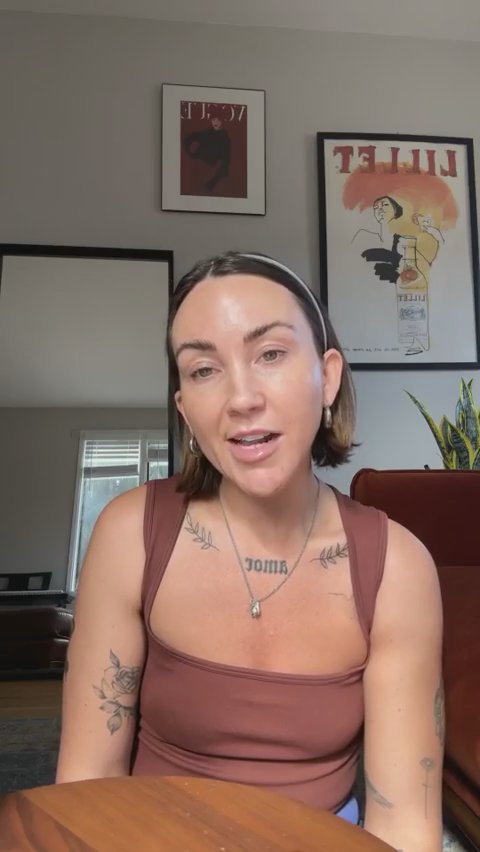
How I’m practicing self-discipline from a compassionate place, rather than a punitive one.
I'm obsessed with this water bottle. It's by a company called vulnerability is cool. And ya girl has dropped it four times. But I am still obsessed with it and hydrating like a queen.
Rachel: I am a writer, a mental health advocate. I've been in therapy for about 19 years for my own mental health. Everything I do online is in hopes of helping one person feel less alone. Today the topic is compassionate discipline.
Milo was diagnosed with an eating disorder when he was 15. He learned to unlearn the idea that he needed to control everything. He reframed self discipline from a place of loving myself and caring about myself. Here's how to reframe self discipline.
Happy Wednesday, my lovely little petunias. Hi, Milo. Say hello. I'm gonna wait just a few minutes to see if folks pop in. I'm a little early, but if you're watching on the replay, here's a funny fact. I'm obsessed with this water bottle. It's by a company called vulnerability is cool, and it has all these cute little, like, reminders like, that are mental health related. And ya girl has dropped it four times. Hence, broken lid, broken lid, broken handle. But I am still obsessed with it and hydrating like a queen.
Your reminder to hydrate. Hi, Steph. Happy to see you. Okay, it's noon, so we'll officially begin if you're new here. Hi, welcome. Hi, Jules. My name is Rachel. I am a writer, a mental health advocate. I've been in therapy for about 19 years for my own mental health. I also have a master's in psychology, and everything I do online is in hopes of helping one person feel less alone. So when I go live on Wednesdays, I like to talk about things that I'm struggling with, things I'm working on in therapy, or things that are just kind of generally at the forefront of my well being.
So today the topic is compassionate discipline, which I'll kind of explain what that means in a minute, but first, I'm kind of explain why this is the topic. So I was diagnosed with an eating disorder when I was 15. I'm 35 now, and I've been in treatment twice. And one of the things that I had to really, really unlearn was the idea that I needed to control everything, and the idea that I needed to have rules around everything and having really heavy restriction, not just in my. In my. In my food and body, but in my life.
And so creating flexibility was a really, really big part of recovery. And removing rigidity and rules was really, really important for me. And not just in my food, but in my mindset and the way I thought about things, because I also thought about things in a very black and white way, either or. And it was very hard for me to see gray in middle ground and be flexible. So that was a really important and pivotal part of my recovery, and it's been a really wonderful mindset shift in general in my well being.
So. So what I've noticed now, though, is that high art cures the soul. I agree. What I found now is that when I want to accomplish something in my life, when I have a goal or there's something in my life that I want to do that is oriented towards my well being, that requires some level of discipline. I really, really struggle. I really struggle to implement self discipline because I've worked so hard to get to a place where I'm not incredibly regimented. And so this is something that I've worked with my therapist on many, many, many times.
And what we've come back to is this concept called compassionate discipline, which is essentially taking this idea of discipline and removing the punishment from it. So removing discipline from this framework that it's a way for us to punish ourselves. So I constantly, in the past, use discipline as a way to punish myself. So if I didn't like the way I looked, if I didn't like how I was performing in life, if I felt rejected, if I felt insecure, these were negative thoughts or feelings I had about myself in my life.
And as a way to punish myself for feeling negatively, I would do all these things to try and make things better. And this was coming at a backwards sort of framework in which I was coming at it from a place of not loving myself. So I had to reframe this hi, Ethan. Into a space where I was coming at my discipline from a place of loving myself and caring about myself. And if I was someone who loved myself, what would I do to accomplish the things I want to do? And not only what would I do, but how would I do it right?
So this also forces me to think about, what am I trying to be disciplined about? And is it actually oriented towards my health? Is it actually oriented towards something that is loving and kind to me, or is it oriented towards me trying to change who I am? Because there's something I don't like about myself? Also, if you haven't met Milo, here's a little snuggle bit of love. Milo. Say hello to everybody. Say hello to our Cadre fam. Hello. So what does this look like? Right. So, one thing, a visual that has helped me a lot that I really, really love, is this idea of wrap.
Oh, sorry. I'm preheating my oven for lunch. I'm making sweet potato fries. Fun fact about me, I love anything that, like, no potato can do wrong. This is totally an aside, but no potato can do wrong. Presented to me in any shape, form, whatever. I will eat that. I will eat the potato. I'm a humongous lover of french fries. So, okay, that was an aside. So the visual I like to think about when it comes to reframing self discipline is. Hi. Speak wonder. Hi, Luke. Is thinking about self leadership.
So rather than being someone that was disciplining myself or disciplining others. What if I was leading myself or leading others? Right? So if I think about discipline in the framework of leadership, suddenly the tone shifts, right? Because if I think about it in the terms of someone else, like, if I'm trying to help a group of people accomplish a goal and I approach them from a state of, or a space of disciplining them until they accomplish that goal, that feels punitive, that feels cruel, that feels harsh, that doesn't feel loving or kind, that doesn't feel trusting or supportive, it feels incredibly harsh and authoritarian.
But if I come at it from a space of, I want to lead these people who are working towards a goal that feels compassionate, empathetic, understanding, motivating, and coming from a place of love and care and consideration. So how can I turn that back towards myself? Right? So instead of thinking about it as self discipline, how do I think of it as self leadership? And as soon as I started to think about it that way, I started to really expand my way of understanding how I approach setting goals, how I approach accomplishing tasks that require some level of self management.
And I started to be able to sort of visualize a pathway towards whatever I was working on from that space of self leadership rather than self discipline. And this also creates sort of an umbrella for being much more compassionate. So compassionate discipline is sort of like an umbrella term, but I think self leadership feels to me like a way that I can start to understand how I can bring myself towards the goals I want to and being, quote unquote disciplined without disciplining myself, without being punitive.
So that's my little tip for today on what I'm working on. It's still really difficult for me. You know, I really struggle a lot with my internal dialogue around. Well, I know I said I was going to stick to this, but, like, I deserve x, y, and z, and so I'm going to just do x, y, and z. And so there also is a lot of inner dialogue that happens. And I think it's really important that we start to develop, you know, we can develop these parts of ourselves that we draw on in those times of resistance or fatigue when it's harder for us to stick with some things that we've set for ourselves.
And having, you know, like an inner wise leader that I refer to and talk to in my head or journal through with, and being able to sort of externalize these parts of self and let them have conversations with each other, that can also be a way to kind of move through those moments of challenge when it comes to can I accomplish this thing or can I follow through with what I've set for myself? So that's something I'm working on right now. I would love to know what you're working on. And as always, if you have questions or if there are certain things you'd like me to talk about, I would absolutely love to share them with you.
Just leave it in the comments. This will be recorded on my profile as always, and I will be here again same time next week, noon PST in Rachel's room, talking about whatever it is that I'm working on with you, sending you all a big hug this Wednesday and I will talk to you soon. Milo says goodbye too Milo say goodbye. That.
Reactions and comments are for members. Joining is free and takes a minute.