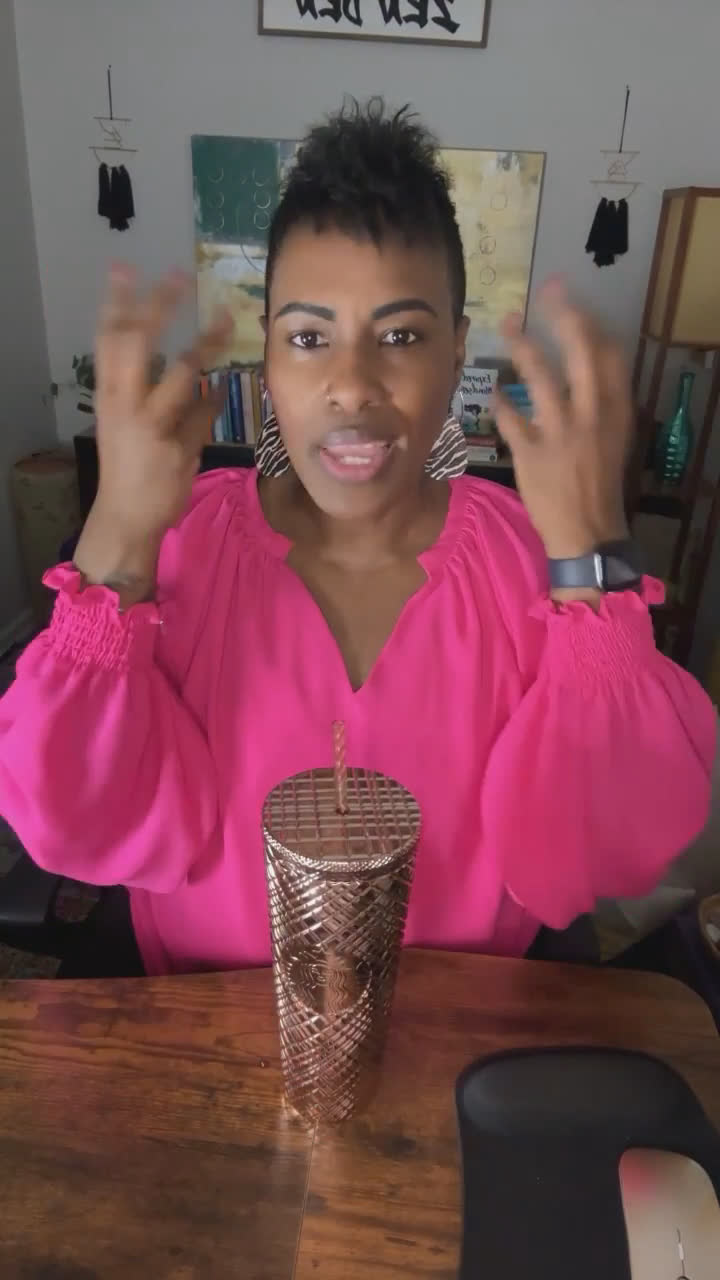
As an elite athlete your mental health affects your athletic performance, recovery, relationships and overall well-being. Are you a young human training be a great athlete, or an athlete trying not to be human? Join Dr.Charryse and let’s change the narrative around mental fitness for athletes.
Kydra Sphere has some happy juice this morning. Non alcoholic, just full of good vitamins and all the things. Grab your beverage of choice.
Doctor Charryse Johnson is a licensed clinical mental health counselor, mindfulness practitioner, and author. For those who joined her on Friday, and I want you to always share a win. As you come in, take a moment and do those.
This week's episode focuses on what is overthinking? What does it look like? How do I stop? Make today application, application, applications.
Overthinking is a bad mental habit. It is not something that you are destined to do for the rest of your life. The only way to break that habit is by doing other things and strengthening other muscles. Here are some ways that you can change the channel and switch up your activity.
Change a habit is about everything that occurs, your daily habits. 99% of what people are ruminating about is in their head. Only 1% of the harm is actually happening in reality. Ignore the thoughts that are attempting to keep you from moving forward with an opportunity. Acceptance is one of the most overlooked skills.
Take a moment and look up common cognitive distortions. Do this daily with at least one of the automatic thoughts that have been overwhelming you. Then cognitive reframe. So I'm resetting the way that my mind is wired.
All right, we said we would end with kind of a quote of the day. It is going to be hard, but hard does not mean impossible. Share this we want you to continue to share the goodness that is found here on Cadre. I will see most of you on Friday.
What's up, Kydra Sphere? It is Wednesday, and that means that you and I get to hang out. So come on in. Grab your beverage of choice. I have some happy juice this morning. That's funny. That didn't sound good, did it? Non alcoholic, just full of good vitamins and all the things. Two things as you enter, doing what we do. One, where are you today? As you can see, those of you who see me on a regular basis, I am back home in Charlotte, North Carolina. Thank you for your patience as I was traveling at the end of last week.
For those who joined me on Friday, and I want you to always share a win. Have this quote. Oh, I love this. In this little jar that I was given and I think I'm going to save it for. For the end. So I'll just shake it up real good, but let me know. Got your cinnamon tea ready here in Charleston. What's up? Upstate South Carolina as well. Hello. Hello. Give everyone just a moment to come in. Hello, South Jersey. Why do I always feel like. Because I feel like Jersey just has a little, uh. So whenever I say south Jersey, I feel like I need to come up with a little something for each one.
Love seeing your wins. As you come in. Please take a moment and do those. It's so important for the health of your brain to be able to recall what's going well. And it's also great for the people who come in after you and replay to be inundated with. Wow, look at what we're doing together in community. Hello, northern Minnesota as well. I love it. Becky. My wind has been staying in my lane. That's a good win and not always easy. If this is your first time here, I'm Doctor Charryse Johnson, licensed clinical mental health counselor, mindfulness practitioner, and author.
But most importantly, I am here and a part of this cardiosphere with you. And we are friends to the degree that you want to be. I would say that we're BFF's. I won't force that on you, but for those who are open, you know, it's what we do. So we're talking today about part two of overthinking. So last week was centered around what is overthinking? What does it look like? Oh, I didn't realize that was overthinking because I do that too. And as promised, I wanted to come back and make today application, application, application.
I'll still give you a little bit of information, but this is where you find the tools and the skills. If you've said to yourself. Yes, I am an overthinker. It is part of what I do. But how do I stop? I will review one simple thing. Whoa. m. And you're showered and dressed. I'm impressed. I mean, like, y'all think I'm really dressed. I can't tell you all my secrets when I'm stressed as you think. I'll just say that I will review just for continuity. What's up, Detroit? Yes. So, ready for draft day?
All right, let me focus, y'all. I'm so hyper. I get so excited when I know we get to have time together. I really do. Let me bring it down. Seven facts about overthinkers that I shared at the end of the last live that I will use to bridge us for today. Number one, overthinkers love to overemphasize and dwell on past mistakes. Number two, they're experts at finding hidden meaning, which can be a strength and a struggle because you're looking for something that isn't always there. But if you look hard enough, you'll also find it.
Number three, they're deeply empathetic. Number four, they're the king and queen of what if. What if this happens? What if that happens? What if? What if, what if? Number five, they have a PhD in analyzing past conversation. So are you that person that you have a conversation, and then after the conversation, you're having a conversation again in your head, and you're replaying every single thing that everybody said, trying to analyze it and look for the deeper meaning. We will set you free. Number six, they often experience analysis overload so you can get stuck in that rumination that comes up at in opportune times and feels like it will never go away.
And number seven, they're experts at predicting worst case scenarios. So that's an issue. Here's the bottom line. And when it comes to overthinking, I'm going to take a sip first. My. My throat is parched. Overthinking is a bad mental habit. Bottom line, it is a habit. It is not something that you are destined to do for the rest of your life, and it has control over you, and there's nothing you can do about it. Wrong. It is a choice. It is a habit. It is a pattern that has been created and developed and has way too much muscle.
And the only way to get through it is for you to break that habit by doing other things and strengthening other muscles to help engage the positive habits over the negative habit of overthinking. Yes, I'm in here breaking toes immediately. For those that are not familiar with that statement, I need to consciously remember that everyone on here doesn't know me. I'm not literally breaking your toes. It's just a very simple, playful figure of speech that we sometimes say when I may say something that kind of hits hard.
So if you're sitting back in confusion going, break my toes. Wait, I thought we were talking about overthinking. You'll catch on as time goes on. But here's something I want you to consider. m. Tiffany Norton like a nine minute live on the difference between willpower and willingness. Now you can take that and go anywhere, like I say those words, and it makes me want to go into a whole thing that I'm not going to. But I do want you to start off by asking this question. Becky, you're good. You didn't scare anybody.
I'm just trying to make sure everybody stays in the loop. I want you to ask yourself, am I willing to break the habit overthinking? It's not about willpower. Oh, I don't, I don't. I try so hard. Are you willing to exercise another muscle? And so let me get into what muscles do you exercise? Muscles being symbolic and what do you do? So the first thing that you want to consider when we look at how to work through overthinking and to create a new pathway in order to change the channel in your brain, you have to change your activity.
Remember habits, wire the fire, the firing off of your synapses in your brain that direct your action. Once you notice yourself in the middle of that overthinking moment or after you're overthinking and you recognize it, at whatever point you recognize it, you have to change the channel by changing your activity so that you get out of your head. What are some ways that you can change the channel and switch up your activity? I'm going to name a few. You can put a few in the chat. You want to do things like call a friend, get into conversation with someone, move your body if you haven't exercised yet or if you're willing to do a little bit more exercise if you want to put on music and dance, if you can get into doing another task.
So a lot of times you're going to see do something different or people will use the concept of distraction as a term for kind of interrupting overthinking the reason why I don't want to use that specific word is one distraction gets a hang up. And I don't want you to distract with fruitless things. I want you to specifically know I am intentionally doing something different because I want to get out of my head and back into my body. That's the whole dynamic. When you're overthinking, you're back in that limbic area of your brain, that lizard brain, that oldest paleolithic part of your brain.
Your limbic system is firing off and it's in the side of threat and fear. So when that happens, you're not accessing your prefrontal cortex. So we need you to get get back in your body. So you need to do something to reengage with all of your senses. So that's why I said movement, music. Do another task. Talk to someone. It's very difficult to be engaged in great conversation. Yes, get lost in a great book, one that you specifically know. Whenever you read it, it really grabs your attention. And here's the other reason that I didn't use distraction, because what I don't want you to do is I don't want you to pick up your phone and start doom scrolling as a means of distracting yourself from your thoughts.
Because what you will find in a scenario like that is you'll take one kind of channel of negative habits and that same activation is there. Then you'll go and pick up your phone or get on social media, unfortunately, depending upon the kind of social media that you're getting on, and then you're going to start looking at things that are rooted in comparison or your insecurities or judging other people. So you have to be cautious about knowing what can you do to change the channel in your brain? That's a question I want you to ask yourself.
What activities help me change the brain and change the channel in my brain without adding to the negative thoughts and feelings that I already have. That's the caveat. And distractions can sometimes be fruitless. All right. 123455 other things that can be helpful when it comes to working on this on a daily basis. Raise your right hand with me. If this fits for you. I want you to say, yes, it is me. I am the overthinker that you are talking about and I acknowledge that I have to work every day to change this mental habit.
Okay, I want you to understand this isn't just about the moment. Changing a habit is about everything that occurs, your daily habits, before you get to the moment where overthinking is attempting to overtake you. So as much as you love this moment with me, hour 15 to 20 minutes a couple of times a week is not going to solve your overthinking, but you taking three to five minutes every day or multiple times throughout the day to work on this habit. Being willing to work on this habitat will disrupt the pattern and create new pathways, other dynamics, tools that can be helpful.
Things I want you to keep in mind. One, the problem is rarely the problem when we look at research around the overthinking and the rumination that occurs in individuals. Research a meta analysis, which means we look at longitudinal research over time in different people, in different areas. And here's one major key theme. The problem is rarely the problem. 99% of what people are ruminating about is in their head. Only 1% of the harm is actually happening in reality. Like, I want you to think about that.
So how do you make that tangible? The next time you're overthinking about something, I want you just to kind of split up the percentage and go, well, how much of this is in my head and a fear that I am really creating and trying to work through and what percentage of this is actually happening right now in this moment and impacting me nonstop? And you might be surprised. Number two, avoid self rejection. This is a big one when you're overthinking a choice, a decision, an opportunity, what someone says avoid self rejection, this is what self rejection sounds like.
Well, I don't know if I really deserve this opportunity to do x, Y and z. Well, they're probably never going to choose me anyway, so I probably won't get it. So I wonder if it's even worth putting in for. Well, people always disappoint me and overlook me, so there's an element of overthinking that also is catastrophizing, that is making assumptions that is already going into a situation, believing it's not going to work out for you. That's called self rejection. And it is an element of overthinking because all of your insecurities and all of your fears, I know some of you are like dang it, are coming up in the moment.
And so then you start trying to calculate what you can do to get around that. Should I do it? Should I not do it? I need to think about it. Do it anyway. So a really great way to challenge overthinking is to ignore the thoughts that are attempting to keep you from moving forward with an opportunity. Do it anyway. Well, what if I don't make it. I really want to go and do this. I have this coming up. I'm probably not going to. Whoa, whoa, whoa, whoa. You don't know what you're going to do until you do it.
So pause that part of your brain and move forward anyway. Number three, the power of now. You cannot overthink your way to a better future. I'm going to take a sip on that. You might want to write that down. I cannot overthink my way to a better future. I don't believe with all my heart that there's anybody on here that has said overthinking has been the most helpful part of mapping out my future. It has been the greatest way to ensure that everything goes exactly how I want it to. No, overthinking has been the part that has made your future scary and uncertain and overwhelming.
No, you also can't overthink and change your past. All you have is right now, in this moment. And that's where practices such as prayer, meditation, sitting and stillness and learning to quiet the mind are beneficial tools of you retraining how your brain handles stress or potentially stressful opportunities. Four, fact check your own thoughts. Here's your assumption that you have. What evidence? Can you prove it in the court of law? Or is it based on your own theories, fears, concerns, and assumptions that you're making about other people?
And five, acceptance is peace. Acceptance is one of the most overlooked and underutilized skills, along with gratitude, learning what it truly means to embody acceptance, which we're going to talk about next week, so I won't get into it now, but when we can accept things are what they are, and here's how I can work through them instead of why they're happening. I didn't have that on my list, but you know, I'm always giving you a bonus, so I'm gonna add it. Part of overthinking is that you're trying to answer why instead of how?
Why does this always happen to me? Why does this person treat me this way? Why can't they hold to what they say? Why did this happen to my family member? Why can't my child do XYZ? Why don't people? You can't answer those questions, but you can answer, how did that make me feel? And how do I want to respond? How can I create a boundary that manages my disappointment with this person? How can I make choices so that I don't end up in this situation again, notice the shift. Why? There's multiple millions of reasons why, but how takes back your power, how is your opportunity to go?
Here's what I can do to create yes, Becky. A workable solution that I get to choose an acceptance, although not the best feeling all the time as you work through it, is so powerful. So I'm going to end you with this simple way to work through tangibly application. You want to make three columns. You can do this again on a piece of paper. You can do it in the back of the mindset matters journal however you want to. The first column says automatic thought because those are the things that overthinking brings up to the surface.
Second column, cognitive distortion. Take a moment and look up common cognitive distortions. You'll realize that you know a lot of them, catastrophizing all or nothing thinking, I can't remember any more of them off the top of my head. I said a few of them earlier, but those two are probably the most common. And you would write down what cognitive distortion do I see myself experiencing in this moment? Making assumptions would be another one. And then cognitive reframe. So you take the automatic thought, recognize that it's coming through a lens of multiple distortions.
You'll have more than one distortion per thought. Let's say, for example, my automatic thought is, I'm not going to be able to finish this race. The cognitive distortion is making assumptions, catastrophizing, thinking the worst. So then a cognitive refrain could be, if I train well and consistently, there's no reason I can't cross the finish line. So I started off with I'm not going to be able to, and I'm worried. Here's all the cognitive distortions. And I ended with a reframe that says if I do what I'm supposed to do on a consistent basis, barring a major injury, there's no reason I can't cross that finish line.
So I'm resetting the way that my mind is wired and I'm changing the direction of that thought. Thought. Do this daily with at least one of the automatic thoughts that have been overwhelming you and coming up at the wrong time. All right, we said we would end with kind of a quote of the day. This says, ha ha ha. It is going to be hard, but hard does not mean impossible. That's a really great message to take with you. It is going to be hard, but hard does not mean impossible. As always, I'm so glad that you chose to come and be here.
Replay this as needed as necessary. Share this we want you to continue to share the goodness that is found here on Cadre and come back throughout the rest of the day because there will be different individuals centering their conversations around mental well being because that is the focus of today. I hope you have a wonderful and incredible day, and I will see most of you on Friday. Bye.
Reactions and comments are for members. Joining is free and takes a minute.