Does your mind run relentlessly with counterproductive thoughts during a performance? I introduce the ATC Model and how to proactively use deliberate thoughts to feel and react to performances how you want to.
Some of the greatest professional athletes of all time struggle with performance anxiety. Do you get nervous when presented at work? Do you have a little self doubt when you're trying to be a leader? We're going to talk about how we can improve that using our self talk.
There's an average of about 40 to 60,000 thoughts per day, as estimated for the average human. These thoughts influence our emotions and our reactions to events. We can use constructive self talk to help us feel more confident in times where we have to perform.
What if I told you that some of the greatest professional athletes of all time, some of the greatest motivational speakers of all time, some of the greatest professionals in any field, really probably struggle with a little bit of performance anxiety. Some of the greatest olympians, like Michael Phelps, Simone Biles, they struggle with performance anxiety, yet they learn strategies to overcome that. And I guarantee you, despite your struggles or experience with performance anxiety, the same transformation can be done for you.
Do you get nervous when presented at work? Do you have a little self doubt when you're trying to be a leader? Do you get a little self critical when you're golfing with friends? If any of those or other experiences resonate with you today we're going to talk about how we can improve that using our self talk. I don't know if you knew this or not, but we as humans, think a lot. There's an average of about 40 to 60,000 thoughts per day, as estimated for the average human. And because those thoughts influence our emotions and our reactions to events, it's a very critical element for us to focus on today.
And we can do this using a strategy known as constructive self talk. Self talk simply is regarding how you talk to yourself. What does that internal dialogue look like? And when I say constructive, I mean asking yourself, is what I'm saying to myself helpful or not? A lot of times when people think self talk in relation to performance psychology, they think, oh, it has to be all positive. It has to be all sunshine and rainbows. That's not what I'm saying. It doesn't have to be positive. But the main question is, is this helpful or not?
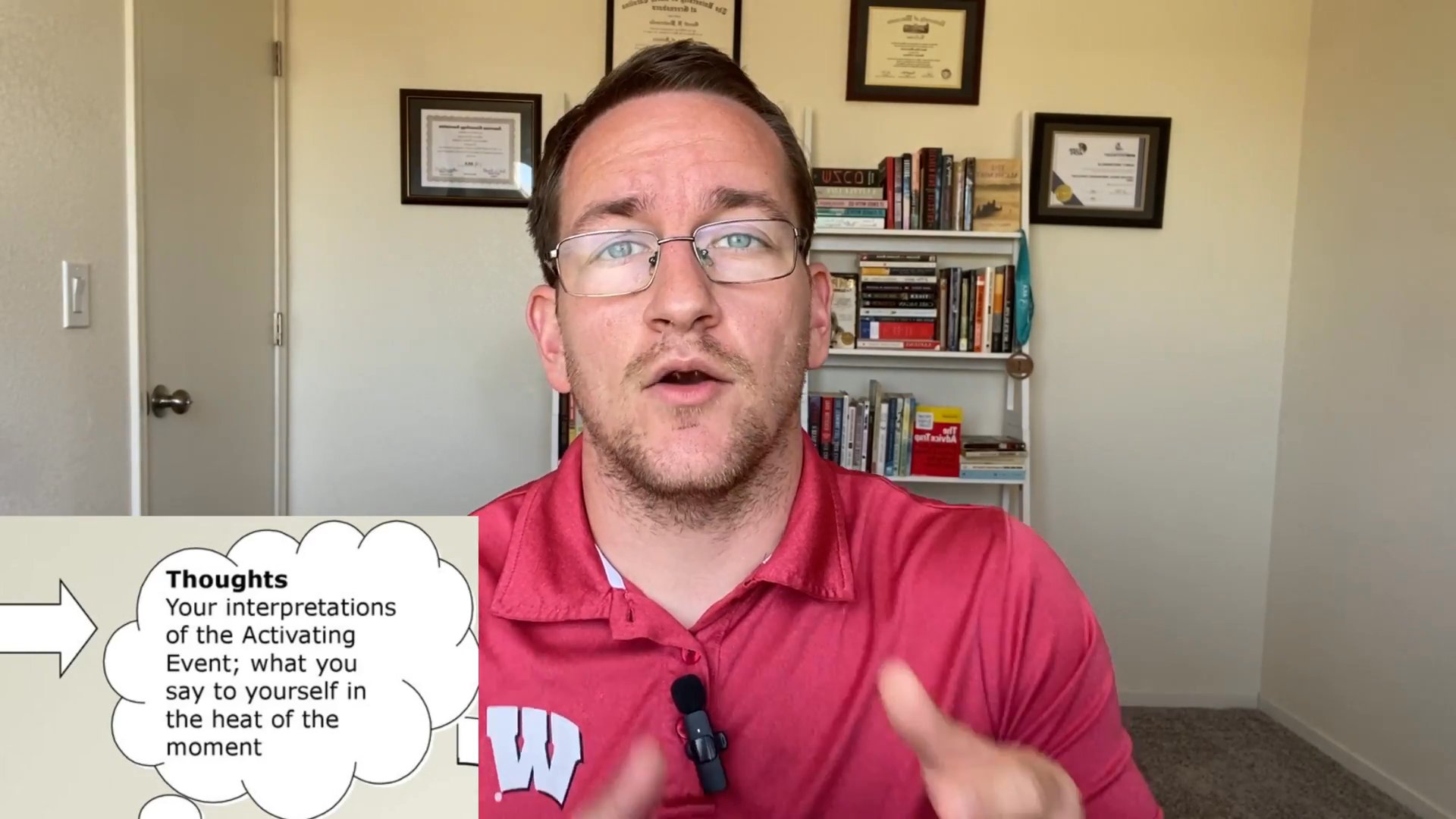
To help show how this works, there's a cool model known as the ATC model, and that can show how we can use constructive self talk, either retroactively or proactively, to help us feel more confident in times where we have to perform. Now, the first part of that is the a, and that stands for the activating event. This is the facts, the who, what, when and where of an event. And the key part here is that this event can trigger our thoughts. And these thoughts, the second part of that ATC, are our raw, in the moment interpretations of the event.
Now ask yourself, are your thoughts always accurate? No. But regardless of accuracy or not, they drive a third part of this ATC model, the consequences. By consequences, I mean, what are our emotions and our reactions to our thoughts? In other words, what do we feel and what do we do or don't do in response to those thoughts? This ATC model helps demonstrate why different people react to, to the same exact situation differently than others. Now, for example, I work with the military right now, and as you know, soldiers get deployed.
Now, a young single soldier who gets deployed might have the thought of, this is exciting. I get to do cool stuff. I get to work out and blow stuff up in a different country. And because of that, their reaction is excitement. Now, on the other hand, that same exact event of deployment for a soldier who's maybe recently married or recently had a child has a different thought process. Their thought process might be, I'm going to miss my spouse, I'm going to miss my child and time with that child. And their reaction, as you would expect, is maybe sadness, maybe a little bit of despair.
And their behavior or reaction to that is maybe they're isolated from their fellow soldiers. So the same exact activating event can be construed differently and reacted to differently based on the thoughts. Use another example in relation to performance anxiety, maybe someone has the activated event. The who, what, when, and where is that? They are presenting to a group of ten coworkers in a meeting at work, and their thought in reaction to that is they're judging me. What do you think their emotions are going to be?
My guess is maybe they're feeling a little bit of anxiety and their behavioral reaction is maybe acting a little bit more timid in that presentation. On the other hand, someone in that exact same situation, a presenter to ten coworkers in a meeting at work, has a thought of, I prepared well for this meeting and their reaction is feeling confident and their behaviors are speaking with conviction in that meeting. You can see why the same exact activated event was responded to differently because of the thoughts that followed that activated event.
And this overall model can be used to understand yourself a little bit more retroactively. Maybe you can look back on the activated event, the thoughts and the consequences of that scenario to understand why you felt and responded to something in the way that you did. And this model can be used proactively. What do you want to think, to feel and react the most productive way in the moment? In other words, figure out the end state that you want to be at. What do you want to feel and do in that moment, and what can you deliberately put into your thoughts to reach that state?
So let's see that model in action. For me, when I used to speak in front of groups and do large group presentations, maybe to a whole football team of, you know, 100 people, including the players and coaches, I just get a little nervous. But when I'm talking to a group of people, I want to feel in the moment and confident. So if I'm using that model proactively and I want to feel confident in the moment, I use the phrases, be where your feet are to be present, and this is your calling. This is what you want to do with your life.
And that helps me feel that confidence going into the moment. Another example for me might be when I'm golfing with friends. Now, most of my sports psychology knowledge honestly gets thrown out the window when I'm on a golf course. So I have to be super deliberate if I want to be loose and having fun. Out on the golf course, I use the phrases be smooth and let the results take care of themselves to elicit those emotions. These thoughts that we are deliberate about can be literal thoughts or expressions or statements or even images that you might have to kind of elicit those consequences, those, those emotions and those reactions that you wanna have.
You can be creative with it and make it personalized to whatever you know will work for you. So, in conclusion, you can use this ATC model to be proactive with how do you wanna show up? And what are the thoughts or images or expressions that will lead to how I wanna show up to lead to how I wanna feel and react to a given situation. You can use this model and these skills of constructive self talk to bring about greater self awareness and greater self regulation of regulating and controlling your thoughts and emotions and reactions to a given moment.
Reactions and comments are for members. Joining is free and takes a minute.