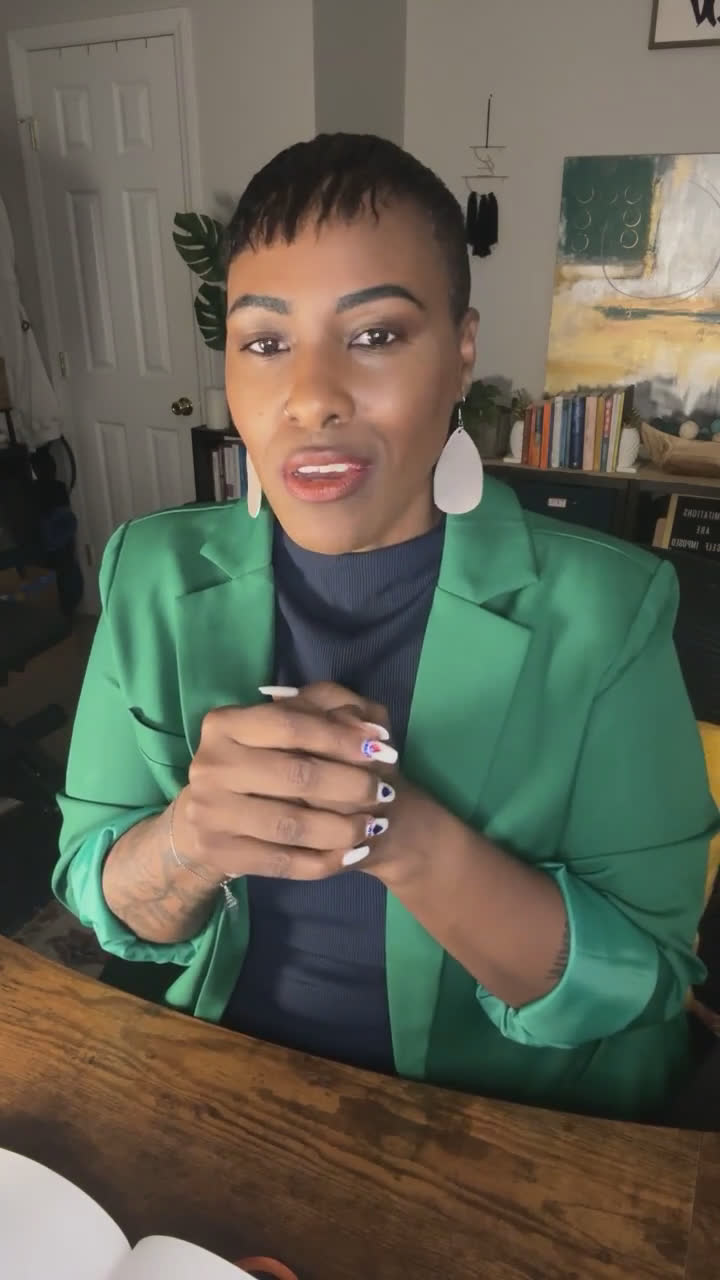
Dr.Charryse provides insight and guidance on how to consciously participate in living a life you don’t need to escape. These engaging and relatable lives emphasize growth mindset, mental health, and the power of choice.
Kaido sphere. What's up? It is another opportunity for us to connect. Come as you are and don't get used to this. Let me know where you are in the world.
If you had to rate your general mood right now, one means let's not talk about it. Where would you rate yourself? Rate your week. Your rating is always subjective to you. And I'm gonna rate myself a. seven.
Doctor Charisse Johnson is a licensed clinical mental health therapist, author, keynote speaker. Love being here with you to focus on how to create peace and harmony in your life. Anything that we want in life always requires our participation.
I want to talk today about guilt and the concept of saying no without feeling guilty. Some of you are bringing up another really great point. There can absolutely be a religious undertone. That is a dynamic that can intersect with our ability to say no.
For your own mental health, it's important for you to practice saying no while practicing managing the guilt. Here are a few things that you can kind of walk yourself through to help you in that process.
It's so important for you not to allow guilt to guide you. Where are you trying to use guilt as motivation? If you find that guilt is at the core of why you're eating a certain way, then you want to do some work around that.
I want you to realize that you are so capable of moving forward in the areas that matter to you most. Stop looking back. Every day is a new opportunity for you to experience joy. If you know somebody that's in need, bring them here to this space.
Kaido sphere. What's up? It is another opportunity for us to connect. Yes. I woke up like this. Just kidding. I have a super busy but exciting day and it was just in my best interest to go ahead and get going early. But, you know, in this space, in truth, come as you are and don't get used to this because at any given moment, I was looking for my lotion, but I think I moved it. At any given moment, I could also show up in this space with a hat and a hoodie and all clothing fits and I can't see you anyway, so you get to wear whatever you want.
Come in. Let me know where you are in the world. It is just my opportunity to see where we're all joining from, to realize the beautiful geographic community that we have created here. Let me know what's in your cup. I'm on my water kick right now. I need to do better about my water. I can get going in long strides and just struggle. I always give you an anchoring question. If you had to rate your general mood right now, one, meaning let's not talk about it. Ten meaning you feel on top of the world.
Where would you rate yourself? We haven't done that in a minute. Rate your week. Your rating is always subjective to you. And I'm gonna rate myself a. I would say a seven. And I'm okay with that. Coming off a little bit of some stomach issues. So I'm not. I'm not peaking at a ten, but I'll take a seven because yesterday was a two. Ooh, cinnamon tea sounds good. It would be good for my belly. I want to focus. Oh, let me introduce myself because there may actually be some people on here that don't know who I am.
For those of you who this is your first time on this live. I'm Doctor Charisse Johnson. I'm a licensed clinical mental health therapist, author, keynote speaker, but more importantly, I am here. Love being here with you to focus on how to create peace and harmony in your life if you're willing to do the work. Anything that we want in life in terms of acquiring our goals and making progress, always requires our participation. So there's a lot of hands on opportunities here, or I try to give you ways that you can apply things.
Well, I really like those ratings. Keep them coming. Some of you have been cheating on the anchoring questions and jumping right in with, you know, give me all the information. You'll get it. You'll get it. But it does help me to know, you know, the temperature your engagement is. How we virtually read the room. I want to talk today about guilt and the concept of saying no without feeling guilty. Now, about half of you, when I say that will go, that is not my problem. I don't have any problem saying no.
Stay with that thought because we'll get into that as well. That can be another side of the same coin. Guilt is emotion that we all feel. It comes up at various times in our lives. If you've grown up in situations or you're currently living in a dynamic, or even working in a dynamic where the people around you have trained you or conditioned you, that your yes is necessary in order for you to feel safe in that environment, then it does make saying no really challenging. Let's do a pulse check. I want you to take a moment and literally think of a scenario where you would need to say no to someone that you really care about and tell me, do you feel any physical sensations?
How well do you do with saying no when it's difficult? Some of you are bringing up another really great point. There can absolutely be a religious undertone. Those of you that are familiar. I am not anti religious in any way, shape, or form. I have a very strong faith. But I do think that that is a dynamic that can intersect with our ability to say no. If you've been taught that a good person is always available, if a good person is someone who is agreeable or someone has led you to believe that saying no is selfish.
So when you say no, what is that like for you? What is your ability to say no? Like? And here's how I got to this conversation. I was talking to a client recently, and we were talking about some family dynamics in her life. And she definitely grew up in a family where it wasn't so much that she couldn't say no. She was never taught that saying no was even an option. So that's another place for you to consider. In her world, there were so many things happening and so many situations and dynamics that she just didn't even know how to manage.
And there were no adults in her life who were stepping in and going, no, leave her alone. She doesn't want to do that. So saying yes actually became a survival skill for her. It was her way of going, if I do all of these things, then maybe everything will calm down. And much like you're saying, yeah, and then when you're in the moment and she's in the moment, and she's trying to say that you feel an increased heart rate, you feel it in your neck, you can feel it in your gut. A lot of times your stomach will hurt when you feel like you're getting ready to approach a conversation.
And yes to my pastors who are on here because there are multiple, my heart goes out to you because I do feel like pastors are often placed on a pedestal where they're supposed to do what everyone wants. And that's the sign of a good pastor, which is not actually true. But I want you to give some talk, some thought, and really think about what has not saying no cost you in life. And I want to take it in a few places. I'm not going to go too deep this morning. I'm trying to work on staying centered on a much smaller topic and not overwhelming you all with information.
Not because anyone told me not to, but just because it's something that I want to work on. So, recapping what I just said, I want you to think about your ability to say no and where you physically feel it. When you even think about saying no, especially when it could be difficult or with someone that you care about, then I want you to reflect on what that looks like in your family of origin. Many times it may be that no just wasn't an option. It wasn't something that you even knew was possible until much later in life.
Which makes it more daunting because by then you've developed and you've created a pattern then considering what has not being able to say no cost you. And that connects very well with the dynamic of our mental health. Because when we struggle to to say no because we want to avoid the guilt, and the guilt feels like it's going to take us out because it's so uncomfortable that guilt actually becomes a smokescreen. I want you to consider that guilt is a smokescreen. It is a combination of anxiety and fear that makes you believe if you hold a boundary that is healthy for you, something is going to fall apart.
But usually the something that's going to fall apart is the other person is the system, but that may be something that they actually need to do. So for your own mental health, it's important for you to practice saying no while practicing managing the guilt. One of the most common questions that I get honestly, multiple times a month, is, well, how can I say no without feeling so guilty? Simple answer. You can't. In the beginning, you're going to feel guilty because you're working to do something that is different than what you've given yourself permission to do.
So if important, to know you're going to feel it. But that's not going to take you out when you feel guilty about saying no. Here are a few things that you can kind of walk yourself through to help you in that process. Number one is the feeling of guilt that you're experiencing matching the situation. That means if someone says, hey, you want to go to lunch, I would love to connect with you. You're exhausted, you've had a hard week, and you feel like you're going to puke because you want to say no about going to lunch, then that's really key to know this is not matching the situation.
Number two question to ask you what assumptions are you making about what will happen if you say no? What assumptions are you making about what will happen if you say no? Number three, can you say yes and protect your peace? If you say yes, will you be able to still honor what you need? Because saying no and giving in to the guilt comes at a significant cost to your own personal needs because you're pushing past yourself. What we also see is if we continue to push past our boundaries, we can also get in situations that are very toxic, unhealthy for us and then lean on self soothing behaviors because we're carrying all of that inner turmoil.
I don't want to give you too many, but those three things, I would encourage you. Make them a note on your phone, put them in a voice memo, write them down somewhere, and before you give an answer, sit down and walk yourself through those questions. Number four, this is the last piece. What's an alternative? Because guilt will make you believe that you have to say yes. And there's no alternative. It's either black or white. But that's not true. The alternative would be, thank you for asking me to lunch.
Right now there is a lot going on and I don't feel like I could hang out with you and show up the way that I want to. But I promise I will circle back with you in a few weeks and would love to find a time so you didn't destroy them. If they have emotions around that, that's their issue and their dynamic. A big part of working through guilt is reminding yourself to take the time to choose an alternative and deciding how much you need to say to another person because you don't need to give them a whole dissertation.
I went a little lengthy just to give you a few ideas around how to word it, but depending upon the nature of the person and the situation and the relationship, then you can decide what you want to share. But it's so important for you not to allow guilt to guide you the last thing that I want to add around the dynamic of guilt. Where are you trying to use guilt as motivation? I could do a whole nother live on that, which I won't. But I also see individuals who will do things or not do things for themselves feel guilty and then have this connotation where they believe, well, if I feel bad about it, then I'll want to continue to do it more.
I hear that a lot when people are working through their health and working to be consistent in their movement and their exercise and their eating. Well, I only did it because I didn't want to feel guilty. That is not sustainable in any way, shape or form. Your brain will eventually override that if you get stressed enough and go, we don't care about feeling guilty, we just want what we want, or we don't want to do what we don't want to do. So guilt and motivation don't live under the same roof. They don't live under the same roof.
Well, they don't coincide. They're not in the same family. If you find that guilt is at the core of why you're eating a certain way, or why you're moving your body and you're trying to avoid the guilt, then you want to do some work around that. Because it's much more adaptive to have a motivation that is centered around you're doing the things that you've committed to doing because you want to say yes to yourself and that you recognize when you aren't doing the things that make your body feel well, that you're abandoning your body.
Nothing to feel guilty about. That can come from a lot of layers. But I just felt like I want to add that in. You don't want to use guilt as motivation that does not work, is not sustainable. All right, we're going to wrap up, and I want to say this. You are a powerful and incredible human. You are capable of everything that you have said for yourself, regardless of how you feel in this moment, regardless of how much you have on your plate, regardless of all the challenges that you may be facing right now, I want you to realize that you are so capable of moving forward in the areas that matter to you most.
There is nothing that you have done in your past that you need to hold on to, that you need to pay penance around. Stop looking back. Right. Guilt is also rooted in the part of us that continues to look back at who we used to be and how we used to act and what we used to do. And you don't have to do that anymore. It will be a much better life journey if you just decide for yourself. Every day is a new opportunity for you to experience joy, for you to learn from yourself and to keep going as you go throughout the week the day continue to come back to the space.
There's so many great providers and creators here that you can listen to. There's several that will be lined up for the rest of the day and also make sure that you are sharing this with other people. There are several people in the world who cannot afford therapy, high quality coaching and don't have community but for $8 a month they could come in and really benefit. So if you know somebody that's in need, especially if there's somebody who is constantly on you for help, bring them here to this space so that they can have what they need.
I love you all and for those of you who join me on Fridays, I will see you then. Have a good one.
Reactions and comments are for members. Joining is free and takes a minute.