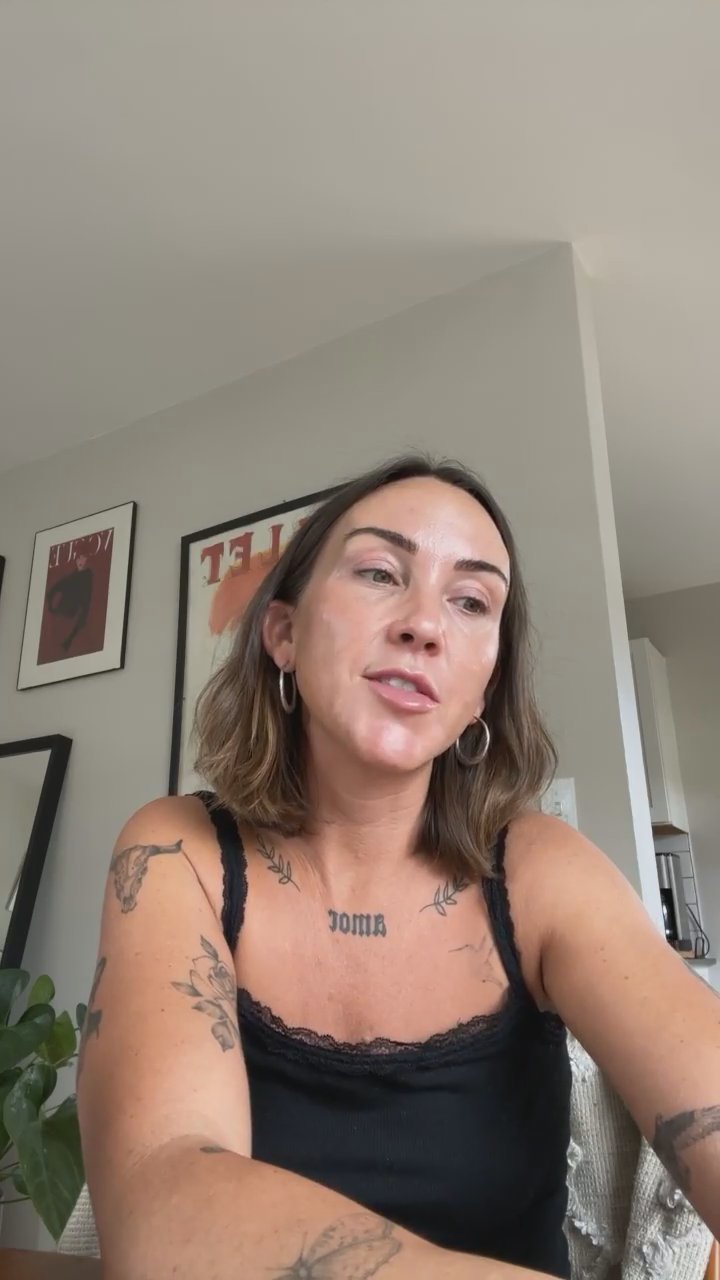
Host reflects on personal experiences of loss and explores grief as a natural emotion that needs to be felt. She offers practical prompts like asking grief what it needs and staying present.
Happy Wednesday, Cadre crew. I am feeling very lethargic and low energy and low mood today. Whatever kind of day you're having, I hope you'rehaving one.
Grief is something we are all familiar with in one way or another. Grief happens often, and it will continue to happen as we live. We're not offered a lot of tools to navigate grief. Understanding grief can help us in so many other ways.
Grief is an emotion like any other feeling. Grief needs to be felt, and that can be really hard. Sometimes grief can feel almost panicky or flighty or physical. It can feel like we're on the brink of the end. It's very important to stay in the present.
Another sort of skill in that is to ask your grief what it needs. Rather than trying to ignore it or shove it away, we start to get familiar with and build a relationship with those parts of ourselves instead. I hope that was helpful.
Happy Wednesday, Cadre crew. Hello. Hope you are all having a. Hope you're having a day. As my friend Kate Spear says, I like that. Whatever kind of day you're having, I hope you're having one. I am feeling very lethargic and low energy and low mood today. I don't know if that's just the season, the changing season, the moon, the super blue moon we had where I am in my cycle, my mental health, all of the above, but I am definitely feeling just low all around today. So I wanted to talk a little bit about grief today.
I think that grief is something we are all familiar with in one way or another. Whether it's the loss of a loved one, the loss of a relationship, the loss of a job, a part of ourselves, an identity, a time of our lives. Grief happens often, and it will continue to happen as we live. And I think it's something that, unfortunately, we're not given a lot of skills around. We're not offered a lot of tools to navigate grief. And I think that a lot of the reasons we struggle with other things like depression or anxiety is because of our difficulty with navigating grief.
Grief is a natural part of how we process change and loss and transition, which is literally every moment of our lives. So I think understanding grief and understanding how to, how to honor it and process and move through it can help us in so many other ways. So I wanted to talk about grief today. Grief is also present in my life right now. I am experiencing some heartbreak. And it's also, a few days ago, would have, would have been my 7th wedding anniversary, but it's not. My husband and I got divorced about four and a half years ago.
So this time of year always kind of brings up old grief. And I'm always reminded of how hard it was for me to move through that grief, how. How I just did not, I didn't know what to do with it. The first time I ever felt grief was when I was eleven, when my grandfather died, my grandfather died. And then when I was 19, I had a dear friend died in a tragic freak accident. And that grief sent me down a spiral of deep depression for years. And so I often wonder, you know, what might, what might life have been like if I'd known how to, how to navigate grief.
And so I just want to offer just a few small things that I've learned in my very short 35 years about grief, about what grief is and about how to process it. So the first thing I want to say about grief is grief is an emotion like any other feeling. So just like sadness, just like fear, just like anxiety, just like anger, just like joyous. Grief needs to be felt, and that can be really hard. Feeling grief can feel incredibly painful. And oftentimes, we don't know how to feel right. We don't know what it means to actually feel our feelings.
How do I do that? Does that mean I'm crying? Does that mean I'm laughing? Jumping? How do I feel grief in my body? And I think the other thing that we need to understand about grief is grief is oftentimes can also feel, like, sometimes when I'm grieving, I feel like I'm dying. Like, it actually feels physically like my. Like I might die when I experience grief. And part of this is because our brains biologically attach to things that are familiar because they're safe. And we use that as a survival mechanism.
So my routines become things that are familiar and safe. My job becomes a thing that is routine, familiar, and safe. People in my life who I speak to on a regular basis, see, on a regular basis, I'm around on a regular basis, feel loved from on a regular basis, that familiarity is safety. So, when we lose things, especially people, but really anything, when we lose something that has been a familiar thing in our lives, our biological survival mechanism kicks in and goes, my life is in danger. So grief is literally a feeling of our lives being threatened.
And so survival instincts kick in. That's why oftentimes, grief can feel almost panicky or flighty or physical. It can feel like we're on the brink of the end. And so I think also understanding that the loss itself triggers a lot in our nervous systems, it triggers a lot for us biologically in our survival mechanisms, which is why grief is one of those feelings that is so important for us to really physically or somatically process. And at the same time, while we're grieving, it's so important for us to practice nervous regulation and ways for us to regulate our nervous system so that our brain can feel and recognize that we are safe and that our lives is not, that our lives are not in danger.
So, okay, that's a lot of. So, what does that look like? That looks like a lot of somatic meaning, physical, of the body processing. So, sometimes I think we think feeling our feelings means talking about it. And that does. Sometimes it does mean talking about it. Whether it's to someone we trust or love, or writing it down, processing it out of our mind and verbalizing it is part of it. And I think when it comes to grief, it's so very, very important that we pair that with some kind of physical or somatic regulation, because we need to also remind ourselves that we're not in danger and that we're safe.
So things that work with that very well is anything that's going to keep you in the present moment. So oftentimes we kind of talk about grief in terms of, you know, we need to let go of the past. And that's why people will say, like, it's very important to stay in the present moment or look towards the future, and that will help you with grief. But I find I like to know why. And that's because we're teaching our brains to stay present. We're teaching our brains to look around us and see what's still here and that we're safe.
So whether that means going on a mindful walk and seeing and naming all of the things around us, whether that means finding gratitude for the present moment and what is. And reminding our brains that there are still things in our life that exist and are keeping us safe. So, staying present and being really mindful, practicing. Actually practicing mindfulness, even if it's just for 1 minute in the morning, can really help our brains get into a space of, I'm here, I'm safe, and I'm okay. And that can kind of reduce that panic that happens when we feel grief or that anxiety around the loss of something or an emptiness.
I think also anything that we can do to feel our emotions in our body. So things like breath work really are really effective. You all know I like to dance a lot. I like to dance through my feelings. So putting on songs and music that makes me move and feel things through my body and expressing emotions as viscerally as possible. So sometimes that might mean punching a pillow or getting in your car and screaming and raging, letting yourself physically emote the feeling through the body, and then regulating your system back to baseline.
So doing things like practicing long exhales to activate your parasympathetic nervous system and trying to do things that are gonna. That are gonna regulate your nervous system and get your brain back to a state of safety. Rachel says, I feel like that has a lot to do with the fact that grief is a reaction to death, whether actual death, part of ourselves or something we imagined. Yeah, definitely. And I think that when we. When we grieve things, we're reminded of our impermanence, right. We're reminded that we ourselves are one day going to be lost and not be here.
And so we are reminded that our time on this earth is short. And, you know, that's a hard thing to grapple with as a human being. It's a very, very hard thing to grapple with as a human being. And so I think grief encapsulates so many different things, and it's present in a lot of different ways, just like Rachel said, like, it can happen when we lose a part of ourselves, right? So oftentimes when we go through therapy and we let go of certain identities, whether that's like a role we played in our family system, whether that's a diagnosis that we identified with, whether that's letting go of certain behaviors or symptoms that once were coping mechanisms but no longer serve us, there's a lot of grief that happens, and we are allowed to and need to honor those things that we move through and let go of and recognize that there's a grieving process to that, and it doesn't have to be swept under the rug, and it has to be felt and honored.
Another thing that I have found that really helps with my grief is an internal family systems technique, where you basically name and identify your grief as though it were a person. And what that does is it allows us to acknowledge that our grief is real. See that it's there, hold its hand and walk beside it, instead of trying to abolish it or ignore it or make it go away or identify with it and become the grief. And so by separating it, we still get to honor it as real and true and move through life while we recognize that it's there and processing it without making it who we are and making our grief our identity.
Because I think oftentimes, too, the struggle with grief, at least for me, is I fear that if I finally let go, then it erases whatever I felt about that person or that thing. That if I really let go, then that means that I didn't actually care about the thing that I was grieving. Because grief is a representation of love, right? Grief is. I read a quote once that was like, we grieve to the extent that we love, or grief is love with nowhere to go. And I think there's a fear of if we let go, then the love is lost, too, too.
And that's not true. And so I think by allowing ourselves to de identify with the grief while still honoring it and witnessing it and walking beside it, we get to process it without consuming us and taking our lives over. Another sort of skill in that is to ask your grief what it needs. So, like, let's say I named my grief Gracie. Like Gracie is my grief. And if I sense that grief is coming up, I can talk to Gracie and say, Gracie, what do you need right now? And having those inner dialogues with those parts of ourselves is a really powerful way not only to get to know yourself, but to really start to pause and recognize there is a need coming up and learn how to identify and cope with that need in a really healthy, productive way.
Rather than trying to ignore it or shove it away or quiet it with things like substances or food or people or distractions, we start to get familiar with and build a relationship with those parts of ourselves instead. I hope that was helpful. I know it was a lot. This will be saved as a replay on my on my page, so feel free to leave questions or comments and let me know if any of that was helpful or if you want me to follow up with anything. I'm happy to either in another live or a static video as well.
I'm wishing you all a restful, peaceful rest of your Wednesday and I will see you same time, same place next week. See you next time. Cadre.
Reactions and comments are for members. Joining is free and takes a minute.