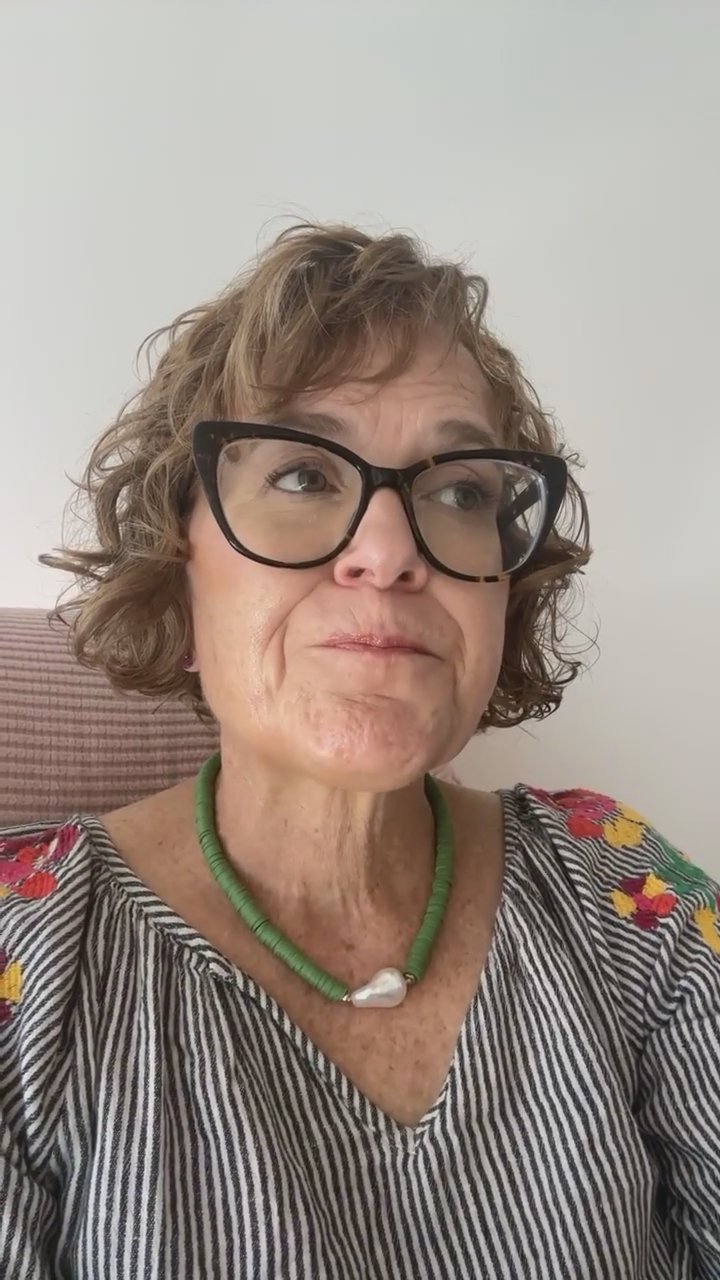
Betsy explores the transition trough, reflecting on her own shift from addictive habits at 19 and the hard dip that precedes lasting change, offering reflections on choosing progress over comfort.
Betsy: Today I am going to talk about the transition trough. At 19, I was smoking a pack of cigarettes a day and eating sugar like it was my job. I knew I could live in low grade misery for all time. To get to somewhere different, it requires change.
The transition trough requires re examining, reevaluating any of that old stuff that might be getting in the way of proceeding the transition trough. Some people love the chaos. And I think part of the reason a lot of people are here on Cadre is to figure out how to move forward even when we're scared.
LZ: I'm in a transition right now. I lost 70 pounds over about 18 months. Slow, steady progress, daily mindful choices, falling off, getting back on. The only way out is through, I guess, is the lesson about the transition trough.
Cadre. Let me know if there are topics that you want to hear about. Share more about what you're going through, too. We're in this together.
Hey, everybody, it's Betsy. It is 11:00 east coast time, 10:00 Minnesota time. Excited to be here with you today, given a little bit of time for some folks to enter the room. But I will say today I am going to talk about the transition trough. Dun, dun, dun. A necessary space for all of us, but one that we don't like to linger in if we can help it, which is too bad. And I'm going to talk about that. But if you're here and want to let me know how your Labor Day was, how your weekend was, that's great.
If you're in Minnesota, did you go to the state fair on the record breaking day? I love the state fair in Minnesota, so that's one of the reasons I ask. So when I was 19, I have mentioned this before, I was smoking a pack of cigarettes a day. I was eating sugar like it was my job. It was probably my smoking was probably my favorite addiction. Probably my second favorite addiction. I was drinking alone in my dorm room. Not romantic or fun. I didn't do a lot of college partying. I just did a lot of depressed drinking and also wired on caffeine all the time.
And there came a moment. I was 19 when I looked forward into the future, which I've later learned is one of my gifts, is sort of this ability to see through time. They call it discernment. Pat Lencioni and his six working geniuses model calls it discernment. I was able to see through time. As far forward as I could look for myself was the age of 29. But I said to myself, my God, if I keep living this way, I could live this way. Sort of completely anesthetized, completely quiet in my own life, wearing wallpaper, feeling icky and gross about myself and never being in a real relationship.
It will look remarkably like this in ten years time if I don't do something different. I don't know where I got that thought. At 19. I consider it grace personally. But I understood. What I didn't understand was that given the way my drinking was going, I might be dead by 29. But even so, what I could see through time was that nothing was going to change. That I could live in this low grade misery for all time and that nothing would change. Hey, Luke. Welcome. Happy Tuesday. I'm talking about the transition trough.
So I knew that I could live in low grade misery, just ad infinitum, dissociated, unhappy. And I took a bet. I made a bet with myself. I said, okay, chances are good if I make any of the changes that it would be required for me to have a life that I would like, that it is going to be some high grade misery as opposed to the low grade misery I'm living in right now. But the high grade misery won't last forever. And on the other side of it is something way better. I didn't know to call it the transition trough, but that's what it is like when you're trying to get from point a to point b, and point b is different than point a.
Like you are really trying to navigate. To get to somewhere different, it requires change. Nobody likes change that much. And there's this transition trough. There's a dip, right? You go from here, and then you dip down as you change, and then you meet the other side, and you can keep on going. And I knew that if I didn't navigate that transition trough, I'd had low grade misery for as long as I could see ahead of me. And I took that bet, and I made the changes. I think I realized what I was doing after I quit smoking as I was quitting drinking, before I stopped eating sugar, though, because I really knew.
All right, if we're gonna do it, let's do it. The other transition trough moment that I had in my life at that time. I've had many, many, many in my life. I'm in one right now. But like I said, I ate sugar like it was my job, and I weighed about 70 more pounds than I do now, and I did not exercise very much at all. And that same summer that I was quitting drinking and quitting smoking. Welcome. Speak wonder. We're glad you're here. That same summer, I joined the YMCA in. Was it in Bryn Mawr, somewhere around Bryn Mawr, Pennsylvania, where I was living at the time.
And I hopped on the treadmill. I remember this so clearly. I was staring at a wall. I hopped on a treadmill. I set it for. Gosh, I think it was, like, 2 miles an hour at 0% incline. And I could walk for five minutes before my calves were burning. And I got off, and I said to myself, and this is my rule of engagement. This is one of my top three rules of engagement. All right, well, Betsy, you're going to have to start from where you are, not from where you wish you were. I was going to have to start from where I was, not from where I wished I were or thought I should be.
And so I started at five minutes on 0% incline. Maybe it was 3 miles an hour. At 3 miles an hour. And I just started from there. A few years later, I started running slowly around the block. It was a walk run around the block, outside. This was in graduate school until, you know, fast forward to 2009. I ran a marathon in 2009, all because I was willing to start from where I was, not from where I thought I should be. And I was willing to navigate the transition trough, willing to navigate the changes in my life, because I had a very clear picture of what was on the other side.
Right. And there is no change. There is no. Well, hello, northwest Pennsylvania. Yay. There's no change. There is no getting from here to there and having it be better. We're not like Simone Biles executing a perfect and beautiful leap over the vault. You know what I'm saying? I am not. I don't think any of us are, really. There's no, oh, I'm just gonna glide into this new life I can imagine for myself, especially if it involves new skills, especially if it involves excavating old habits, old feelings, old conclusions we drew from the terrible things that happened to us over life or the difficult things that have happened to us in life.
We draw conclusions from those things, and if we don't re examine those conclusions, they continue to run the show. And the transition trough requires re examining, reevaluating any of that old stuff that might be getting in the way of proceeding the transition trough. And some people love the chaos. Some people get in the middle of the change, and they just love feeling icky, and then they go back because they get too scared, or those are two separate things. Some people love the chaos. I can kind of recognize those people pretty quickly right now.
They like the chaos more than they like the conclusion of the transition trough. And some of us, and this has happened to me frequently, we get scared. Like, it's not a smooth path. Right? It's like we go part way, we spiral down, we spiral up, we head back, we go forward. And I think part of the reason a lot of people are here on Cadre is to figure out how to keep moving forward even when we're scared. To me, that's a lot of life. That's a lot of mental health for me. How do I live in reality? Not dissociated, not anxious.
Anxiety is not reality. Nothing. Using alcohol or drugs or sugar or caffeine or cigarette, whatever it is, how do I keep moving forward even though it's scary and I am very tender after a lifetime of dissociation and the navigating the transition trough, just knowing that's what I'm doing. Can be helpful. Yes. Awesome. Steady progress. Those are three great words for the transition. Trough speak wonder, even though I, you know, he also meant them as a phrase, I think so. The other thing I will note is there's a really great book by a guy named William Bridges.
It's called transitions, and it was given to me when I lost my bid for re election to Mayer in 2017. It was suggested to me by my husband, but also by other people. And it is one of the books I recommend most because we can see the transition as a doozy of a time. It is also incredibly rich. Some of my best creativity and biggest insights have come in that transition phase, and most of us are trying to rush through it. This is what he talks about in the book transitions by William Bridges. We're trying to rush through this.
You know, we're trying to cross the road as fast as we can, dodging cars, right? Get from curb to curb as quick as we can. But there's so much to be learned. I learned so much about myself, why I'm resistant to this particular change. What does it it going to take? I have to use different parts of my brain to figure out what the right strategies are to move forward. I have to forge new friendships, new relationships, get new support, new coaches. It's an incredibly rich time, a fecund time, if you will.
And he really walks us through how to stay in those moments, how to really relish the transition and like, milk it for all it's worth. So by the time we get to the other side, we're there, steady and strong and really ready to take on what invited us to the next side. And I mentioned I, you know, I'm in a transition right now. I work for myself. I've been growing my business this last year. It has required a great deal of me. And as I was thinking about this live stream, as I was thinking about Cadre today, I thought, oh, right, I'm in a transition.
I should probably a recognize it b, milk it for all it's worth c understand that I'm going to resist seeing it that way because change is hard. My husband often says, no one likes change, but a baby with a wet diaper, and honestly, they will fight you. Even when they want a new diaper, they will fight you as you're changing it. And people are usually the same way about change. But I also think about that in terms of community, because often as we get in with other people, that's a change in and of itself.
Just new friendships, new relationships, new groups. When we move when we join something here on Cadre, right, that can be changed. That can be its own. Transition trough is being part of something new, and sometimes you're collectively going through that transition trough together. And because everybody has different things that are hard for them about change and hard for them about moving forward, and sometimes we fit together in those changes and can really bolster each other, and sometimes we b*** heads with them.
All of it is illuminating. All of it can be useful. So speak wonder. I lost 70 pounds over about 18 months. Slow, steady progress, daily mindful choices, falling off, getting back on. I've discovered weight fluctuates. Your worth does not. That was my experience, too. I did it very slowly. I had to change a lot about how I ate, which was hard, and I felt like a raw nerve most of the time. I don't know if that was your experience or what have you, but for me, every ounce of weight I lost had some feelings associated with it.
So I really had to get a black belt in feeling feelings as opposed to eating my feelings, which is good to remember at this phase of life where, you know, I'm a 55 year old woman and my metabolism is different, my whole physical structure is different. It's good to remember slow, steady progress and pay attention and get a black belt in feelings. Thank you for sharing that. Speak, wonder. I appreciate it. That was my experience, too. The only way out is through, I guess, is the lesson about the transition trough.
But that rule of engagement of mine, start from where you are, not from where you wish you were. I could not start from running a marathon when I could not walk for more than five minutes on a treadmill. I had to start from exactly where I was at and build from there. And I have to remember that a lot in my life every day, because every day is fresh. So that's what I've got this week. Cadre. I'm so grateful to be here, so grateful to have this chance to talk with you and be present with you. Let me know if there are topics that you want to hear about or things you want to hear more about and share more about what you're going through, too.
We're in this together. It.
Reactions and comments are for members. Joining is free and takes a minute.