Jean Nichols leads a Monday reflection on managing overflowing inboxes and planning the week, sharing practical tricks like unsubscribing, reviewing last week’s activities for what energized or drained her, and strategies to split or reframe draining tasks.
Jean Nichols: Happy Monday. We are entering into the week before Thanksgiving. This is the time of year that I love cleaning my inbox. What tricks do you have for filtering through your overwhelming email boxes?
Jules: What is one trick you have to minimize or clear out that overabundant inbox of yours? On Monday, I like to do a reflection. What percentage of time last week I spent every Energized by the work that I was Doing? You can insert whatever phrase works for you based on your natural lens.
On Mondays it's really a great day to look forward. I know really well the activities that are going to drain and deplete me. When we are drained or depleted by our work, other things happen. Now I'm setting myself up to be greater success.
When you have activities that super drain you, there are a couple of things to consider. Can you break that activity into smaller segments? Is there a different way for you to work with your boss or your manager to create a different environment for that activity?
Do your reflection. Go back to last week, find what brought you joy, see what you can carry forward into this week. And get real honest about looking ahead this week to see what drained you. Let's create some strategies on that.
Hello, everybody. Happy Monday. My name is Jean Nichols. I'm in Minneapolis, Minnesota. My trusted colleague has arrived to co host today's session with me. That's major. Always excited to be here with you. Not so sunny today, but still an exciting day. Good morning. Speak wonder. Happy Monday. Hello, Jules. Happy Monday. Excited to have you all here. We are entering into the week before Thanksgiving. Can you believe it? I am sure, like all of us, your emails have been getting filled with promotional items sales that are coming.
This is the time of year that I love cleaning my inbox because all those random things that I purchased throughout the year. Anytime I get those sale emails, I decide, is this really someplace I'm going to shop again? And if yes, I stay on the email and I see what happens. And if no, I go out and I click unsubscribe. And it's so refreshing to just clean that up a little bit. I've been trying to be more active with decreasing the amount of junk I get in my inbox so that when I go every morning into to log in, I can not feel so overwhelmed by so many emails.
What tricks do you have for filtering through your overwhelming email boxes? I will see people's phones sometimes and this is a little soapbox for today. And it'll be like the little email box on their phone will say like 5,000 emails or more. And then literally my heart starts to race. Cause I'm like, how the heck do you, one, get there? And two, how do you clean it up? And then my next filter in my head goes to John. Help with that. I can help you simplify this so it doesn't fill up so fast. Not my circus, not my monkey.
That seems to be the phrase. So I would love to know in the chat today one trick you have to minimize or clear out that overabundant inbox of yours. It's Monday. It's professional development day. The start of our conversation started there. One trick for you on today. I thought I'd kick it off with a future forward look and a backwards look. And what I mean by that is we oftentimes spend so much time in our days doing, doing right and we have lists and we check them off. Maybe we don't make lists.
Maybe we have post it notes everywhere and we just eventually work our way through the post it notes and throw them away. But what I like to do sometimes on Mondays is take a pause and look at my week in the past to see how I spent my time. I love this, Jules. And speak wonder. Popping in with Their unsubscribe. Whenever possible and appropriate, I hit the unsubscribe button. Yeah, right. Sooner than better, sooner than later. But what I like to do on Mondays is I like to sometimes do a reflection.
And I don't do this every week, I'll be honest. But I do try to do this at least once a month when I can or when I remember it. So for many of you, this could become a weekly tool. For some of you, it could be a monthly tool or maybe a daily tool. It's not a bad thing to do over a period of time. So what I do is a reflection. I look back at last week, and I look at all the activities that I did. So I kind of pull up my calendar, and I see what I had scheduled on my calendar for last week for meetings.
If I have time blocks where I'm blocking off time and I'm working on certain activities, I try to remember what those activities were that I was working on during those time blocks. Was I designing something? Was I answering emails? What were those time blocks for me? And then what I do. And if I don't remember that, I think about, you know, I might sometimes go through some of the emails, conversations that I had last week because that will sometimes trigger some insights in my mind. If you see me shifting a little, that's because this little guy down here, he was pushing his leg on me because he needs more pets.
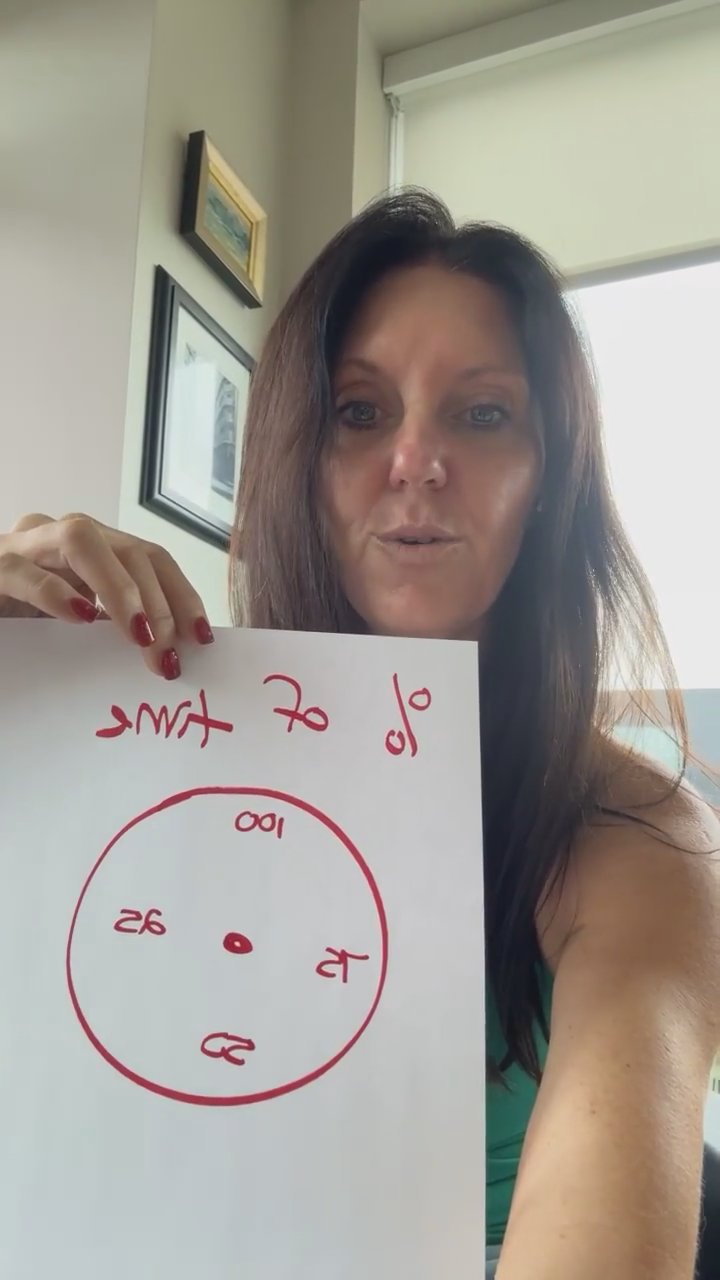
So this is how the Cadre goes. Getting real today. Team major's driving the conversation. So when I do that reflection, what I do is I pull out, like, a little trusted sheet, and I'm gonna pull this sheet up for you. And it's really silly and simple, but what I do is I create this little graphic that says percent of time. Now, I don't know, maybe I needed to write it backwards so that it shows up correctly, but the top says percent of time, and the circle is simply a circle with a dot in the middle, like a bullseye or a clock.
And I show a 125, 50, and a 75, and that those numbers, for me, are time points. And for some of you, you might want to just do 10, 20, 30, 40, 50. You might want to actually create a clock. If you have a copier, you make copies of this so you have extras so that you can do multiple snapshots in time. And so what I do when I look back on the week is I try to identify what percentage of time last week I spent every Energized by the work that I was Doing. Now, why do I use the word energized? It could be, what percent of time did I feel successful in my job?
What percent of time did I feel satisfied with my work? You can insert whatever phrase works for you based on your natural lens. For me, energy works because I am a high empath and I feel. Or I'm an enfp, right? So I feel emotion first or I feel that extroversion. I feel that energy from people or work. And so that that phrase works for me. I know some people where they, when I say that phrase, they squint because it doesn't work for them. But if I change the phrase to where did you find the most success last week?
Where did you feel like you were winning last week? Where did you feel like you were accomplished? All the same words. So find the phrase that works for you. Then look back on all those activities and try to get real. What percent of time did you spend energized, successful, accomplished with the work that you were doing? Last week was a great week for me. So on my little handy dandy chart, I'm somewhere upwards of 75%. Now, why was that? I got to design and lead a women's conference and do a kickoff presentation at the conference.
I recommended a plot twist for what the activities and how they were going to be facilitated went based on the number of people that attended versus the number of people that we had planned so we could keep the experience really exciting and connected for everybody. I got to facilitate a workshop for leadership at the Habitat for Humanity. And there were a number of other things where I got to problem solve on the fly. And I love solving complex problems. And I love those moments when things seem to be going crazy, out of control and I can look at the landscape and come up with the solution and plot twist us right away.
I don't know why I get really excited about that. And when I say that, anybody who's a high planner or high list maker, it stresses them out. So those are the people I like to partner with because they're great at making a plan and I'm really great when the plan goes awry. So last week was a great week. So I look back on that and why that's important is what I can do is start to make a list of the things, the activities that I got really excited about. So I set a few of them. Facilitating problem solving, designing a conference.
All of these things are things that really get me excited. I love public speaking. I know some of you will cringe when I say that. I love inspiring a room of people. I love doing the research to find the statistics and the information that are going to really land the key messages. Oh, and I got to be on a podcast and share information. So so many different things happened last week that it just felt like the, the perfect week of working on, on things on my computer, designing and then other activities where I got to be with people.
It was a great week. Now I do a look forward. So on Mondays it's really a great day to look forward. So I look ahead at my calendar and I see what are the activities on my calendar? What do I know I need to accomplish, what events do I need to attend, what work do I need to accomplish, what meetings do I need to be in? Because when I look ahead, I can do a predictive indicator, if you will, or I can do an index that says, okay. Some of these types of meetings I know are going to be draining for me, de energizing.
I'm not going to feel as successful in or I, I know that these meetings are just going to be more challenging for me to get through because of the outcome of the meetings or the topic of the meetings. And there are some activities that I need to do in my consulting work that I may not love, but I might be really good at them. For example, I'm taking over some project managing activities. And I don't love that because I'm not great at lists and I'm not great at tracking things for myself. But because I'm doing it for the project, I can change my perspective on my why to make it a little bit better for me.
But I know really well the activities that are going to drain and deplete me. So what I do then and what I do next is I schedule workouts around them or I schedule my walks with Major to get out in nature, maybe listen to a podcast or just maybe do some breath work while I'm walking with Major. I look at my calendar that way intentionally so that I can create activities that will either help me reset on my schedule so that I can get my energy back, my mojo, whatever it is that it is for you, or I can schedule something that will give me enough energy so that I can feel really strong going into the activity itself.
Now why might you ask, would I do that if, for example, my time clock here was down in the 25%? So if I looked ahead at my week and I discovered that 25% of my week was going to be exciting, that there were actively things that I was looking forward to and it was only at 25%. That means that 75% of my week I might feel drained, unaccomplished, unsuccessful, depleted, unexcited, unmotivated by some of the things I need to do. And what I know is based on science and studies is that when we are drained or depleted by our work, other things happen.
For example, if I'm working on an activity, if I'm building a project plan, for example, I'll use a specific example. If I'm building a project plan, I love creating things. I'm energized. If I'm managing people to get their checkboxes done, that can be really depleting for me because I don't like to micromanage people. I like to assume positive intent that they're going to get their work done. But when I have to project, manage and consistently create those status reports and identify where we have gaps all the time, it becomes very depleting for me.
Some people are really great at that. They are really energized by that. So what might drain me might not drain somebody on my team. And that's okay, because that's when we can find some balance. But when I know that this week I'm going to have a little bit less exciting of a week, I might try to, in my free time, do something that is exciting for me. Maybe it's designing a new event because I like to bring people together in community and do fun things together. Maybe I read a book or do some research.
I get really excited when I'm learning. So if I can do an inventory of what happened last week to see where I found the most joy in my job and see how I could plot some of those activities into my future work. Now I'm setting myself up to be greater success. I also recognize that when I'm working on activities that are draining to me, I might snap at my dog, I might not show up great for my team and be crabby or in a bad mood. So we can't control physiologically, we can't control when we're drained by activities that we're working on.
We slump our shoulders, we lean back, our eyes get squat squinty, and our facial expressions look pouty. When I'm working on something I'm really excited about, like me jumping on these Cadre calls. I'm so excited for these moments, to be able to share opportunities so I can share more with that. If you have questions about what I'm saying, put it in the comments, add it to the comments. On our main page. And let's have the conversation about what this looks like. Jules, you asked a question. What should you do when you have more than one activity in a week that more than drains you?
When I'm drained like that, I tend to avoid all activities. Great, great question. So when you have activities that super drain you, there are a couple of things to consider. One, talking to your manager, have you actually expressively shared what this activity does for you? And if yes, how have they responded? Have they given you support? If no, what's stopping you from having that conversation? Now, sometimes we work on really small teams. So, Jules, you work on a really small team, and we don't have the luxury of always swapping activities to other people in larger groups.
I had this happen in my workshop last week. Somebody shared an activity in our workshop that drained them, and somebody else said, wow, I really like that. And oddly, because of their jobs, they could switch. They could swap out a couple of activities. So now they're in the process of cross training so that someone else can take over this particular activity. And now this other person who is draining, they have more time to fill up with something other, something else to help the organization and the work.
The other opportunity, Jules, in this instance, is can you break that activity into smaller segments? A time study will tell you that if you're working on one activity for one hour that you're totally drained with, you will check out of that activity, meaning you will go get a cup of coffee, you will read your Instagram or social media, you'll answer emails just to take a pause. It takes five minutes on average to re engage with whatever the activity was you were working on. So for me, I have to do invoicing.
I get paid that way, but it's draining for me. So I might do one invoice and then I reward myself with something. Maybe it's going for a quick walk, because sometimes the invoices can be long. Or I'll say, in 30 minutes, I'll get through these invoices, and after this is over, I'm going to get up and go make myself a matcha at home. And the knowing that I get to have a matcha after this will get me through the activity of getting these done, because it's like a little mini reward. So if there's opportunities to break it down into chunks, that can help get through the activity itself.
Now, the time study says it takes on average five minutes for you to re engage with the activity. So knowing this and knowing that those interruptions can actually deplete the focus and deplete your ability to get it done. You're now having one hour spent with 25 breaks on average. That's 25 minutes that you're wasting of time that you're adding on at the end of your day. So if there's an opportunity for you to shut off the phone, shut the door, insert whatever it takes for you to just focus for blocks of time to charge your way through, and then have a reward of some sort at the end, that can help.
And that's great, Jules, that you can identify those activities that you interrupt a lot. No driver, focus on them. My invitation to you is to again see if there's a way that you can make it into bite sized chunks so that you can feel successful working through it. And then if the actual activity itself is so overwhelming, is there a different way for you to work with your boss or your manager to create a different environment for that particular activity? Now, Jules, if you want to pop into the comments and we can continue the conversation there, let's do it.
Let's see who else on Cadre can offer insights and perspectives as well. So with that, Happy Monday everybody. Do your reflection. Go back to last week, find what brought you joy, see what you can carry forward into this week, or plan into your future weeks. And get real honest about looking ahead this week to see what drained you. And if last week drained you, get real with that too. And let's create some strategies on that. Type them in the comments, put in the comments in the room. Let's chat it out and let's do this.
Happy Monday, y'all.
Reactions and comments are for members. Joining is free and takes a minute.