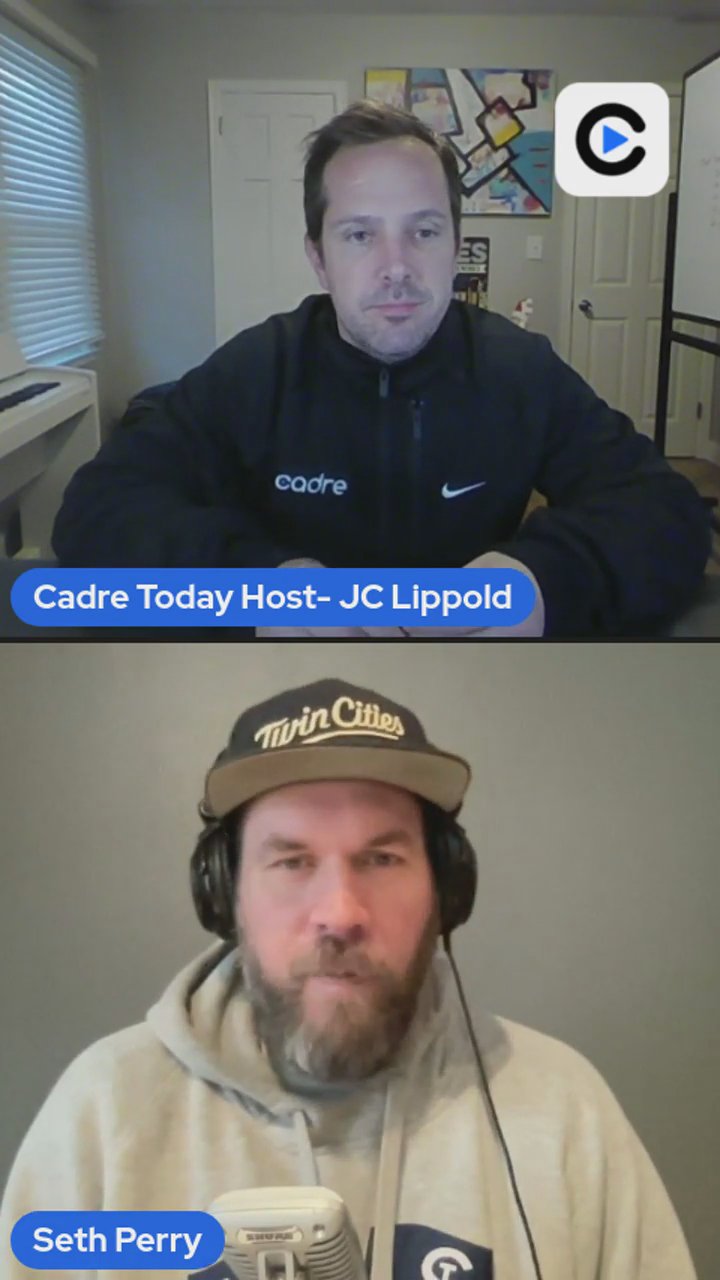
Join Cadre Today host, JC Lippold as he gives you a unique look into your favorite Cadre Contributors. Within this interview, you'll experience folks being real, folks caring about you and others, and folks fostering space for beautiful nuggests of insight and inspiration to appear. This week we welcome, Seth Perry as we talk about Mental Health Stigma in the Faith Space.
You see the wonderful Seth Perry in live stream this morning as well. Seth, how you doing this morning? Good morning. I'm doing good. I've been up already, walked the dogs, and I'm grateful to be here.
Boba is the beagle and Morty is our greyhound. None of them want to stay out for very long. We were in and out as quickly as possible. The windchill was cold.
This is your first Cadre Live contributor interview. The way that these will be formatted, I'll ask three questions. But you also have the opportunity there at home, wherever you are, no matter how you are doing.
Seth Perry: I am ultimately self conscious about my vocation. Most common place that I'm asked this question is in recovery spaces. In recovery spaces, Christianity has caused a lot of trauma. How do you feel when people ask you these questions?
Seth Godin: How do you describe or define the word vocation? He says being a pastor is less about converting people to a particular institution or religion, but more about finding a way to meet the needs of people. He says Cadre is a secular community of people empowering them to go out in the world.
People have a need to talk about mental health stigma at church. Fundamental distrust of modern psychiatry exists in many faith communities. Mental health recovery is like a multifaceted and diverse community. Many faith communities are in the process of making slow changes.
Seth: What would be the take home prize that you would want people to walk away with? He says he wants to empower people to keep seeking. Where can people find you in the Cadre sphere? Seth: You can find me at 1pm Central Time.
Well, hey, good morning, Cadre. How are you doing today? You may be like, wait, hold on. Why are there two people on the screen? Yes, you see the wonderful Seth Perry in live stream this morning as well. And by golly, I'm clicking into the live stream myself right now on my phone. And there we are in the background. Seth, how you doing this morning? Good morning. Yeah, I'm doing good. I'm great. I've been up already, walked the dogs, and I'm grateful to be here. All right, well, we are in the great north, so I have to ask, how was the weather out there this morning?
It was cold. The windchill was cold. Yeah. So that was, that was tough. Yeah, but I bet what's, what's, what's your pup's name again? Well, I have Boba and Morty. So Boba is the beagle and Morty is our greyhound. So yeah, we were cold. We were in and out as quickly as possible. Yeah, yeah, I was, I was gonna say I have, I have two. I have two dogs that will go out for about three seconds and then Willow will hang out a little bit longer. But in this weather, none of them want to stay out for very long.
Well, everybody in the Cadre sphere, you may be wondering. Gene, I saw you just logged on. Nice to see you this morning, Gene. What's going on? Well, this is your first Cadre Live contributor interview, Right? As we always say in the Cadre sphere, we're bringing together professionals and peers to foster a community knit together with resources to show you that there are many ways to being well. Which means we all communicate in different ways, we all think in different ways, we all stir up the things that we need to stir up in different ways.
So sometimes you see live streams, you can see Seth, you can see Jean. Jules, good morning. Good morning, my friend. O four sons for us. I love it. Thanks, Jules. Sometimes you go, I know exactly what I'm looking for of the topic or the length. So you can jump into some pre recorded content. Maybe you find some love or some inspiration in the community feed. Well, now you have the opportunity to have interviews right here with your favorite Kadia contributors. So Seth is kicking us off. And the way that these will be formatted, I'll ask three questions.
One at the beginning, one in the middle and one at the end. But you also have the opportunity there at home, wherever you are, no matter how you are doing. And if you're doing great, that's awesome. If you're not doing great, that's okay too. Wherever you are. Whatever's going on, here's a chance for you to go ahead and weave in to a nice cup of coffee, a nice walk on the treadmill, a nice laying in bed a little bit extra long this morning with the family, with the dogs. So to start things off, I'm going to ask one of my most anxiety inducing questions for me personally, but it's who are you, Seth, and what do you do?
And then there'll be a little follow up question to that. Yeah, my name is Seth Perry and I'm a pastor. And so I'm a pastor in the, in the rural, a rural bedroom community of the Twin Cities. So when I am asked what I do, I normally answer with that, you know, that is my vocation. But I have to say that being a pastor is a very broad job description and it often garners a lot of questions when I, when I tell people what I do because people are really curious about what pastors app actually do when it's not Sunday, you know.
Yeah, absolutely. And you use a word that I, that I really appreciate that I think is becoming more and more front and center and that is, that is vocation versus versus work or profession. So we'll talk about that in a moment. But the second question, you know, attached says how do you feel when people ask you these questions? So, so you already said, it's like there's already, there's always a lot of curiosity around the who are you and what do you do? But when people ask you the who are you? What do you do?
And you say, pastor, how does that make you feel? Where does that bring in your head and heart? Well, I am ultimately self conscious about my vocation and it's kind of interesting because the most common place that I'm asked this question is in recovery spaces. So I'm in recovery from addiction. I live well with bipolar disorder. And so in recovery spaces, Christianity has caused a lot of trauma. I see that, I hear about it a lot. So clergy are kind of the center of that trauma. And so when people find that out about me, yeah, I do wonder how then they feel about me, talking to me and really approaching me.
So it's not something that I necessarily offer up a lot. I'm a little bit more comfortable talking about it now than I have been in the past. But on the other side of things, you know, I've now become comfortable saying that I am a recovering addict and I'm in long term recovery from mental health disorder. And in Christian spaces, which is something that I used to not do so. That was something that I hid for quite some time, for over a decade. And so it is interesting that in both of those communities, you know, in recovery, I didn't want to tell people what I did for a living and where I was working.
I didn't want to tell people that I was in recovery, you know, know, which was interesting. Yeah, yeah. I mean, and, and, you know, maybe one of those curiosities or assumptive natures as people go, oh, pastors wants to make people feel safe or that or, or, or, or, or brave or that there is a space for them to exist in. And like you say, for you to go ahead and say both of those pieces of, of. Of who you are as a person, you know, of your history, of what you carry, you know, like you say, the fight, flight response of going, oh, gosh, now do people feel less safe or less brave around me or less open?
So let's tap into that word. How do you describe or define the word vocation? And as you look at maybe the large aperture, the large zoom of your world as being pastor, how does your vocation maybe make that aperture a little bit smaller or focused with who you are as a person, as an individual? What, what would you say your, your specific vocation is in this world? Yeah, here's how I kind of uncovered my vocation. I think that when I was very young, people said I had this ability to, you know, sense a lot of what people are going through, be compassionate and, and also just think about the needs of others and how they can be cared for and listened to.
Um, and so I left that for a while. Obviously I had a history of addiction, and when I got clean, then again, that was kind of reaffirmed that I have these skills, compassion, listening, and this intuitive sense of helping people. So that's the real focus is recognizing a need in people and finding a way to meet it. So for me, being a pastor is less about converting people to a particular institution or religion, but more about finding a way to meet the needs of people. And so I can do that just myself, one on one, or I can inspire other people to come along with me and help others as well, which I think is part of the role of being a pastor, because there's leadership kind of built into that whole concept of that vocation that you, you build helpers and sustainers in a community where you can inspire them to follow in what you're doing or even just out of their own faith practice, find a way to help others.
Seth, I'm glad that this is on camera so I can see myself on two screens cheesing as I hear you speak because again, you know, I know that an earlier stage, you know, you had a theater background, and often, you know, storytelling is a really powerful way that people find space and find their part within community. I think of you as a neighbor. I think of you as, you know, someone, you know, with all the work you do in the social media world where a lot of people are wandering, looking for community and space.
You know, I got to, I got to be a guest on your YouTube show. And the people who walked into that community that you were holding, they were able to, as you said, to. To be the people doing what they feel called to do in that space. And I think, you know, Cadre is a, is a secular community of people, a pluralistic community of people that are empowering them to go out in the world and, and be what we say Cadre is being. So it's, it's, it gives me a lot of hope to see that the path that you're forging and also a few to share.
You know, 10 years ago, you weren't willing to say X or you weren't at a place where you were X and Y and Z. So as I've been inviting contributors to be a part of these conversations, and this is our maiden voyage, I've been very vague and asking the question, so what do you want to speak about? You know, and, and, and you wrote back in the, in the form, you know, mental health stigma in the faith space. Why, why is this the conversation front of mind? You've already, you know, circled it. But spend some time talking about what you see, what you hear, what you know, and, and the work that you're doing and the work that needs to be done.
What I really see is that people have a need to talk about mental health stigma at church. And there's been some progress lately, but I don't think we need to just drop everything and say we've made. We've. We've arrived at some sort of place where suddenly everything's okay at church because a few people have been talking about it for the last four or five years. And even faith leaders like myself have been talking about mental health and our own mental health conditions, which I'm open, my bipolar diagnosis.
So here's why. I think two things. Fundamental distrust of modern psychiatry, counseling, psychiatric medications in the medical field in general exists in many faith communities. And faith is often seen as the only component of recovery. And for me, it Is one component of many components of my recovery. So on Cadre, you'll see how mental health recovery is like a multifaceted and diverse community. And we celebrate everyone's unique path. Like you said, pluralistic. Right. Everyone has a unique path of recovery, and that includes unique spiritual aspects of recovery.
And there's kind of a mutual respect for that. And I want to see a lot more of that in faith communities that I interact with and faith communities that I lead. But the other part is, many faith communities are in the process of attempting to look at the ways that they negatively affect people's mental health. So the faith community itself, in how it has been structured, its history, its traditions, its leadership, the lack of checks and balances, and the resistance to progress and to change with the times and the needs of our culture and society, Many faith communities are in the process of making slow changes, like many churches do.
Right. Or other faith communities. It's a slow change when there's change. So many of those faith communities are doing well, but there's a portion that are in direct opposition to reform and change. They will still participate in setting standards of behavioral control, information control. So behavioral control would be specific things that you should and should not do, and there are consequences if you don't in a faith community. Or information control, which would mean you should only watch these particular movies and these.
Read these books and. And then. And thought control, which would mean basic, basic punishment and retribution for behavior and other things. And then emotional control, which is huge in the history of the church, that you shouldn't feel certain emotions or you shouldn't be emotional about certain things. It's unholy or it is, but, I mean, I'm the exact opposite. There's so much God in emotions. So those are the things that I'm seeing out there. And I really hoping that I can be a voice in inviting people into thinking about a faith community as something else than the things that I've just recognized as problems.
Really? Yeah. Yeah. Seth, you. You just hit so much. And I think, you know, one of the, you know, as I think about that phrase. Right. Mental health stigma in the faith space. Right. We could take out the word faith and put in workspace, home space, school space, society space. And. And I think, as you spoke, it's, you know, so much of existing communities, it seems like where they think their success is, is. Is in creating a binary reality for people. If we can make this sound really simple for people.
Yeah. People can either be in or out. You do this, and you're Right. You do this and you're wrong. This is how we act. That is how they act. And again, even though this may be an easy way to sell the message, it doesn't seem like it fits. It's. It's a square peg in a round hole. Whether that is a God space, a country space, a family space, you know, what, what, what, what, what, what, Whatever the top of the mountain is. But I'm curious if. If you see yourself having to fight the fight, the binary of, like, right, wrong, good, bad, this, that, and where that's showing up today.
Yeah. I think the way that I talk about wellness is that basically it has a lot to do with institutions, and institutions totally live in that right or wrong black and white space that you're talking about. And, and so for myself, I totally bought into it that there was one way for me to do recovery and there was one way for me to do spirituality, and I saw that everyone else really should follow suit. Right. So then when you look at all the different places that you've. You've talked about where we try to navigate our world in recovery and in mental health recovery work, home, you know, in our social lives, and there's.
There still is a very spec. There's specific binary where, where I see a lot of people struggle with looking at these multiple modalities of recovery that, that really can help them, but it kind of can go against the culture of their job, the culture of their home life, and the culture of their friend group. And, and that's something that I think if you come and check out enough content here on Cadre and see our contributors and what they do and what they talk about, I think that that is a place where you can feel welcomed and safe and just feel like it's somewhere where at least you can listen for seven or eight minutes on a Tuesday afternoon or on a Friday night or whenever and just feel like someone's connecting to your reality.
Yeah. And Seth, you just raised another very popular polarizing binary, and that is, you know, social media good, social media bad. Again, like, I look at how you have created a world. So I'm also located in the Minneapolis St. Paul, Twin Cities area. And I know that, that the congregation that you serve and care for is, you know, like you say, it's in a fifth, sixth, seventh, eighth ring suburb. So the Twin Cities, you look at people, look at the downtown or the urban area as a very specified group of people.
And then you get into the verbs and other specified. You get into the rural, another specified. But then I look at how you can create space that is more again pluralistic simply by using a format like this. And the work that you're doing is pretty, maybe sad to say, groundbreaking, but it truly is breaking ground as opposed to running into the wall without letting the dust fall. So I appreciate what you're doing and the way that you're doing it. As we wrap up here today, you know, again on Cadre, we focus on creating these little morsels that, that don't require you to take all of your time.
Now again, these live stream conversation interviews are a little bit longer at the end of the day. Hopefully this leaves you with going, huh, okay, yeah, now what? So if you're going to provide everyone who's listening today or watching this later in pre recorded, what would be the take home prize that you would want people to walk away with? If they're going to have some, some, some reminiscent of this conversation, what would you want them to take away? Yeah, I think that when it comes to what I do mainly, which is mental health in faith communities, when I talk about that with people, I think that I need to empower people to keep seeking.
So if you don't feel like you fit in at a faith community, keep seeking. If you feel like people are not listening to you at work and that you don't feel supported, keep seeking. Find support where you can maybe make your work life a little more bearable. And if there's trouble at home, keep seeking. Absolutely. I think that that's something that I did early on in my recovery and I eventually found a place where I fit in. And I think sometimes people don't realize that there are other options when it comes to faith.
There's other options when it comes to mental health and there's just other options when it comes to all around wellness, which is why we have such a broad scope of voices here on Cadre. So that is the one thing, just those two words, keep seeking. And I hope that everyone can find their own way of doing that. I'm writing it down right now. Keep seeking is a really, really great mantra for this time of year. As the days get dark, as the year starts ticking away. Seth, where can people find you in the Cadre sphere?
When do you live stream? You can find me at 1pm Central Time. So that's 1pm Central Time, 2pm Eastern Time and 11am Pacific Time on Sunday. And you'll see me for about 10 minutes on a Sunday afternoon. And I talk about a wide variety of things. But a lot of what I've talked about today is is is at the center of that. Awesome, Seth. Thank you so much. We are officially out to sea with our Cadre contributor interviews here in the Cadre sphere. We'll have one about every single week. So I will be placing the community feed who our next guest will be.
But in the meantime, you can find me every single day during the week. 7:30am Central Standard Time here Cadre today, 8am on the weekends. Seth have a great week ahead my friend and we will see you all later. Have a good everybody. Bye. It.
Reactions and comments are for members. Joining is free and takes a minute.