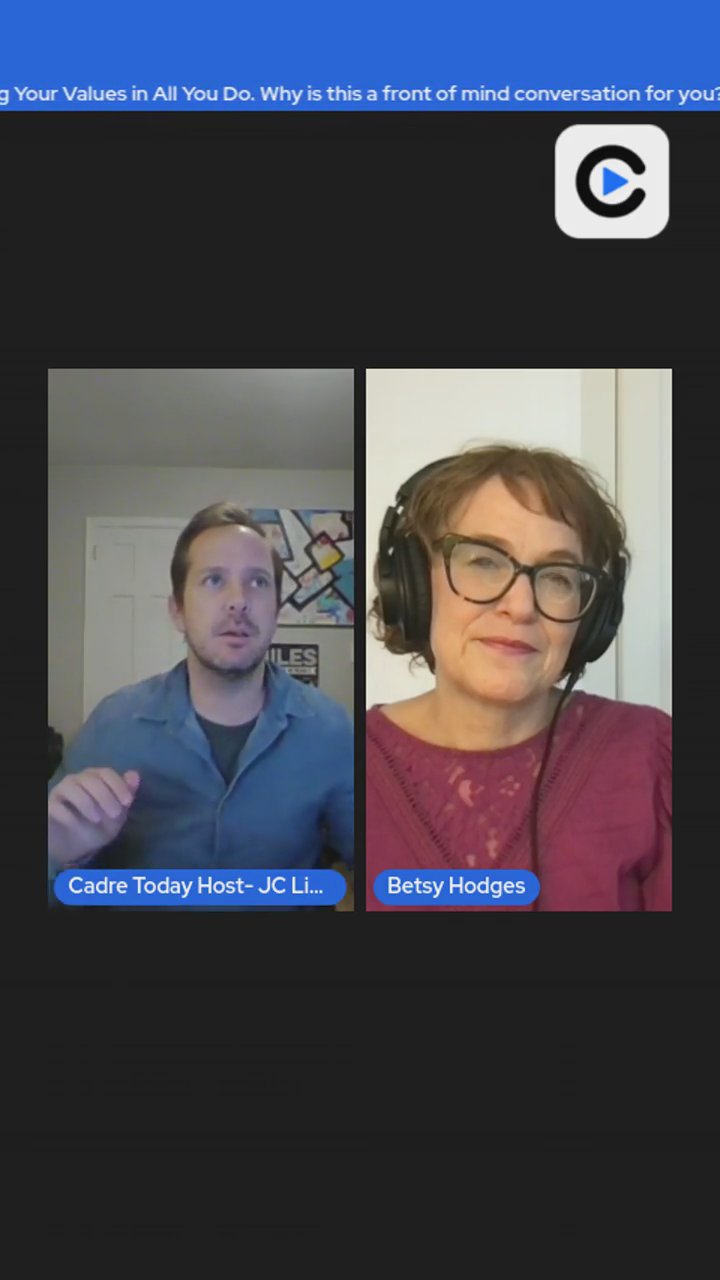
Join Cadre Today host, JC Lippold as he gives you a unique look into your favorite Cadre Contributors. Within this interview, you'll experience folks being real, folks caring about you and others, and folks fostering space for beautiful nuggests of insight and inspiration to appear. This week we welcome Betsy Hodges as we talk about living your values in all you do.
This is Cadre. You see my face 365 days a year. Whether this is your first time in the Cadre sphere or the thousandth, we allow you this starting place to know who you're showing up as. I would love to take a moment to say hello to my good friend, Betsy Hodges.
It is back to be in Chile, in Minnesota. Washington D.C. is doing pretty well. It's sunny and pretty mild. I love it.
Betsy: Lots of hearts are flying in, Betsy. Who doesn't feel the love on Cadre? Really? It's one of those consistent moments of getting doused in good energy, knowing that you're not alone out there.
This is an interview format. It's a new opportunity for you to connect with your favorite contributors in a conversational way. Feel free to drop questions or thoughts into the chat.
Betsy Hodges is a consultant and a writer and advisor and a speaker on issues of local government. She is also the former mayor of Minneapolis, Minnesota. When people ask, who are you and what do you do, Hodges often uses code switching.
If you wanted an early take home prize, it would be to ask yourself the question, what is the most important thing about me? For me, the most crucial thing is my sense of humor.
Cadre Today asked contributors to talk about living your values and all you do. Betsy said her feelings aren't a great basis for decision making. She said her number one value is doing what is right regardless of convenience.
Betsy: Am I leading with my damage or am I Leading with my growth? She is a survivor of childhood sexual abuse. She says she has been healing from this at that point for 35 years. She wants people to know that it is possible for your dreams to come true.
Betsy: What are your rules of engagement for your life? And for some of you, it would actually be useful to write them down and post them somewhere. Start from where you are, not where you wish you were. Love what you love, whatever it is, as long as it doesn't damage you or others.
The prompt will be what are your rules of engagement? And then I'll share Betsy's top three with the prompt of you asking yourself. Your regular live stream is 1pm or Eastern Standard Time on Tuesday. Next Cadre Today interview will be on Monday with the one and only Speak Wonder.
Foreign Cadre or good afternoon or good whatever day, whatever time it is, because you could be watching this on pre recorded or if you are live right now with me and my friend Betsy Hodges. I hope you are doing well wherever you are. And even if you're not, know that that is okay too. What is this? This is Cadre. Today, you. You see my face 365 days a year. So whether this is your first time in the Cadre sphere or the thousandth, we allow you this starting place to know who you're showing up as.
Today is always changing, is always fresh, is always worthy. So I would love to take a moment to say hello to my good friend, Betsy Hodges. Betsy, how are you doing? C. how are you? Oh, I am good. It is back to be in Chile, in Minnesota. And you know, I'm in Minnesota because the first thing I say when someone asks me how I am is how the weather is. So Betsy, How's. C. today? C. is doing pretty well. It's sunny and pretty mild. If we have to go to the weather situation. Pretty good. It's pretty good.
I love it. Well, hey, let's, let's say hey to who's here this morning. Cafe Marisa. Nice to see you. Jules, Colleen, Luke, nice to see you, my friends. Lots of hearts are flying in, Betsy. I hope everybody, I feel the love. I feel the love. And who doesn't feel the love on Cadre? Really? Yeah. It's one of those consistent moments of getting doused in good energy, knowing that you're not alone out there. So what are we doing? You see two faces on the screen, everybody. This is an interview format.
It's a new opportunity for you to connect with your favorite contributors in a conversational way. So if you're tuning in live right now, feel free to drop questions or thoughts into the chat. But I ask contributors, what would you want to talk about? And then we build a conversation around that, knowing that a lot of our mental health and wellness journey starts from that place of going. Here is how I am in a cultural, linguistic honesty. And here's how I would talk about my world and the way that I'm feeling it.
So let's jump in with our first question. Betsy, I always love asking, who are you? What do you do? And from a mental health standpoint, when someone asks you that question, who are you and what do you do? How does it make you feel, Betsy? Well, I mean, I'll start with the how does it make me feel sometimes it's tricky to answer that question because there's all kinds of ways that I could answer it. So who am I? I'm Betsy Hodges. Right. What do I do? Usually people mean that in a professional sense.
C. so 100% of the time, people mean that in the professional sense. And the answer is, I am a consultant and a writer and advisor and a speaker on issues of local government, on issues of racial equity. And where those two things meet now in the background of that answer is, and I'm the former mayor of Minneapolis, Minnesota. That is a. At this point, it's a credential I have, which is useful to let people know. It sort of gives them a sense of my experience. But it's sort of weird to say because it's also.
I don't bring it. I bring it up for the credential. I don't bring it up to be like, so I'm special and important the way some people can. And so that's. So that. That's the tension for me is I didn't get. I didn't finish my PhD, but I did finish my term as mayor. So that is my credential, professionally. Yeah. Well. And Betsy, you spoke about the idea of code switching. When someone says, who are you and what do you do? Internally, we ask ourselves the question, what do they want to know? Or even more so, who do they want me to be in this moment?
So, again, as a Minneapolis kid, like, like you are. You are one of those people I've looked up to you one of those people who I know as. As the position which you held, but also, we often are so much more than that in any given moment. So I appreciate you kind of sharing the reality that I think a lot of people settle into. And the other thing you raised up is being on the East Coast. Yeah. When people ask, who are you and what do you do? You know, I lived in Boston for a year, and it was very much me going like, oh, I get it.
You want to know where I live, what I do for work. And if this is like a maybe a social meeting, is there going to be value to us knowing each other after this, after this first meeting? Yeah. Because. Yeah. C. C. it's not that. But, you know, a lot of the. I don't work on the Hill, I don't work in the federal government, but I do have relationships there. And I have work. I have clients that have those relationships. So I'll go to an event or some such. And it really is the sort of quickest. We have to slot each other into place and we're doing the networking and how do I know you?
And here, let me give you my card. And that to me is I'm, I'm used to that, having been a mayor and in the political world, that happens a lot in the political world everywhere. C. so I'm used to that and I can do that. But it's also sometimes bemusing. It's like, I really just want to talk about the fact that I watched Carry on on Netflix this past weekend. Yes. And we can do that, but we have to get through the slotting each other into place. And what do you do? And where do you, where are you from?
And in D is where are you from? Because in those settings, people are from all over the world and all over the country. C. C. or what have you. But those settings, it's very much, where are you from? What do you do? How can I do this Plinko game to get you in the right slot at the bottom. Yeah, Enemy again, like this. This is such a rich opening because, you know, if, if you're listening right now, you may notice we're about seven minutes into the conversation and it took, you know, someone who does, who has, you know what?
I've come to know this wonderful desire to be self aware and to be ever student and ever growing. It took Betsy seven minutes to get to a place past the here is what I do to the here's what I'm watching on Netflix. So again, often if you're at home feeling like, well, I don't even know who I am because. Because I don't have the time to work through those layers, find those people to have the conversation with. We would love to chat with you right here and go, hey, who are you? We'd love to get to know you.
Because so often it's the why are we watching the Netflix that we're watching right now that helps us express what we're feeling and what we're going through. Well, it's funny, for whatever reason, you saying that made me think it was maybe 20 years ago now, maybe longer. But the other thing, you know, the other qualification I have for some of the work that I do is that I have been in recovery for 35 years and that's a strange thing to lead with. But there are some environments where that's relevant information.
If I'M doing a proposal for clients in a certain way or whatever it is that I'm doing. But, you know, this, this won't be the take home prize. Spoiler alert. I have a different take home prize. But if you wanted an early take home prize, it would be to ask yourself the question, what is the most important thing about me? Because I realized some, some number of years into my recovery, into my mental health journey, whatever people call it, that, you know, the challenges I faced as a young person were not actually the most important thing about me.
And that was a revelation for me as someone who was doing healing work. And I think there are probably some people in that space here on Cadre as someone doing healing work. Excuse me. I was so deep into that work that it took a while to get out, to be healed enough to say, oh, but this isn't the most important thing about me. For me, your mileage may vary. For me, the most important thing about me is my sense of humor. That is something I value in myself and other people and in the world. Years ago, I did a values assessment with a coach, a writing coach, and I wasn't shocked that integrity was my number one value.
I wasn't shocked that courage was my number three value. I was shocked that humor was my number two value. So that's the most important thing about me. So that's your early, that's your early take home prize is question. I wrote down bonus take home prize and I can validate the credential. Betsy Hodges is freaking hilarious, everybody. In the most warm, joyful of ways. Thank you. So I love vague prompts in this world. I think especially in this type of communication, sometimes being given the space, the playground to run around with a question or a thought or a quote or a story is really important because it allows you the autonomy and the agency to go, so what am I doing and why am I doing it?
So as I've been asking contributors, hey, would you want to be on on Cadre Today interview? And if so, what would you want to talk about? So when I asked Betsy that question, here's what Betsy said. Living your values and all you do. So why is this a friend of mine conversation for you, Betsy? Honestly, because I have been. See, in recovery, there's a process one does that has many components to it. Let's say there are 12 components to it and each I have been working through. I just graduated from the 12th component last weekend.
Let me put it that vague way. Thank you very much. Again, this is a 35 year process. I've done this many times. But I was grappling with this idea of, okay, I've been doing all this work. It was about anxiety. I've been doing all this work on anxiety. I've. Anxiety has grappled with me Since I was 8 years old, let me put it that way. Anxiety has been doing its best to have its way with me since I was 8 years old. And I have done a lot of work and had a lot of success learning how to live with anxiety or whatever it is, what, however you want to phrase that.
But it was kicking my b*** about two years ago. And so I thought, well, I know this transformative recovery process. Why don't I apply those principles to the biggest problem I'm facing? So I've been doing that very intentionally and I got to the last step which was basically, you know, you've learned all this stuff now you've got to practice these principles in all your affairs. And I got very stuck there. Again, I've been at this for 35 years. But with this right now, I was just, I don't want to practice these principles and all my affairs.
I don't. I know there's stuff I believe. I just don't want to act like it all the time. I don't want to act like I believe what I believe all the time that's inconvenient and unpleasant and difficult at times. And, and so that's why it was front of mind. And I came to some breakthroughs around that. Between the time I posited that at this topic and sitting here in this chair today, I, I have come to some realizations about it which is one, my feelings aren't a great basis for decision making. For me, they are a very important data point.
I think I did my first Cadre live about this. As a matter of fact, they're a very important data point, but they are not a great basis for decision making because of just this reason. There are days where I don't feel like working out and that's an important data point because some days I don't feel like working out because I have a cold and then it makes sense to not work out. But some days I don't want to work out because I don't know, I'd rather eat my weight in cereal or something. But that feeling of wanting to eat my weight in cereal is not like a great basis for deciding whether or not I should work out.
It's like, well, I have this long term goal that takes daily steps and today it makes sense to continue to take that step. My feelings about it are not actually that important today, but since I do feel that way, maybe, you know, I can. That's a data point. So it's like, well, I am a little tired. So today's a day when I work out. I'm going to either take it a little bit easier or I want to connect with the people who are, you know, at the place that I go so that I can feel a little boost from the connection as opposed to just the boost from the activity, whatever it is.
So that's what I mean. Like living my values and all that I do. It's funny because just having referenced having done that values assessment and that my number one value is integrity. And this, you know, one of the definitions of integrity is, is doing what I know to be right, regardless of convenience or comfort. Which is another way of saying living my values in holidays. Well, and, and, and Betsy, I think, I think you, you brought, you just gave me such joy and hope because so often culturally we're supposed to stop at discipline and consistency and do the thing no matter what.
But in reality, on the other side of that is an in unsustainability, like what you just said. If you're listening at home, everybody taken, all of the voices within this bipartisan, like existence in who we are and go, hey, my feeling is saying, don't do the thing. But it's like, no, is it? But what is it really saying? It's saying do the thing in the context of your values. Do the thing in context of where you're at today. Well, yes, and I suppose the most basic is, as a recovering alcoholic, if I feel like drinking, well, that feeling, I've spent 35 years ensuring that that feeling cannot gain.
This is a terrible phrase, but dispositive purchase, meaning that it cannot make the decision for whether or not I drink because that will wreck my life, you know, that feeling. And then often for other things actually including drinking. But oftentimes too, my feelings, if they're coming out of, of a part of myself that is unhealed, that is hurt, that was hurt long ago in the past, and I haven't healed fully yet, which is most of my hurts from long ago in the past. I've done a lot of work, but they still, you know, they're still there.
I don't know. The question for me often is why would I put it? Why would I put a, an unhappy 10 year old in charge of my adult life? Yeah, yeah. You know, like if that's where the feeling's coming from, why would I put an angry 12 year old in charge of my life? Like, I'm. If an angry 12 year old, even one I loved, walked into my house right now, there's a whole bunch of things I would want to do with and on behalf of that 12 year old, but putting them in charge of the adult decision in my life is not one of them.
Yep. I mean, Kathy Bates said it on an office episode. I, I love my nephew. He can swim in my pool, but I'm not going to let him live in my house. Like, like, to the point you go, it's like we have to take these voices into the context. Cafe Marisa says that 100 spoke to me. Wow. Thank you. Yeah. Like those of you who are listening at home, if you're thinking, if you're putting this into your context, what is your, what is your value or what is your application? Because I know that you're here at Speakwenness has very helpful insights.
You know, we talk about this at Cadre, that we are bringing together a community of contributors to foster resources to show the world that there's many ways to being well. And Betsy, what I hear you saying again and again is showing up in the way that I need to show up is not going to be decided on by one element of my being. But taking them all into consideration and looking at the world that you're currently in. Yeah. One of the questions I've been grappling with lately, actually on the public, in the public sphere as well as for myself, it's.
It's one of those things that it's true inside and it feels like it can expand to the rest of the world is am I leading with my damage or am I leading with my growth? Right. Because I want my growth to be making the decisions in my life. I don't want my damage. To me making my decisions in my life, there's a lot. And I'm not shading myself. We all have places we're hurt that haven't healed yet. I guess that's what I call my damage. But that's probably some negative phrase for somebody, you know, use whatever phrase works for you.
But like these places where I've been hurt, which, you know, which aren't done healing and that I haven't mined them for all the lessons they can give me and all the compassion I can wring from it. Those hurt places. Am I leading with those hurt places or am I leading with my growth? When I decided to be public in 2017, as a matter of fact, about the fact that I'm a survivor. This is a content warning that I'm a survivor of childhood sexual abuse. When I decided to be public about that, one of the reasons I felt like I was in a place to do it is because I could talk about it from my growth and I wasn't expecting the world to be my counselor.
I wasn't leading with the place. I was hurt. And I think, I hope, at least for some people, when you hear that, you immediately understand what I'm talking about. And you can see, oh, right. When that celebrity was talking about their situation, they were basically wanting the public to be their therapist about it. They were just showing the mess, they weren't carrying the message kind of situation. And I really had to be clear. My intention here is to let people know I have been healing from this at that point for 35 years.
For 30 years or whatever. And I have come a long way. And I am sharing this, yes, to free myself from the burden of keeping other people's secrets, but also because I want people to know that it is possible for your dreams to come true and for you to build a great life for yourself, regardless of the circumstances of your early life and your early challenges. Oh, Betsy, I am going to listen to this conversation 53 times and continue like little, little, little bits. Because again, it's, it's again, if you're listening at home going like, wow.
And often we listen to conversations like this and we go, well, I'm going to put that person on a high shelf. I'm going to put that person as a, as someone who's, quote, quote, got it figured out or who, quote, quote is so. And, and again, and it's like, no, what you're hearing here is someone who is in the journey daily, daily, daily living with values, processing the highs, the lows. Here's how I'm going to speak about it again. And even like, going, oh, this may be a phrase that may not sit well with someone.
And I'm acknowledging that this is something that may be hard for some people to hear. And I'm acknowledging that what you're seeing is this live processing with courage and curiosity in just the most amazing way. Speak. Wonder says, sharing the mess, showing the mess, not sharing the message. Yes. And wow. Speak, Wonder. Thank you. And let's, let's go ahead and move knowing that we have days to live and places to go. Betsy, from today's conversation, as you look at where you thought it was going to go and where it has Gone.
We say every single thing that we do here should have a stickiness or something that you walk away. You can put it into your satchel. So what's the take home prize that you'd love people to walk away with today? You know, one of the things in this conversation and one of the joys of participating in Cadre for me has been realizing, you know, one of my missions is to share my experience, strength and hope with people, to give meaning to what's the negative things that have happened to me by sharing what I've learned from them with others and how much I have no worry about sharing the fact that I, you know, that I struggle with anxiety.
And anxiety does its best to struggle me. And in that spirit of Cadre, you know, I call my weekly thing my rules of engagement because I literally, I have them posted on my wall, like right here. And so the take, the, the sticky take home thing I want to share is one, what are your rules of engagement for your life? And for some of you, it would actually be useful to write them down and post them somewhere because I use them in moments where I'm trying to figure out how to move forward. And I'm going to share that.
One, two and three. My one, two and three rules of engagement. Most of them are not in any particular order, but 1, 2 and 3 are. One is love what you love. I'm a Star wars nerd. You know, I guess that would be enough, right? I love, I love action films and I love Bruce Springsteen, the music of Bruce Springsteen. Like, I'm a total nerd for all these things. Just love what you love, whatever it is, as long as it doesn't damage you or others. To start from where you are, not from where you wish you were or where you think you should be.
Start from where you are, not from where you wish you were. I learned that lesson my first weeks of recovery when I got on a treadmill and I could only do 5 minutes at like maybe 2 miles an hour at 0% incline before my calves were burning too much to go forward. And I really was like, well, this is where I'm starting from. I guess this is where I'm starting from. And I want everyone to know that was in 1989 and in 2009, I ran two marathons. Yeah, yeah, you know, and so rule of engagement number three.
You can do everything, just not all at once. You can do everything, just not all at once. Which is how I talk to myself about the fact that I have a thousand good ideas, but I really want to be able to focus on the ones that are going to move my life forward. Most those are my top three rules of engagement. It might be useful for people to think about what their own rules of engagement are. Yeah. And speak. Wonder just gave me props for taking notes. I have seven. Nope. Eight post it notes here.
But if you're wondering, it's like, oh, those are so great. But I didn't write them down, y'all. You'll see them in the community feed in just a few minutes. The prompt will be what are your rules of engagement? And then I'll share Betsy's top three with the prompt of you asking yourself, what are yours? And I'll even say this as someone who the best breakfast conversation I ever had was with this wonderful spirit here, right down the street from Orange Theory Uptown in uptown Minneapolis, I saw this wonderful person give my near and dear friend Mike the most wonderful cat in outer space.
And like, these are sticky things for me that help me go, how do I understand Betsy's gifts and perspective that maybe can change mine? And that's what we're doing here at Cadre every single day. Betsy, your regular live stream is 1pm or Eastern Standard Time on Tuesday. It's Tuesdays at 11 Eastern, 10, 10 Central. Rules of engagement. Come visit and hang out and and and chat because it's super fun. Yeah. And then our next Cadre Today interview will be on Monday with the one and only Speak Wonder, talking about their wonderful theme of harbor pilots from the magical Lake Erie.
Betsy, I hope you have a great rest of the week. I can't tell you how thankful I am for you taking your time this morning. C. and if you're ever in Minneapolis, let's go get some breakfast at the diner. I would love to. C. thanks for having me on. We'll talk to you later. Have a good one.
Reactions and comments are for members. Joining is free and takes a minute.