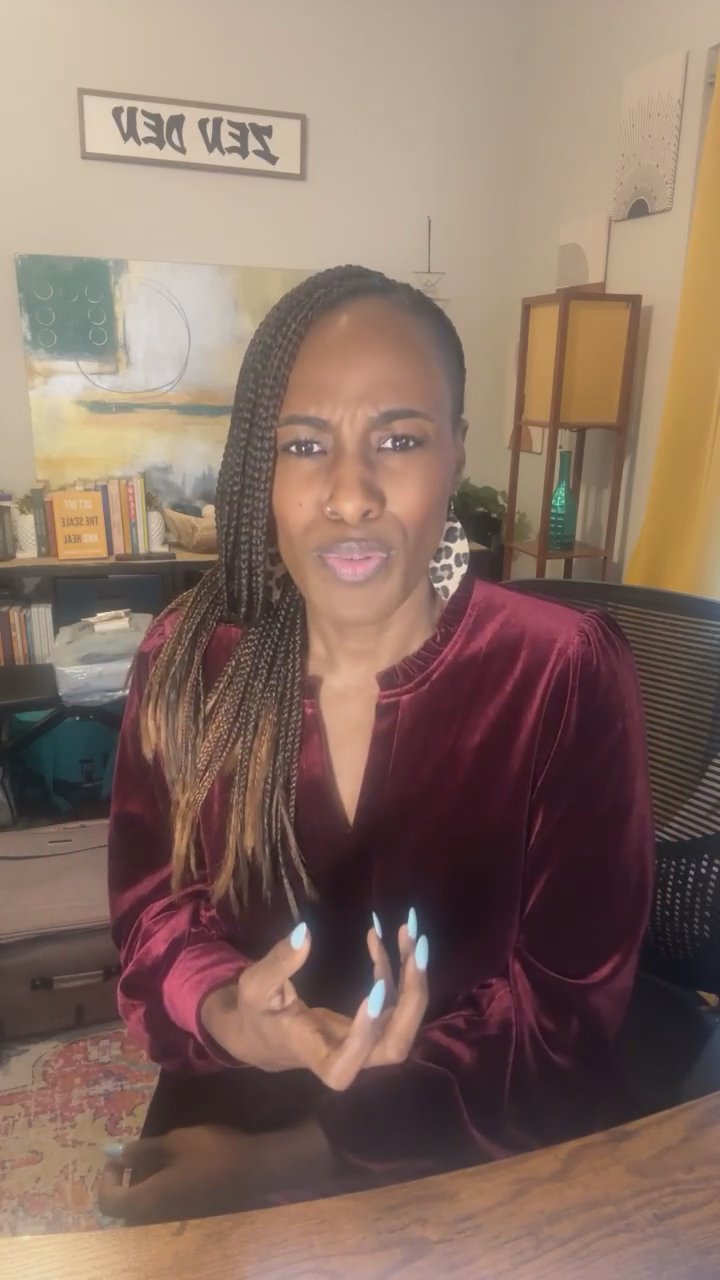
Dr. Charisse Johnson, a licensed therapist, explores the quality of thoughts, distinguishing thoughts from feelings and how narratives shape perception. She guides reflection on self-talk, influences on thinking, and the link between thoughts and boundaries.
Dr. Charisse Johnson is a licensed clinical mental health therapist, mindfulness practitioner and author. She wants to spend the rest of the year focusing on the quality of our thoughts. Happy Friday.
There's going to be a change to our time. We're going to stay here on Fridays at 8:00 through the rest of the year. The first of 2025, I'm going to move. If your plate could talk to Sunday evenings at 6pm.
Our thoughts are not always facts. They are, as a whole, emotional events. How you feel is valid. It is your truth. But our thoughts are very powerful. And even though our feelings are are valid, we have to take time to understand the connection between our feelings and thoughts.
What have you been saying to yourself about yourself, about other people? What is happening that might be influencing my thinking? Our thoughts are always typically going to fit our narrative. We have the ability to adjust our thoughts as we get information. Thoughts and boundaries are hand in hand.
Conscious fear. What is up? It's so good to see you. Happy Friday. If you're listening to this in real time, but whatever day it is, hello, good morning, good afternoon, good evening, what's up? You fill in the blank. This is your first time here. I'm Dr. Charisse Johnson, a licensed clinical mental health therapist, mindfulness practitioner and author. And I come into the space a couple times a week so. So that we can talk about all things life, health, trauma, grief, the world, all the things.
I know I need to like, straighten that up a little bit, but it's true. We're gonna get into what is real and what's happening. I do want to say this. I want to spend the rest of the year, it is now December 13, 2024, really focusing on. Hi Jackie, I'm so glad you could come in live. The quality of our thoughts. But before I get into that, thank you, Steph Irwin, for getting me together. Let's talk about where you're from and where you're at right now. Hello, good morning, Georgia. Good morning, Buffalo.
Let me say what's up to North Carolina, since that's where I am right now. Hello, Houston Rep. Your city, your state, your country, the one you're in right now, the one you want to be in, you decide what it all looks like. That being said, hello, Northern Minnesota. That's where we're going to spend time. Hello, Virginia. Thank you. I'm glowing. You know, it was a rough week, but today has been a beautiful morning. I will definitely say that. Hello from Erie, Pennsylvania. Give everybody another minute or so to come in.
Hello, Wisconsin. Are you saying that a 11 degrees here. Oh, my word. Hello from the ATL Kane, 1906, Minnesota. All the good things. But like I was saying, two things that are important. One, we're going to spend the rest of the week months talking about your thought life. And then two, there's going to be a change to our time. I know all of you don't like change, but I think this is going to be a really great change. We're going to stay here on Fridays at 8:00 through the rest of the year. The first of 2025, I'm going to move.
If your plate could talk to Sunday evenings at 6pm A couple of reasons why. One, it will allow us to focus the whole dynamic of if your plate could talk, what would it say? What's happening for you? What do you need to shift around at the beginning of your week? Right, that makes sense. So that you can really think about what you need to do in order to experience the kind of week you need. And it spaces things out. I know that you all see me on Wednesdays and Fridays, and that's fairly close together.
So now you'll see me on Sundays and Wednesdays. Number three. People who live in different time zones are like, Dr. Charisse, can you please get off of these early morning times? So I will. I will choose one evening time. It'll be interesting to see what I show up, like at 6:00 on a Sunday. I think it would be a little smoother. Anyway, I will announce that a million times. If you follow me, you're gonna see that announcement. We'll make it known. You'll see it happen in college. You'll be able to change your calendar, but keep that in the back of your mind.
Focus of today is Jackie. I'm glad you like that. You're probably like, yay, I'm actually free. Yeah, I think it'll be a good change. I was going to do this whole series that said 12 truths in therapy that may just change your life. And I could have just gone through all 12 truths, but these truths are so good, I didn't want to rush through them. So the truth that we will focus on the rest of the month because it is literally that big, is. Let me grab one thing. Okay. Is. And you're going to hear this.
And I don't think you're all going to like it. Thoughts are not facts. Pop in the chat. Tell me what you think when you hear that. What's the first thing that comes to mind to you? No judgment, just, you know, use nice words. Thoughts are not always facts. How does that land for you? Definitely a discussion that I've had with other people before. And such an important discussion because the power of our thoughts is astronomical. Right. Our thoughts impact everything we think. Yeah. I can repeat that.
Our thoughts are not always facts. Thoughts are not always facts. And so I want you to think about that. What are your first reactions to that? Robin, it sounds like you're having some clicking sounds. If anyone else hears that, let me know. I can't hear anything. But, you know, that could just be my first reaction. Is feeling not validated. Yeah. My self thoughts aren't how others see me. Yeah. So I want to break that down. It does not mean that how you feel is not valid. How you feel is valid.
It is your truth. But our thoughts are not always facts. Many times they can be. Let me give you a quick example. Before I even get into that, a little Bit. Yes. We have assumptions based on our past experiences, based on how we feel about ourselves. Let's say for an example, I'm somewhere and I see someone that I haven't seen in a long time. And in my interaction with them, it wasn't as warm and fuzzy as I'm used to. And my thought was, oh, interesting. You hear a click and a thump in all the lives.
Now that is something I will let it know. That is wild. No one has ever said that. So thank you. We will look into that. My interaction with them, then my thought is, they must not like me anymore. I must have done something to make them upset. That is my thought. That is my feeling. It is absolutely valid for me to feel that way. That is my truth. Because I didn't get something I needed from that exchange. But that thought is wired into my assumptions. That thought is wired into what I might be feeling emotionally in the moment.
Maybe I needed a greater source of validation. That thought isn't based on me asking that person, hey, are we okay? Has something changed? That thought, for example, isn't centered around me actually knowing the truth. So there is this dynamic of us understanding that our thoughts are very powerful. They are not always true. And even though our feelings are are valid, we have to take time to understand the connection between our feelings and thoughts, see what's impacting the way we think. I'll give you another example, and then I'll kind of pull in a few other pieces.
Let's say you're in a situation where you are having a horrible day. And when we have really bad days, if we're really honest with ourselves, that typically changes what we think about ourselves. And so let's say on your bad day, you decide you're a failure. I'm a failure. I can't do anything right. I'm failing at life. It's all terrible. We say that, let's be honest to ourselves based on our emotions of that day. That's a real thought. It's a real feeling. It's valid to feel that way when we're already feeling low or we feel like a number of things are happening in our lives, that stacking against us.
Then we come out of that mood state and we lift and our thought lifts as well. I'm not a failure. I'm overwhelmed. I'm overwhelmed by the number of things that I want to accomplish, that I don't feel like I'm doing the way that I want to. That becomes the reframe. So we have to keep in mind all thoughts are not facts. They are, as a whole, emotional events. Yes, Gwen. Their emotional reactions based on our current mood state, our hunger, our sleep, who's in our life at the time, what stressors are impacting us.
Their emotional events that come to life and are so layered. They're also based on our past hurts and things that we've experienced in the past. It doesn't mean that any of those things are important. I don't want you to leave here and go, well, great. Now I feel like I can't ever trust myself. That is not what I'm saying. What I want you to do as we think about, if your plate could talk, what would it say? Where have your thoughts been flaking? If you're doing this with me, make a big circle somewhere, whether you do it in your mind or on a piece of paper, and just begin the process of jotting down what you've been saying to yourself.
What have you been saying to yourself about yourself, about other people? Don't judge the thought, don't try to change the thought and make it nicer than what it is because you hear me talking. I want you to be really honest and go, what is the quality of the thoughts that have been on my plate within the last week? And then you may also, of course, do this after we're done. I want you to take some time outside of that plate, metaphorically, and go. What is happening that might be influencing my thinking?
Thinking right now? Maybe this is a high time of grief for you, as we are in the middle of the holiday season. Maybe you don't even celebrate the holidays and you're sick of everybody who does. Maybe you're going through a financial stressor, maybe you're going through a marital stressor. Maybe you're single and yearning for companionship and this is another time of year that you are overwhelmed by having to spend it alone. It could be a number of things. Things. But I want you to genuinely take some time to do that.
Now, normally I come in these lives and I give you all the things, right? I'm going to give you the neuroscience and here's these five things. But I'm not going to do that today. This is going to be a progressive series. I encourage you to start here, come back, and then make sure you're responding. All I want you to consider today and as you go throughout the rest of the week is all of my thoughts are not always facts. What else is happening? What else is coming, going on? What else could be at the root of this thought?
Make that plate Ask yourself, you know, certain things and then go, so I'm reading things. If a person has the same thoughts about what they are saying to me, is there real thoughts to me, regardless of it, if it's not their real thoughts that we're talking about as a whole? Yeah, very true. Our thoughts are always typically going to fit our narrative. That can change, Right. We have the ability to adjust our thoughts as we get information. But yeah, our thoughts are going to be centered most often around what we believe is true, what we need to believe is true.
And let's be real when we're in relationships. That takes work because you've got two different people with two different sets of thoughts that come from all of their stuff. And you really have to work to, like, readjust things and realize, like, wait a minute, I need to adjust this. Because me thinking this way might be impacting somebody else. It might be impacting myself. And then, yeah, when we set boundaries, for example, somebody's mentioning questioning a firm boundary that you set while you were grieving that loss and not wanting to experience that behavior.
Yeah. Thoughts and boundaries are hand in hand. And I think it's tricky because we might feel better because we're not experiencing that behavior. And then we think, maybe I can let that boundary down. I think a really great way of knowing whether or not we can adjust that boundary is to try it. Right? Oh, here's my thought. Maybe I can adjust this boundary. Let me try. It doesn't work. Boundary comes back up. Or if it does, then we can make adjustments. That's another key we'll get into that more is that we have the ability to adjust our thoughts, to take in new information, to take responsibility for where our thoughts have caused us to act in unfortunate ways.
Right. I will totally out myself. My thought life is. It's a lot. Hear me as a neurodivergent, as a person, as a human, as someone with historical dynamics of trauma, not excuses, just real. My thoughts can be all over, regardless of any degree or anything else. So it does take time to sort them, to write them down. What are my thoughts? What are they coming from? And often we'll find that a lot of our thoughts are rooted in fear. They're rooted in our desire not to experience something that we've experienced before or our desire to avoid something that we are concerned about can be a number of different things.
All that being said, the key is thoughts are not always facts. They are emotional events that are impacted by a number of factors in our lives, in our emotions, in our experiences. Take some time and just create some awareness around what thoughts have been on your plate lately? What are you saying to yourself about yourself, about others? And how are you responding as a result of it? How does it influence your appetite, your movement patterns, your sleep patterns, your social patterns? And then what else is going on that has you in the place that you are?
And then just leave it there? And then we'll reconnect next Friday and we'll pick up where we left off. I'm so glad you came and to spend a little time here. I look forward to seeing you next week. Have a phenomenal rest of the week.
Reactions and comments are for members. Joining is free and takes a minute.