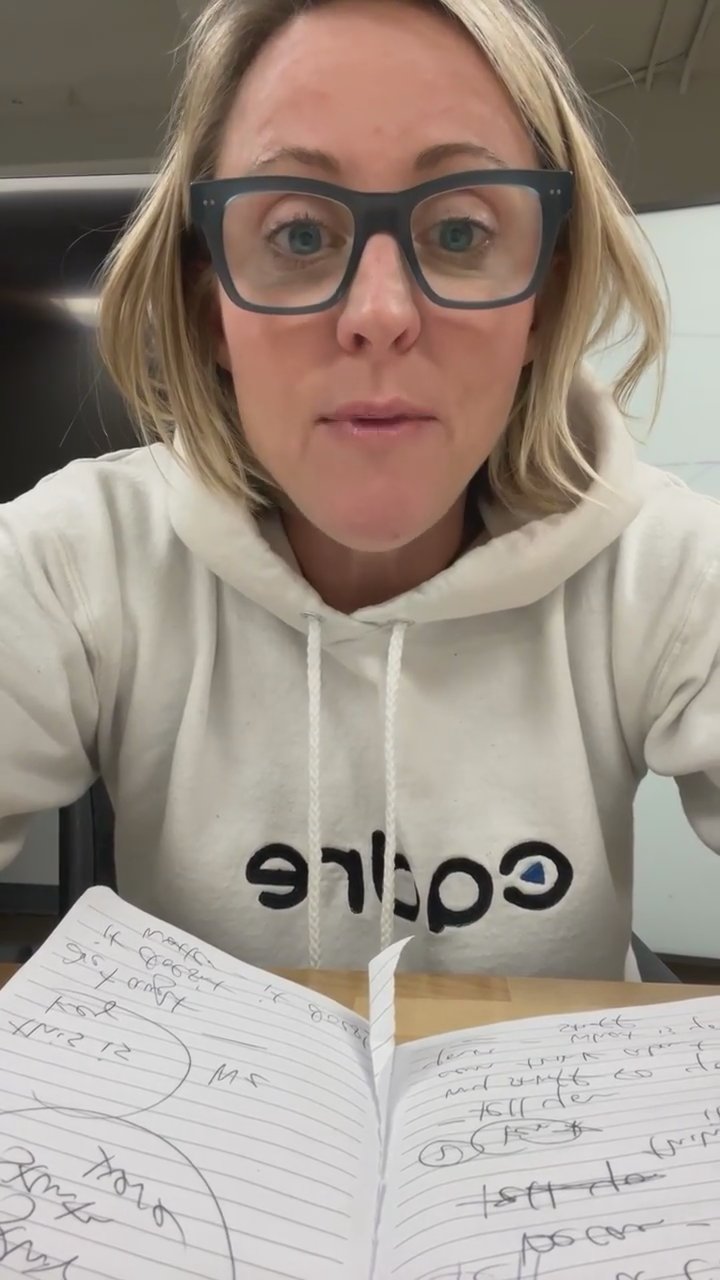
Shannon shares lived experience with cPTSD and caregiving while outlining a course-like series on self-love, offering actionable steps from nine years of therapy: grounding in your history, naming truths aloud, practicing changes and sustaining them.
Cadre. Happy Friday. Shannon, live from Cadre, with my Cadre sweatshirt on, of course. Here today not as a clinician, but as someone who comes to you with lived experience. I'm a caregiver for my child with autism. I have a whole bunch of acronyms.
Today is week two of a series, How I Learned to Love Myself. I was 40 years old when I learned how to love myself. This is what I learned in nine years of therapy. Took all of the information and put it into actionable steps.
Shannon: What is your stuff? Just ground yourself in your stuff. What are things that you lived through, as a child, as an adult, whether it's a divorce. Everything starts here with the acknowledgement of what you've lived through and the acknowledgement that it even exists.
My therapy started at 40. For me, it started with a knowing in my soul. The first step is to know that something is wrong. The second is to say that truth for you out loud. The third is to put that into practice. And the last thing is practicing it long term.
Cadre. Happy Friday. Happy Friday. Cadresphere. It is Shannon, live from Cadre, with my Cadre sweatshirt on, of course. Happy Friday to everybody. For those of you who don't know me and who I have never met, I am Shannon. I am part of the Cadre team. And I am here today not as a clinician, not as a person with any. Any clinical expertise, but as someone who comes to you with lived experience. So I am a person who lives with cptsd. I'm a person who lives with anxiety, and I'm a person who lives with.
Oh, my gosh. What is the other thing? Oh, I'm a caregiver for my child with autism, so I have a whole bunch of. I have a whole bunch of things on my list of acronyms. So I'm so excited you're here today. Hello, Jules. I see you guys joining. It's great to see everybody. So. So today is week two of a series, How I Learned to Love Myself. And I'm going to give you today a little bit of grounding in what this is going to be. And I'm going to start by telling you that this is going to sort of be a course, and I'm going to give you context as to why.
So I was 40 years old. I'm 48 years old now. I'll be 49 soon. And I was 40 years old when I learned how to love myself. And it was a process. And I'm going to tell you in a minute a little bit about me and sort of all the things I live with. But I first want to say to you that during the 40 years before I started therapy and before I started to learn how to love myself, I didn't know what it meant. So I struggled a lot. And people would say to me, it starts with loving yourself, right? Like, yeah, you're in this hard time.
You have to love yourself. You can't rely on a partner. You can't rely on external things. It starts with you loving yourself. And while I understood that in a theoretical sense, I think when it came to what to actually do with that, I did not know what to do with that. And. And I just sort of lived in a bubble or gray, right? I just sort of lived in a space of like, yeah, I get that. And then I just went on pretending to live my life in a way that I pretended like I was happy and I wasn't. So as a result of that, what I did was started therapy at 40.
I blew up my life. And when I started therapy, I Took all of the information that I learned over the nine years that I went through something called Air Network Therapy. And because in my day job, I'm a business person, and so I'm actually the COO of Cadre, and I love business. And if you ask anyone I work with, I love structure and strategy. I love taking information and putting it into actionable steps and saying, like, okay, we learned this thing. Now what do we do with it? And so that's what this is for, for me and for you.
This is a series that says if you don't know how to love yourself, if you're living a life that doesn't feel like you and you don't know what to do, here's what I learned. Take it or leave it. But this is what I learned in nine years of therapy. Okay, so I'm going to do two things today. One is I'm going to tell you a little bit about my own stuff, primarily so that you can think about your own stuff, too, and that's important. So as I just, again, share a little bit about me also, so that you can know your stuff is.
Is. Is normal, I want you to think about the things that you have lived through and why this is so important. Is that part of the key to all of these things, this entire process of loving yourself, It. Everything starts here with the acknowledgement of what you've lived through and the acknowledgement that. That it even exists. And I know that might sound crazy, but this may have been the hardest part for me, and it might be the hardest part for you. So I'm Shannon. I have cptsd. What does that mean?
That means that I lived through a lot of trauma in my childhood, and it means that I had a lot of divorce. I had religious trauma. I had a mother that wasn't the mother I needed. There was many people in and out of my life. There was emotional abuse. There was just a lot of things. And so I ask you, as I share those things about myself that I lived through and what I went through, I would ask the same to you. What are things that you lived through, whether it's as a child, whether it's now as an adult, whether it's a divorce.
So I also, as an adult, have lived through two divorces. My child has autism. I've lived through being a caregiver. I've lived through losing everything and then building it back up again. I've lived through just many, many things, and so have you. And so I think as we think about this again, if I'M going to reframe this as sort of like a course of like, hey, where do I start loving myself? Step one. And I actually put in the community, I put the five steps that I learned. Step one, where everything starts, is to think of yourself in this and say, what is your stuff?
Just ground yourself in your stuff. And if you can't put a name to it yet, that's also okay. So that's. That's. Number one, is as we go through this, and if. If it's writing it down, these are my notes. They're messy. That's okay. If you can't even write it down yet, that's also okay. But maybe starting there and just saying, like, hey, these are some of the things I have lived through. The list may be long, the list may be short, but that is really the first step. So as we go through this course, as we go through these learnings again, I have called it into five things, and those are what we're going to talk through in this together.
And so now I'm going to reference them, and they may not be verbatim to what's in the community. But number one that we'll talk through in this series is to know that something is wrong. Right? And what that means, I guess for me, how it presented is, like I said, my therapy started at 40. For me, it started with a knowing in my soul. When I remember being successful, successful that I had a house and I had two beautiful children, and I just graduated from grad school, and I had a husband and I had what.
What seemed to be the perfect life. And I remember very clearly sitting in my guest bedroom at my house and looking out the window and saying, is this all there is? And feeling deeply, deeply lonely inside. So for me, that was like a knowing and knowing that that's not supposed to be how I felt that the world would say, you have everything and so what's your deal? So that was sort of the start of my knowing. So again, that is sort of step one in my process of how I learned to myself is to first know that, like, hey, something's going on.
Number two is, now this is where I'm gonna get it messed up. I know I'm gonna mess it up. Oh, is to say it out loud, this is a step that can take a long time. For me, the way this manifested was actually related to my mother, which is a whole other topic and maybe very, very different for you, and that's okay. But step number two was whatever that thing that, you know, you start to know that this thing isn't right inside with you. Number two is to say that truth for you out loud. And it might be many, many truths, and it likely will be true many, many truths over time.
And that's number two. Number three is to start to see a world where X can exist. So essentially you've noticed something's not in alignment with who you are. Number two is you've said it out loud, right? So you're taking these baby steps, like, okay, I noticed this thing, now I'm going to say it. And you might just say it to yourself. Saying it out loud, by the way, doesn't mean you have to say it to another human. You might say it out loud to yourself. Number three is that now in your head you're going to go, what if it was different?
What if my world was different? What if it wasn't that way? What if this thing that scares me or this thing that is true, what if it wasn't? Number four is, I'm gonna again, get the words wrong. But number four is starting to put that into practice, right? It's creating that in real life. So beginning to believe it, putting yourself into that, making it real, just doing it once, testing it, putting it on for size, practicing it. And the last thing is practicing it long term, right? It's an ongoing effort of, oh my gosh, there's a thing.
I'm saying it, I'm imagining it, I'm doing it and I'm continuing to practice it. That's it. And I know that sounds simple, it's hard. And I'm going to talk through each of these steps in detail over time, but I wanted to share them with you today so you know what's coming. I actually have PDFs because I am a nerd and I am a business person with a ton of type A personality inside me. I have PDFs and I have all kinds of stuff to come that I will share in the community over time. But I just wanted to give you some insight into that.
And then again, just sort of underscore one more time that the key thing about, about this message today, where everything starts is what I said at the beginning, which is, you know, I introduced myself and I said, I'm Shannon and I have these things. And I think that's where everything starts in this entire journey of loving yourself, is that just starting to own who you are. For better or for worse. You don't have to say it out loud to anyone else, but just starting to take note of these are things that may have happened to you.
These are experiences that you had. They are not your fault. They are not good or bad. They're just things that happen to you. They're things that you experienced. And so I would just encourage you to just start to be aware of them and not judge them. And that's a great place to start when you think about how you can start loving yourself. So as we head into the weekend, I just want you to know that you are loved in the world, that you are valuable in the world, no matter what happens, no matter what has happened to you, no matter what you're going through.
And I know it. I've lived it. And so I want you to know that Cadresphere is a place for you to be who you are and be accepted and supported and honored and seen. So we're thrilled that you're here, and we'll see you again next week. I will probably add something in the. In the comments just to continue to keep this going, but I hope you guys have an awesome weekend, and we'll see you soon here at Cadre. All right, bye, guys.
Reactions and comments are for members. Joining is free and takes a minute.