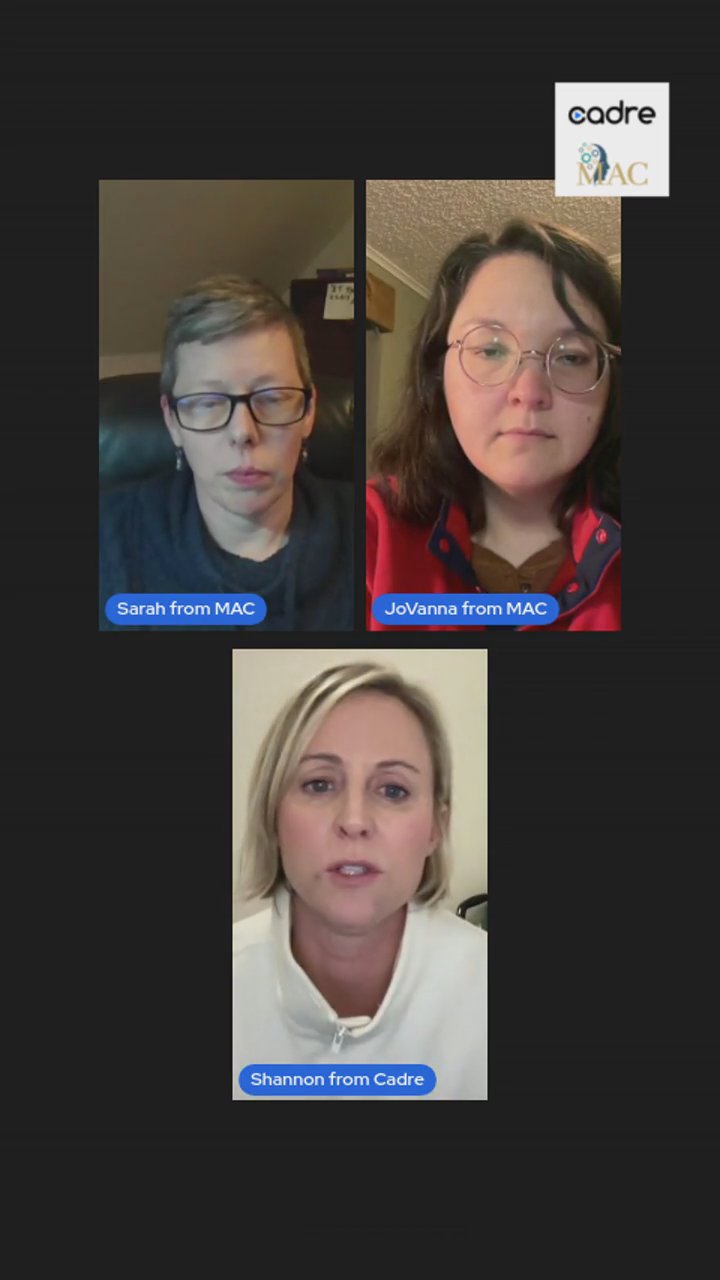
Join Shannon from Cadre, along with Sarah Monahan, Director of Speech and Language Pathology, and JoVanna Balquier, Speech Pathologist, from MAC Midwest, as we discuss all things Speech and Language Pathology—the science, the practice, and the reality of what it means when it's part of your or a loved one's treatment plan. If you or someone you know has questions about this but doesn't have access to professional support right now, that's exactly why we're here!
Shannon is hosting a live Q and A with Minnesota Autism center. She is also the mother of a child with autism. The event aims to give people access to information about autism. We love having you here tonight.
Sarah Monahan is the director of speech language pathology and occupational therapy services for Mac Midwest. She's been with Mac for just a little over four years. It's been really exciting to see the changes and in the team.
Giovanna is our lead SLP at Mac. During undergrad, she worked as a behavior therapist at an autism center in Nebraska. The transition for you over to the autism space is a newer one. There's definitely a lot of growing pains, a lot to learn, but luckily Mac has such a collaborative environment.
Cadre is a platform where it's kind of like social media for mental health. Mac Minnesota Autism center is our partner in that. As we go through, we want you to ask questions. Please just pop your questions in the chat and we will see them and answer them.
My son has autism. First person that raised the flag for us was a speech therapist. Speech therapy encompasses speech, language, communication, social, emotional development, cognition, and also Swallowing disorders. How that correlates with autism is that many individuals with autism have difficulties within those different areas.
SLPs might be the first to notice a difference in a child who maybe if, you know, exhibiting autistic traits. A lot of those differences have to do with speaking and thinking and swallowing. Because we have education in what, what typical development looks like, it's easier to recognize what is outside of what is typical.
Do speech issues automatically flag a neurodivergence? There are lots of speech and language and communication difficulties that occur outside of autism. What I would say about dyslexia and dyspraxia is that SLPs are an important member of a collaborative team.
Jovana: What are some of the common ways in which speech is affected or plays out with an autism diagnosis? What are there things that parents can generally expect when it comes to speech and autism?
Can you talk about early intervention with speech therapy? My son with autism was a little late with speech. I often wonder, if we had intervened earlier, if some developmental delays would have been less delayed. When parents have questions about their kids, it's great to ask a professional.
How do you know when you're making progress in speech therapy? My one that I look at often is like the child's participation in activities and also spontaneous self generated language. How does speech and ot interplay with each other?
You need to treat the whole child and not just the mouth. I've been trying to absorb as much information as I can from occupational therapist, physical therapist. Because it's all connected. That's amazing. I love that.
My son exhibits echolalia and I'm wondering if as a parent I should be doing anything to encourage minimizing it. I wonder how it be responded to in a collegiate setting or in the workforce. I like to think that our world is getting a little bit kinder to people who have different minds.
Sarah and Giovanna, do you want to say any final words? This has just been wonderful. I appreciate everyone that joined tonight and asked questions. We'll see you soon again in the Cadre sphere.
Hey, everybody. Happy Thursday from Cadre. Welcome to Cadre. I am Shannon. If you have never been here before, my name is Shannon and I work with Cadre. I'm a Cadre team member. Take off my glasses so don't get that reflection. I'm a Cadre team member, and I am here to host tonight's live Q and A with Minnesota Autism center because I am also the mother of a child with autism. And so I love these nights because I get to see my friends tonight at Sarah and Giovanna from Mac Midwest Minnesota Autism center, and they join us to help people who might not otherwise have access to information about topics that are important to families who are living with autism.
We love having you here. I bring the peer, or not the peer. I bring the parent perspective, and Sarah and Jovana bring the clinical perspective. And so we're so happy to have you here tonight. So, Sarah, do you want to first introduce yourself and just share a little bit about you, how long you've been at Mac, maybe where you. I know you are also in upstate Minnesota, if that's. I don't think that. Up north. I don't know. That's. Yep. Yeah, that would be awesome. Thank you, Shannon. Yes. Yes. So I am.
And thank you so much for having us. It's. It's such a great opportunity for us to be able to. To share our expertise and many years of combined knowledge between Jovana and myself. So, yes, I am Sarah Monahan, and I am a speech language pathologist. I am also the director of speech language pathology and occupational therapy services for Mac Midwest. And I've been an SLP for 18 years, and I have worked in every setting from acute care hospital, outpatient skilled nursing facility, elementary school, other outpatient pediatric practices, and here.
And I've been with Mac for just a little over four years, and it's been really exciting to, you know, to see the changes and in the team. And we've got Giovanna here, who is our lead SLP at Mac. I'll just let you say a little about yourself. Beautiful segue. Yeah. So I'm Jovana, lead slp, as Sarah said, and I've been with Mac for a little over a year now. Prior to that, I work worked in skilled nursing facilities, but during undergrad, I did work as a behavior therapist at an autism center in Nebraska, which kind of sparked my interest and passion with working with this population.
Awesome. Where in Nebraska? I just have to ask. I went to Nebraska. So we have to do the Nebraska connection briefly. Oh, awesome. Okay. So I'm originally from Nebraska City, but I went to college in both Lincoln and Omaha, so we crossed paths. I graduated from Lincoln, so go Big red. Got your red. Yeah. No one in Minnesota is from Nebraska, it seems like. So it's nice to be here. That's awesome. And so the transition for you over to the autism space is a newer one, you said in the last couple of years.
Yes, it happened last fall. There's definitely a lot of growing pains, a lot to learn, but luckily Mac has such a collaborative environment, and all of my peers are really good at fostering my learning. And so, yeah, it's just been a good experience. That's awesome. Well, so the way we usually set up these Q and A's, and I just want to set the stage for the conversation tonight. So Cadre, if anyone is brand new to Cadre, because I know some of you may be, Cadre is a platform where it's. Honestly, it's kind of like social media for mental health.
Right. So if you're on Cadre, it's a safe place to find support for and support and community for anything. Many things that people go through in life that are just normal human experiences. One of those things is being neurodiverse or caring for someone who is neurodiverse. And so Mac Minnesota Autism center is our partner in that. They've been our partner for a long time now, and we love them. And so they come on. We come on and talk about a couple of different topics. And so tonight, as you all watch this, please, we're here to be here for you.
So we are going to start talking and having a discussion, but as we go through, we want you to ask questions. Ultimately, this time is your time. And so that's why Jovana is here. That is why Sarah is here. So please just pop your questions in the chat and we will see them and answer them. So let's start at the beginning, though. I just really of speech language pathology, and I actually, my son. So my son has autism. He's 15 now. He was actually. He was diagnosed and the first person that raised the flag for us was a speech therapist.
So I would love to hear, just for the basics, for maybe someone who doesn't really understand what is the role of a speech therapist? What is speech therapy? And then how does that connect to autism? Maybe just starting there would be awesome. Do you want to just talk about our scope of practice generally? Sure. I will give you my elevator pitch, I suppose. So. Speech therapy encompasses speech, language, communication, social, emotional development, cognition, and also Swallowing disorders. So we do a lot within our.
And how that correlates with autism is that many individuals with autism have difficulties within those different areas. Yeah. Which is something I don't think people understand. And so at least I'll speak for myself. I think when people hear speech. Speech. Well, I think first of all, it's just a speech therapist typically is what people hear. And so I think people have the idea that that might be for I can't say certain words or you struggling to communicate. And so I'm just going to again, be the human in the room and the parent.
And so just when I googled what is a speech pathologist and what does it do? It really is. It can get into, like you said, swallowing. It can get into connected to food and connected, I think, to sensory elements as well, Correct? Yeah, for sure. So I think. Could you talk a little bit more maybe, Sarah? Just about. How does. I'm assuming that's not. Like, where do you just. Do we start with all those things as a parent or does that come further down the line? So I have two children, two neurodiverse children who, in my own journey as a parent, I have often thought, how on earth does anybody raise children without graduate courses in child development?
Yeah, yeah. And so, you know, and when I was, when I, when, when My oldest was 7 years old and needed to explain to his friends at school, what does, what does mommy do and what does daddy do? It was way cooler to say daddy helps people with their computers and I needed to have this visual like mommy helps the people with speaking and thinking and swallowing. Yes. And so, and so in within that realm, you know, I think that one of the reasons that SLPs might be the first to notice a difference in a child who maybe if, you know, exhibiting autistic traits, is that a lot of those differences have to do with speaking and thinking and swallowing.
And so because we have education in what, what typical development looks like, then it's easier to recognize what is, you know, outside of what is typical and have a better understanding of what a normal variation in communication might look like. Because there's lots of parents who, you know, get unsettled by something that they're not used to and might say, oh, does my child have a problem? And you know, and so it's. We're also in a position to reassure parents that, you know, what a lot of four year olds can't say they're ours.
And you know, and that is part of a normal variation at that age. Got it. And we just Got a question kind of to tag into that, Sarah. And also I've been sick, so apologies if I cough. Cause I think I might, but excuse me. So the question is, and to that end, it's a great question, do speech issues automatically flag a neurodivergence or do some people just have speech issues absent of neurodivergence? And I think that's a fantastic question. There are lots of speech and language and communication difficulties that occur outside of neurodivergence, which is again, something that I came into speech therapy via my son's autism diagnosis.
But there are so many I have found as I become more familiar with it, and I'm not going to get the names right, like dyspraxia, dyslexia, and I think those are all, and forgive me if this is wrong conditions that speech therapists work with. Is that right? Yes, yes. I mean, what I would say about dyslexia and dyspraxia, which also fall under that umbrella of neurodivergence, that SLPs are an important member of a collaborative team. Got it. To address those things, because a reading specialist, not every SLP is going to be a reading specialist.
And there are really great reading specialists and people who specialize in learning differences like dyslexia. And when you're talking about dyspraxia, also known as apraxia or apraxia of speech, which is what. Can you define it just so people know what that is? Sure. So apraxia praxis is the carrying out of motor sequences. And so apraxia is a motor sequencing disorder that. And so what the brain has in it to convey, I think we really take for granted the sequencing of fine motor movements, I mean, which are fingers, right?
Those are little things. We do the little things. But if you think about how many little muscles are in the mouth and how many ways our mouth touches parts of itself to make the sounds that we're making. I mean, if you think about the. The quick brown frocks, fox jumped over, the lazy dog. Right. Or whatever, that the number of, of sounds that need to be sequenced accurately to convey that message is absolutely mind blowing and something that we take so for granted until we, you know, substitute a sound and then whatever we say has a totally different meaning.
You know, I mean, we've all had the experience where, I mean, if. If I say bat instead of pat, then, you know, somebody could do damage to somebody. If I say pat the dog and somebody bats the dog, like. And so that's like. That is a Minor, minor difference. And so if you have difficulty, if you're, if you're, your frontal cortex has difficulty putting the sounds in the right order and motor movements in the right order, it's going to be really challenging. And that's, that's kind of. So that's so interesting.
And again, I am a, I am a quorum of one. So that means nothing. But what I say means very little. But I think what's interesting is I think when we hear speech therapists, we don't think of any of that. Like even just the equation of what you just said, that equating speech therapy with fine motor skills. I don't think of my mouth. I don't think of my mouth at all. And so I think as caregivers, and that's the only lens I can speak from, it is now I'm sort of making that connection in my own brain to what you're saying and what you all see as clinicians, which is there is this whole like huge scenario or this whole big process happening in, in these kids brains that has to come together to hit, that we take for granted.
And so when a speech therapist goes in there, that's the stuff that you all are working on. Is that right? Yeah. That's crazy. I mean, it's amazing. It's crazy in a good way. It's an amazing. It's amazing because that's so much to pull apart and just sort of. It's just a lot and I think a lot to again for a parent. So if that's the case, how might that manifest? How might something like that manifest that I would see as a mom or a dad or a caregiver? Are you talking about specifically for apraxia?
Well, if I'm getting off topic, take me back. But I'm just trying to think of, I'm putting myself again in the parent lens. So if I'm someone who might not have access to a clinician or might not have access to resources, what am I? What should I be? How am I going to know if something my kid is doing from a speech therapist lens? And even just going back to this question is a flag for neurodivergence. I would say obviously you want to be as familiar with norms and stuff, but I mean, I feel like there's probably an internal point where you're like, okay, they're not talking yet.
They're having these big behaviors over things that are probably, we would feel are minute, like maybe a certain type of clothing or eating something that's different. Those Are those are red flags. And then as far as, like, apraxia, if you're trying to get your child to imitate you saying ball, and you can see them really struggling to get that word out, but they're not getting any sound out or completely different sound out, that could be an indication that maybe there is an apraxia of speech component.
Interesting. Okay, Sarah, do you want to. Is there anything, Sarah, you'd add to that or just different. Yeah. So one of the. I think one of the hallmarks of apraxia of speech that differentiates it from other phonological disorders or disorders of speech sounds is that, you know, if somebody is struggling with making the S sound, for example, and they. And they consistently put their tongue between their teeth, you know, either because their teeth are formed in such a way that it's really hard for them to bite their teeth together or for whatever reason, or they can't.
They can't hear the difference between this sound and the th sound. Right. That's a phonological disorder or sometimes just an articulation disorder. If they can hear the difference and it's just teaching them to say it, that's articulation. But if they're having a hard time discriminating between the sounds that they are substituting or. Or having a difficulty with, that is more like a phonological disorder. And apraxia is that the. That the speech sound errors that they make may be inconsistent, and so they don't make the error every time, or they make a different error in the same word or.
Or their. Their. Their vowels are inconsistent. Okay. That the inconsistency of the speech sound mispronunciations or whatever. Yeah. And so to that end. Forgive me. Excuse me. To that end, what are some of. Or are there common ways in which speech is affected or plays out with an autism diagnosis? Like what. What are there things that parents can generally expect when it comes to speech and autism? Or is that even a fair question to ask? I think that there's a lot of variety. So you can't. So it's not even.
It's not even a good question. Not in a bad way, but it's just not a. Like, it's not. It's every. Every. It's the saying that every kid with autism is one person. Yes. Yeah, that's exactly what I was thinking of when you asked that. Yeah. Yeah. So can you just talk a little bit about that? Just so. Just so parents, I think, can understand how when a child comes into your office or an adult even comes into your office, what are the first things that you start to think about or see or look for? Jovana, you have a number of clients that you see that and some of they.
And I know that your caseload has some variety in it. Do you want to talk about some of the sort of variety of goals that you work on? Yeah. So it's called autism spectrum disorder for a reason. So there is a large spectrum. I'm working with certain individuals on pre linguistic skills. And so what that looks like is really trying to establish social motivation. So working on not eye contact, joint attention, and finding motivating items or activities for them and then sharing that joy so that they will then be more apt to want to communicate with me.
I'm working with other individuals on discriminating pictures so that we can eventually work towards larger communication systems. And then I have clients who are non speaking who I am trying to trial various speech generating devices with them to see what best fits their means and makes the most sense for them and provides them with a robust language system. And then I'm also working with kids who are fluently speaking but need a little bit more support in learning early literacy skills. So things like rhyming and identifying, excuse me, identifying the phoneme when shown the letter and then working on sequencing vocabulary to tell narratives because that's a really good skill to have for academics.
Yeah. Wow. Okay. So it's everything from. And again, I think this is what's so enlightening for me is. And again, my son has had speech for years and years, still has it now. It's really what you work on is everything from like even that shared attention you talked about way back in the beginning, which again is a behavior which is just interesting versus the child saying something or the human. It's not tied specifically to language. It's a social behavior which is just sort of like, I think for me, shocking.
Just, I didn't know that. I think it's good for parents because I think again, I'll just speak for a parent for a second. You don't know what's encompassed in those words. When someone says a speech. I know for me it was like speech and ot and I'm like, I know that OT is his body, I think, and speech is what he says. And I don't really know even to this day truly what falls in each of those buckets. I know that collectively they work together. So hearing, you know, even just you explain the breadth of what happens is just really fascinating.
And I think so good for parents to Know, I also wonder if that would incent parents to seek help sooner because it feels like it's more. Might feel more meaningful if they can make that connection to behavior. Right. And I think that's something that I talk a lot about with staff at our centers. Is that really the foundation for communication? If we're thinking of it as a pyramid, the bottom is regulation and the child feeling safe. But then right on top of that is that social motivation. So without those, the child's going to have difficulties totally having the ability to learn and then communicate.
Yeah. Well. And this is perfect setup. So we got another question. Another great question. Honestly, can you talk about early intervention with speech therapy? My son with autism was a little late with speech, and perhaps we should have noticed it earlier, but we explained it away, which is very, very normal. I often wonder, if we had intervened earlier, if some developmental delays would have been less delayed. Okay, I need to jump in with this, because first of all, I need to say to that parent, you're doing great.
Thank you. And there's that. You know, as a parent, I can certainly look back on decisions that I made with my kids because I was doing the best that I could with what I had to work with. And if I knew then what I know now, I would have made a different decision. A thousand percent. And I agree with you. This is why we love Mac, by the way, friends, because this is how they are. But 1,000%, whoever asked that question, I just want to double down on that. You're doing fantastic. Yes. So I just needed to make sure that that was heard first.
Thank you. Thank you. And. And so early intervention with speech therapy, and Giovanna can speak to this as well, is, you know, I think that when parents have questions about, you know, what's going on with their kids, it's great to ask a professional. And I do also know that sometimes you can express kind of a. Just a little niggling concern in the back of your head to your pediatrician and have your pediatrician say, your kid is fine. And as a. As a parent, you can still have that concern. Trust yourself, you know, and there's also times when.
When pediatricians say, what do you think? Like, do you think your kid. I don't know, your kid doesn't eat very many vegetables, you know, or whatever it is. And you, as a parent might say, I really think that my kid is okay. Yeah. And I would say, still trust that and keep asking questions, you know, And I agree. I mean, go ahead. Sorry. Yeah, no, I mean, certainly accessing the resources and getting your questions explored with professionals is a really important step. And it's a really hard step.
And like, and not every time do two parents agree on what the next step should be. And so there are so many barriers to that early intervention piece for a lot of parents. And so when we do early intervention, you know, some of the things like Giovanna was talking about establishing that, that joy with, with real little kids is absolutely at the heart of what we do in speech therapy. We want to get down on their level. We want to get into their world. If they want to bang a dinosaur on a castle, like we want to take a dinosaur and bang it on the castle too.
We want to get into their world so that it builds a bridge. Right. It helps them to feel safe, it helps them to feel validated and it helps them to, it just increases the likelihood of them connecting and being motivated to communicate because motivated. Motivation to communicate is powerful. Yeah. Yeah, I agree. I love all of your answer. That was great. I agree. I just, I just want to also double down on it again as a parent because I'm rereading the question and it's just, it. Yeah, you can't, you can't go back and punish yourself because you know, when my son was a speech therapist brought it up to us and we had a son, we had another son first and I didn't notice it like he was, you know, so.
And I remember when she brought it up, I was like, surprised, like, oh, huh. So I just think, you know, we all do our best and yeah, I just love that you pointed that out, Sarah. So thank you. Colleen also, who's our producer behind the scenes says, now I'm crying. So, you know, feel the feels. That's always a good sign. Okay. So someone comes in, they're going through all of that and we know, we just talked about all the things you all are looking for. How do you know when you're making progress in speech therapy?
Like what, what things should we be looking for that is that are wins? There are so many different factors that you can look at. My one that I look at often is like the child's participation in activities and also spontaneous self generated language. Many kids with autism have echolalia where they tend to repeat things they hear either immediately after the fact or they will script shows or movies or other bits of media that are meaningful to them. So I work with many kids on introducing them to different models of language that they can utilize throughout their day to day.
So when they start using those Pieces that I've been teaching them and then breaking them up and making their own phrases. That's a big win in my book. And then also independently using speech generating devices. I started with a kid last fall who was using a very basic communication board and is now using a speech device with a maxed out grid. Granted, a lot of those buttons are hidden, but it's still. I mean, that's. The progress is evident because he's able to tell you that he wants to go to YouTube and watch Super Mario and he wants you to rewind the video when before it would have been a behavior of a big screaming match because he was unable to communicate what he wanted.
That's awesome. That's. Yeah, those are definitely. That's amazing. Yep. And getting them. Getting them out of their world. Right. Or just sort of connected to others, connected to it, to everybody else. Yeah, Yeah. I would echo the. The initiation. Right. Like, because there are. There are a lot of autistic kids who can learn to imitate, who can learn to respond, who can learn to follow a prompt if you say, say hello to your friend. And you know, there's a degree of prompt dependence that can occur when their only communication is because somebody tells them, okay, it's time for you to communicate now.
Or just the only time they communicate is when somebody asks a question. And that those breakthrough moments like Jovanna was talking about are like when a child initiates communication with you, gets your attention, like, approaches you, like, puts their hand on your arm to get your attention, taps points at something, wants to show you something. Like, that is. That's. That's just a beautiful, beautiful. And so how do you, when you think about the work you all do, how do you think about it being integrated into, like, you know, I was mentioning before OT or the school setting, as kids, you know, get a little bit older and they're engaging into that sort of, hopefully if it's available, that full spectrum of care.
How does speech, I mean, even just like speech and ot, for example, how do those two interplay with each other? And how do you know what makes one child. Sorry, now my questions get rambling. I know that they do. And I think my other question is how do you know? And what's speech versus ot? That's a maybe that's the question. So those are two questions. I'm so sorry. There's a Venn diagram because there is some overlap. So speech therapy, again, thinking, speaking, and occupational therapy works on more of the fine motor movements, but they also work on cognition, visual Perception skills, which speech kind of dabbles in and then that sensory integration and sensory regulation.
And they also do feeding side of things when it comes to like getting the food on the silverware and bringing it to the mouth. And then from there speech therapy kind of takes over. But they also deal with the sensory component of foods too. So there is, there is a lot of overlap. One thing I love about working for Mac is the that there is so much collaboration. So whenever I am stuck on a kid, I really talk to my occupational therapy counterpart as well as behavior therapist to see what the child's sensory needs are to ensure that I'm meeting those needs so that I can work on our communication and language goals.
And then whenever we have a kid that is going to transition out of Mac, we generally have a meeting with the school and kind of determine what that transition will look like. And depending on that kid, it might be a quick transition, two weeks and they're in school full time. Or usually it takes a little bit longer to phase out, but we try. And again, I'm speaking just with my specific Mac building, but we try to utilize the same language, the school is using the same visuals and then we'll troubleshoot any issues that they are seen in school in terms of communication or behavior needs and vice versa.
Yeah. And as our learners get to be school aged, you know, another place where that speech and OT overlap happens is in executive functioning skills. Right. And so that the ability. Yeah, so, yeah, so executive functioning skills are the ability to plan, make a plan and understand what steps are in the plan and carry out the steps in the right order to complete the plan and as things come up, modify the plan if needed and continue toward the goal. I like to think of it, I've described it in adults.
I've described it as like, okay, so you're, you're, you're driving across town to the flower shop, right. And you, you know where the flower shop is, you know the route to get there. You know what, you have to get all the things and you get in your car and you drive partway there and oh, there's a construction site. Executive functioning is getting your working memory and the new input, the new information and making and working with those things together. So, oh, this wasn't here last week when I drove to the flower shop.
So I need to go on this different route and then the ability to reroute and then get back in so and actually make it to the flower shop. Remember what it is that you got there for and then making it home again. And maybe not running into the construction because you remembered to go around. It's like what we did pre cell phones. It's like what we had to do when we had maps back in the 90s. Myself. Yes, yes. But executive functioning skills, like you know, sequencing skills. Sequencing is really important for speech and for communication and for putting a sentence together.
And sequencing is also important for learning how to get your clothes on in the morning and. Right. And make your snack and remembering to put the bread away and all of those things. So got all the parts. So we've got our bodies, we've got our brains, we've got our. And then it does like, it extends into like our daily living skills. So. So it really is like everything like you said Giovanna before, it's like this Venn diagram that everything's overlapping which I think makes it. It does make it from the outside it makes it feel complicated because you don't really know what's doing what.
Just know that altogether it's like a big stew. And if you do it all, it works. But it is an interesting. That's. I love that you guys are pulling this apart for us. Cause it's. It's like, it's so helpful to understand because I truly never understood until right now. And I've had this. My son's had his diagnosis for 13 years. So this is kind of crazy to me in a good way. One thing that I've been reflecting on a lot lately that I've heard somebody say that I admire in the field of speech pathology is that you need to treat the whole child and not just the mouth.
And so I've been trying to absorb as much information as I can from occupational therapist, physical therapist, so that I can better do my job. Because it's all connected. It is. That's amazing. I love that. That's a beautiful. That's fantastic. Okay, you guys, we got another question and I'm gonna say this word wrong. My son exhibits echo. Echolalia. My son exhibits echolalia and I'm wondering if as a parent I should be doing anything to encourage minimizing it or if it's something I should be supporting as a normal behavior for him as a high functioning 18 year old.
I wonder how it be responded to in a collegiate setting or in the workforce. Great question. Oh, take it. Okay. Okay. I. I am very neurodiversity affirming and so I don't think there's anything wrong in it. But I would say I would encourage if he's scripting a line and, you know, he's frustrated, acknowledge his frustration and maybe give him the language he can use and then maybe a strategy to help him through that frustration as far as how it will be responded to in a collegiate setting or in the workforce.
I like to think that our world is getting a little bit kinder to people who have different minds. And I also know that, I mean, my husband and I will quote the office to each other back and forth. And I feel like it's. I mean, it's not as uncommon as. Yeah, see, you know. Yeah, yeah. And I would also. I would also. I would add to that that, you know, supporting it as a. As a normal behavior for him. Absolutely. Affirm your child. And if you understand something, like, if you understand, oh, he's using that script, and I understand the context of that script, so I understand the meaning of that script in a way that somebody who is unfamiliar with him.
I think that it's okay to interpret that if you're in conversation with other people and to talk about it. Yeah, yeah, yeah. And helping your son to be an advocate for himself and to help him by, you know, modeling language, that might be a key word to help people understand what the. What the echolalia or what the little piece of script means can be supportive. And it's. It's true that you're. There's. There are going to be jerks everywhere. Like, and they are, I believe, and I continue to believe, the minority.
Like, I really think that. That people are kind and good and. And welcoming in general and that when we. We will all. It's all of our job to. To cultivate spaces in which people can be heard and seen in. In exactly the ways that they show up. Because there's so much more to anybody than just like, how they appear or present in. On any day, in any context. I agree. I think you just. I think that was a mic drop, Sarah. I'm trying to think of an office reference now. Jovana. I'm sitting here going, God, what can I.
Michael Scarn. Yeah, there you go. There you go. I was trying to find a better fitting one. It didn't work. But that is fantastic, you guys. Our time flew by. It's already 8, 8 45, which is insanity. It's already over. This has been so great. I appreciate you both so much. I appreciate everyone that joined tonight and asked questions. I feel like I was just so enlightened tonight about the work you guys obviously both do as individuals, but also just the work that, you know, mental health professionals and speech language pathologists and ots, and everyone does in support of all these families and kids.
So thank you for everything you do. Thank you for being such loving, beautiful individuals also who are like, treating the whole person. And to Mac, thank you for being our partner. And to the Cadre sphere, thank you for coming tonight and being part of our Cadresphere. So we will see you soon again. And I think that's it. Sarah and Giovanna, do you want to say any final words? Thank you so much for having us. This has just been wonderful. Yeah. Thank you. This was a good time. Awesome. All right, guys, well, we'll see you soon again in the Cadre sphere.
Bye, guys.
Reactions and comments are for members. Joining is free and takes a minute.