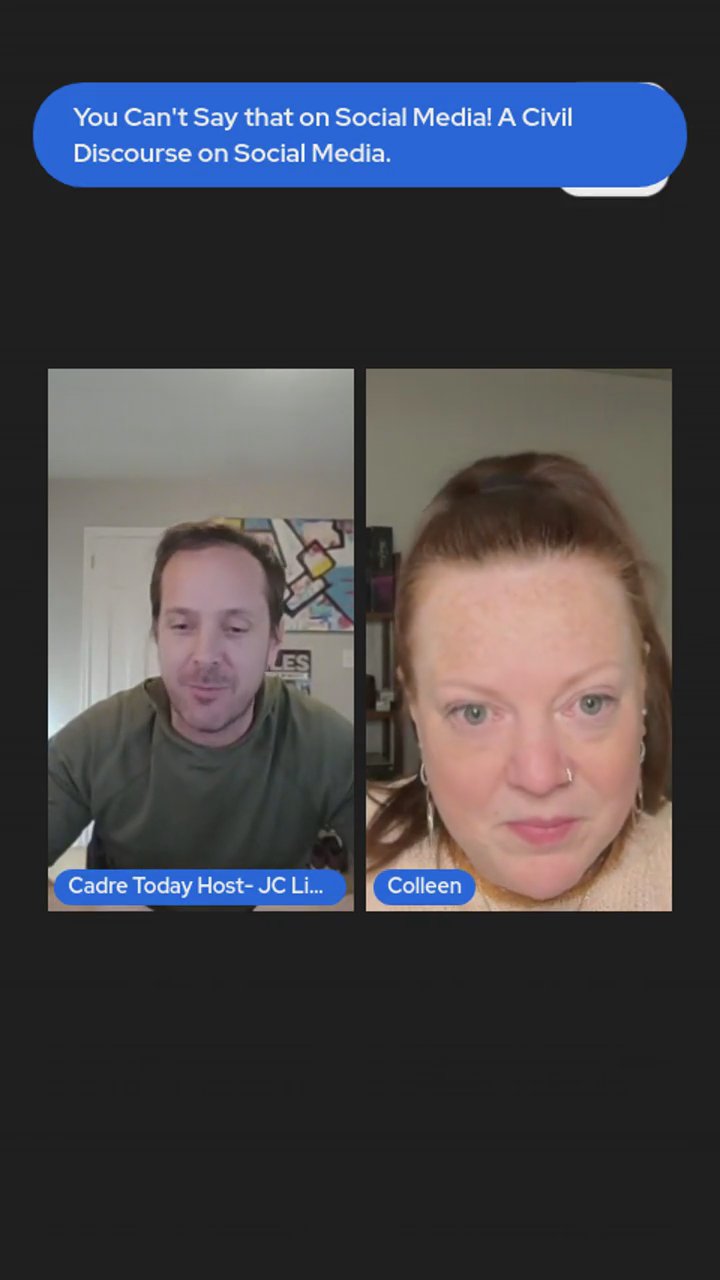
Social media is a funny space. And yet, it is one with great power and potential to positively impact and change the world. Join us for a civil discourse on social media where they'll discuss ways in which we can use this beautiful tool to connect with others to talk about the real stuff that is front of mind and deep in heart.
This is our maiden voyage of. You can't say that on social media. But guess what? We can right here in the Cadre sphere. And we're going to talk about it right here. So far, we have L846718 tuning in.
Sex, religion, politics. Those are the three things that you can't talk about in public. How do we have conversations about things that maybe we don't necessarily see eye to eye about? Now's the time that we need to start practicing and flexing those muscles.
What is the actual human thing that we can connect to in the conversation? It's not about how certain groups view things. But rather it's about, like, where is the common ground where we can start this conversation. And that's all we have to do.
The idea of food is now highly, highly politicized. It's not only about finding the human element in it, but it's also recognizing that the other person you're in discussion with is also human, and they're having a human experience also. Lead with appreciation and assume.
J.C. Johnson: I think if we assume connection and lead with appreciation in every conversation. He says it starts with how we would like to be treated and how we treat ourselves. Johnson says if we can enter every interaction with assume welcome and extend welcome, then we're golden.
One thing we all do when we're home alone is dwell on things that people have done to us in the past. Sometimes when you're in that airing of the grievances, I call it writing a strongly worded letter. If you've put those words out there, those are out there for good and not for good.
J.C. says we get choices about who we interact with and how we interact. He says with intention, we are going to be living intention of that thing impacting our lives. As we wrap up today, everybody, it's in our nature to share that take home prize.
We want to talk about how that bite feels and how those itches feel. Do that with compassion and with love and understand. See the humanity and scratch your itches. We'll be back two weeks from today in the Cadre sphere.
Sa. Well, good afternoon, Cadre. How are you doing out there? I hope you're well. Colleen is with us today. Everybody. Colleen, Hello. Hello. Hello, Cadre. I'm. C. this is going to be fun. Yeah, I agree. And if you're going. Wait, what. What are we doing? What are we doing? Well, this is our first. This is our maiden voyage of. You can't say that on social media. And yes, we need to go ahead and make that into, like, the sound. Like, we need to put that on our soundboard. Right. Someone see that on social media?
Yes. Okay, bonus point for anyone at home. When you hear you can't say that on social media, what does it remind you of? So far, we have L846718 tuning in. Junk food Junkie. Luke, Anna, Shannon. What a great crew here, y'all. Hello, everybody. Thanks for joining us. So you know the title, but what are we really doing doing this? We know that we live in a world where social media is the. The headline. Is social media bad? And of course, Cadre is saying, actually, social media is a pretty powerful tool that we can use in ways to create space with professionals and peers, to foster resources and build a community, to show the world there's many ways of being.
Well, that's what we're doing here, using social media. But we also know sometimes we go, well, what can we say? Or what shouldn't we say? So this really is that space where we are going to start laying out maybe those things that you keep under the desk or you throw in the closet that you don't know how to bring up. And Shannon gets the extra point. Shannon says you can't do that on television. Yes. For all of y'all, old millennials, young Gen Xers who grew up with little Nickelodeon in the 80s and 90s, that wonderful classic television show.
You can't do that on television. But guess what? We can right here in the Cadre sphere. Yes. And we're going to talk about it right here in the Cadre sphere. So, Colleen, why don't you kick us off. If you think about social media in 2025, what are those things that come to mind first, about the taboos, the cans, the can'ts, the things that kind of fill your cup and the things that. So, you know, I was raised in. In a family where we. We abided by the three things that you can't talk about in public.
Do you know what they are? Sex, religion, politics. Those are the three things. Like, if you want to keep friends. If you want to win over and influence people, you just. You steer clear of those things. And, you know, we did. I mean, we were pretty good about that. Unless we were in circles. Right. Where, you know, maybe we were with church friends. Then you do talk about religion, but, like, you never talk about sex, and you definitely don't talk about politics. We just keep that, you know, under wraps.
Unless you're talking to somebody you agree with. Yeah. And that is the thing that I think we are seeing so much of right now on social media. It is no secret. Right, that we are living in a pretty divisive time. And so I think a lot of times people want to have engaged conversations about things that might be political, but might not be political, but maybe have been politicized. They want to have those conversations, but we lack the skill of doing that. We lack the skill of actually talking to people who we.
Who we maybe don't agree with, who we might not see eye to eye with. We have not honed that skill because we've abided by the rule. We don't talk about sex, religion, politics. Now, I don't know what you get up to in your own personal life. And maybe there are lots of things that we have called taboo at different times that maybe we need to pull back the curtain on. And certainly mental health is one of those things. That's exactly what we're doing here at Cadre is bringing those things out into the light.
But I think now's the time that we need to start practicing and flexing those muscles. How do we have conversations about things that maybe we don't necessarily see eye to eye about? Colleen, you just framed this so wonderfully well. And the first thought that comes to my mind is one of my favorite thinkers. Her name is Beth Comstock, rad woman who saved General Electric from bankruptcy, saved NBC Universal from bankruptcy. She said in 2019, that change is happening slower now than it's ever going to happen again.
Said that in 2019. Interesting. And then we think, well, 2020, very much was this inertia shift where we felt like everything was. Was moving faster and it was out of control. But in those areas, what do we do? We start making assumptions. Yeah. Writing this. Okay, well, we can't talk about this here. And. Well, why can't we leave this here? And at the end of the day, what I hear you saying, Colleen, is how do we. Just like any other skill set, how do we flex and build the muscle for going. No. Well, in reality, everything is politics.
Every. Everything is Wrapped into stuff that we believe or care about. Meaning maybe that fits in the religion bucket. And at the end of the day, we are a part of creation. Everything is a part of this world of the sex word. Right. Where it's like we are all in relationship with one, with one another. Right. Cadre is one of those catalysts that's helping all of you out there flex and build the muscle for going, I really need a space to talk about these things. Yeah. Is it. It may be right here. Well, and I mean, we do, you know, to that.
To that point, right? That idea of flexing the muscle. Like we, we live in a really binary world where it's like, either it's good or it's bad. You do it or you don't do it. Right? Like, we talk. I mean, listen, I don't want to get off track, but like, we talk about that with food. Food is bad or good, Movement is bad or good. You know, certain beverages are bad or good. This behavior is bad or good. Talking about politics is either bad or good. But there's gray areas everywhere. And especially when it comes to talking about politics, religion, and by the way, junk food Junkie weighed in and said, growing up, I was taught about those three.
Sex, religion, politics. But also don't talk about people's race. Which again, is interesting. Right. Because I think we are not artful in this day and age, and I'll cop to it myself, I'm not artful about talking about race because we were taught differently in the 80s and 90s about how to talk about race when I was in my formative years and working through school, that you don't. You don't. I don't see color. We don't talk about that. We don't exactly. And that's just not true. And so one of the things that I try to think about for myself when I think about that, those places in life where maybe we've had a binary understanding, like, you don't talk about it, or you do talk about it, or you can talk about it, but only in these circles is what is it that we're actually talking about?
Like, let's actually get to the nut. What's the. What's the theme of what we're talking about? Right? So maybe there is a. Like, maybe. Let's just. I'm trying to think of an example without going, like, completely off the rails. But, you know, what is the actual human thing that we can connect to in the conversation where it's not about how certain groups view things? And how other certain groups view things. But rather it's about, like, where is the common ground where we can start this conversation?
Where's the human place where we can start to. To start. To start. Yeah. And that's all we have to do. We don't have to get to a resolution. I don't need to move you from where you are to where I am. We just have to find the place where we can find our humanity together. Right. Thousand percent clean. Something that you and I, you and I kind of talked back and forth about prior to this conversation was this analogy. And everybody who's listening right now chime in on what those things are that you go, gosh, I really need a space to talk about X.
And even though it may be related to Y, what I need to talk about is X. Here's the analogy. Think about that mosquito, the mosquito that flies around, and all of a sudden it lands on your arm, it bites you, and it flies away. What do we end up talking about on the other side of that experience? We don't talk about that mosquito. I'm going to go find that mosquito. We talk about the impact that that thing has left on us. Yeah. I'm going to say one of the. One of the three taboo words. Let's say something that's going on in the political environment right now has hit me in a certain way.
What we can do. What I can do is I can talk about. If Colleen asked me, it's like, jc, how are you doing? I could be like, you know what? I'm really. I'm really scared. And clean may go, why? And I may provide you the mosquito. But in reality, what Colleen can do for me is go. I understand that you're scared about something or frustrated or confused in this space of civil discourse, especially if we're talking about mental health, we are all living with our own bites. Yeah. And the thing, clean, you brought it up earlier.
The idea of food is now highly, highly politicized. And people that you may have thought were on, quote, quote, your side are now appearing to maybe be on, quote, quote, the other side. And you go, wait, but I thought everybody who was on this side believes these 19 things on this. I believe these 19 things. And it just doesn't work that way. Right. We do get confused because we start to put people. We file people away. And listen, some of this is like the way our brains are wired. Right. Our brains are wired to sort.
To figure out who's got the matching baggage to my baggage. Who's the person that I can talk to about this other thing that I also believe. Right. We're trained to do that because that's safety. It feels like safety. And at the end of the day, here's the. The beautiful thing, it's not only about finding the human element in it, but it's also recognizing that the other person you're in discussion with is also human, and they're having a human experience also. Right. And so recognizing that that human also has free will and might at any moment change the way that they think, feel, or see something.
And then our job is to still be present with the human being on the other side of that. I mean, how often at home y'all do you go, do I need to cut this person from my life in order to X? And the answer may be maybe again. And there's a. There's a wonderful, great answer. But I often think we go, okay, if I cut everybody out of my life, who. Who doesn't agree with me or is. Is saying the thing that on the binary left or right is. Is opposite of me, we start worrying that we're going to lose all of the people.
And that worry is. It's another bite, but it's very real. You know, I always say, and I have a tattooed across my chest. Not yet, but I've been thinking about it. Lead with appreciation and assume. I thought that's what you had. Not yet, but I'm thinking about it. Which also would be a great tattoo. I know. Okay. But. But here is. Here's. Okay, here's my tangent for the day. Okay. This. This. This is the remnant of. Of a dog toy. It's. It's. It's a. It's a flat little rainbow. But my old. My. My baby dog, who's also my biggest dog, Willow, carries this remnant around and will not ruin it.
So I really am thinking about getting this, like, tattered rainbow on my. I love that I love. And now back to the conversation. Yes. I think if we assume connection and lead with appreciation in every conversation. And again, that may sound very Pollyanna or very like, ah, but no, like, I use that when I know I'm walking into conversations with people who are ready to rip me apart and who I may honestly want to kind of rip apart, too, but I'm going to go. I know that there's a human inside of you who has experienced stuff, and I appreciate that.
So I'm going to lead with that appreciation. And I'm also going to assume that we have things to Connect on. C. i'm so glad you said that. I had a little known fact. Actually, it's probably not little known, it's just a fact. I, I went to seminary. I have my theology degree in leadership and innovation and ministry. And I had a seminary professor who I adored and she used to start every class by saying at the beginning of every, every term, she would say in this class, we assume welcome and we extend welcome.
And what I love about that is that it, for any person, either one of those things at any given time can be really difficult. There are certain circles I walk into and I think it's really hard right now for me to assume welcome. And there are some places where I find it really difficult to extend welcome. But if we start every day and every interaction and every, if we, if we do those two things together, we are always going to be in a better place because if we can enter every interaction with assume welcome and extend welcome, then we're golden, ruling all over the place.
Right? Do unto others as you would have them do to you, not do unto others as they've done to you. That's a whole different oh yeah rule. But note, how would you like to be treated? I would like to assume welcome and extend welcome, which means I have to assume a posture in a conversation of welcoming even an opinion that I don't agree with. And then how do I, once that is in the middle of the room, how do I work with that? How do I see the humanity in the person that I'm welcoming and welcoming them to give that opinion I'm welcoming.
And then I'm assuming that my opinion is also going to be welcome in this space. So how do I create that space as well? As you read junk food's comment, I'm going to piggyback right there because the funny thing about the golden rule is it's an infinity symbol, right? It starts with how we would like to be treated and how we treat ourselves. And if we get in the routine of going, I treat myself with such criticism and such disdain that we can never actually speak our truth. If we, if we can't assume and extend welcome to ourselves and our ideas and our reactions and our emotions, then we start being incapable of doing that for other people.
Yeah. So again, you know, as another feel theologian in the house here, like we know that people innately are people who are capable of doing things that are very above people's natural state of fight, flight, rest, digest. We can connect, we can give, we can honor people. But it needs to be in a space where we are like you're saying flexing that muscle of going, how do we create the civil discourse? Yeah, yeah, okay, let me read junk food junkies comment. Junk food junkie said. JC and Colleen, one thing we all do when we're home alone is dwell on things that people have done to us in the past and if we should give them a second chance or not.
I love this because that is some truth right there. I mean, who among us has not engaged in the festivus airing of the grievances when we are alone all by ourselves, thinking about all the wrongs that have been done to us? You know what? We rarely do. I don't know about you, jc. I don't do this. I don't sit at home and think about all the wrongs I've done to other people, known or unknown. But you are correct. And I don't have an answer for you about, like, how to stop doing that, but I do have this answer for you.
Sometimes when you're in that airing of the grievances, I call it writing a strongly worded letter. My family laughs at me about this because I'm always, at any given time composing a strongly worded letter in my head. All of them go unsent because that's the Karen energy that I don't want to bring to the table, which is telling everybody else all the things that are wrong with them or with what they think or how they behaved in a certain experience. Right? So now I lost my train of thought. I forgot what I was gonna.
How I was gonna land that plane. But, you know, I do. I do find myself writing those strongly worded letters. Oh, that's what it was. It was. Don't send them. Don't send them. That's not. If you need to do that for. For catharsis, great. But this is part of the problem with social media is we have the instant gratification of jumping in, saying what we think or feel, and then dropping and then running. And then you can decide whether or not you want to like water that by going back and manning the comments and seeing what people have to say.
Or you can make a choice to protect your own peace and never go back. But the truth is, if you've put those words out there, those are out there for good and not for good. Do you know what I'm saying? Like for good, they're out there forever, but not for good. The. The permanence of your fight flight reaction. Again, we have, as I often say, right here in the Cadre sphere, our nervous system does not have an opinion. So when all of a sudden our nervous system goes. We've been trained by, we, we've trained ourselves to go, that must be bad or that must be good.
In reality, our nervous system is simply saying something's happening. And I wanted to let you know that. So what are you going to do with it? Yeah. Allowing yourself to write the letter, to be in this space of discernment and then going, now I'm going to. Because I'll tell you, you know, and speak. Wonder who just said, some offenders don't desire a second chance. They don't want to reconcile. I think in our current world, yeah. A lot of people go, I need to write this person off. Where I think in a, in a more adjusted nervous system space, holistically, people don't walk away from people because of, of bad, Good.
Right, Wrong. But because in the moment what they're needing is something else. Like, like I'll tell you, I, I've never thought of myself so highly that me removing myself from their life is gonna be like, haha, that will show them. Yeah. Like I remove people because I go, you know what? Right now I don't think that me and other person need each other. Yeah. That doesn't mean like brick wall. It means no. Right now I wish them well. If they wish me well, that's cool too. And now I'm going to keep doing the work and getting into the stuff that, that's moving me.
I'm going to acknowledge the bites, I'm going to itch my bites and then I'm going to keep moving, moving down the pathway. C. what is so beautiful about what you just said is the realization and the, and the recognition that we get to be. We get choices about who we interact with and how we interact with them. Right. Nobody. Not nobody. That's not true. Right. Because sometimes you have family members that you have to figure out how to navigate. But for the most part, broadly in the world, we get to choose who we're going to remain in conversation with and we get to choose what the nature of those conversations are going to be and how we're going to like what the contract of our relationship is in terms of what is on, you know, on limits and off limits, et cetera.
What a beautiful thing that we get to be part of that choice. And too often we believe or we behave as though we believe that we are not in control of who we share conversation with or who we choose to be in tension with at any given time, but we are fully in control of that. And you just said something that, that another one of those like residue things that made sense in my head once and it comes back when someone says the word intention. I always love saying intention. I n T E n T I o n. Like intention, like oh, I have intention for my day.
Yeah. Or I n space. T E n S I o n. Yeah. Those things feel the same. If we have an intention, we are going to be living intention of that thing impacting our lives. Junk food junkie says yes. Our knee jerk reaction to things or in situations cause us to say things down the line we wish we didn't. And with having an intention of going, why am I even engaging? I'll tell you, I love social media. Social media has changed and saved my life. It's connected me as an introverted, panic ridden person to people all around the world.
People often say to me, jc, you know, everybody. And my response is always, I'm working on it. And also I don't want to spend time with most of them and I don't want to spend time with any of them for too long. Yeah. But for me to be able to know that I have a connectivity to helps remind me that one of the things I hope you find right here in the Cadre sphere is that you really aren't alone. You may be in further proximity or closer proximity to some people and other people. And that's a really beautiful choice that we have.
But to the point you can always go, boom, I'm here. Here's where I am, here's my bite. And that's powerful. Yeah. Yeah. So I was just gonna say JC just to that end, you know, that's just a reminder that Cadre is definitely a place for us all to kind of share our bites. And, and that's one of the things I appreciate about what goes on in Cadre in the Cadre sphere is the way that people show up for each other and talk about their bites. And we don't have to have the same bites to know that the bite itches.
We all know what that itch feels like, where it comes from. We may never understand, but we can go, I got a bite and it's itchy. And here's the space to share. Yeah. So as we wrap up today, everybody, it's in our nature to go ahead and kind of share that take home prize for us as the people who are on the screen. But also so whenever you leave a live stream or whether you leave a prerecorded content or you see something that someone shares in the community feed. One of the great ways to make those things sticky is to go, here's the morsel that I'm going to carry with me.
So I'll share one that came from clean. You know, sharing the assume and extend model for welcome. We can walk into our days going, I'm going to assume that I am welcome. That's hard. And I'm going to extend welcome. That may be hard, but I'm going to lead into moments with that mentality. Clean. Any take home prizes for you from this 23 minutes. Yeah, actually I want to talk about that mosquito and that bite and it is kind of the last thing I said, but I love the framing of that JC because it's something we all understand, especially in Minnesota where the Minnesota state bird is a mosquito.
Bites are plentiful and we are all covered in those bites. And if we can find more occasions to talk about how that bite feels and how those itches feel and notice that other people have those same mosquito bites and, and do that with compassion and with love and understand. Even when we're having a conversation about something that may feel political or divisive or in that category of three, sex, religion, politics or race, we'll add that fourth one and it feels strange and it feels uncomfortable to recognize that we are having a human interaction and put our humanity at the center of that.
When we're talking about our itches and we're talking about those mosquito bites, it's because we're human beings and if we can relate to each other in that space first, it kind of all goes in the same soup. Extend, welcome, assume, welcome. See the humanity and scratch your itches. What a beautiful end to today's conversation, y'all. We'll be back, Colleen and I, two weeks from today, same time, same place, right here in the Cadre sphere for this. You can't say that on social media. You can't say that on social media.
On social media. But I want to leave the last words to Speak Wonder and Junk Food Junkie's mouth Speak. Wonder says we can heal from our bites in the Cadre sphere and Junk Food Junkie gave it an absolutely pointing up to it. 100, y'all, you are writing this story. And five minutes from now, y'all, Jen Varale is going to be coming into the live stream right here. So if you got more time today, hang on out. We hope you are well wherever you are and we love you. We'll see you soon. Thanks, Colleen.
Thank you.
Reactions and comments are for members. Joining is free and takes a minute.