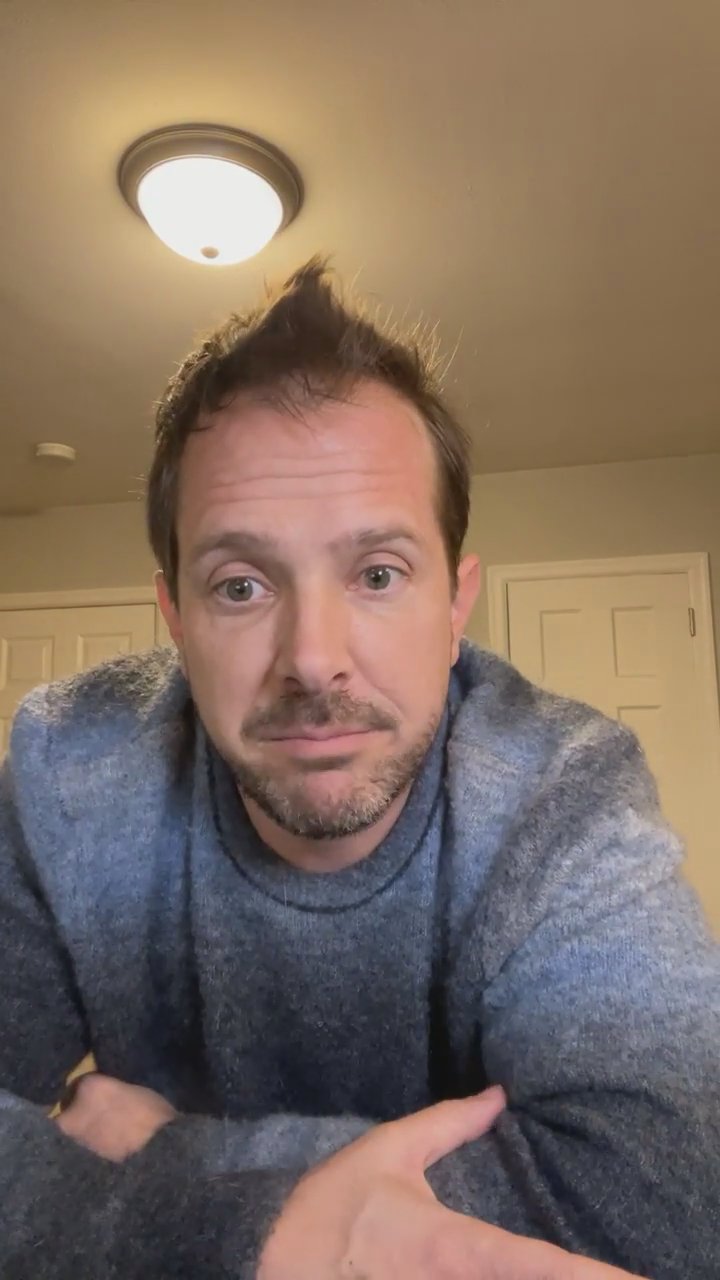
Chris Fortman reflects on caregiving across families and professions, shares his recent hospital experience, and explores how saying sorry functions as a humble, courageous gift in care settings.
Hey, hey. How are you doing? You good? Well, I hope you're great. If you're not, guess what? I'm not sorry to say that it's okay to be not great. You may be in one of these moments of life that is okay.
Cadre: Today we talk about caring for others, whether that be a family member or a neighbor. He says the systems of care that are set up are phenomenal. Says sorry is such a wonderful gift, and it takes courage and curiosity and humbleness.
So, caregivers out there, I invite you to think about the times that you say sorry. Sorry can mean a lot of different things. But if you feel like you need to say sorry because you're not enough, you are more than they would have otherwise. You are given the gift. I'm not sorry.
Hey, hey. Good morning, Cadre. How are you doing? You good? Well, I hope you're great. If you're not, guess what? I'm not sorry to say that it's okay to be not great. You may be in one of these moments of life that is okay. Chris Fortman, Beezobits. It is okay if you are not great, but we hope that you are. And guess what? As life goes, if you're down here, you may get up here. Maybe up here. You're probably gonna go down here, baby, I'm sorry, not sorry. Boom. A little Demi Lovato. Sorry, not sorry.
This morning, to start off your day in the Cadre sphere, cold but sunny in Erie town, Pennsylvania. So did anybody ever, ever watch Erie, Pennsylvania? It was like a pseudo horror children's spooky show. But it was also kind of funny. It was one of my favorite shows growing up. T North. How are you, my friend? We got a crew here today. Colleen, how is Chicago doing? Nice to see you all. Oh, hey, on Thursdays, what do we talk about? A lot of times we talk about caring for others, whether that be in, you know, caring for a family member or specifically a child or a parent or spouse.
Sometimes it's caring for the neighbor. You know, I. A lot of my work is with people of an older age. So often I see people of the boomer or the greatest generation care for others in that generation. They pick each other up, drive them to doctor's appointments, so and so forth. They have that system set up. Or maybe, as I'll speak about today, it's caring for people within your profession. I know a lot of you work in worlds of healthcare or social services, and let me tell you, yesterday I was cared for by the best and the best and the best of people.
At Methodist Hospital in St. Louis Park, Minnesota, I had a little surprise surgery. All is okay and well and I'm on my feet and enjoying a new day. But by golly, it's amazing. The systems that are set up in, let's say hospice organizations or let's say heart institutes or hospitals, all these places, the systems of care that are set up are phenomenal. And I got to see the insides and the outs yesterday. Like, not even kidding. I know sometimes and a lot of times, right, the process is slow. But I had a surgery consult at 11:00am By 11 by 1:00pm I was in surgery, getting ready.
3:00 surgery, 7:00 coming home. The amount of people who, who took care of me, it was dozens and dozens and dozens of people. And not even kidding. Every single one of them, at least one time, most of them over half a dozen times, said the word sorry. I always say words are vessels, right? Words don't mean nothing outside of what we say that they mean. And saying sorry is such a wonderful gift, and it takes courage and curiosity and humbleness. But I tell you, through a good year and a half of some messy medical stuff that I've been going through, the amount of times I hear medical professionals apologize, it's a lot more than I hear other people apologize.
And I know why. You never know when the person who you're seeing, who is your patient or is walking down the hall, doesn't have a. A healthy perspective of what your role is. They may think that you are the one who's supposed to give them the answer and give it to them now. And that if you aren't giving it to them, you're mean or you're lazy or you're mischievous or something. So as often as I could, when I wasn't loopy or. Or. Or something else yesterday, I was like, hey, the last thing you need to say to me is sorry.
And then I would explain why, you know, I'm a person who doesn't sit still well, I'm a person who doesn't do medical stuff well, and they made me feel safe, and I, you know, got to have stuff happen to me that most people on this planet never, never would have access to. So, caregivers out there, I invite you to think about the times that you say sorry vessel. Right. Sorry can mean a lot of different things when you say sorry because you feel like you are not. Now, I'll tie into what I talk about on Saturdays.
That you are not enough, that you are not doing enough, that you are actually as. As that person who needs you to say sorry because they're looking at you with a microscope that. That you are actually giving people the best gift in the world, and that is seeing them and caring for them and providing things that they can't provide them themselves, like calm and poise and reassurance and your expertise and your care of all your education and all of your experience. Nobody should ever have to say sorry for being in the midst, being the intermediary for people interceding within their pain or their struggle or their.
Or their anxiety. So if you're sitting there right now and you're going, here's the person I care for, it may not feel like you're doing enough, or they may make you feel like crud. Sometimes if you stub their toe. If you bump them into a wall, if you're. If you do something, you go, you know what? I really need to say sorry. Yeah, throw it out there. But if you feel like you need to say sorry because you're not enough, you're not doing enough, you are more than they would have otherwise, and you are a gift.
So to all my peeps at Methodists yesterday, thank you, thank you, thank you, thank you. And if you're going to say sorry, I'm going to say not sorry, y'all. You are given the gift. I'm not sorry. Who are you gonna see today? It's Thursday. I think you have a couple other live streams coming up this afternoon, early afternoon. I'll be back tomorrow morning as we get ready to wrap up the work week. But, y'all, you're doing these things. Boom. You just gave me an idea for a Cadre today, and there it is.
We'll see all y'all very soon. Peace.
Reactions and comments are for members. Joining is free and takes a minute.