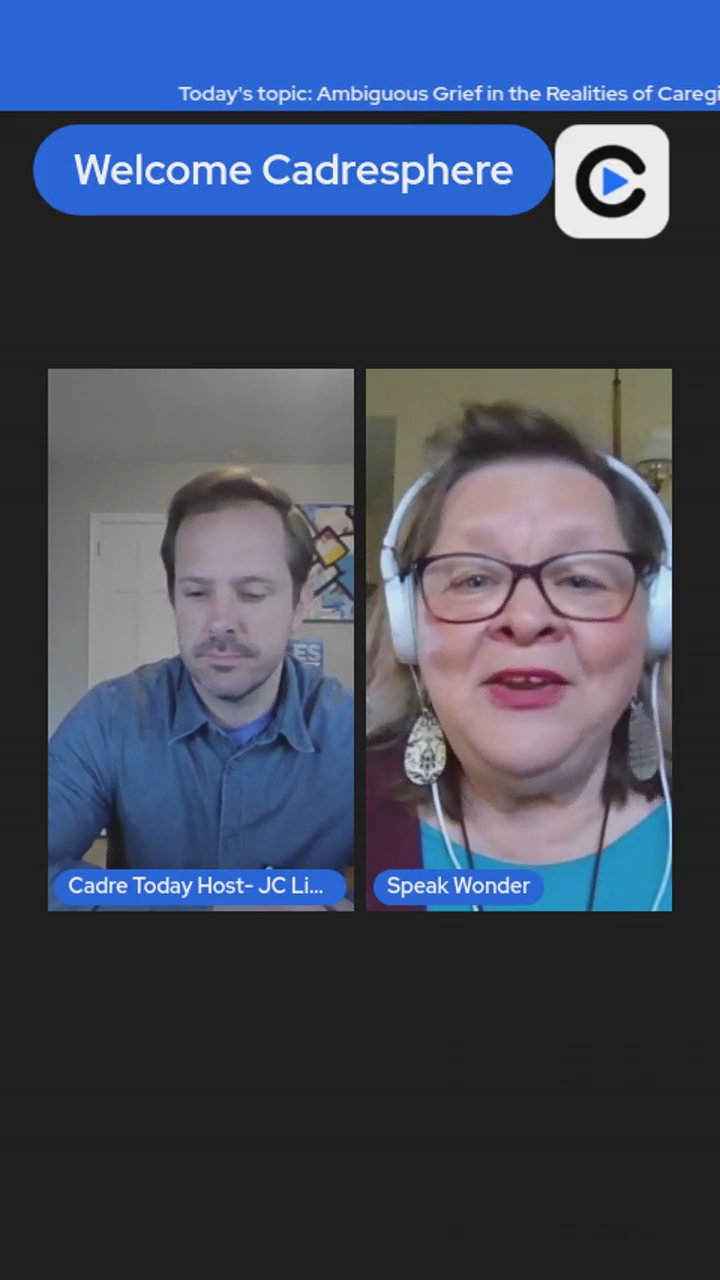
Speak Wonder joins a Cadre Today interview to explore ambiguous grief in caregiving, discussing how grief appears in the daily doing of care, the uncertainty of anticipating loss, and how curiosity and community can help navigate those experiences.
Speak Wonder and I are glad that you are here. We know what we know and we care about you. It takes people who risk to say I have a perspective and risk to connect with others. Double sunshine coming from Jules this morning from up Northern Minnesota.
Speak Wonder is back for a Cadre Today interview. Mel, grab a cup of iced tea and thanks for joining us this morning.
Cadre Today interviews always start by asking the questions, who are you? What do you do? And how these questions make you feel. The questions will be answered differently every day and will always be right. It's important for our mental wellness.
Today said hey, I want to talk about ambiguous grief qualities of caregiving. So speak wonder. Because speaks to living a life that's a verb and not a noun. See the conversation here.
Ambiguous grief is an invitation to lean in and learn from your experience. It's also a warning that you might be looking at end of life. Like carrying a wound that you don't know how it got there. How do these bumps and bruises surprise us in the caregiving space?
Grief shows up in the reality, in the verbing and the doing of caregiving. The ambiguity comes in thinking ahead. It is a reminder that everything's temporary, that life changes every day. When we lean into ambiguity, which is not terribly fun, it's worth the exploration.
So, so speak wonder as we, as we wrap, we always leave people with a take home prize. In community, there will always be touch points of loss in some way, shape or form. Lean into them. Bring your curiosity, discover what's hopeful about it and hang on for the ride.
Sa well, Cadre, how are you doing today? As you can see, we got two smiley faces. And even if we weren't smiley faces, our faces would still have just as much worth and value. But hey, I'm glad that Speak Wonder and I are here. We are glad that you are here. We know what we know and we care about you. If you've been on the Cadre sphere in the last week, you know that that's how I say hey every morning now. I'm glad I'm here. I'm glad you're here. I know what I know and I care about you. That's the aha, right?
What does it take? It takes people who risk to say I have a perspective and risk to connect with others. Dr. Green, good morning. Jules, good morning to you as well. Double sunshine coming from Jules this morning from up Northern Minnesota. Well, hey, it's a Cadre Today interview today and Speak Wonder is back in the. In the warm seat. It's not a hot seat, but hopefully it's at least warm. Speak Wonder, how you doing? Oh, it's great. You know, jc, when I join you, I feel like whether I join you on a live stream or in this platform here on the Cadre, I feel like you just invited me up to the front porch for a cup of iced tea.
That's that, that, that's the hope, right? Mel, grab a cup of iced tea and thanks for joining us this morning. Well, if this is your first time on Cadre Today interview or this is your first day in Cadre, welcome. So often on Tuesdays we talk about how do we build community. And I always, on my regular Tuesday talk about the idea of the hour facing click. Which means Speak Wonder and I have been here for a long time. So it's least it's less about us and it's more about the people who haven't been here yet.
It's our job to minimize assumptions. To minimize like, everybody knows everything and to go, huh? So what makes someone who's here for the first time not know? The one thing I will say is we're never going to give you one pathway to being well. We're going to say you probably have the truth in you somewhere and you may need other people to help galvanize that, bolster that. But in these interviews, we get to hear conversation rather than one person, we get to hear two. These conversations always start this way by asking the questions, who are you?
What do you do? And how these questions make you feel. So Speak Wonder, who are you? What do you Do. And how do these questions make you feel? Thank you. I am. I'm a pirate. I have my pirate mug. Isn't that great, matey? So I'll lead with that. I'm a harbor pilot, and by that I mean most of what I enjoy talking about on my day. Thursdays, grief day. I'm sorry, caregiver day, rather on the Cadre. I like to talk about harbor pilots, and I love the symbolism, and so I just take that and run with it.
And the basic premise there is that we're all. We are all harbor pilots managing each other's safety into safe harbor in many, many ways. I'm a grandmother. I'm a writer. I keep a journal, which lately I've been calling it field notes, because that just is more descriptive for me. And I love to encourage people. So encouragement is something I like to do with mindfulness every day, whether that's jotting down a letter, bringing something to the. In the community chat, calling a friend. So encouragement is.
Is also who I am. And how does that make me feel? It makes me feel seen and valued, and I think that's important for us for our mental wellness. Yeah. And those listening at home, T North, thanks for joining us, y' all. But those who are listening at home, you know, Speak Wonder has been in this. In this chair before and has been asked that question. And I'll tell you, the answer had a different nuance, had different elements last time than it. Than it did today. And it's really important to know who you are and what do you do and how those questions make you feel.
Those are not questions like. Like, let's say I asked Speak Wonder. Speak Wonder. Big question. Two plus two equals four, right? So if I ask Speak Wonder that question every single day, Speak Wonder probably is going to answer the same question and always be right. But the questions, who are you and what do you do? Those questions will be answered differently every day and will always be right. If they are. That's a big shift for our mental health because so often we go, well, I am this, and I can't do that today, Therefore, I don't have worth, or I am this, or I need to be this or I'm supposed to be this.
And if we can't do that, we feel less than. We feel incapable, we feel anxious, we feel less an imposter. So Speak Wander, thank you for exampling for us what it looks like to answer those questions that are always changing as we move on. Everybody, as I said about Cadre today interview, I always go so what do you want to talk about? And I keep it that vague, that open. Because again we wander. We I I love the idea of field notes. Speak wonder. Because speaks to living a life that's a verb and not a noun.
Like being out in the wilderness doing the things. Speak wonder. Today said hey, I want to talk about ambiguous grief qualities of caregiving. So speak wonder. Why was this top of mind? And take it away. See the conversation here. So with field notes. I have been keeping notes of my mom. She is my person, the person that I and caregiving. I say that cautiously because I'm not a hands on caregiver. She lives in a beautiful assisted living situation. She has skilled nursing around the clock. My role as caregiver is emotional.
So that's where the gift I have for encouragement comes into play. I get to encourage mom on the telephone or visiting her in person. And so I keep field notes of things that she talks about. I ask her questions, things that I won't be able to ask her when she's no longer with us. And I treasure every moment alongside that beautiful interaction with my mom, whose name is June and she's lovingly called June Bug. At the home. Juni Bug is a delight alongside the blessing of getting to see her and getting to talk to her, getting to share my poetry with her.
Is this ambiguous grief. I know that incrementally she's leaving us. And I would like to start, if I could, JC with what Ambiguous grief is not great. I deliberately avoided Google. I didn't want to give you a clinical definition. It's out there. I've heard it in workshops. It has a definition. But I deliberately decided not to research ambiguous grief and instead define it from my point of view. It is not active grief and it's not a vigilante. Mom is not at end of life. So it's not a bedside vigil.
And it's not active sadness. It's also not depression. Although it could lead to depression if you fixate on it in a negative way. That is what ambiguous grief is not. I just wanted to make those fine tuned adjustments. What it is is an invitation. It's a warning and a thin space grief is an invitation to learn. Ambiguous grief is an invitation to lean in and learn from your experience. It's also a warning that you might be looking at end of life. And I'll get to the thin space later. But I wanted to also describe ambiguous grief as very much akin to carrying a wound that you didn't know how you got.
Okay, so everybody in the cadmphere. C. have you ever maybe looked down at your foot and realized, oh, I have a cut. When did I get that? I don't remember injuring my foot. And so you do the thing, you find the band aid and you go on with life. But you don't know how it got there. That's ambiguous grief. When you're carrying little cuts and abrasions, little bruises, nothing big, you bump something, you don't know how it happened. It's kind of a mystery. You're like, ah, how did that happen? How did that get there?
So you lean in a little and you think about your day and how you might have injured yourself. You may or may not find out. That's the ambiguity. That's the mystery. That's the shroud over something that you can't quite define, but you don't need to be afraid of it. It's evidence of a life being lived. It is evidence of a life being lived, a life being lived with intention, with courage, with moving forward. Because if we stay status quo, or if we stay on the sofa, or if we become smaller in our fear, we won't get those abrasions and bruises.
We will avoid those. However, we will not live fully, and we won't be leaning into that. Which is a mystery and has a tinge of sadness, but also an invitation to learn. Yeah, absolutely. So, so how does this. How. How do these bumps and bruises surprise us in. In the caregiving space? I think during conversations with our friends and family, sometimes the bumps and bruises come. I know I've discovered a bruise or, or some sort of a scrape later after a conversation. And it is a wounding. It could be an unintentional remark.
It could be somebody's attempt to comfort me, which is genuine and appreciated. Sometimes the communication is faulty. That's the world we live in. We don't always communicate well. So. Jc could you ask the question again? It's a marvelous question. Yeah. So. So, so, so as we think, you know, like, like, like grief. Grief shows up in. In lots of spaces. And you set the aperture today to be how ambiguous. Grief shows up in the reality, in the verbing and the doing of caregiving. So, so, so where and when, like, what is the reality of how grief of an ambiguous nature enters in as a character in, in.
In the caregiving story? Okay. There you go. Yeah. Thank you. For me, personally, it is the fact that my mother is going to be turning 94 next month in May. May 8th. Shout out to all the May babies. Yeah. Are you one? No. I'm a March baby, but because I'm a Pisces, I just say yay for everybody. Yay for everybody. Yeah, I'm Aquarius. I'm January. So I have this booklet and this goes along with my line of thinking. It's titled Gone from my Sight and it's about the dying experience. So I've become a student of this booklet and it's beautiful, it's beautifully written.
It's a very small, thin volume written by Barbara Carnes, who's an rn. And it's super, super practical and very life giving. So that is the shape of my grief is wrapping my awareness around the fact that mom is incrementally leaving us. She has mild dementia as part of my field notes because she says some really funny things. Really funny. And the humor is, is a healer in this whole scenario. The other way that I think grief can be ambiguous in caregiving and in life in general is folks tuning in who have somebody that they're caregiving who's perhaps on the spectrum, maybe a family member with different abilities and something that needs to be adapted to life.
The ambiguity comes in thinking ahead. Will this continue this way? How will we have to change and adapt as this person grows and matures? What kind of education are we looking at? I've become through Cadre, keenly aware of the ambiguity around grief and letting go with special needs kiddos. I learned so much from so many people. I'm thinking particularly about our friend who does comedy, Ms. Shannon. Ms. Shannon. I like to call her my favorite onion because she likes to peel back our layers. And she's very practical, she's funny and she's not afraid to look at the difficulties in life.
And I think that's a wonderful combination. So we also have ambiguous grief in general. In general. Okay, I. C. but if you're a pet lover. I have a pet. I have a beloved dog who's over there snoozing. She's in perfect health, she eats well. She's my little heartbeat at my feet is what I like to say. And so there's no pending leave taking of my dog. But I know I'm going to outlive her. That's an ambiguity. That's a tinge of sadness, if you will, that surrounds our joy. And I think it is a good marker to have in our reality.
Not something to focus on and not something to actively grieve. But it is a reminder that everything's temporary, that life changes every day. C. get on the Cadre and say, I hope you're okay today. That's great. If you're not, that's okay too. And it's okay not to be okay. And that's the ambiguity. I love Mary Oliver, the poet who, the late poet who says, pay attention, be astonished. Tell about it. Yeah, pay attention. Be astonished. Tell about it. When we lean into ambiguity, which is not terribly fun, who likes to explore murky things, who likes to go in a cave that might have cobwebs, you might have to pull them away, but it's worth the exploration because you will discover things you didn't know before.
One of the things is hope. There's always hope. And you will find the shape of it, the meaning of it, and the application of it for your life on that day. Well, and I think you just made a good connection. A lot of people who roll their eyes at the idea of hope, they have a good reason to roll their eyes at hope because hope is an empty vessel. Right? Hope is, hope is something that we have to make up, something that we have to risk and have courage with. Much like the form of grief that you're speaking about today.
You know, like, hope is something we've all experienced, but also something that's very hard for us to put the finger on. T North 66 says we use it with families in our hospice work and it is wonderful and gives helpful life figures, situations we may encounter again to be able to say it's unfair and irrational to think that we should be aware of everything that we're experiencing, you know, and, and, you know, I've had a bump on my nose for a couple of weeks and every time I feel it, I go, gosh, this hurts.
Did I somehow break my nose without knowing it? And the answer may be maybe. And that's, that's, that's, that's kind of what this conversation has been about today. How do we, how do we become aware of the things that, that are the evidence of the fact that there's a life being lived? So, so speak wonder as we, as we wrap, we always leave people with a take home prize. The take home prize is exactly that. Right? It's, it's often really easy to think that what you're experiencing right now, those who are tuning in, that this is happening to you rather than through you, happening outside of you, rather than amongst you.
So you may go, it's like, oh, here's what I'm going to take from this today md you know, I, I, I, I see you just jumped in. You may be going, ooh, this is the, this is the, the little tidbit I'm going to carry with me or Dr. Green or Jules or Mel or T. North. Whoever, whoever you are, you may go. Here's my take home price. We'll have speak. Wonderful. Provide an example. So speak wonder. What are you going to take from today's conversation? If I may? This is a book I wrote. Will you hold my story?
And will you hold my story? Is about the protagonist, Megabeth. She's a little girl. Here's a picture of Maggie, the main character. Do you see what she's carrying? She's carrying burdens on her back. She's carrying a big package and she's a small girl. I have spoken to children's groups at schools and I love it because what I lead with is, do you have big feelings? To an adult, I might say, do you experience grief and loss? To a child, I say, do you have big feelings? Invariably they'll say, yeah, I get mad at my brother.
Or I'm sad because my, my pet parakeet died. Children carry burdens, and Maggie just wants somebody to hold her story. She just needs someone to talk to. So the takeaway, I would say, is when you sit with your story. And in this story, there are other people who approach her who are carrying their own. See this fella carrying his burdens. So we run into other people carrying their story, their load, their burden, their ambiguity, their own mysteries. So that is why the takeaway is that ambiguous grief is an invitation.
It's an invitation to converse. Little Maggie Beth sits outside on the stoop in front of her house saying, will you hold my story? C. lean into this conversation and the Cadre is part of the community, here on the front porch, we are having a conversation that might not take place if we didn't lean into the mystery. Yeah. So it's an invitation for conversation, to learn from others and to learn from your own questions. We can do that. In community, there will always be touch points of loss in some way, shape or form.
Lean into them. Bring your curiosity, discover what's hopeful about it and hang on for the ride. It's worth the trip. Yes, it is. Everybody, thank you for tuning in to another Cadre Today interview. It is always a joy to spend time with each of you who tune on in. It's the reason why we do what we do. So know that Cadre is always here for you. Everybody, whether it's in pre recorded, whether it's in live stream, whether it's in the community feed, or whether it's one of these special conversations that we get to have in the interview format.
So speak wonder, have a great day on the lake, enjoy the sunshine and everybody, we will see you soon. Bye.
Reactions and comments are for members. Joining is free and takes a minute.