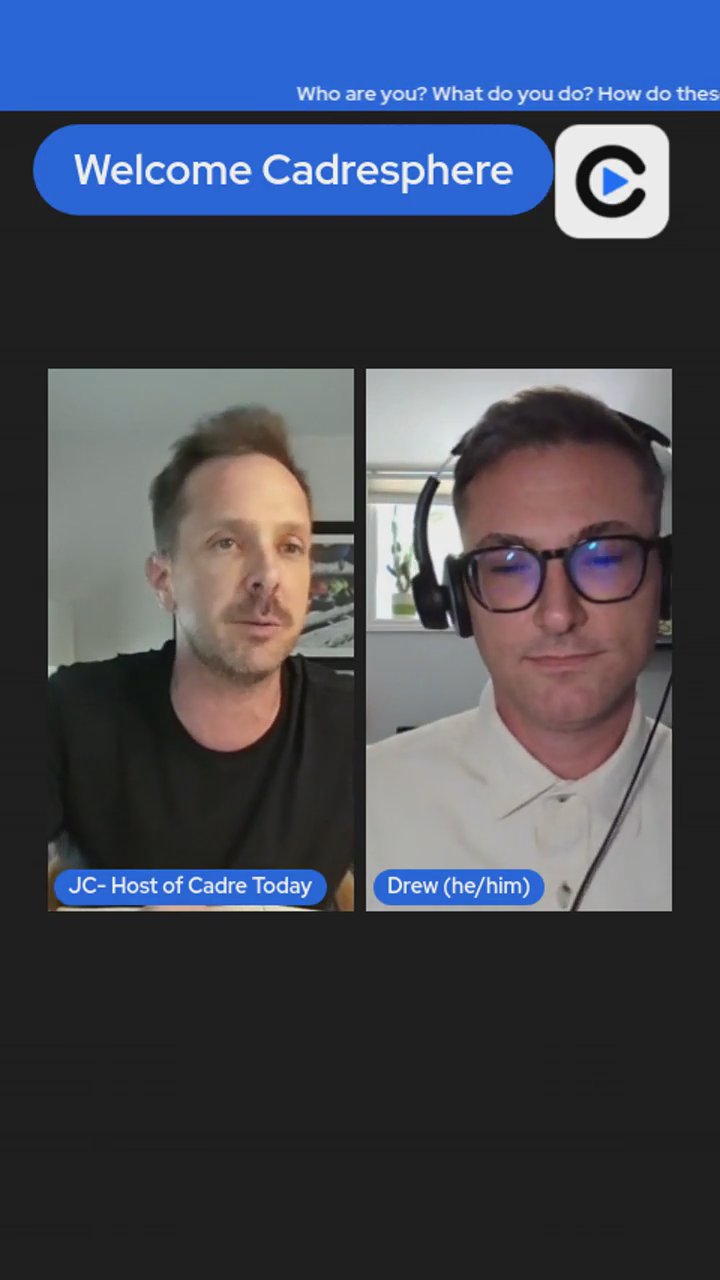
Social media is a funny space. And yet, it is one with great power and potential to positively impact and change the world. Today, I am joined by Drew Hemler, MSc, RD, CDN, FAND, a dual registered nutrition expert who never provides one-size-fits education for individuals or groups because progress can't happen without personalization.
Our fourth edition of you can't say that on Social Media. A civil discourse on social media. Our guest today is someone who I met in conversation literally about 45 seconds ago. Drew Hemler to the Cadre stage.
Drew Pearson is a registered dietitian in Canada and the U.S. He is also the first in his family to graduate from college and university. Pearson talks about how the mental health journey is pluralistic. Here, he shares three ways to introduce yourself.
Food is not just fuel, it's also about identity. It's about emotion. In some cases, self expression. There is a responsibility within us food and nutrition communicators. If we want civil discourse on social media, we have to lead with compassion.
The term cultural foods, to me, in my opinion, is binary thinking. What it says is if there's cultural food, then there are non cultural foods. Places and spaces that speak to a person's culture that really support positive spaces in a people's mind.
One of the best places to start is not to oversimplify nutrition itself. Even the most accurate nutrition information can be misinformation when it's not contextualized. Usually coming with a value based approach is most effective first to get people to stay well.
What we say about food online can transform someone's reality in positive and or negative ways. Are we educating really and elevating with not only accurate but contextualized information, or are we just say echoing? Everybody in the Cadre sphere of questions coming up, please throw them in the chat.
Well, hey. Hey there, Cadre sphere. How are you all doing today? I know you saw me this morning for Cadre Today, but we are back this afternoon with a special Cadre interview. Our fourth edition of you can't say that on Social Media. A civil discourse on social media. Our guest today is someone who I met in conversation literally about 45 seconds ago, but we've been in similar spheres for a while, so it's great to go. And welcome Drew Hemler to the Cadre stage. Drew, how are you doing? Wonderful.
Thank you for having me. JC and Cadre, thank you for having me. I'm excited and somewhat elated to be here to talk about this important topic. I love that. So, Drew, I always like asking the question this way, so. So in the Cadre space, you know, we acknowledge that the mental health journey is pluralistic, and there. There's not one way to being well. There's not one way to experience life. So normally when. When we. When we welcome someone to the Cadre sphere, we ask these questions. Who are you?
What do you do? And how. How does it make you feel when you're asked these questions? Because, of course, we're inundated with having to put ourselves in a certain box in a certain way. But introduce yourself, and then whenever you have to introduce yourself, how does it make you feel? Okay, firstly, and really, to help, I guess, set, like, the angle or perspective for our conversation up ahead, I'm going to spend maybe a few more minutes than most people do introducing themselves. But I think it's important to do this because of the contentious, sometimes sensitive topic that we're about to discuss.
So I'm going to do this in kind of like three layers. Layer. One is I'm the son of two very kind and loving parents, one of which passed away over a decade ago and was during my later, more formidable and impressionable years. I'm the youngest sibling of three who experience ups and downs in life, like so many, but including a friend's suicide, a parental divorce, a parent's passing, as I just said, being closeted for a bit, quote unquote, experiencing migration and more. But also I'm part of this huge, loving and close extended family.
Having said that, I'm a cousin among dozens. No lie. My father is one of nearly a dozen siblings himself. Um, I grew up in central or upstate New York, 20 minutes from Syracuse, New York. Go orangeman. Really, in this rural area with a graduating class of 100. So a very isolated, small population, shall I say, as a kid and teenager, it. If I wasn't like on say a snowmobile or a knee board or a tube on water. I was in the pool, around the trampoline in the backyard. So as active of a child as you can imagine.
But. But that didn't come without a lot of broken bones and really hilarious stories about my cousins breaking their bones. Layer two. I'm queer. The first in my extended and immediate family that is known to be queer. And I say that known because who knows, I'm the first in my immediate family to graduate from college and university not just once, but actually quite a few times. 4. So there's this badge of pride that I wear with that I'm partnered with an amazing Canadian Venezuelan where we reside in Toronto, Ontario, Canada.
I'm a Canadian American myself. I like to say that because I get asked this all the time. My children are my plane tickets. They are my global food and people experiences and they are my art experiences and my art collection. Then level three. So what how most people normally introduce themselves, but I like talking about the, those, those bits that really help humanize us. By trade I'm a. Or by profession, but where so much of what I've just kind of explained comes into full effect. And I use nearly say every day in my work and what I do.
I'm a registered dietitian. S. to elaborate because, you know, in my experience, registered dietitians or RDs are not universally known or really understood among many. I hear all the time that when I introduce myself through this say, professional lens that it's the first time someone's heard of the professional title. So dietitians provide expert level nutrition guidance. We really translate information that's rooted in scientific evidence, really into practical personalized nutrition care plans for individuals and groups.
It could be for communities, it could be for populations. So we play this really vital role in promoting healthy eating habits and dietary patterns, really in like say, preventing and managing chronic diseases and conditions and illnesses and really improving overall health and well being through food and nutrition, of course. But a lot of that comes with psychology and this is through a lot of different ways. Research, academia, private practice, community and population health, and in a lot of specialty areas like kidney, heart, cancer and so on and so forth.
Personally, within the profession, I wear many hats in many communities, one of them being an education strategy consultant. And with that there's a lot of communications work. But I'm also a practitioner and it's something I think I'll always be involved with because I love working with humans. On such like a personal level when it comes to food nutrition, learning about their cognition and creativity and their approach and their experiences with food. So, so I provide like one on one and group education, counseling and just general nutrition education both in New York and in Ontario.
So I'm a busy guy. Also, also I serve in academia. I also serve as a professional practice leader for a telehealth company in Canada. So keeping people up to date with science because it evolves and how that rolls down to recommendations and sometimes our scope changes. So how does that evolve down to what a dietitian can and can't do with clients, communities? Also, also, also I work in corporate wellness and there's other things that I do, but maybe just to leave it there or leave this kind of intro here.
I'm really an active and passionate volunteer and supporter and leader within the broad and deep profession of dietetics. Really helping in continuing education, professional development, communication services a lot professional development, experiential learning like workshops. I've helped in practice regulation and most recently, most recently I've joined the board or the leadership team in our national organization, the States called the Academy of Nutrition and Dietetics. So I do sleep, I swear.
But, but how often do people go oh Drew, you do too much Drew, you need to sleep more, Drew. But again, when you're living a vocation life, when you, and well done in, in telling a really beautiful story and your story, right, we, we often think as humans that we should all be very good at telling our own story because we, we're living it, but we know the things that separate us from it. And those things are often what's stigmatized, what's going to be misconceived or perceived or what's going to be taken, taken down a different pathway, right?
When all of a sudden, you know, you dropped your second layer of, of queerness along with, with, with, with, with Canadianness. All of a sudden I wanted to go into a little RuPaul's Drag Race, like are you in? But again, all of a sudden we could go down those pathways. Where do we go? But I think from your. A cousin among dozens. I will use that phrase forever and ever because it's something I heard within your context. As a linguist myself, I always talk about cultural linguistic interpretation.
We use words to express a certain thing to a specific group of people at a specific time in order to move them in a specific way. And that's today's conversation. If you have tuned in prior Cadre sphere to our, you can't say that on social media, civil discourse on social media, this conversation is a powerful one because we know social media in a very stigmatized and polarized world is often seen as, as a bad thing or a good thing. And if you're going, well, I want to do things right, what should I be doing or how should I be doing it?
I'm so excited, Drew, to have you and your background and your passion and your vocation to be able to talk about the use of our social tools to communicate about food, about sustenance, about the way that we not only fuel our bodies, but the way that we express ourselves through our culture, our cuisine, and all of those things. All. I'll open it up, broad spectrum. When you, when, when, when, when you said, yeah, let's, let's have this conversation. What, what, what first came to mind? And, and what would you share with, with the audience in the Cadre sphere about communication and social media world?
Yeah, you know, I thought of a lot of things because food is so individual to a person, yet it's so universal in what it serves in humanity. Survival, culture, celebration. One of the first things that I thought of was, you know, and a lot of people, when they reach to social media to learn about food, usually it's about nutrition. To that I say, food is not just fuel. It's also about identity. It's about emotion. It's about, and in some cases, access. So think memories, rituals, sometimes survival, and in some cases, self expression, and a lot of cases, self expression.
A lot of the individuals that I see in Ontario and Quebec are transgender or gender diverse. And self expression through food and nutrition plays a huge role. You know, in saying that or just looking at that first statement. I said, when we reduce food to, like, good or bad, we. We really risk erasing someone's culture. We erase, not considering their budget. We erase or don't consider the trauma that they've carried throughout their lives and how they approach food sometimes through that. So, for example, like, the same image of, say, a green smoothie, which is like this typical wellness food image, right?
This green smoothie or this quinoa or acai bowl means wellness to one person, but it can mean guilt or alienation to another person. Truly. I literally just saw an article on LinkedIn about the, you know, the sweet green CEO talking about, you know, the validity of the 16 salad. And you go, it's like, and. And the response was, yes, it's 16, but what you're paying for is so much more than a sell. I go, 16 for someone who 16 is. $16 is a lot different than someone who's $16 is. Oh, $16. So, so, so to what you're speaking about, all of the layers do not hit every single person in the same way.
Absolutely. And you know, kind of to bring it to social media and dialogue that happens. If we want civil discourse on social media, we have to really lead with that compassion for how people experience food, not just how like we define it clinically. To your point. C. and I thought, man, what angle do I want to come at this? But it's always through this humanistic and compassionate perspective. But I always, I always think of those of us, whether we are regulated professionals, we're food and nutrition enthusiasts, we're content creators, influencers.
Have you or other regulated practitioners that aren't like necessarily experts in food and nutrition, but talk about it because they are authorities in some way in health, in human physiology and pathophysiology, so they feel a need to talk about it. There is a responsibility within us food and nutrition communicators. Someone who may be scrolling through social media while say, or picture this, somebody who's scrolling through social media that we don't know about may be in the middle of an eating disorder recovery.
They might be in the middle of experiencing food insecurity or living with say a chronic ailment that is gravely impacted by certain foods or patterns or like certain dietary intake. So that post about say clean eating, quote unquote, which, that, that kind of rhetoric drives me insane. Yep, it's usually not helpful. It's likely harmful. In my opinion, it's harmful to everybody because it perpetuates really this, this binary approach to foods. Rather than putting foods, say on a spectrum, for example, at one end all of the time or more exposure to foods, or on the other side of the spectrum of sometimes foods or less exposure to foods.
So we don't need to be perfect, but we do need to be mindful. That's the most important consideration is when we post these images or this key messaging or these sound bites or these photos of beautiful food. There's potentially millions of people that are looking at that and we might only be looking through our own, our sole experience without providing a lot of context behind it, which is so important. Well, and I just think it's like so in the Cadre sphere we have two contributors named Roshani and Rebecca who started a company called Marigold.
They're two non white women in the food space who also work in the death doula space. And they use cultural foods, which are so ingrained within every person's story and history when you are honoring someone, when you are nourishing your body in the time of grief. And they use cultural foods to the specific people that they're serving to go, what are the foods of your people, of your story, of your narrative that connect you back to the story? And then how do you see that as being healthy and nourishing in a world that may look at your quote, quote, countercultural or different culture, or subsect cultural foods in a less nutritious or a less positive way?
You know, again, all of these different voices invite us to look at the human experience through lenses that are not our own and then soften us and slow us down enough. But I'm curious, like, if you think of someone going, drew, I get it, I got it. So how do I start being more humanistic? How do I start noticing the things within other people's narratives who may have more influence or more understanding or knowledge? How do I start seeing these things? Yeah, that's. That's a great question. That's a loaded question.
Because it also depends on the person and where they're at. So, for example, as a registered dietitian, I'm not there to speak at people. I'm there to have a conversation with them and learn what layer or level in their experience they are with food and nutrition and then build upon that. So kind of taking that approach, but I'll try to approach it in a more universal aspect. But I have to, like, mention this first. That. And I get a lot of kickback from this. And I understand why among, like, my community of nutrition experts, that term cultural foods, to me, in my opinion, is binary thinking.
Because what it says is if there's cultural foods, then there are non cultural foods. Exactly. And a Twinkie, Fruit Loops or that's bound to a certain culture and has meaning to an individual, whether it's less healthful or not, it has some purpose towards a person's food or life experience. So I get a lot of kickback. Or I, you know, I've, I've seen eyes twitch when I say that. And because dietetics, it's taken decades for us to recognize this, you know, to take away a lot of that whitewashing that we've learned in academic training and to recognize the value of other lived experiences, other ways of doing and thinking, which is why I love living in the most diverse city in the world.
Yes. Other ways of enjoying Foods. But that term cultural food says, well, there are non cultural foods. Well, and Drew, that's it. You like. My adjacency to the dietetics world was I was a part of the first comprehensive research done on food, body and fitness shaming. I was brought into the team as the non dietetics voice to present to the 30 top food communicators in North America about the application of. And the headline of this research is simple sounding solutions to complex realities are the root of all shame.
Like I'm a straight passing gay kid from the first ring suburb of Minneapolis where I came from the quote, quote ghetto where my cultural foods were like our holiday celebrations were Old country Buffet and McDonald's Happy Meals where when I am in a stress fight flight situation, the way that I calm and ground down is by enjoying some wonderfully processed, prepackaged, shelf, stable, fortified foods from the corner market. Because we're a, we're a food desk. We don't have a grocery store. So in that space I get to decenter myself because I pass as cultural normative.
But in the world it's like I've been gifted with always being the other, even though I get to pass as and I get to exist with the privilege of. To your point, it's like, what is culture? It's something everybody has. What is influence? It's something everybody has. But how do we slow down enough to be able to go, what are we saying here? Because universals very rarely serve more than the people who are most centered within that macro culture. Yeah, yeah. And just to like piggyback off of what you were just saying about those, the restaurant that you're really.
That has a lot of value to you. That adds to one of those pillars of health. It might not be the most nutritious food, although I would argue that there are options within that that you can pick and choose. And even if it's not, it still adds to your mental health, which is so sometimes more important than what people are putting in their mouth, to be honest. You know, we have seen the impact that mental has on mental health, has on people. And food and nutrition doesn't fix that. And that's, that's where those places and spaces that speak to a person's culture, which people might not associate, that really support positive spaces in a person's mind.
Okay, to go back to. Because yes, you know, we can digress forever probably to go back to like, where do we start? Right. I would say one of the best places to start is not to oversimplify nutrition itself or food and food experiences. Because it can be just like people's mental health is. It's, it can be very complex sometimes. Just to put, like to give an example, saying sugar is bad or sugar is poison, which I hear a lot, I hear a lot of this dialogue along the general public. You'll never hear a registered dietitian say that because we understand like the context and the application and just it being a poison itself is just false, but it really ignores context.
Like just to give this one example, naturally occurring sugars bound to other nutrients in whole foods versus added sugars. Now even looking at added sugar itself, it's not poisonous. It might be less healthful if we look at like the dosage or the eating period that contains added sugar or looking at something like the frequency of consuming added sugar or how often it's consumed throughout the day or the week. So this good or bad messaging also ignores many people's access to other foods. So not to mention individual needs and say strategies to consume enough of a nutrient in a day to sustain health and avoid malnutrition.
Something I talk about, which I think sparked your interest in approaching me was I talked to registered dietitians and I've talked to many other healthcare practitioners about this dialogue that we have online as regulated practitioners. Protecting the public, and in part of protecting the public is driving narratives that get people used to nuance, get people used to complexities of food and nutrition or in whatever capacity they're serving clients and communities. And in that, coming up with clever ways to introduce science.
And most people don't grab onto science first, let's be honest. Yeah, more and more people are becoming anti science, which is very scary. But grabbing onto people's values first will get them almost every time. I think actually at Food Fluence, I learned this past year when I was there from a amazing speaker at the center for Food Integrity. Charles Arnott talks about like 70% of people on social media will grab onto your message if you come from a values based approach. So speaking to the lived experience, the culture, the emotions, the trauma, that's how you can grab a person to then maybe open it up to the scientific background of it or scientific validity.
And something I talk about with dietitians is that even the most accurate nutrition information can be misinformation when it's not contextualized. Yeah, talking about like iron and spinach, like that's accurate, but we need to put it in context. It's a lesson. Bioavailable form of iron, it needs to be paired with citric acid or vitamin C to be more biologically valuable. So just another example like that. So even accurate information is misinformation when it's not contextualized, but to the point where we're saying later, a salad is great and wonderful if people enjoy it.
If they don't, don't eat a salad. But if they do, what's the cost of it? Is it accessible to them? So adding that additional information, which quite honestly can be challenging in social media because you are fighting this, what I call in a different talk, dilemmas, inherent dilemmas of being on social media, which is tempo, the amount of speed of information that people grab onto. You got like three, like three to seven minutes to grab, three to seven seconds to grab someone's attention. And what, how are you gonna, how in like maybe 15 words before they start scroll, how do you get them to stick?
And then when you did get them to stick to your video, how do you introduce in a way that they stay and then provide enough context? So it's this dilemma that we have as credible nutrition communicators. Really there's no right or wrong answer. Everyone's approach is really different, but it's takes a lot of creativity. But usually coming with a value based approach is most effective first to get them to stay well. And Andrew, like you just said, like, like I, I go back to spinach. One of the things that we see in so many humans, and as they move through this cycle of feeling bad and feeling not enough, it leaves them more and more desperate to do the right thing or to be seen that they care enough to care for themselves.
And all of a sudden you see people go, oh, here is the three to seven seconds. And Drew said, eat spinach. So all of a sudden I start downing all spinach that I could possibly eat without, without contextualizing it into a. Is there joy, is there sustainability, is there healthy habit? But also is this actually the thing that's going to help me become good or enough? Because at the end of the day, people want to like, people want to be on their own sides. People want to be in their conversation.
They want to be, be grounded within their own sustainability. But to your point, the rapidness of social media invites us to form a relationship first. So then that conversation can exist outside of the cadence of social media. Yeah, that, that nuance again, really grabbing their attention during that first three to seven seconds is really important. But once they stay digging into that nuance and that complexity or just the different applications or you know, doesn't work in this scenario or works in that scenario to go back to like sugar or even added sugar.
Maybe not the best choice for all the, you know, the all the time or more exposure foods to somebody who's more sedentary. But it's very essential and key to the athlete that is trying to sustain prolonged physical activity. It is essential. That's why they have gel packs. That's sugar that's absorbed really quickly because they need that sugar instantly for their central nervous system and especially their muscles. But when you grab their attention, the, that nuance that you can provide in that key messaging or that sound bite or even if it's like a longer form video reel, it strengthens food and nutrition messaging.
Every time it says I'm not selling you a shortcut, which that is a red flag in and of itself always when it comes to food and nutrition. What it says to like dozens, maybe hundreds, maybe thousands, maybe millions depends on that. The content creator is that I'm walking alongside you through this journey to understand that food experiences are individual. And learning about its complexities in context of say, health and well being requires deeper discussion. So you know, bring it back to the theme.
Civil discourse really requires curiosity, not certainty. Or like this black or white approach, in my opinion. Yeah, Drew, these, these moments are, are always whirlwinds but, but we, we, we always try to offer a take home prize because you know, people, again, like, like people who've been tuning in for the last 26 minutes and 40 seconds, they may go, I know it's just like, and, and neither of us are slow speakers. So this is probably like the regular, like 64 minute conversation for a regular paced voice.
But to the point we love to offer those little take home prizes, those things that, that either came to mind or if you're going, here's, here's my passing shot, you know, like, like I think, I think you just, you just said it, you know, like don't oversimplify food and food experiences. I hear the pause that, that's necessary in that and that ties me back to leading with what people care about, their values, forming relationships that are going to slow down out of the cadence of people consuming social media.
But, but I'm curious as our guest today, if you're going to offer, you know, one passing shot, what would it be? For people who've tuned in, in the spirit of talking a lot, I'll say a couple things. What we say about food while online, it doesn't just inform, it really can transform someone's reality in positive and or negative ways. So before we post, we can take the time to pause and ask are we educating really and elevating with not only accurate but contextualized information, or are we just say echoing?
And what I mean by echoing is repeating food and nutrition messages that are already out there without adding depth, context or critical thought. The that doesn't really build value, it just really adds noise. We don't need louder voices, we need wiser ones that consider viewers as human beings. Yeah, inform and transform, educate and elevate. This is like Leslie Bonci rhyming here. Like oh my gosh, the words. The wordsmith. I just talked to her yesterday. The wordsmith. Yeah, Drew, this has been selfishly a gem of a conversation for me to get to spend time with you.
Everybody in the Cadre sphere of questions coming up, please, please throw them in the chat and I will relay them back back to Drew. But Drew, thank you my friend. I hope Toronto is bright today. San Antonio is giving you a yeehaw all the way down. The sun just peaked out a couple hours ago, so doing well here. Thank you JC for having me. I appreciate it. Have a good one. We'll talk to you soon. Take care.
Reactions and comments are for members. Joining is free and takes a minute.