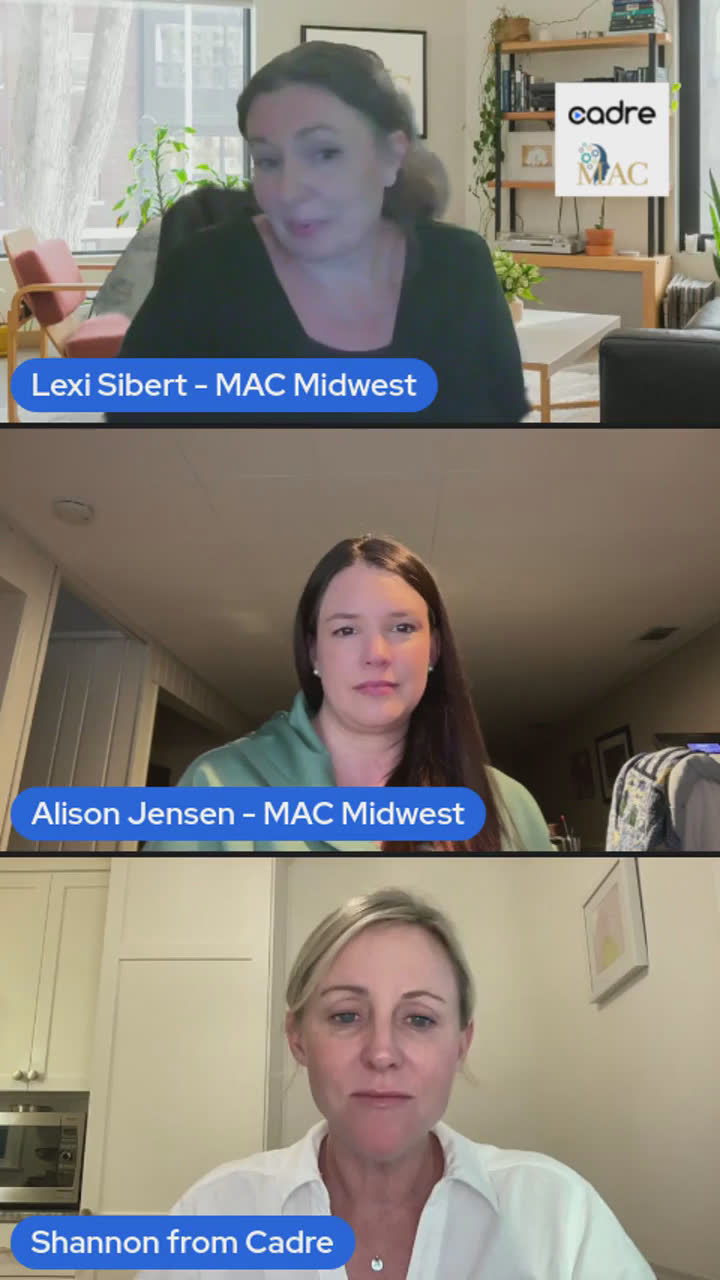
Join us for a live Q&A session as MAC Midwest partners with Cadre to explore the deeply personal and professional ways that parenthood and clinical practice intertwine. Board Certified Behavior Analysts Alison Jensen, MA, BCBA and Lexi Sibert MA., BCBA, LBA reflect on how their lived experiences as parents shaped their approach to supporting others. For Lexi, parenting came first and led her to the field of ABA. For Alison, her clinical lens transformed the way she parents. Together, they offer two powerful perspectives on what it means to show up with both evidence and empathy. Whether you're a provider, caregiver, or community member, this open and relatable conversation will offer thoughtful insights, shared experiences, and practical takeaways you won’t want to miss.
Foreign. Welcome to our Cadre Live. We have a live community Q and A as we do and come to you on these different topics. We're here to be a safe space to talk about things and to learn about things. And we're doing it in real time.
Tonight's topic is Empathy Meets Evidence. A Behavior Analyst and Parents Guide to Trauma Informed Care. What that means is you're getting clinicians who are clinicians and experts and they're also parents. Just hearing those stories is what we're going to do tonight.
Lexi is a board certified Behavior analyst. We study the science of behavior. Teach families strategies to help them do the things that we do. She is also an autism mom and that's how she found the field.
Allison is a BCBA and has been in the ABA field since she turned 18. Allison and Allison aligned in that because she was a teacher as well. Mac Midwest serves families in Minnesota and now regionally and beyond in Iowa and Wisconsin. Tonight, we're going to talk about trauma informed care.
Why does trauma informed care matter when it comes to helping families with autism? Trauma informed care is just recognizing that there's more behind an individual. We do a lot of practice of watching body language to make sure that we are doing right by the learner.
What would qualify as trauma? Anything that influences potentially negatively somebody's life. trauma can manifest in multiple ways. Practice understanding how trauma might impact someone.
Max: Lexi and Allison, share a little bit about your personal story. Max: My son is autistic. He was diagnosed around the age of two and a half. He says traditional ABA therapy was harsh for his son. Now he sees a multidisciplinary team that focuses on teaching skills.
Those things happen in our children's lives too, and in our learners lives. And if we're not taking that into consideration when they come through the doors each day, then we're doing something wrong. That's so beautiful. Thank you.
Allison, do you want to share a little bit about yours? And then we probably will answer a couple questions. Like I said, I went to college to be a professor. I am full of weird, useless knowledge that I will gladly grandstand about at any given moment.
When he was in undergrad, he worked at what is now called Lifescape in Sioux Falls, South Dakota. Mac has been at the forefront of the change in ABA practice. Do you think trauma informed care helps parents reframe expectations?
Is grieving considered trauma? For me personally, yes, absolutely, it is. Even after a number of years, it can still hit you one day. Do you see that manifest in caregivers, too? Being compassionate and having empathy with parents is important.
I hate this time. And it's so slow and I wish we would go faster. But also you have to, like, that's the deal. If you just ignore it, it's, it doesn't go anywhere. It just is the truth.
We had another question that says, does Mac help children with difficulties learning things in school and at home? We primarily focus on autistic individuals. But we're not training parents to be therapists. We're training them to incorporate into their parenting style things that we know are effective.
How do you manage the balance between evidence based work and evidence based approaches and then the human piece? Is there like a rule of thumb as to how you do it? ABA is all about being individualized.
There still needs to be a lot more education behind what it means to be autistic. A standard classical education is not going to suit the way their brain processes the world. We need to figure out how that individual brain processes so that we can teach what's most relevant.
Is it important to know or understand what the trauma is or if there's just evidence of trauma. Help to know because then you can revamp the way you approach concepts with that particular individual. On the flip side, it's important for us to know the traumas that our staff have been through as well when we're pairing them with our learners.
Who's going to do it for them when you're not here anymore? And is it going to be someone you trust? If we can teach your child to take care of their own basic needs, we got to go through the hard times to get them there.
Any advice thoughts for folks as they transition? Like, when is the time to think about that? Parents. Where do you want your child to be? Where would you, you know, what are we working towards here?
Thanks for being here, everyone that was in attendance. We hope this helped you feel seen and heard. And also, you're doing a great job, all you parents and kids and clinicians. See you next time.
Foreign. Welcome to our Cadre Live. Welcome to the Cadre sphere here tonight. We're so excited. We have a live community Q and A as we do and come to you on these different topics in the Cadre sphere of things that we all live with as humans. Because if this is your first time here and you and you haven't ever been here, Cadre exists to be a place where we can find support from community. So that is from each other, that is from professionals like Mac, Midwest, Allison and Lexi, who are here tonight.
Winter. Just in one second. But. So we're here to be a safe space to talk about things and to learn about things, and we're doing it in real time. So if you don't have resources, if you don't have someone to talk to about this, this Q and A is here for you to ask questions and to just feel less alone. So welcome you guys. Okay, so I'm Shannon. For those of you who don't know me, I'm part of the Cadre team. And again tonight we have. I'm also an autism mom. And so tonight our topic is about autism and it's an awesome title.
I'm going to read it from my screen here, which is Empathy Meets Evidence. A Behavior Analyst and Parents Guide to Trauma Informed Care. What that means is you're getting clinicians who are clinicians and experts and they're also parents. And what's really cool about this story tonight is that as they were sharing with me their background, both Lexi and Allison came to their belief system, to the way they practice in different ways. And so just hearing those stories is what we're going to do tonight.
Okay, Lexi, do you want to go first and introduce yourself and just share You're a bcba, which is a board certified Behavior analyst. Do you want to also explain what that is and then tell us a little bit about you? Okay, so we study the science of behavior. You know, that's what we do at college. But, you know, the bottom line is we're here to help children to learn and help them to be successful. Teach families strategies to help them do the things that we do and do it in the most kind, gentle way that we possibly can.
You know, hearing those children's voices, even, even if they're not verbal, you know, just hearing them. I've been a BCBA for two and a half years. Before that, I was a BCABA for six years. I am also an autism mom and that's how I found the field. So it's been a journey. Yeah, that's awesome. Well, welcome. Thank you for being here tonight. And you're in Florida, so thank you for. She's staying up late, you guys, so we're gonna say thank you for that because that's, that's, that's hard to do on a Thursday night.
Okay. Allison, can you tell us a little about you and you're also a BCBA? Yeah, I have been a BCBA since 2021. I've been in the ABA field since I turned 18. It was my first job in college. I went from being a. Wanting to be a history professor to being a sped teacher. And then I taught for a year and realized I don't like teaching in that capacity. There was a lot of, you know, red tape and just bureaucracy that you had to waddle through. And it just didn't feel good to know that I was supposed to be changing somebody's life for the better, but not giving the.
Getting, getting the tools that I needed to do it in the way that I felt was actually beneficial to the learner. And I accidentally fell into ABA as a part time job and I was like, this is it. This is my life. I love it. That's amazing. And doing it since. And Allison and I actually aligned in that because I was a teacher as well. And I had a similar kind of awakening. You know, it's like, this is not. I'm not able to do enough here. I don't feel like I'm being effective here. And I also fell into aba.
I, I was like looking through Craigslist, came up with a behavior assistant job because there weren't even rbts at that time. Okay, yes. Oh my gosh, I'm old. But yeah. And I was the same Alison. I walked into that center and within two months I was back in school to go down a whole different career path. And I haven't looked back. That's amazing. And I think what we find so Mac Midwest, for those of you who don't, who are not familiar with Mac, they serve families in Minnesota and actually now regionally and beyond in Iowa and Wisconsin and continuing to grow.
But they're, they're here to help kids live their best lives. Help them. And they really, what's so great about them is they do it across education, they do it across mental health therapy. Right. So in addition to specific autism services, occupational therapy, speech therapy, it's also like there's mental health pieces, right? There's other. My son, for example, has anxiety, ADHD and autism. So it's all those things. And so I think what's so cool about tonight is we're going to talk about trauma informed care.
And I think if one of you would share, maybe Allison, if you want to share this time, what does that mean and how is that? Why does trauma informed care matter when it comes to helping families with autism? Yeah. Trauma informed care is just recognizing that there's more behind an individual. When they come into our centers, we don't know what they're necessarily, what their socioeconomic status is. We don't know what the family dynamic looks like. We don't truly get an idea of what's happening in their home life when they're a center based learner.
Even those who do work in the home don't necessarily get to see all of that because there's a different front that's put forward. And so we go in assuming that there is trauma there and that we need to be very mindful about how we approach this individual. We do a lot of practice of watching body language, watching there's little subtle movements to make sure that we are doing right by the learner and on their timeline, instead of just pushing our way in, saying, hey, we're going to teach you this today and you have to be okay with it.
We go at their pace and we monitor how they feel about us so that we can be the most successful and work through those traumas with them in a safe, respectful, dignified environment. That's a great, that's a great definition. And then what would qualify as trauma? I mean, I know that's a weird question, but as parents and caregivers and all the things like what is trauma? And that's such a word right now in general, like, tell me what, what, how would you all define that? Anything that influences potentially negatively somebody's life.
So anyone who experienced covet. Yeah. Oh my God, yeah. Anything that really does change you and makes you kind of not you, but one. Yeah, whoever. Yeah, yeah. Really kind of question how they move forward. You know, people who are still, still scared wear masks all the time. You know, they, they're terrified. They're traumatized by the, the COVID experience. People who maybe have been one too many times startled by a loud sound. If they're unsure of someone coming into their environment and how loud they might be, they might be a little bit hesitant to have them in their space.
So trauma can manifest in multiple ways. There is one main, like clinical diagnosis, I think. Jamie, Larry, our other, you know, mhp, who's with you guys a lot, she can help you on that concept of It. Okay. Practice understanding how trauma might impact someone. It just manifests a little bit differently. But knowing it's. It's their home life and what they've experienced in the. In the real world, they bring into the center. That is such a beautiful thing because essentially you're just like, hey, we've all got stuff, and it's going to manifest different ways.
And it also sounds like it's manifesting in our bodies and in the learner's bodies. And so paying attention, you said, like, Lexi, you said to the sign, or, you know, Allison said to the signs of, like, how's. What's. What's a child's body behaving? Like. Like that kind of a thing as well. Yep. Yeah. Okay. That's awesome. I love that. I love that. Oh, you guys were getting a lot of questions. So before we get to these questions, I really. I wanted to. And thank you, Colleen. We've got three, but we're going to hold on to them for one second.
Lexi and Allison, as much as you want to share a little bit about your personal story, because I know part of what makes Max so awesome is you all show up as humans in addition to, like, I've seen it firsthand with your entire team. You are some of the most dedicated people, and you bring your full selves to this. And so if you would each maybe just share a little bit about that part of it, that would be fantastic. Lexi, I don't know if you want to share first sort of your. Yeah. Your clinical slash human story, whatever that is.
So for me, as I just mentioned a little while ago, my son is autistic. He's 14 now, but he was diagnosed around the age of two and a half. And this is kind of what brought me to Mac and to the environment that we're in now. And I, you know, he was in services, and they were kind of the old traditional compliance based, you know, you're gonna do what I. What I say. Kind of. ABA therapy was very much harsh, is. Is the word I would say. And it never really sat right with me. And at the beginning, and I'm not gonna lie, at the beginning, I was like, well, these people know what they're doing, right?
They're. They're the experts. They've done it 100 times, a million times. They've been doing it for years. They know what they're doing. Just, you know, go with it. Breathe through it. I could never breathe through it. It was. It just didn't sit right. And seeing my son not want to Be there was huge for me. So we bounced around a bit, you know, from place to place, until we find somewhere that the owner said, you're. You're not going to see what you've seen here. I hope that's not going to be a problem for you.
You know, our progress might not go as quickly at the start as you might have seen in other places, but what you will see here is you will see happy children, and you will see staff who are looking for those learning opportunities in a natural way, and they're grabbing onto those naturally occurring teaching opportunities to teach those skills. It doesn't look like kids sitting at a. At a desk being drilled with, what's this? What's this? What's that? What's this, what's that? And while there is a.
There is a place for that, that shouldn't be everything, you know, that shouldn't be six hours a day. And that's sort of how I saw Aba delivered. Okay. 12 years ago. Yeah. So we moved about, we found that, and then Covid hit, and a friend referred me to Mike, and it was just like coming home. It was like finding somewhere. I'm sorry. I get emotional even thinking about it. Okay, that's beautiful. Where you have this team who are multidisciplinary, right. You've got your speech therapist, you've got your OTS, you've got your mental health professionals, you've got your BCBAs.
And ABA 5, 10 years ago was all about, you know, behaviors, behaviors, behavior. And, you know, that's all that was the focus. But it's not like that, because our kids aren't just, you know, beings off behavior. They've got thoughts, they've got feelings, they've got opinions, they've got. They've got traumas, they've got stresses, they've got things going on in their lives outside of therapy. And to just. I shared this with you before. I kind of feel like Mike is somewhere that I would be happy to have my son and I would know he was safe.
And I've always said, if something's not good enough for my son, it's not good enough for. For anybody's son. And that's kind of. So I get emotional, and that's how I really, really feel about it, you know, and that's how I feel about Mac, and that's why I love it. Yeah. Well, I think I thank you for all of that. I also think, you know, when you're talking about behavior, when you even, you know, it's like behavior can be like that word, as if you say it like that, it's such like a heavy, like, oh, you have behavior.
But you know, I, like I said, I also have a son with autism and I think my dog is going to bark during this call. I'm so sorry. And, but I think one of the things too about autism, and I know this isn't always the case, but like sensory processing elements, like bodies will feel things. And so, you know, we all have that in some capacity as people. There's stuff that bothers us, like nails on a chalkboard. And imagine, this is how I would always say in my head is like, imagine if you're like nails on a chalkboard, nails on a chalkboard.
And then having response to that is considered a behavior. And I don't, this is my opinion, you know, I'm just jumping in with my own opinion. But I think it's such an interesting piece because it is, I mean, that, that it's, it's just, it's just how the body, it's just our bodies, their bodies, you know, it's a physiological response, isn't it? It's, it's, it's not something that's, that's thought about. Yeah, for the most part. It's not something that you. Yeah, there are people who think about what they're going to do before they do it, but a lot of times it's just your body's physiological response to what's going on in the environment.
And you, that part of that is the truck, you know, comes from the traumas that you may have experienced in your past, how you react to certain situations. It's your learning history. You know, if you've had like, as Alison mentioned about the loud bangs, if you've heard these. I grew up in Northern Ireland. I went to university in Belfast in the capital. Like, we would hear bombs going off. So when I used to hear lightning when I first moved to Florida, I used to jump. And it took me a long time to, to get, you know, to not jump when the lightning goes off.
And sometimes if it's still really close to the house, I'll jump. Those things happen in our children's lives too, and in our learners lives. And if we're not taking that into consideration when they come through the doors each day, then we're doing something wrong. Absolutely. Thank you. That's so beautiful. Thank you for sharing all of that. Yeah, thank you. It's amazing. Allison, do you want to share a little bit about yours? And then we probably will answer a couple questions. But yeah, I'd love to hear your.
Yeah, yeah. Like I said, I went to college to be a professor. I was like, I'm gonna tell stories all day long. I'm gonna be a history professor and it's gonna be grand. I still do tell a lot of history stories. You can ask any of my staff. I am full of weird, useless knowledge that I will gladly grandstand about at any given moment. I'm really good at trivia too. We're going to tap into that later. We'll do one grandstand moment before we go maybe. Okay. But while I was in, in my undergrad for that, I was also working at what is now called Lifescape in Sioux Falls, South Dakota.
But at the time was children's home, children's care home. And I did residential. So they would be in away from their families. They would be living in quad bedrooms. So each bedroom had four kids in was in this big long hallway and it was a challenging behavior unit and I was guaranteed to get beat up every single day. The style of therapy we did was, I think it was called like California something. But it was a hands down fees, feet down, quiet mouth, eyes on me, 1, 2, 3. And it was very robot like.
And I remember sitting there going, this isn't real life. This isn't. Doesn't feel good to do this. And then you couldn't have a relationship with your learner. You couldn't. At that time there we were called them patients. You couldn't. It was high fives and handshakes. You couldn't give them compassion. You couldn't be a compassionate provider with them. And at the time, I get it, it was, you know, 2004 is when I started there. So yeah, we had huge evolution in the field and how we operate nowadays and, and, and Lifescape has evolved tremendously as well.
But that was my first foray and I was like, okay, now I want to be a sped teacher because of that. And then I got into, I started working at another in home, Aba company which was very traditional style Aba big into low boss method. You know that 40 hours intensive therapy, lots of punishment procedure. I remember walking one kid up and down the hallway of his home for about an hour and a half straight because he dragged his arm across the wall. Oh wow. Yeah. He's three in hindsight. Oh my gosh.
Two year olds do that. Years old. Yeah. Oh my God. Who touches everything in my house? And I want to be. Yeah, that's, I'm not gonna use over correction or restitution. On him. Because that's not appropriate. Yeah, yeah. So I see you just, like, cringing. Yeah, yeah. And then, yeah, I got all the experience I needed there. I had researched all ABA companies in Minnesota at the time, and Mac was the biggest and the number one company back in 2010. And I was like, you know what? I'm gonna go there.
I got all the hours I needed, came to work at Mac. And what I've appreciated. Mac has been through a lot of variations of itself, but what has maintained throughout all of this is being at the forefront of the change in our practice and making sure that we're not lagging behind where the field is, that we are pushing ahead even a little bit further than the field is at the moment. Yeah, this whole compassionate aba, that's this big movement right now. We started doing that before COVID Yeah. Really going into.
Before we even had BCBAs at Mac, we were like, how can we help this kid be the best version of themselves, even if that doesn't mean they're catching up to their neurotypically developing peers? Because they won't. A lot of them won't. But where can we get them to just be happy and healthy and vibrant members of society? Because that's all they need to be. And do you think. Do you think that the trauma informed care helps parents reframe expectations? When you come at it with a different lens, like, to your point, what you just shared, like, being more realistic about the whole self that comes to the table with a learner, with a child, and saying, like, hey, they're not going to.
Because it feels like what you're saying is the past was like, we're going to train you, we're going to put you in a line, and we're going to make you execute the behaviors we want you to execute, but then again, not taking into account the holistic human behind it. So do you think parents feel differently when their child's receiving trauma informed care versus I mean, I'm assuming. I know the answer is yes. But, like, how do you see that manifest? That is a really good question. Some parents are still very much looking for that traditional aba.
They are behind punishment procedures. And I don't want to say, like, the punishment sounds horrible. And it is. It can be with the way the general populace identifies the term punishment. Yep. Punishment ultimately is just use of, you know, bringing in to the equation or removing from the equation something to decrease the behavior. Okay, so you might use a timeout. Timeouts are appropriate. They're socially appropriate. But some kids with autism don't understand a timeout. It doesn't make any sense.
So the use of it is irrelevant to them because it doesn't change their behavior. And so just teaching parents to recognize, you know, yes, we can go that route, and that is something to explore. But is that actually going to benefit your kid in the long run? Because the real world isn't necessarily going to put them in a timeout. Right. Yeah. Let's talk about strategies that the real world will actually apply and things that will actually work. You go to work, you get paid, you're going to show up to work the next day because you got paid the first day.
Right, Right. To increase all the things you want to see. So talking through with them, let's talk about the positives and the good and how do we enhance that good that we're already seeing and make it just shine in this kid versus identify the things that they can't do? Because just because they can't do that particular thing doesn't mean they can't excel in this other thing. Absolutely. Yeah, absolutely. That's awesome. Answer. Okay, I'm going to go to a couple of questions. Lexi, for you, is grieving considered trauma?
I would say for me personally, yes, absolutely, it is. And it can hit. Even. Even after a number of years, it can still hit you one day. And those things are, you know, those are things we take into consideration at our center I work at, and I know Allison's like, because some of our children may have lost parents or grandparents, and it does affect how their day goes and it does affect how their week goes or their year goes, or it could be over the course of multiple years. So it. Absolutely. In my opinion and my personal experience, it's a trauma.
I think it's even more traumatic when it's unexpected. You know, when it's a young person or someone who's really healthy and then just suddenly they're gone, you know, but, you know, even older parents, I think it's still quite traumatic. And do you see that, do you see that manifest in caregivers, too? I mean, we talk a lot about caregivers on Cadre as well. For myself, I know I had to grieve. I know I did some grieving. When you go through this process, do you see that as well? I mean, and obviously, and your parent also, Lexi, like, do you feel and see that in your own experience?
I do. And I think that. I think that in this world of social media right now. Right. And. And we're. We're all posting Pictures of our kids and our friends are posting pictures of our kids. And my kid did this and my kid did that. And when you're on in your own little bubble, sometimes I don't see my son. Well, I don't see my son as autistic most days, but some days I'll see something, I'll be like, he's not doing those things. Like, does he want to do those things? And then I'll like, he is, he's verbal now.
He speaks. We were told he probably wouldn't, but he will talk the leg off a chair. Now are you very much argue. But you know, I'll ask him, do you want to do these things? But I can only imagine how difficult it is for parents who can't get those answers. Yeah. You know, and that's, that's hard. That is hard. So I think being compassionate and having that empathy with parents and just being human and realistic and not, you know, we, we do work with parents, you know, once a week. Okay. We go through strategies and we, we talk about all these things that you can do.
Yeah, but you're a parent. Right. And I'm a parent. Yeah. The strategies go out the window sometimes. Yeah. So don't beat yourself up over it. Right. And absolutely. Yeah, you do grief. You, you grieve the life that you envision in your head and it takes a while. And I, I've seen people again on social media be ridiculed over that. Oh, how, how can you say that about your child? How can you say that about that this and how those feelings are valid. Those are the feelings that we have. And it doesn't matter what, what anyone else thinks about them.
It's how you feel and you have to work through it. And some, some parents are struggle even to tell families or take their children to, to places where their families are going to be because they feel like they're going to be judged or they're, you know, they're going to be, you know, what if my kid breaks something? What if they drop something? What if they get into something? What if they, you know, what if he has a toileting accident in front of everybody and all those things are real or the, the big one I always go back to is in the mall.
I was in the mall one day with my son. He had a meltdown. He dropped to the floor. I was sitting on the floor holding him. My other son, who was only about 10 at the time, was trying to block us with his body. And he's like 57 pound wet at the time. Because we have seen videos on social media of kids having trouble in public and people being, what would you do if this was your kid? What would you do if this was your. And all these responses, well, I do this and I do that. And you sit there and you think, this world is just not ready for, for our children.
And then it just, you know, some people, I, I would say, don't give up. Let that drive you. Yeah, I used to cry. I don't anymore. I just say, hey, you know, he's got autism and he really struggles and we're working through it and it would really be helpful if you could just like keep going. Yeah, but it's a lot of work to get to that point. So that's part of the grieving process. But if you work through it, I think you get to a stronger point where you're able to say, I'm sorry, I can go off at tangents, but I think, I think just it's a, it's a journey.
It's a journey years. And it takes longer for some families than it takes for others. No, I resonate with everything you're saying. And I think even, you know, you, you all were talking about the learners in the beginning that getting to there. And I'm just going to, you know, getting to the outcomes, getting to the successes for the kid, child, children is going to take longer because you're making time for the, for that. Right. Time for their trauma and you're making time for all the things. And so I think it's the same for caregivers.
Right? We have to make time. It sucks. I hate this time. And it's so slow and I wish we would go faster. But also you have to, like, that's the deal. Because like, what you were saying in the beginning too, Allison, is like, if you just ignore it, it's, it doesn't go anywhere. It just is the truth. And so you can make someone perform, I guess, if you want to, but that's not reality. And it's also not a long term solution for a human. Right, Right, Absolutely. We had another question that says, does Mac help children with difficulties learning things in school and at home?
We can. It's a matter of like, we primarily focus on autistic individuals. So it's one of those things of. You go through that CMD or the comprehensive multidisciplinary evaluation with a mental health provider. They do the evaluation, determine if ABA services are appropriate for the individual recommendation of the dosage. So do they need a full 40 hour do they need 10 hours? Do they need more group based programming? And then going from there determines whether or not we would move forward at Mac or if we say, hey, you know what, maybe it is just home life that we need some support that let's do family skills or caregiver collaboration sessions where we coach you coach parents through.
We acknowledge, hey, yeah, this is hard. You're not wrong. Here are some ways that we can resolve this today. It might not work tomorrow, but it might. Yeah. Win today and then we can come back tomorrow, hash out how it works. And if it didn't work, let's, let's go together and develop a new plan where, you know, kind of going that forward backward concept. Previous when I was training, trained on how to do family skills, it was teaching parents to be therapists. And that's not appropriate in my opinion.
It's not appropriate. Parents are parents. Yeah, yeah. They're going to want to love their children. They're only worried about not only their primary worries. Are, are they, do they feel loved? Yeah. Are they fed? Are they healthy? All those other behavior things we can work through. Once parents feel that, that, that particular part is good, we can come in and work on some of those other strategies, as Lexi said. But we're not training them to be therapists. Yeah. We're training them to incorporate into their parenting style things that we know are effective.
1. It's overwhelming, right? If you try to learn everything. I remember when my son was first diagnosed, he's 16, almost 16, and he was diagnosed at 2 as well. Young. And I remember I was like, I will conquer this thing. I will make a list and I will learn this and I will do this. And I was like, oh my gosh, this is, I cannot do this. And you do you learn? I remember learning like proprioceptive input and doing like joint compressions and heavy work and all these things. And to your point though, it's like it could be a 40 hour a week job.
And then you're like, how do we do, how does this happen? And so I do think it's like the grace all around and then also managing the difficulty also it's sometimes it's just hard. Like I think that's the other thing is getting through those moments of the meltdown in the store or, you know, whatever that is for you. And you sometimes just have to like be in it. And that is also the hardest. That is like the worst part. I mean, I'll speak for myself because you can't get out. You know, you just have to go through it and that's all you can do.
Yeah. So that's, that's difficult. Okay. I had another. It's a comment from Kyle. It. Allison is so good at living this out as well as teaching. I think I know who that is. Thank you. We're just going to share that compliment because I think another interesting thing is how do you manage the balance between evidence based work and evidence based approaches and then the human piece and how do you, if you had to. And I'm sure it's different for every child or learner, but how would you fundamentally.
Is there like a rule of thumb? My dog. I'm so sorry. Is there a rule of thumb as to how you do it or is it. Yeah, I don't think there's a rule of thumb. It's you, you look at each individual child and you see what it is that they need to go to the next environment. You know, because that's our goal is to these, these children as quickly as possible out of Mac. As great as Mac is, in my opinion, like, it's what makes it great is that we're not trying to make lifelong learners for Mac. We want to get them in, get them what they need to be successful in school, in the community, being able to go to church on Sunday with their families if that's what the family is looking for.
So we work on those specific skills that are going to take them to the next environment. And I've forgotten your question now. That's okay. No, it's fine. How you balance the 2. So evidence versus, and I think even just to take it further from evidence, like, and I'll again speak like parent expectation, like, give me an outcome. Make this better. Yeah. Balancing it with the child. So if you, if I will tell parents if your child is running into our center every morning happy and smiling, they're going to learn.
If we are having to fight to get them out of the car, to get them up the, the hallway, to get them into the room and they're just sitting crying for the whole, the whole day. We're doing something wrong and your child is not going to learn. So give us this time at the start to build these relationships to make your, you know, to find out what it is that your child needs to be happy here and to provide that for them. And we will spend those first days and weeks just like watching the child sometimes just following them around, trying to, you know, put a few little programs in here and there, you know, to, you know, as they occur naturally, to Find out what it is that that child needs to be happy.
The science is always going to be there. The strategies are always going to be there, but you can't use them if the child's not receptive. Yeah. We have to get to that point first, and that sometimes can take a little more time, but once you get there, you kind of start to see a shift. Yeah. You know, and the speed of, like, those skills just starts to take off for a lot of our children. Yeah. So that's kind of, you know, the science is going to be there, the strategies are there. Let's do it kindly.
Let's not go in like a bulldozer. Yeah. Yeah. Allison, is there anything you would add to that? Yeah, there's. We have this thing called happy, relaxed, and engaged, and you can't measure happy, relaxed, and engaged through a textbook, because for everybody, it's very different. I am happy, relaxed, and engaged. When I have a book and a coffee, I am beyond ecstatic. And then you throw the rain that we had in earlier today, a book, brain, and coffee, and I am through the moon, happy. Like, that is my form of happy, relaxed and engaged.
Yeah. If you were to talk to my husband, that sounds like absolute torture. So knowing what happy, relaxed, and engaged is, per individual is a very, very individualized. And ABA is all about being individualized. But you can't utilize the strategies until you know what actually makes that particular kid ticket, and you use what makes them tick to help you build their skill sets. Yeah. And I think what's so interesting is two things. One is you, as you all keep using the words learning, learning, like the goal, it seems like the objective is learning.
You call them learners, and we're learning, which I think I'm putting on my parent hat, you know, I think. And it's changes, it evolves. This is again, my. My experience. But from point of diagnosis to once you start to become. You know, I've. Now. I've been in it for 14 years with my son. It's different expectations, but I very much remember in the beginning being like, how do I fix this? What are the steps? You know, And I think you don't make room for all the things you're saying, probably because it's hard to process that.
Meaning. Like, I think that's one of the interesting things about autism in general is it's. It is that it is a. It isn't to be fixed. Right. Like, I think. And that's. That's again, my opinion. But it's humans who are just like, I'M a human and you're like everything you just said with your husband and his preferred activity, which maybe it's shopping in the mall. It's probably not. But whatever that is. Right. Everything Basketball. Beautiful. So whatever that is. But I think it's such a good.
I just think it's such an interesting reframe that would be so helpful to people. And I think it's just really hard. I don't know if you have any opinions. I'm just rambling. But I just think it's a curious. I think it's one of the hardest things. Acceptance and learning and evolving our point of view to accept. Yeah. One of the things that I think makes the diagnosis of autism so hard is that when people are say, oh, you're diagnosed, oftentimes there is a medication for it or a treatment for it and it'll go away or autism is not something that goes away.
It will always be there. What we can do is support developing the trades or the skills that will help an individual be able to be themselves. But in a world that maybe isn't always designed for. Yeah. Fake individuals like that. Yeah. It's not bad seem to. And I'm throwing that blanket statement out of people. But there's. There still needs to be a lot more education behind what it means to be autistic and how that will manifest very differently as somebody with a level one diagnosis of autism varies pretty drastically from someone with a level three.
And Lexi and I primarily work with a lot of level three individuals and level three is the more profound meaning. They are non speaking most of the time or minimally speaking. They use augmentative communication. They need support staff with them quite often they need support through all of their individual needs. Their learning style is different. And so we need to recognize that a standard classical education is not going to suit the way their brain processes the world. And we need to figure out how that individual brain processes so that we can teach what's most relevant to that individual in their family and in their community.
I don't know if you've heard that saying, if an individual isn't learning the way you teach, then change the way you teach. Yeah, that's smart. Yeah. That makes total sense. And I do. I agree too. It's so interesting. We work at Cadre. We work with a lot of different organizations and one of we were. We had an event last year where Mac was in attendance and we talked to HR leaders who hire people with disabilities and it is such, you know, we heard these beautiful stories of People who had incredible value in the workplace.
And I do a thousand percent agree. It's just the constant re education of here's the possibility, here's the reality, here's, you know, here's the truth of all of the value and all of the, you know, power that every, that everyone brings to their, to their role and their opportunity. But I think it is, it's us that has to reframe our own minds versus, you know, like no one's doing anything wrong. Like, I think that's the hard part too is like we're. No one's doing anything wrong. And so we just have to accept it, you know, society.
Here's a really great question. In thinking about trauma informed care, is it important to know or understand what the trauma is or if there's just evidence of trauma, like, do you have to try to fix the thing and focus on like, oh, we know that they're grieving because of the this or we know that they experienced, you know, being unhoused, something like that versus we just sense there's trauma. We don't have to talk about the particular trauma. I think it helps to know because. Help to know because then you can revamp the way you approach concepts with that particular individual.
If they are someone who can understand their experience, then you can dive into that with some other resources that we have as providers to help them understand the situation. Situation that it's out of their control. But then there's also some that we don't know and we just have to be mindful that there is likely something there that we may never understand. But we can watch how they respond to us and what we bring into the environment and we can modify based off of their reactions and that will give us a clue as to oh, this potentially happened or oh, they might have experienced a really bad car accident and that's why they're terrified of, of seat belts or got bit by a dog and now the fence, they're sprinting away.
Yeah, that makes sense. Yeah. Like Susan, anything you'd add to that or. No, I'm just thinking about a couple of learners recently that have come through with experiences and it's really modified how we have paired them up with staff and everything. On the flip side, I think it's important for us to know the traumas that our staff have been through as well when we're pairing them with our learners, because there could be triggers on both sides that will make it not. Not the optimum pairing for learning.
So it goes both ways. Yeah, that's such a good point. It's definitely important to know or at least have an idea. I mean, we don't want everyone's personal business if they're not happy to share it comes and says, hey, I would prefer not to work with this learner. I have had a rough experience with something that this learner maybe does. Yep. They're not judging the learner. They've just had an experience in their past that has made it really difficult for them to be the right person to teach. They're caring for themselves.
Yeah. Then that's incredibly valuable, especially with working with the population we do work with. If you're able to recognize your own limitations and your own barriers and work through that, then you're in a better spot to support. It might not be that particular learner, but another individual who has barriers and experiences that they need to overcome. You're going to be in a coming from a spot of empathy where you can better support that process. Yeah, that makes total sense. Okay, we have one more question.
Do you find that mothers become the protective bear of her cubs, of their children that have autism, and how do you break them of it so that their child can learn? Yes. And I'm going to say, I'm going to tell you what I tell parents because this was said to me maybe a year or two after my son was diagnosed. Who's going to do it for them when you're not here anymore? I know, I know. And it's a really hard conversation to have, but it's an important one to have. Yeah. And parents don't want to hear it because we want to live till we're 120 and outlive our children.
And that's my goal. I'm going to live till I'm 120. But realistically, that's. That's the conversation. Who's going to do it if they're not here to do it anymore? And is it going to be someone you trust? Yeah. So if we can teach your child to take care of their own basic needs, we got to go through the hard times to get them there. Because honestly, statistics will show you that that's where most of abuse happens, in care homes for people with autism when it's. It's toileting, it's hygiene, it's those kind of things.
So I might not go that deep with, you know, in that conversation, but I will just say, who's going to do it when you're not here anymore? But it's kind of like the Renee Brown quote, which is like clear as kind. It's similar. Right. In that. And it's hard to hear that my son, again, is 16 and we're reaching, you know, we're. We're on the precipice of adulthood and it's, it is scary and it's a. You have. That's the reality. We just, I was just at a conference where we had a. We had some folks there who are attorneys and who are looking at like, who's the person that is.
My words are, excuse me, not caregiver, but the. When someone. The guardian. Yes. And just thinking about the future when you're not here and the truth is, is the kindest thing you can do is to prepare. Prepare for that. And it's a dagger in your heart as a parent because you just want to take care of your child because no matter. I mean, my son is six two and 200 pounds and he's my little baby, you know. So you still always, I feel like come with that perspective. Yeah, absolutely. Yeah. But their lives are.
They're already struggling. Right. So as a parent, you're like, I just want to do it because he's already got a really tough life ahead of him. Yeah. And that was sad. Well, who's going to do that for him when you're not here anymore? And I'm like, it was a smack. It was like a real smack in the face, but it was a smack I needed. Yeah. Allison, anything you would say about that? I worked in group homes in college and I remember like just the experiences I had there of these people are there. Yeah.
They're underpaid. It's an under place. They are doing their best, but their best is under extreme stress and under resourced. And it was hard to. I worked there for four months and I was like, this is not the population. It is the population I love. I work with teenagers right now and I absolutely adore it. But that was the breaking point of I will do everything I can when I'm working with these teenagers to make sure that they get the tools that they need so that they are safer in their adult lives than what I've experienced.
And does Mac. This will be my last, my last little thing. But does Mac provide. I know Mac goes up to 21 today. Is that right? Up to 21? I know. Any advice thoughts for folks as they transition? Like, when is the time to think about that? Parents. Right. Is it when they're diagnosed at 2 or 3 or 4? Or do you think about that when they're 14, 15, 16? Is there a perfect. No, no. From the start. You're working with that from the start. You've always got that. And that should be something you talk about in the first meeting.
Where do you want your child to be? Where would you, you know, what are we working towards here? Because if we know what the goal is, then we can get the steps in place to get your kid there. Now, I'm going to hyperventilate as we hang up on this call because my son, we're preparing for the next phase. And I am continually telling myself all of these things. So thank you for the validation that we need to continue to have these conversations as parents. But you guys, this was such a gift. Thank you so much for sharing both your personal stories and your clinical expertise.
But I just. We deeply, deeply appreciate you because as parents, we don't always get to hear this side. Right. You get limited time and limited access. And so just a huge thank you for all you're doing for kids and being so empathetic and trauma informed and then also being with us. So. So we just deeply appreciate you. So thank you. Thank you. Thank you. Okay, well, thank you guys for being here. Cadre Sphere, again, Mac Midwest. com org I should know. org we're going through a whole. You are. org or Google Mac Midwest and.
Or reach out to us on Cadre. But again, thanks so much, you guys. Thanks for being here, everyone that was in attendance. And we hope this helped you feel seen and heard. And also, you're doing a great job, all you parents and kids and clinicians. So thank you. All right, guys, well, thank you. Have a great night. You too. See you next time.