Kathy Joy explores the metaphor of ballast for balance and stability, weaving reflections on risk taking, accountability, and caregiver self‑care while sharing personal anecdotes from Erie, Pennsylvania.
Kathy Joy is coming to you live on Harbor Pilots Caregiver Thursday from Erie, Pennsylvania. Today's topic is ballast, which is for balance and security, stability, maneuverability. Could you drop me some hearts?
Rachel Logan talked about becoming a risk taker. Risk taking is allowing yourself to leave your comfort zone and face challenges. Most of all, Rachel says, experience the struggle. Complacency stifles the abundant life that you were called to live.
JC this morning talked about balance and healthy accountability. Amar Jewel says it doesn't matter how you complete it, it's still 13.1 miles. Stress challenges You. And struggle builds us up as people.
JC Says accountability is not a character trait. It is fostered in an environment where people have autonomy, an agency, and the things they need to get the job done. It doesn't have to feel good in order to have good in it.
A ballast is a weight placed low in the ship to increase stability and lower its center of gravity. It's useful for every everything from a small fishing boat to a large cargo ship. And it's useful as a weight for conversations. Risk taking is the necessary weight that adds stability and helps you maneuver.
Join Shannon Paul for Comedy in the Chaos. She will be live at 3:00, Eastern Standard. I'm going to keep my sunbonnet on and hope for better weather. See you next week in the harbor.
And we are live. Come on in. Come on in. Pull up a chair. Pull up a sofa. Pull up a yoga mat. If you do like I do, keep on driving. Pay attention. Just listen to the audio. Sometimes I join Cadre live streams in my car. But to be, you know, safe on the highway, I don't watch the video. I listen to the audio, and then I do a replay so I can catch the body language and the nuances. Hi, Jules. Good morning, everybody. My name in real life and in the Cadre is Kathy Joy. My Cadre name is Speak. Wonder why?
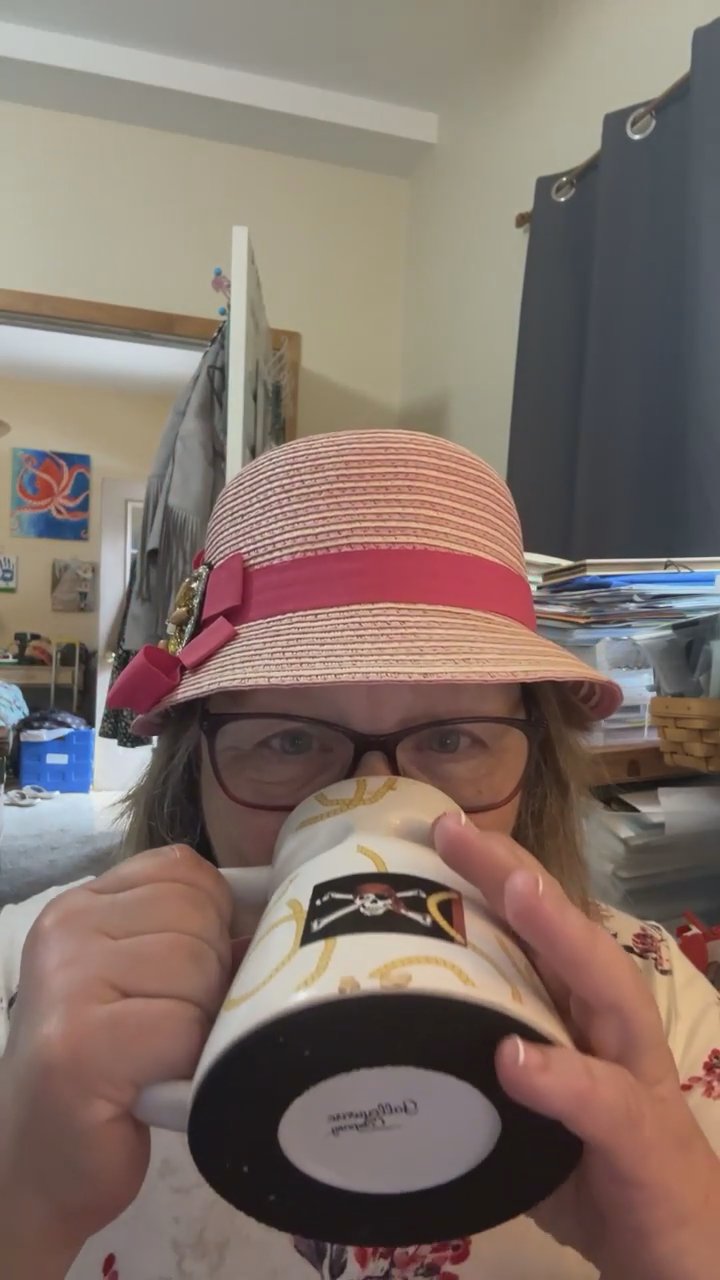
Because I love to take words and fill them. Words. Words, as JC Said this morning on his live stream, are vessels. And I like to fill mine with meaning and poetry. Gonna take a sip. This is my pirate cup. Ahoy, matey. My friends self Care for me is in a coffee mug. And some days are three coffee days. Today, this is my third cup, and it is good. Let me tell you something else before I jump into all things harbor pilots on the Cadre. This is one of my greatest life hacks. It is Monk's Fruit. Monk fruit sweetener.
It is absolutely zero calories, and it's a sweetness alternative that I put in my coffee, which I take black Monk fruit sweetener. Of all places, I find it at the big retail chain TJ Maxx. If you have that in your area, maybe you could try some Monk fruit. It's available anywhere in the sugar aisle. I also bake with it, so those were two incidentals. Except that, of course, my pirate cup is so very apropos to my harbor pilot talks. Oh, I got the coolest thing. Check it out. This is my typewriter keyboard, which is electronically paired via Bluetooth to my computer because I'm old school and I learned on.
I learned the home keys on a typewriter before there were word processors, before there were laptops and tablets. Yeah, I'm old. So do you like my little beach hat? I got that in the marketplace district in the city of Pittsburgh about two years ago. And I am coming to you live on Harbor Pilots Caregiver Thursday from Erie, Pennsylvania, where today I noticed on the news we are under a beachfront hazard. Yeah, we get big waves from Lake Erie. It's a shallow lake, and so it is described as. What was the word?
Violent. Meaning that the waves can come up quickly and strong and big. I. I've done video of some really big waves on Lake Erie in Erie, Pennsylvania, where that is my closest harbor. You guys are also my harbor, my port of call, my friends in the waters. When they're calm and when they're rough. Me too, says Jules. That must be the coffee comment. Thanks for the. The compliments on my hat. I'm so excited because I love it in a Cadre week when you get the trifecta. That was my corgi in the background.
She's very random. She's patrolling the property. Her name's Gracie. Yeah. When I. What I'm saying, when I say trifecta is JC's live this morning and Rachel Logan's live yesterday and my live today are per. Are forming a trifecta of wisdom that I hope you'll love. I'm so excited because, frankly, those two JC and Rachel gave me some. Some good material from which to glean and to put together my life. Yeah. The word for today is ballast. Ballast in nautical terms is for balance and security, stability, maneuverability, and I'm going to get to the complete definition of ballast in a little bit here.
Hey, could you drop me some hearts? I want to know that you're here. I'm in a different room in the house. I think the WI fi is pretty strong. If anything's not coming through, I'm sure you'll let me know. Just drop me some hearts. Or maybe a sunshine like Jules did. Yeah, we need sunshine. You know, we're under a beach hazard alert, meaning we're also under a severe thunderstorm alert. There we go. I'm getting some affirmations through those hearts. Appreciate you. C. lipple this morning. Well, let me.
Let me back up one day and go to Rachel. I 100% invite you to go to Rachel Logan's live from yesterday and do it on the replay. She talked about becoming a risk taker, and there was some really good stuff in there, and it kind of hit me where I needed to be hit, to be nudged, to be reminded. She said risk isn't just the big things, like swimming with sharks. Risk taking is a daily practice, and we do incorporate it at work in our relationships. Examples that Rachel listed as risk taking in the daily would be speaking up in a meeting, inviting somebody to dinner, reaching out, asking for a mentor, leading a conference, signing up for a class, saying yes to something or saying no to something.
Risk taking, Rachel says, is allowing yourself to leave your comfort zone and face the changes and challenges, to take these on bravely and with confidence. But, you know, we don't feel comfortable. I am not comfortable. Risk taking. And then she listed the reasons we're not comfortable, which are human and real. Fear of failure, rejection. Yeah, we hold on to limiting beliefs such as, I'm too old. Can't do that. I'm not a mom, or I am a mom, or it's too early in my career. Maybe I should hold back.
So many limiting beliefs, and they're just the voices in our head. If you take the risk and it succeeds, yay. That's. That's a win. You took the risk. It went well. Check that one off the list. Yay. But if it makes a plop, boom, splat, landing. If it doesn't land in the way you had hoped it might, then it's time to recover. Address the fallout pivot, learn from it. Most of all, Rachel says, experience the struggle. Wow, that's a tough one. That is a deep sip from a long cup. Deep sip from a pirate cup.
Experience the struggle. Yeah, I feel like if I just got on the Cadre on a Thursday and just popped in and said, experience the struggle would have said everything, but I have more. Experience the struggle and try again. Speak up the way you need to be heard. Speak up the way you need to speak up. Unrehearsed, raw, real. And then Rachel kind of concluded her talk yesterday by saying, complacency stifles the abundant life that you were called to live. We are meant to live joyful lives full of abundance, and complacency stifles that.
And complacency happens when we avoid risk. And just saying. Rachel has signed up for a half marathon, and she said it out loud into the Cadre verse, the universe that is the Cadre. She spoke it into the Cadresphere, the community of people who love and support each other, and said, hey, guys, I'm going to run a half marathon. Well, she said she's signing up. She might be walking, walking, running, limping, crawling. It's a half marathon, and that is to be commended in whatever way it is accomplished.
And she signed up. You know why? Accountability. She wanted to speak positive accountability into the air and have us receive it. That's risky. That is risk. Healthy risk. So as we talk more about caregiving, let's come up to today's Live with JC Another good one to replay if you missed it. I actually watched it live and then replayed it. JC this morning talked about balance and healthy accountability. So he dovetailed Rachel's life, which happens so often in the Cadre. We don't call each other up and say, h, how can we reflect each other's presentations in balance this week?
It just happens organically. Yeah, Amar, stress is good. Too good. Stress challenges You. Indeed it does. And struggle builds us up as people. 100%. 1 miles. Oh, yes. Yes, it is. Yes, it is. I don't know if you've ever heard of angel man syndrome, and it is a disease that a baby is born with and it cannot be eradicated. It can only be managed. And my friend adopted a little boy with angel man syndrome who is now a grown man. He's 26, and he participates in marathons. Now. PJ is on the spectrum. Plus, angel man syndrome is.
Is a myriad of complicated things, and it has rendered him mobile only by wheelchair. So he has a marathon runner who pushes his wheelchair, and the two are victorious in numerous, numerous half and full marathons. It's amazing. Yeah. 1 miles. So JC also talked about opportunity cost, which is a term he uses sometimes. It's when we ask, what's the opportunity cost of engaging in something that's worthwhile, such as self care, Difficult conversations. He said, it's okay if it doesn't feel good. It's okay if it feels less than good in order to move forward.
Yeah, for me, that's the crux of the matter. I avoid things that don't feel good or sit right or rhyme things that are not in harmony, harbors that are not still waters and don't feel good about that. But JC Reminds us that it's okay if it feels less good in order to move forward. Running, walking, or being mobilized in a marathon might not feel good, but it's necessary in order to move forward. And JC with his wisdom bombs, also dropped this one. It doesn't have to feel good in order to have good in it.
So if you come away from a difficult conversation or a hard day of caregiving or an emotionally taxing day that didn't feel good. But was there good in it? Was there good in your day? That's an important question. Accountability, JC Said, is not a character trait. Wow. Yes and amen. It is not a character trait or a. A mark of integrity to have accountability. It's simpler than that. It's a fostered environment. Let me just read it word for word, okay? Because he said it better than I can interpret it.
JC Says accountability is not a character trait. It is fostered in an environment where people have autonomy, an agency, and the things they need to get the job done. Accountability is fostered in an environment where people have autonomy and agency and the tools they need to get the job done. It's not punitive. I've heard parents, and I've been that parent who says, you need to be accountable, you need to be accountable for that. And then just the tone implies punishment, and it isn't. Accountability is people risking to do something together.
This is where we find balance. Then he went on to say, words are vessels. They're empty vessels. And it's not until we place something inside of these vessels that they gather momentum and meaning ballast. You knew I'd come full circle back to the word ballast. So here's my takeaway for you, my giveaway, my gem of wisdom I want to drop on you. It's not until we place something weighty and meaningful inside of it that we get stability, balance, and maneuverability. For me, it's the weight of a hard conversation that still needs to be had, still needs to happen.
I looked up heft. I looked up weight and heft, and heft is kind of like weight. But as a wordsmith, I wanted to know more. So I went on my Merriam Webster thesaurus site and it says heft is something ponderous, heavy, or substantial in some way. So a ballast is a weight placed low in the ship to increase stability and lower its center of gravity as it moves through the water. A ballast in a ship can improve maneuverability. It reduces rolling and pitching. When the waters are rough. That low center of gravity, it rides lower in the water so it can pass under loading rings, pass under bridges these days instead of sandbags or sugar bags.
Back in the old days, they used flour, sugar, sand to provide ballast or weight. Now it's liquid. It's usually water pumped in from the ocean itself, which is very efficient. It's readily available, it's a renewable resource, and it can be changed or refilled while still at sea. The ballast or the weight in the bottom of the boat is useful for every everything from a small fishing boat to a large cargo ship. And it's useful as a weight for conversations. I'm focusing on conversations today because I find relationships sometimes out of balance.
And they're out of balance because I'm avoiding them or I'm avoiding the hard conversations. So a ballast in your life, in your daily navigating, is useful for small understandings. That would be your fishing boat. And it's also useful for the elephant in the room. That would be the big cargo ship. The elephant in the room is that bigger conversation that needs to take place. Yeah. Thanks. Amar for the affirmation. So no matter how harsh the storm, the ballast can keep your boat from getting blown off course.
We need to be intentional about balance, about providing weight as we sail through the day as human beings relating to other human beings, as caregivers, as people of accountability in the best possible way. Also, if you empty the ballast too quickly, if you let that weight out like quickly, it can cause a rapid ascent to the surface. And then you have upheaval, you have panic, you have a boat pitching and lurching. And isn't that what happens when we panic, when we back off of something where we avoid something?
It makes that vessel come up quickly because we've removed the weight or the stability of what needs to be done. So you're willing to take a risk, is the weight you provide, your intention is the weight you provide in your boat to enter into something truly worthwhile. In conclusion, my friends, risk taking is the necessary weight that adds stability and helps you maneuver. That's your ballast. Healthy accountability is a way to find and maintain balance. Healthy accountability is people coming together to collaborate, to be creative, and to do something together in community.
Isn't that what we're doing in the Cadre? We're providing ballast and maneuverability for each other. And words are vessels. When we place something inside the empty vessel of a word, we give it weight, we add balance. We provide stability for the ones we care for and for ourselves. Risk is not just the big things, it's the everyday things. It is saying yes to something. It is possibly saying no to something. Risk is self care speaking up for yourself. Self care is the ballast of caregiving. Self care is the weight and the heft and the stability of filling your center of gravity and maintaining that balance.
And for me, I have a difficult conversation I have been avoiding, and it's in the caregiver room and it's with my siblings. I don't know how it will go, but I know we have to have the conversation and I'll probably initiate it because I'm the girl, I'm the verbal one, I'm the little sister, and I'm the POA power of attorney. So if this conversation goes well, that's a win. If it doesn't, I'll recover. I will learn and pivot, refill the ballast with the renewable resource of self care and say along, I invite you to sail on and to remember that self care is the ballast, the weight and the heft of caregiving for others in your life and self care for yourself.
So recognize when you need to refill the ballast, have a measure of accountability. Maybe call a friend and say, hey, I'm going to do this thing. Would you ask me about it later? Not punitive, no repercussions if you're not ready, but intentional risk. Maybe you can think of one thing today, or this week, or soon, that needs your attention, that maybe you've been avoiding. To live and breathe and have a pulse is to be human. To be human is to be fallible and fragile and silly and beautiful and complex and infinitely needy of one another.
I invite you to join Ms. Shannon Paul for Comedy in the Chaos. She will be live at 3:00, Eastern Standard. Meantime, I'm going to keep my sunbonnet on and hope for better weather in the Eerie area, and probably avoid the peninsula today because of the beach hazards. See you next week in the harbor.
Reactions and comments are for members. Joining is free and takes a minute.