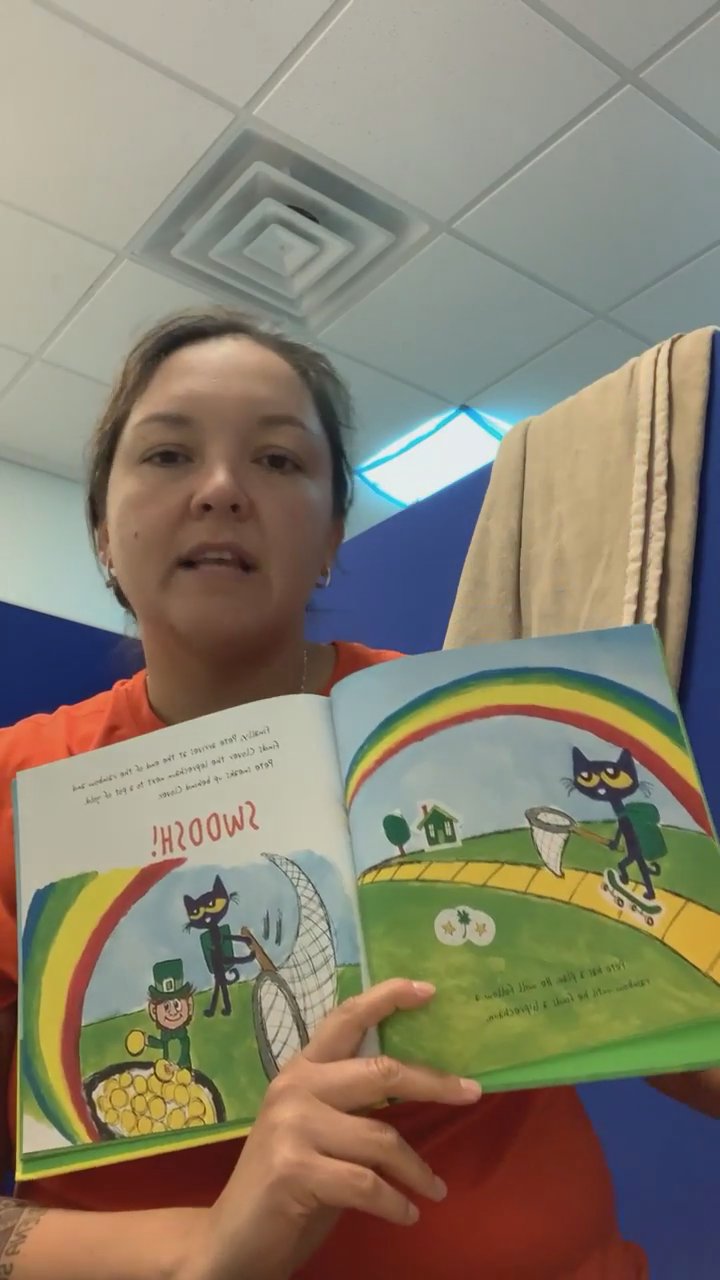
Move beyond wh-questions & labeling to help support young readers engagement and comprehension. These strategies were sourced from Kelly Vess, The Preschool SLP and episode 10 of her podcast.
The presenter welcomes viewers, states her role, and introduces the session goal: strategies to support engagement, attention, and comprehension for emerging readers. She credits the Preschool SLP podcast as the source and names the four key strategies.
Jovana explains that the strategies are most effective with books that have a clear storyline rather than purely rhythmic or repetitive texts. This helps viewers decide which books to choose when trying the techniques.
This chapter demonstrates the predict technique by phrasing prompts as gentle curiosity (e.g., “I wonder what’s going to happen next”) to engage children without pressure. She links the technique to building temporal understanding and engagement.
Pretend invites children to act as characters from the book, providing movement and make-believe to deepen connection with the story. Jovana gives examples like taking a movement break and assigning roles to foster playful learning.
Project involves putting yourself into a character’s situation and talking through the emotions or reactions you might have. The presenter models language for expressing how helping a friend might feel, supporting emotional comprehension.
Problem solve guides children to think through a character’s dilemma and suggest alternate actions (e.g., traps, treats). Jovana contrasts this approach with rapid question quizzing and explains how it reduces pressure and increases natural engagement.
She reiterates the four P’s—predict, pretend, project, problem solve—credits the specific podcast episode for more detail, and explains that these strategies move beyond simple 'W' questions to better support engagement and comprehension.
Jovana thanks viewers for joining, restates her role at MAC Midwest, and signs off while inviting viewers to future sessions about speech and language.
Okay, wow, my hair is kind of wild today. Welcome to my live stream. Today I'm going to be talking about strategies for storytelling to help support the engagement and attention and comprehension of emerging readers, emerging communicators. So my name's Jovana, I'm the lead speech language pathologist at MAC Midwest, formerly known as Minnesota Autism Center. And yeah, I just wanted to share these strategies with you because they are really helpful with drawing kids into a story without feeling like you're peppering them with questions.
So this material. These strategies have been gleaned from a podcast episode by the preschool SLP. Her name is Kelly Vess. I believe it's podcast episode number 10. And there are four key strategies that I will be talking about. They're called the four P's and they are predict, pretend, project, and problem solve. So I have my storybook here. These strategies work more so when there is an actual storyline within the book. So books like, I don't know, Chicka Chicka Boom Boom might not be the most effective with using these strategies.
strategies, but you can certainly try. So for predict, let's say you're reading along, you're reading your story, you're reading your story, and you come to a page and maybe this one says Pete has a plan. So to use predict instead of saying, Hey Johnny, what do you think is gonna happen next? Just phrase it as, Hmm. I wonder what's going to happen next. This takes the pressure off the child that still kind of pushes them to get their wheels turning to see what's going to happen next. And so again, just a good strategy to engage them, but also work on skills like temporal concepts.
Like first, Pete was hanging out, he was on his skateboard, and then what's going to happen next? oh, I think this is going to happen next. So again, our first P is predict. Second P is pretend. And it's just like the word says, pretending that you are a character in this story. So maybe you get done reading or maybe you're in the middle of the book. Hey, we need a little movement break. Let's pretend you're Pete and I'm the leprechaun and you're going to try to catch me. Because kids love make believe, kids love play, and that's how they learn best.
The third strategy is project. So projecting what's happening in the story onto yourself and try to talk through how the events in the story might make you feel or what you might do in that situation. So, oh my goodness, let's say Pete helped Squirrel study for his test. I wonder how that makes Pete feel. If it was me, I would feel so good for helping my friend. So again, projecting what's happening in the story onto yourself. And then the last P is problem solve. So taking the problem within the book and talking through how you might do things the same or differently to solve the problem.
So in this book, Pete's trying to catch the leprechaun. He's not having very much luck. So if I'm reading, I could say, hmm, I wonder what I could do to catch that leprechaun. Maybe I could set up a trap. Maybe I could lay out his favorite treats. And again, it's just a nice way to get the children involved without peppering them with questions. What's this? What's this? What's this? That puts a lot of pressure on kids and it feels like you're quizzing them. It's not fun for the child, nor is it really fun for you as the reader.
And it's more natural, more engaging, and so Yeah, I hope these four strategies are something that you will be able to use in your practice or with your own children or children that are in your lives. So again, these strategies are called the four P's of storytelling and they are from the Preschool SLP podcast hosted by Kelly Vess, who is a speech language pathologist. I believe the episode is episode 10 and she goes a little bit more into detail into the strategies. But again, those strategies are predict.
So, hmm, I wonder what's going to happen next in our story. I wonder what Pete's going to do now that the leprechaun has him trapped. The second P is pretend. So make believing that you are a character in the story or experiencing something that a character is experiencing. The third P is project. So taking what happens in the story and projecting it onto yourself and imagining how it would make you feel. So P got trapped by that leprechaun. If that was me, I would be really angry. And then the last P is problem solve.
So working through the problem in this story and talking about how you would do things the same or do things differently. Oh, Pete tried to play the guitar to trap the leprechaun. I don't think that's a good idea. I wonder what I could do. Oh, I know I could set up a trap with a bunch of candy. So predict, pretend, project, problem solve are all good ways to move beyond those W questions, beyond quizzing the child, and instead serves as a bridge to engage them in the story to support their engagement and their comprehension of the story.
Thank you so much for joining my cadre live today. Again, I'm Jovanna, lead speech language pathologist at MAC Midwest or Minnesota Autism Center Midwest. And I look forward to seeing you in the next one. It's always a pleasure to talk all things speech and language with you guys.