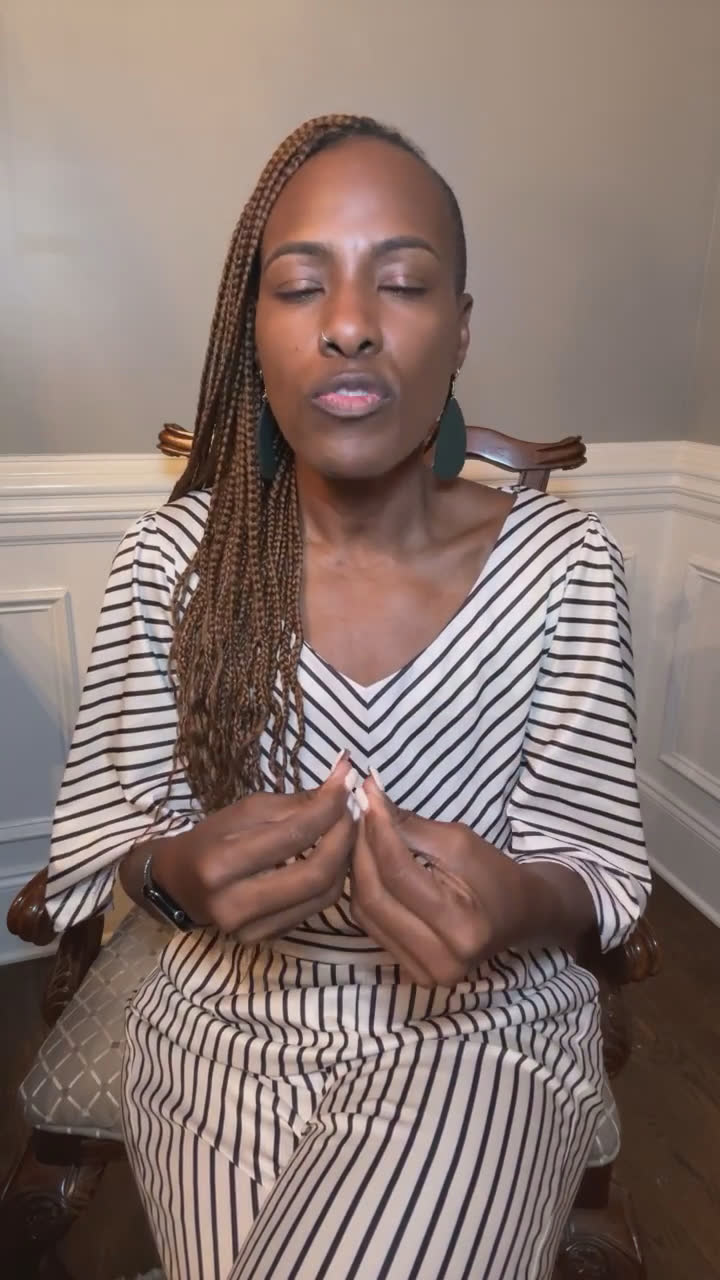
Dr. Charisse Johnson explores how to stay hopeful when life feels heavy, guiding listeners to notice and name struggles and practice simple self-regulation like rating the week. She highlights empathy, mini shutdowns and tearfulness as signals of capacity.
Dr. Charisse Johnson is a licensed clinical mental health therapist, mindfulness practitioner, and author. Rate your week one to ten. Check one meaning it has been a really difficult week. Ten meaning it was a phenomenal week based on the context of your life.
How do we stay hopeful when the world feels heavy? If you've felt any level of heavy over the past month, give me a heart. Our brains are wired for empathy. There is power in a mini shutdown.
How do you know when the weight of the world has become too heavy for your nervous system to hold? One of the primary ways that I know is I become tearful. These are not signs of weakness. They're signals of capacity.
Morning. How are you right now in this moment, I'm going to pause and slow down. Take a pause with me. Give everyone an opportunity to come and to get situated. If this is your first time on a live welcome. I'm Dr. Charisse Johnson. I'm a licensed clinical mental health therapist, mindfulness practitioner, and author. Most importantly, I am a contributor on Cadre and it's one of my absolute favorite places to be every week. And you will continue to see more of me in the weeks ahead. Typically, we start two ways.
Good morning, Steph Irwin. We say good morning, good afternoon, and good evening depending upon when you're listening to this. Hello, Andrea. Hello, Jules. Rate your week one to ten. Hello. I can't see it. Jeanette. Good morning to everyone. I have on light colors, which actually makes it difficult to see the screen. Rate your week one to ten. This is our self regulation. Check one meaning it has been a really difficult week. Ten meaning it has been a phenomenal week based on the context of your life.
Doesn't mean a perfect week, but you're doing the best you can to stay regulated. And then we say where you're from. I am in Charlotte, North Carolina, which is my home city, and I love doing that. We've already seen Good Morning north than Minnesota, so that we have an opportunity to kind of talk about our collective locations and a reminder that you are not alone, because it can feel that way sometimes. Hello, Jackie. So one of the things that I want to focus on or what I want to focus on this morning is how do we stay hopeful when the world feels heavy?
Now, you may not be in a place hello, Statesboro, where the world feels heavy right now. But I want you to think world in the context of your world, whether that's your work world, your home world, or the world as a whole. If you've felt any level of heavy over the past month, give me a heart. Send a reaction. Let's let the community know you're not alone. Again, alone. This could be heavy in any area of your life. So I always want you to take the things that I say and really expand it into other areas.
How do you stay hopeful? I will say this. It's first not denying the areas of your life that are hard right now, whether that's an area that you're experiencing or an area that someone that you love is experiencing. Hello. Speak Wonder from Erie. Paul. It's a matter of just acknowledging. I know it's there. I'm not denying it. But we also want to come into spaces like this. We want to realize what does it look like for me to regulate. Opening quote. Hope isn't the absence of pain, it's the current.
To stay present in the midst of it. Can we be honest? It is really challenging to want to stay present, present. When life feels heavy, our natural inclination is to escape. Whether that's to avoid things that create conflict or tension. To rest more, to eat more, to drink more. Could be a number of different things, but often anything other than having to sit in heaviness, completely understood. And that is what the brain would encourage you to do because it wants to save you. So it says, hey, go get some great dopamine.
Go do something different with your life. Our brains are also wired for empathy. Did you know that, like, we're actually designed to care about one another. So if you come across somebody that seems like they lack empathy, there's a deep problem. But that wiring of care also makes watching stress while experiencing stress very difficult. And yes, Jackie, or shut down. You know, let me say this as a caveat. You know, I could bring this up when we get to the tools area, but I'm gonna say it now. I do think there is power in a mini shutdown.
There are moments where you may need to go, I need to pull back. I need to restore, I need to recover. So shut down with intention, with a plan of moving through that shutdown so that when you get to the other side of that time of recovery, you feel like, okay, I've recharged, I've poured a little bit back in my cup so that I can continue to move forward. It's natural to feel like you want to shut down. However, if that's something that feels like an absolute need, you feel like you can't resist it, time limit it.
Make sure you have things that you do during that time and that you know you're going to have to wake back up and go back into facing reality. Our brains are wired for empathy. We have these things called mirror neurons. So that means even as we watch things that we see, it's going to impact us, even if we're not directly impacted. That's a part of what we call vicarious trauma. And with the presence of social media, we are inundated with mirror experiences that cause us to hurt for others. I will be fully honest, that's one of the things that I find so sacred and powerful about Cadre, about this space, is that when I'm here, I know nothing is coming my way other than what I go seek.
So I absolutely encourage you to Pull away from the part of your brain that doom scrolls and make sure that you're spending time in this space with multiple contributors as a reminder that you can let your nervous system down and you don't have to continually put things in your brain and hold it when the brain is flooded. Secondhand stress creates cortisol. Cortisol is our stress hormone that rises. Your nervous system begins to interpret cortisol global suffering as a personal threat. That's why scrolling the news makes us very tense and overwhelming.
So how do you know when the weight of the world has become too heavy for your nervous system to hold? Take a moment and I want you to think about that. Of course, I'm going to give you some ways that you can identify. But how do you know for your body and for yourself system that the weight of the world and what you're watching and the weight of your world and what you're carrying has become too heavy? One of the primary ways that I know is I become tearful. I am not a crier in particularly. I cry most when I'm angry.
But when I notice that I'm watching a movie or doing something random and I become tearful easily, that lets me know, okay, something's off, something's too heavy. I need to work through something and find a way to release some of it. A few ways that you might notice things have become too heavy is emotional numbness. That means you feel a little disconnected or indifferent. So when things happen that you actually need to react to, you don't. Your reaction is very like, yeah, I hear you, I see you.
It's one more thing. So you don't even feel like you have the energy to react or overreact about anything. Physically. Your body may feel tense even while at rest. You might struggle to focus. You might feel easily startled. You might notice a heaviness in your chest. I also see for a lot of people, a lot of digestive discomfort where you feel like your stomach is always hurting or even while eating. It's really challenging. Some of you will even feel a sense of fullness because you're emotionally full.
So you go into a meal and then you kind of stop at a certain point and you think, oh, my goodness, I thought I was hungry, but I already feel so full. What's wrong with me? You're carrying a lot. Yes. Blood pressure can soar. Rapid heartbeat. It's important to know your signs, but also keep in mind these are not signs of weakness. They're signals of capacity. In other words, your capacity is challenged. Your bucket is too full and needs to be released in some way. So that's something that I want you to keep in mind, not a sign of weakness.
There are signals of your capacity. Another one that I want to add is, is sleep. You may either want to sleep more than normal, or you will find that you have a difficult time sleeping because when you lay down, your mind is racing. You might have a little insomnia. It's difficult to fall asleep. Or then it's the next morning, around the time that you need to get up before you're getting into that heavy sleep. And yes, cravings, cravings, cravings, particularly for sugar, high carb, high fat foods.
If you've been with me recently, you know I am in the midst of this Jolly Rancher kit. I know that stress. I know that's heaviness. I've gone most of my life since childhood and rarely touched a Jolly Rancher. And then I hit these waves where I'm like, give me all the Jolly Ranchers. I don't care what else I'm supposed to eat. And I know for me, that is a signal. And so be honest with yourself, not out of shame, but so that you can recognize, okay, I need to do something about it. So here's the thing.
We can't fix the world, but we have to stay human in it. And we do want to stay present because we don't want to miss the really great moments. One of the most powerful things that we can do in the midst of the heaviness is to connect with people and experiences that we love because they create oxytocin. Oxytocin is the connection hormone. And did you know today's fun fact? It actually increases your resilience. That means the more healthy, happy, joyful social connection that you have, or connection to experiences that bring you calm and grounding and joy, the more capacity you restore in order to move towards life.
So, you know, we talked about wanting to withdraw, wanting to isolate, and wanting to shut down. The challenge with that is that you reduce your oxytocin because you're not having connection with anyone or anything. You're very closed off. So it's the opposite of what we need to do, and it genuinely doesn't help. Collective anxiety is not supported by isolation. It's anchored in connection. It's remembering that we were not created to carry everything alone, which is why being in these spaces makes it so wonderful.
So I want to give you two quick skills that you can use if you find yourself in this space. First, emotional containment. All right. Emotional containment is about honoring what you see without internalizing it. So let's say that you're looking at the situation that's present in this moment, around people who are getting ready to lose their benefits, around food. Emotional containment would look at, oh, my goodness, this is so sad for the families and the elderly and the disabled and the children who are going to suffer without those dollars.
See it, name it, feel it, but don't absorb it. Right? So how do you not absorb it? Part of it is recognizing that you solely holding it and absorbing it doesn't change. Change anything. You can then find a way to feel like you're part of the answer. So I know the other day, for example, I went on and found multiple apps that I could start sharing with people who might be struggling and don't want to say anything that would let them know places in their area where they could get food at a reduced rate or find food banks.
So that was my way of saying, this breaks my heart. Holding it will crush me. What can I do? So I stay present, but also feel like I'm being helpful.
Reactions and comments are for members. Joining is free and takes a minute.