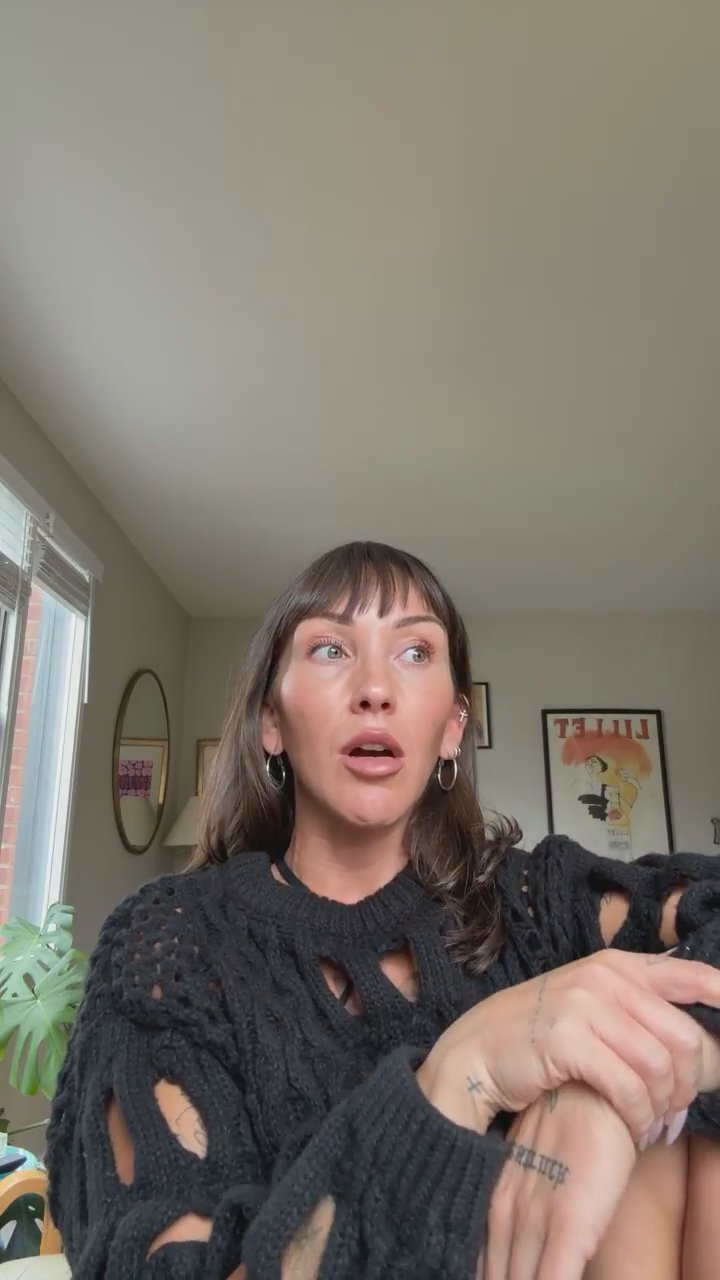
A host reflects on how growing up with chaos or inconsistent caregiving can make familiarity feel like safety. She explores the distinction between safety and familiarity and how that shapes adult patterns and responses.
Happy Thursday, cadre crew. Hello, hello, hello. I'm tired. I don't even know what I was gonna say. Mama Girl is tired. Happy Thursday. It is Thursday. Hi, Rach. And it's a cloudy day here in Seattle. I am about to get my period, so I feel real tired, lethargic, foggy, a little bit irritable, emotional, and at the same time, this cycle has been much better than previous ones, and I think a lot of that has to do with not drinking, so that's pretty awesome. I just posted a video, hi, junky. I just posted a video to my page about the difference between safety and familiarity.
If you're not already aware, cadre is doing a theme of safety this whole month for September, which I think is a great concept. I speak wonder, and so I just posted a video to my page about the difference between familiarity and safety. And I wanted to just kind of expand on that today in this live session because I think it's something that it's a concept that is very it can seem sort of like it doesn't really matter. It's sort of vague, but it's actually something that impacts us in a lot of different ways.
And so I just wanted to kind of talk about it. So if you are someone who grew up in a chaotic household or a household or had family members or parents who were not very consistent, either in their parenting style or in how they showed up for you, if it was sort of like an unpredictable environment, or if you weren't physically safe growing up at any point, or there was any kind of abuse or neglect, that oftentimes can, while we are developing as kiddos and our brains are like sponges and we're kind of learning about the world, that can create for us this sense in our brains that that is what is normal, that that's what's common.
And not only that, because our home or our parents or our caregivers, what did I say, home like that? Our home or our caregivers or our family is also meant to be when we are kiddos, our safe place. It is meant to be where we experience and feel safety and security. So what happens is we start to confuse what we experience on a regular basis as safety even if it's not. So if we experience a lot of chaos, if we experience a lot of inconsistency, if we experience any kind of abuse or neglect, whether physical or emotional, if our households or our homes are void of love or affection, we equate that to what is safe, even if it's not.
And our brains at a very biological level are designed and primed to seek safety as a way to survive. And our brains also love familiarity. Our brains will see things that it knows, that it understands. And it will gravitate towards that because when we can predict an outcome, even if that outcome is not necessarily safe, positive or healthy, at least we know how to prepare for it. And that to the brain feels safer than going out into the unknown where we have no idea how to prepare. So there's a lot of ways in adulthood that this will show up, where we might find ourselves stuck in what feels like really, really chaotic cycles or patterns of abuse or relationships that we know are not good for us and yet we find ourselves drawn to.
We might self sabotage a lot when things start to feel peaceful or calm, we might create chaos because we are not used to the calm or the peace. We might experience discomfort with ease, we might experience discomfort with joy, we might experience discomfort with boredom or relaxation or have a hard time sitting still. These are all potential indications that our brain is actually mistaking things that are not safe for safe and having a hard time recognizing things that are safe as safe. And that doesn't mean there's anything wrong with you that doesn't think you can't change that.
It just means that for one reason or another, your brain has been primed to see certain situations as a safe thing, even if it's not. And it's likely because that is what is the familiar thing. This doesn't necessarily mean something has happened in childhood. Sometimes it has to do with relationships we have, right? So like, you know, if you think about like, who is your first boyfriend or girlfriend or the first person that you dated, chances are in life, you probably dated similar people, whether it's how they look, whether it's how they act.
And it's because our brains went, oh, that was my first experience of love, even if it wasn't a good experience, even if it wasn't a healthy experience, even if it wasn't a long experience. And so our brains are going to try and recreate that to see if we can get love again. And so we oftentimes will seek something familiar, even if it's not the right thing for us. And so I think the first sign, when it comes to the first sort of like thing to do when it comes to trying to rewire or reprogram our brains to seek things that are familiar rather, sorry, seek things that are safe rather than familiar, is noticing those patterns, right?
So noticing in your life, where do these really show up? For me, a lot of it is self-sabotage. I do, I'm a queen of self-sabotage. Anytime I get really close to life feeling like how I want it to or how I have tried to get it to based on what I've done in therapy, I will self-s abotage. I'll binge eat, I will drink, I will, you know, not take care of our responsibility. I will do something to impede my ability to reach that point because I'm so not used to being there. I am much more used to suffering or hating myself or, you know, or self-harming and so to speak.
So for me, it's a matter of noticing when I'm meeting that point of, okay, this feels like a moment where I'm going to self-sabotage and trying to make a different choice. I'm not going to do it every time. I'm not going to get it right all the time and that's okay because rewiring those patterns is going to take time. My favorite metaphor for this is like, if you think about like you're trying, let's say you're trying to grow your glutes at the gym. It's not going to happen overnight. If you go to the gym today, you're not going to wake up tomorrow with a dump truck.
It's also not going to happen in one month. It's probably not going to happen in three months. It might take six months to a year for that muscle to grow. And it's also not going to happen in six months to a year if you only do these exercises once or twice. It takes consistency and repetition. It takes rest. It takes honoring if there's an injury, red irection. And this is the same with our brain. Our brain is a muscle. So to grow that muscle, to strengthen it and to change it, we have to repeat things consistently over time.
And so that can, it can be frustrating, I think, when we are doing a lot of work on ourselves, to not get that visual representation of progress, right? Like if we're working on building a physical muscle, or not his own, but like an external muscle, like a bicep or whatever, like we can kind of track that a little bit more clearly, visually, we can measure it more with the brain. It's a lot more abstract. We can't physically see the change. It's hard to measure it numerically. So we have to, we have to kind of sometimes make our own forms of measurement, but also acknowledge times when we do succeed.
So acknowledge times when like, let's say five times in a month, I self sabotage, and the next month, I only do it four times. And there was one time we're interrupted. We have to start to acknowledge those moments, because we need to start to be able to measure our change for ourselves. So we can see that growth. So that is my spiel about the brain and familiarity. And again, I just posted a video about that on my page on cadre. If you want to check that out, I'm just going to read these comments.
Yeah. It says I'm realizing that I've been stuck in this familiarity so long, it doesn't even feel safe anymore. Very interesting. Yeah, it's it's wild when that when we like are repeating patterns that don't even feel safe anymore. And yet we continue to repeat them. That's when we know our consciousness, like our wise self knows that the familiar thing is not safe, but the lizard brain, the part of our brain that is just focused on survival hasn't quite caught up yet. So it's really, that's them the challenge of how do we get the conscious part of ourselves to interrupt when the lizard brain automatically just wants to do the thing that is familiar?
No, you're not I am. I don't know. I don't remember what you were responding to is there's another one that was. It can take place at your workplace. Co-workers can make it feel unsafe for you. Yeah, definitely . It happens in all kinds of places really, truly. And it's usually relational, right? It's usually about how other people make us feel whether they make us feel safe or not. So yes, that is very true. Okay, my loves. I hope this was helpful. And again, there's some videos on my page right now about safety.
And make sure you check out some other cadre community. Wow, brain, other cadre contributors to see what they're posting about safety this month. I'll see you next week. Same time. Share place! Again, bye!
Reactions and comments are for members. Joining is free and takes a minute.