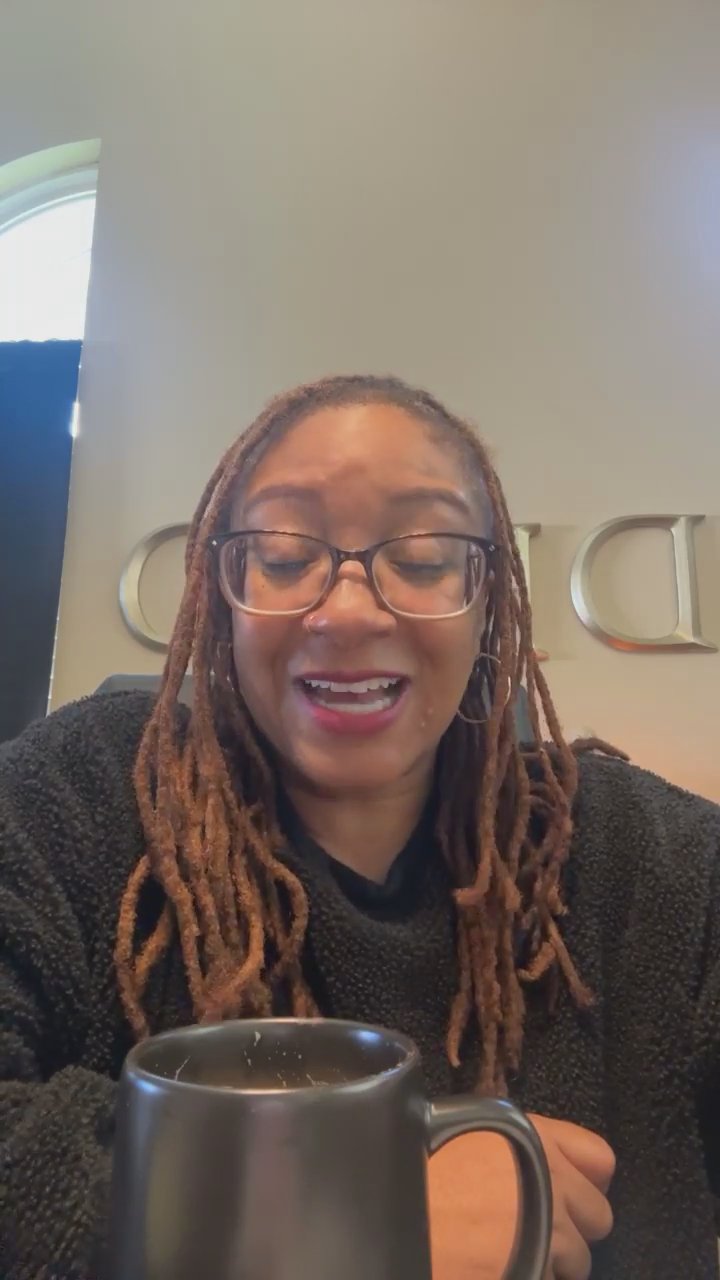
Dr. D explains toxic empathy and trauma bonds, exploring how excessive empathy can keep people stuck in unhealthy relationships and offering reflective questions to consider afterward.
Hello, cadre. It's me, Dr. D. I just looked at my nails and I look a mess, but that's okay. Random thought of the day. I have plenty of those. I hope you do too, because I know I'm not alone in that. For those of you who might be wondering what I'm drinking today, of course it's coffee, but it is a vanilla caramel little mixture that I kind of put it together with a little bit of cinnamon. with my Nespresso. So here it is. Let me take a sip real quick because I just made it. And is this Mel Myers?
How are you doing? Where are you joining from? Where are you located? Hello, Miss Brittany. Oh, this coffee is good, y'all. Okay, let's get into it. Oh, wait, before we get into it, again, this is all about Domestic Violence Awareness Month. And so I want to show you guys my bracelet. So I've been wearing purple all month and let me know if you've been seeing purple around town where you live because there have been maybe, ooh, New York. Okay. There are purple ribbons or you might see purple flags or something purple in your city or town that represents domestic violence awareness.
And I know there are some Where I live, there are some local domestic violence places that are actually going to different businesses, trying to bring awareness to it. And so I'm one of those businesses. I'm considered a safe spot for people. And that doesn't mean that they come to me for safety, but if they were to ask about resources for domestic violence, I would have that available for them at my office. So I've been wearing purple in honor of Domestic Violence Month. So we have been talking about the cost of things when it comes to domestic violence.
And today we're going to talk about the cost of empathy. And I have a YouTube video about this, just a short video, but I'm going to give you some snippets here. Okay, so make sure you have your pen and paper today because I'm going to give you some questions at the end that I want you to write down and I want you to think about them later. All right, so Tell me in the chat, have you heard of the term toxic empathy? And if you've listened to me before, you might have. So have you heard of what's called toxic empathy?
So toxic empathy, I'm gonna get into it. And today we're talking about the cause of empathy. So toxic empathy is when our Our way of showing empathy to others gets in the way of having healthy relationships and having too much empathy or empathy where you get stuck in a toxic cycle will prevent you from getting the support that you need, but it also prevents you from getting out of toxic relationships. So I'm gonna dig into that. There is something else called trauma bombs. Okay, these are some big words for you today, toxic empathy and trauma bonds.
And a lot of people assume a trauma bond means that you are connecting with someone because you both experienced some type of trauma. So for example, if you are connecting with someone because you both have been in a fire or you've lost everything to a fire, people would consider that a trauma bond, but that's not what trauma bond means. So let me clear that up for you. A trauma bond is when a victim in a situation bonds with their abuser. They get stuck in this toxic pattern of empathy and they are bonded to the abuser.
So they're afraid of disconnecting from their abuser because they have so much empathy and they want to help the person that's abusing them. Tell me if you've been there because I have. Okay, so if you identify with that, me too. Me too. Been there. And I'm going to tell you a little story. Not all the details. I'm going to give you a little bit. So when I was younger, I noticed that I have this natural gift of empathy. That's why I'm a therapist, right? And I started to recognize that I was staying in toxic relationships for way too long because I had so much empathy for the people that were hurting me.
I saw their pain. I realized why they were doing the things that they were doing. It made sense to me that they would do what they were doing. But because I had so much empathy, I created a trauma bond with them. So every time I was hurt, instead of addressing the pain that was there, instead of addressing their behaviors towards me, I used my empathy to understand them, to forgive them, to make sure they were okay so they didn't do it again, right? And so I developed this trauma bond and it's very toxic and it's hard to recognize that that's what's happening because your empathy sometimes is what keeps you safe in the relationship, especially if there's violence in the relationship.
If you can lean into the empathy you have for an abusive person, The abuser will accept that as, oh, they get me. I can do this again. They accept me for who I am, the abusive person. Yes, I'm an abuser. So I'm going to keep doing this because they get it. They know it's going to happen. So there's no reason for me to stop it. So your empathy can not just hurt you, but it also hurts the other person from changing their own toxic behavior. Dream big 30, you said this is amazing. I'm glad you liking it.
So think about relationships you have been in, or if you've recognized this in some of your friendships, because it's, oh, it's so tragic. I've been in too many relationships where my empathy kept me stuck. It kept me stuck in a relationship that I didn't necessarily wanna be in anymore, but I also got to this place of wanting to protect the person that was hurting me, so I didn't tell anybody about it. I didn't even bring it up to them that they were hurting me. I just dealt with it. I would cry in secret.
I would do what I needed to do to take care of myself. That's what I thought. But I never spoke up about what was hurting me because I understood their behavior. I knew why they were hurting me. I knew all the trauma that they had in their background, which made sense to me why they would act this way. And my empathy wanted to help them through it. Don't fall for that. You cannot help. Well, I will say you can't help someone, but it's not your job to do that. That's what professionals are for. Okay, so don't get stuck in a trauma bond.
But some people question, well, are trauma bonds the same as codependency? And it's not necessarily, but it's very closely related. So codependency is when you You gravitate towards this need to be needed, and that feels good even when it hurts. So you might be in a relationship with someone who's always asking you for help, that's always needing you, and you stay in that cycle because you like to be needed. So yes, trauma bonds will lead to codependency, and that's the cost of our empathy. We get stuck in.
codependent relationships where we can't separate. And if we were to separate, we think about, well, if I leave this person, how are they going to get the help they need? If I leave this person who's hurting me, then how are they going to survive? As if they cared about our survival. Okay, so let me leave you with these three questions. I want you to write them down and I'll say them a little slower for you. I want to make sure you get time to write these down and reflect on them. And if you want to share any immediate responses to this in the chat, feel free to do that too.
So your first question to think about for the week, when has your empathy turned into self abandonment? When has your empathy turned into self abandonment? And question number two, is your empathy keeping you stuck? Are you stuck in a toxic pattern of empathy? Okay. Question number three, what are the costs of you staying in toxic empathy? What have you lost? What have you had to sacrifice because you're stuck in toxic empathy? So I'll read those again. Number one, when has your empathy turned into self-abandonment?
Number two, is your empathy keeping you stuck? And number three, what are the costs of you staying in toxic empathy? And I will say the cost of me staying in toxic empathy in past abusive relationships is I lost sleep, I lost peace, I lost friendships, I lost time with people that I cared about, and I also lost the ability to connect with people that are actually healthy. I lost time away from the man that I'm with now because I didn't know him yet, but the door would not have been open for him to come into my life because I was stuck in toxic empathy.
So what are the costs that you have? All right, y'all, that's all I got for today. I hope that resonates with you. If you got something from it, you know me, drop your coffee mug in the chat for me, and I will see you next week. So I will repost these questions in the Cadre Sphere, just in case you missed it. And if you feel like you learned something, share this with someone, okay? And I don't know who else is up today, but make sure you tune into some other creators on here. We have a whole new group of people and the energy behind some of these other people sharing on Cadre, it's amazing.
It's really inspiring to see how we are all coming together in this community. So I hope you guys have a wonderful day and I'll see you next week. Bye.
Reactions and comments are for members. Joining is free and takes a minute.