The presenter outlines communication skills for relationships affected by chronic pain, covering lowering emotional walls, reflecting and I-statements, aligning perspectives, soft and hard boundaries, and persistence in change.
The presenter welcomes viewers back to the series, outlines that this is part two on managing relationships, and explains the video's focus on communication skills to help with relationship challenges arising from chronic pain or illness.
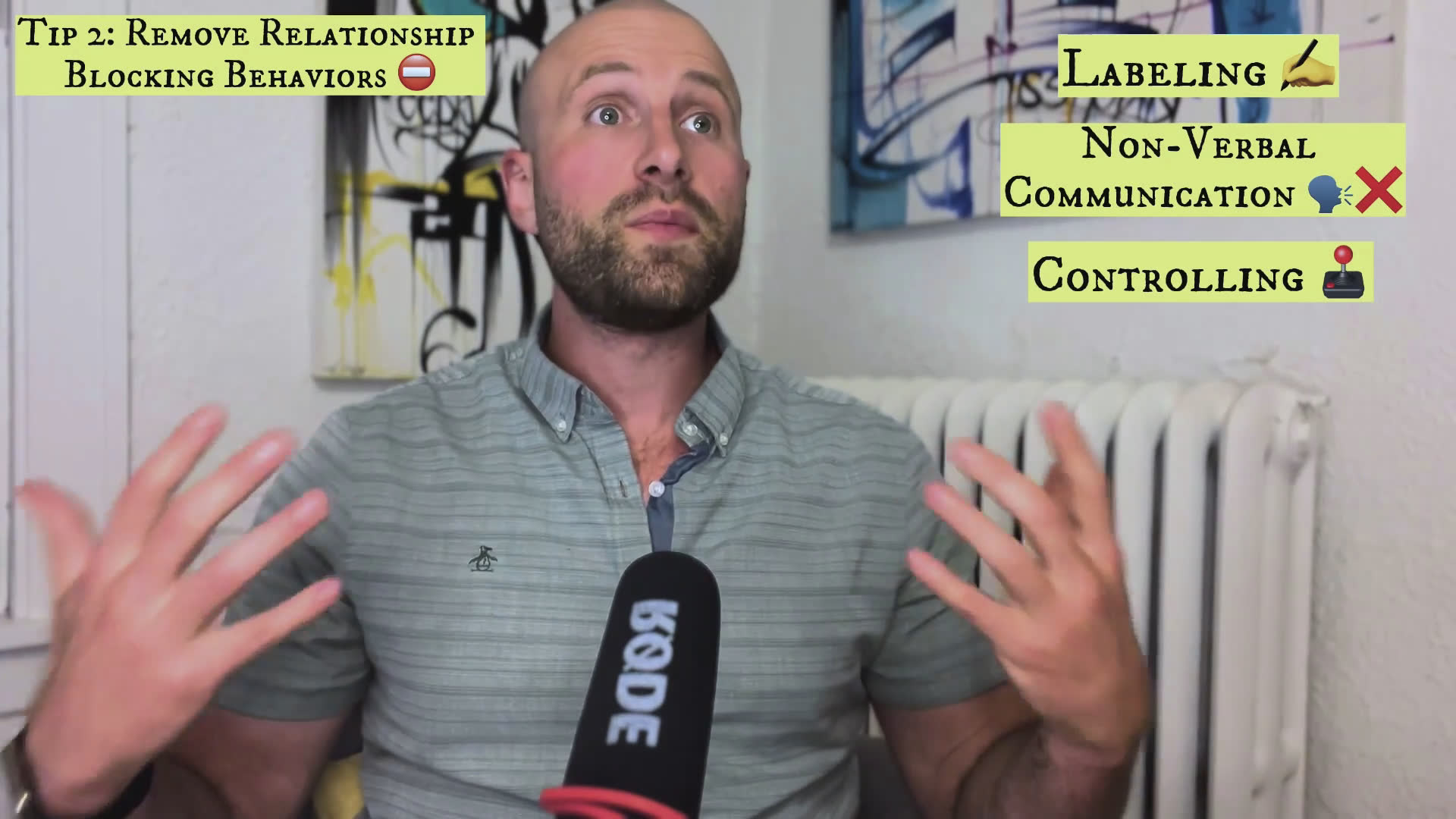
The host defines emotional walls and lists behaviors that provoke defensiveness—like labeling, aggressive body language, and controlling language—explaining why these actions prevent authentic, vulnerable conversations and how to avoid them.
This section covers mindful 'conscious communication' techniques such as reflecting back what someone says and using I-statements to express perceptions and feelings, with examples showing how these reduce defensiveness and improve understanding.
The presenter discusses acknowledging truths in others' perspectives (aligning) to disarm conflict, and ways to promote positive behaviors like giving reputations to live up to and using upbeat tone and body language.
This chapter explains soft boundary-setting (asking for what you need) and hard boundaries (asserting consequences for unacceptable actions), with examples about asking for breaks and limiting critical checking-in behaviors.
The host emphasizes that changing relationship dynamics takes time, advises holding firm in using communication skills and boundaries, and reassures viewers that consistent positive communication will often lead others to adapt.
Welcome back to 15% Better, my series on managing chronic pain and chronic illness. And in today's video, this is part 2 of managing relationships. And today we're going to be focusing on communication skills with your loved ones because as we've talked about, there's so many complications and stresses in relationships when you have a chronic condition. As many of you know, I make videos here on Cadre on all sorts of different topics, but one of them is on communication. I do a lot of teaching and lecturing on the topic.
I'm even writing a book on it. But today is going to be focused on using varying communication skills in regards to the dynamics that come with having chronic pain and chronic illness in your relationships. As I talk about in a lot of my lectures, effective communication can have so many different benefits. When we learn to more effectively communicate, it can really help diffuse conflictual situations, help repair relationships, and even for relationship building. and learning how to support the loved ones in our life.
So again, there are so many benefits, but today I'm going to give you my top five tips for using communication skills in regards to managing relationships when you have a chronic condition. My first tip is about lowering people's walls. Now we all have emotional walls and these are defenses and essentially they protect our ego. And I don't mean that in a bad way, but our ego is our sense of self. So when someone says something to us that is offensive or makes us feel bad about ourselves, if we feel like we're trying to be controlled or manipulated, if we feel like someone is talking down to us, if we feel like someone is being aggressive towards us.
if people are being sarcastic. There's all these different ways that people communicate that raise our walls as a way of self-protection. Now the problem is when those walls are up, there could be no healthy exchange between you. So my first tip is to avoid doing those relationship blocking behaviors, that's what I call those, that raise people's walls and gets in between you while having an authentic and vulnerable relationship and conversations that could really help enhance your relationship, especially when you're someone who struggles with chronic pain.
There's some other examples of relationship blocking behaviors you should avoid. One of those is labeling. Calling someone any kind of name is going to make someone extremely defensive. That may seem obvious, but if you notice in conflictual situations, we tend to do that. Now an extreme example would be calling someone stupid or lazy or being insensitive. Right now sometimes we can act in those ways. However, we are people who are doing those actions that person. So be sure to avoid something like that.
One of the biggest ones is in your body language. So being really mindful of this because there's a famous saying that 30% of what we communicate is in the actual words and 70% is in the body language. So be careful that you're not being overly aggressive or you have your arms folded or you're shaking your head, right? Because those are some of the things again that bring people's walls up and it prevents that healthy exchange. So some other relationship blocking behaviors that I frequently see are controlling.
One of the ways I find that this comes out is saying things like you should. Like you should be doing this. You're not doing this right. And the second you do that, the person's reaction is going to be doing the opposite. If you concede to the fact that you should be doing something that you're not, that means that you're wrong. So when you do that to someone else, they're immediately going to get defensive. They're going to protect their ego. And regardless of that person should or shouldn't do that thing, or if it would be beneficial to them, it doesn't matter.
Because it's all about the person communicating and how they're communicating versus the message itself. So if you want that message to come off better, just really be mindful that you're not doing those relationship blocking behaviors or coming off like you're trying to control them. The next is using certain skills of effective communication or what I call conscious communication, which really means taking mindful action, putting thought into what you're saying. And one of the first skills I teach is called reflections.
And this is one of the easiest ones that you can do. And that's essentially repeating back what that other person said. Maybe not exactly, but if that person says, I'm really frustrated when you don't take out the garbage, right? I mean, it's literally parroting back what they said. So you're really feeling frustrated and upset. You feel like I should be taking out the garbage and then I'm not fulfilling that obligation. That's taking a little further, but essentially it's just repeating back and what that does is it shows that person you're listening because active listening is so important if you're going to have a healthy interaction, if you want that person to feel like they're being heard.
and to lower their defensiveness. So try doing those reflections. Another example is using I statements and this is portraying how you feel, your perception and not just stating something to be truth. This can make other people really defensive when you're making a definitive statement about the situation and not being open to the fact that this is your perception and that it may not be reflecting reality, that you're not just assuming how they feel. Here are a couple examples of using I statements.
I feel frustrated when I can't do activity like you, like going on a bike ride, that I really want to and I could see your disappointment. Another version of an I statement may be, it seems like you think that I'm not trying. I really want you to know that I am and that I see your frustration. Another really powerful tool is aligning and that is finding some truth in what the other person is saying and acknowledging it. By doing that, it's extremely disarming. When you're in a conflict, you're essentially in an argument and you don't want to concede any ground.
Therefore, the situation escalates, it becomes a debate. However, when you could stop and take some accountability for something that maybe you brought to the table that you did wrong and acknowledge that they have a point in something, it can really change the tone of the conversation. It takes the heat out of the room and it really opens the door to have a more healthy and productive exchange as the walls go down. Here's an example. Even though I'm in a lot of pain and feel like I can't do these activities, perhaps there are times I can put in more effort and I'm going to do my best to try.
Number 3 is using a set of skills to help promote healthy and more productive behaviors. So being able to better influence others into a more positive dynamic. An example of this is giving someone a positive reputation to live up to. Now they may be falling short of that, but you are going to acknowledge some positive trait that they have and open the door for them to act on that positive trait and change part of the dynamic. I may say something like, I know you're a really understanding person and are going to recognize Another example is having an upbeat and positive attitude.
You always have to be mindful of your tone. It's another example of using positive nonverbal communication to keep the conversation in a more positive and upbeat light so that it doesn't feel so heavy or conflictual. Another skill involves active listening and essentially that's just letting other people talk, letting them share, hearing them out. A lot of times people are going to walk away from a conversation feeling better the less you say and the more you allow them to say. So try more active listening, try more reflecting and allow others to express themselves.
Another one is using as many affirmations as possible. Anytime you catch them doing something nice or kind or you see them making an effort, be sure to acknowledge that and that positive reinforces that behavior and makes them more likely to want to do some of those healthy and positive things that help you. Another important communication skill is setting boundaries with other people and this can come in different forms. The first one I call soft boundary setting and that's just essentially asking for what you need.
For example, hey when we're out and we're taking a walk I may need to take a break once in a while. So something as simple as that is setting a boundary saying this is what I'm able to do or not able to do. You'll hear an example I gave in the last video and in my story video of how people were always constantly checking in on me. And I had to set a boundary with them to say, I appreciate you checking in on me. However, I'm going to ask that you don't do that because it really makes me feel bad about my situation and I don't always want to think about it.
So for those people who are really supportive of you, by taking that leap, by enabling yourself to set a boundary and advocate for yourself, it's going to really help. Unfortunately, not in all situations are people going super supportive. Some relationships may be trickier, more conflictual. And that's when it comes to setting hard boundaries. Now, hard boundaries in nature are a little bit more assertive. They're a little more confrontational. However, you can still do them in a positive and upbeat way.
Essentially, you're telling someone that the actions you're taking are not acceptable to me. Therefore, if you do those, here's the action I'm going to take in response. Now again, that sounds kind of bad, but sometimes you have to do this because if you allow these behaviors to continue, it could really have a negative impact on you, especially if those behaviors are unhealthy coming from other people. So here's an example. When you question my honesty, when I tell you I can't do certain tasks, it really has a negative impact on me.
If I feel like I'm being criticized in the future, I'm not going to be able to engage, I'm just going to walk away. I know that you love me, you're trying to support me and want the best for me, but this is something I have to do for myself. The last suggestion I have is a culmination of what we talked about before. And that is when you have different effective communication strategies, you're changing the dynamic of a relationship. And when a relationship has been in the same dynamic for a long time, sometimes it's hard to change and that could be hard for other people.
Now some people are going to be more responsive to others with your new communication skills or with setting boundaries. But even if they seem to be having a hard time with it, just hold firm and have faith. Just continue to take responsibility for what you have control over and maintaining a healthy dynamic and just wait for them to come along. Now it may feel like it's going to take a lot of time, but I promise you if you use a lot of these skills you remove those relationship blocking behaviors.
If you maintain more of a positive attitude, if you're more affirming, if you use aligning and disarming, over time they're going to generally shift because they probably want a positive dynamic as well. So hold firm and have faith. Okay so that was a very general overview on a lot of different communication skills. Again I've written a whole book on this so go ahead and check some of the other videos out on Cadre that I've done on communication skills that go a little bit more in depth. It's going to take a little bit of practice, but a lot of these are pretty easy.
A lot of it is addition by subtraction, sometimes by avoiding those relationship blocking behaviors alone, it could really make a difference in changing that dynamic and having more healthy and fulfilling relationships. As I mentioned before, one of the most important factors for our happiness are relationships. So I hope you take my suggestions from this video and last video to heart, start to connect with more people who are supportive and really put effort and energy into enhancing those relationships for them to be more supportive, more authentic, more vulnerable, and ultimately more fulfilling.
So I wish you the best in your journey. Speaking of journeys, we're almost at the end of ours. There's only one more main video left in the series, and that is my vision for you. It's culminating of everything that we've talked about, my hopes for you in the future, some changes that you can make and commitments you can make to hopefully work your way to being at least 15% better.
Reactions and comments are for members. Joining is free and takes a minute.