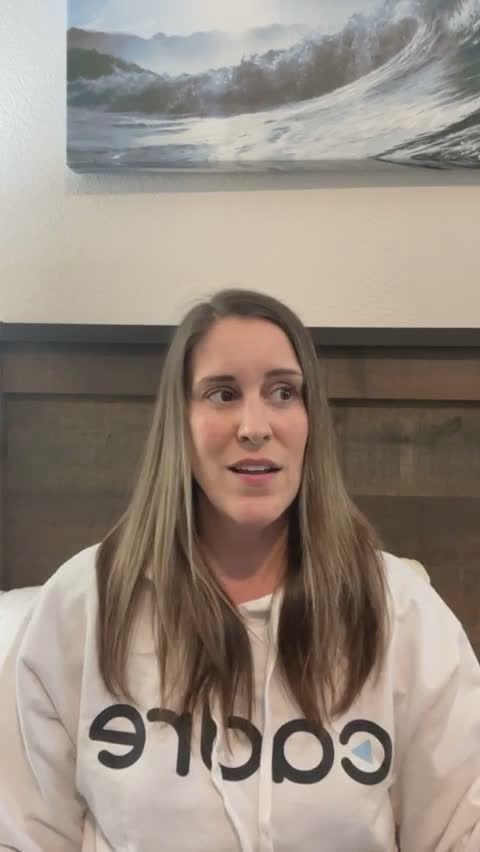
When we feel out of control, powerless, and consumed with worry and anxiety, we often turn to control to help manage these disturbing emotions. In this video, Dr. Carrie will describe her journey with anxiety and how to relinquish control even when it feels like there is no other option.
If you have ever struggled with anxiety or worry in your life, give me a thumbs up in the chat. The root of anxiety and worry is fear. We're going to unpack a little bit of my experience and then some tips for you.
Study: Perceived control diminishes anxiety. We try to control things when we're anxious or fearful. But none of these things actually work. Here are some ways to manage your anxiety.
Hey, Cadre family doctor Carrie here, going live. We have a lot to unpack today, so I'm going to dive right in and I just want to do a little bit of interaction upfront here. If you have ever struggled with anxiety or worry in your life, give me a thumbs up in the chat. Just so I know that I'm speaking to people who this resonates with. And to be honest, I think we can all say that at some point in our life we have experienced some sort of anxiety or worries. But if you're somebody that's really struggled with that, I really want to hear from you, and I want to have an interaction on the live stream today, so give me a thumbs up.
If you're somebody who has struggled with anxiety or worry in life. I used to really, really struggle with this, and I would say it's kind of like been one of my fundamental issues throughout life. To be honest, I didn't realize this until only a couple of years ago that actually the root of anxiety and worry is fear. And that's a natural human emotion. Like, we all are made to have fear, right? That can be, like a life saving emotion, to have fear. So it's not a bad thing in and of itself to have fear, to have anxiety, to have worries.
Some people say, you know, I struggle with worry, but it's actually my greatest motivator to be successful and to get things done so it can actually be, like a positive thing. But a lot of times what happens in our brains when we allow anxiety and worry and fear to just continue to kind of run in our brains, it can take us down a spiral. And so I just want to give you this quote and talk about a research study, and then we're going to unpack a little bit of my experience and then some tips for you.
So stay tuned with me. Buckle up for the ride. So they've done this study, and the quote is, perceived control diminishes anxiety. So let me unpack that for you. So if you are in a vehicle and you are the passenger, let's say the person driving, you trust them to drive the vehicle, they're a good driver. And you guys are driving down the freeway and all of a sudden people are slamming on their brakes. You see a car flipping over one is coming into your lane. All this stuff that's going to cause anybody some anxiety, it's a little bit of fear for your life there in the vehicle.
But they've done the studies that the person who's in the passenger seat has more, like anxiety, physiological response than the person in the driver's seat. Now, you're both in the vehicle. You both are experiencing the same catastrophe around you. But the person who has the steering wheel in their hand, who has the stick shift in their hand, has more control over the vehicle than the passenger. Not really when cars are flying at you on the freeway, but that perceived control over the situation can diminish your anxiety response.
So what do we do as humans with that information? We try to control things when we're anxious, when we're worried, when we're fearful, we think that if we can be in control, it will calm us down, because it actually kind of does for a short term. Right. And so the title of my live stream today is lining up the remotes, because that is actually something that I used to do to manage my anxiety. Many years ago, I had, you know, kind of a chaotic life going on. I was in a very unhealthy marriage and just is really riddled with a lot of fears in life.
I was one of those that struggled with the what if scenario, what if scenario, everything. You know, it's my constant in my head of the what if scenarios. And so one of the things I would do to calm myself down before bed was go around and clean up my house, and I would, you know, wipe my kitchen counters down. And then I would go over to the living room, and I would literally line up the tv remotes and, like, perfectly line them up, like, very obsessive compulsive behaviors. And a lot of people that do struggle with obsessive compulsive behaviors are doing this to mitigate their anxiety and fear and worry.
And so that was just one of my things that I would do to calm myself down, because I could have control over this, right? I could have control over my external environment if I could make sure that everything was neat and tidy in my house before I went to bed. And so a lot of us that have struggled with anxiety and fear, we find ways to mitigate that by trying to control things, because we know that perceived control diminishes anxiety. And so one of the things you might find yourself doing is controlling your external environment.
Like, you're maybe somebody who needs to be super organized because it helps you calm down. Maybe you're somebody that finds yourself controlling other people, and you can get very demanding and manipulative of other people because your life is completely out of control. So that is the only way you know, how to just sort of get some control so that it can diminish your anxiety response. So it's a very natural human thing we do, and a lot of us do these things subconsciously. But I want to express this to you today, that none of these things actually work.
We think they work because for the short term, we feel a little bit more in control. When we have controlled a situation, we have controlled an outcome, we have controlled another person, we have controlled our external environment, we feel a little bit calmer because it does lower your sympathetic nervous system response a little bit, but it never lasts long time, which is why somebody who struggles with anxiety, worry, fear, can never seem to get that under control. No matter how much you try to control something, it never actually diminishes the anxiety.
So then what do we do if that's not going to work? Well, I want you to just understand today that anxiety and fear are natural. They're normal human emotions. And if you catch yourself kind of in that spiral of that, one of the best things I've learned in my own personal practice is to recognize, kind of like, when my brain is going there with that kind of fear response and say, you know what? I recognize I'm doing that again. I recognize I'm kind of catastrophizing something. I'm saying a lot of what ifs and nothing's, you know, I'm kind of like, my brain is spiraling and going there.
So what do I do? I recognize when that happens. And then I just say to myself, okay, I'm going to allow myself to be worried for a little bit here. And I actually did this the other day, and in my prayer time with God, I told him everything I was worried about, and, like, just. Just said it out loud. Like, I'm worried about this. I'm frustrated about this and this and this and this and this. And then once I kind of, like, got it off my chest, then I immediately switched into gratitude, because fear and gratitude literally cannot coexist in your brain at the same time.
And so one of the things I've learned to mitigate anxiety and fear in my life is to be more grateful for things. And I know I used to think, like, people who, like, were super positive and grateful all the time were just kind of, like, ridiculous pollyannas. But it actually works in your brain because it tells your brain we need to turn the worry and fear off, and it allows the other parts of your brain to kind of kick into gear. So you start focusing on the positives and the things that are going well in your life.
This is actually a leadership term called positive inquiry. Let's focus on the things that are going well, and it actually will drive you to continue doing things that are going well. And so I want you to try that next time you feel like your brain is just kind of, like, going off into, like, anxiety fear response, and maybe, maybe your life is utter chaos and, like, you literally don't know where your next meal is coming from or you don't know what's going to happen with your children or you have an ill family member.
Like, whatever the case may be, I'm sure you actually are going through something that is really stressful. And anxiety response is very natural in those kind of situations. I'm not to diminish those, but just saying, like, once you feel like your brain is kind of going there, recognize when it's happening and start focusing on what you're grateful for. And you'd be amazed what can happen in your brain with that anxiety and fear monologue when you do that. So that's just the one tip I wanted to share with you guys today.
And just also tell you that it's normal to struggle with anxiety, worry and fear because it's a normal human emotion. So just recognize that in yourself, too. Don't fight it every single time. Sometimes you have to kind of. And then stay tuned with me because next week, we're going to continue this conversation about how to be contagiously calm, how to, like, just exude calmness in every circumstance. So I hope this was helpful for you today, and I just appreciate you guys tuning in with me. God bless it.
You.
Reactions and comments are for members. Joining is free and takes a minute.