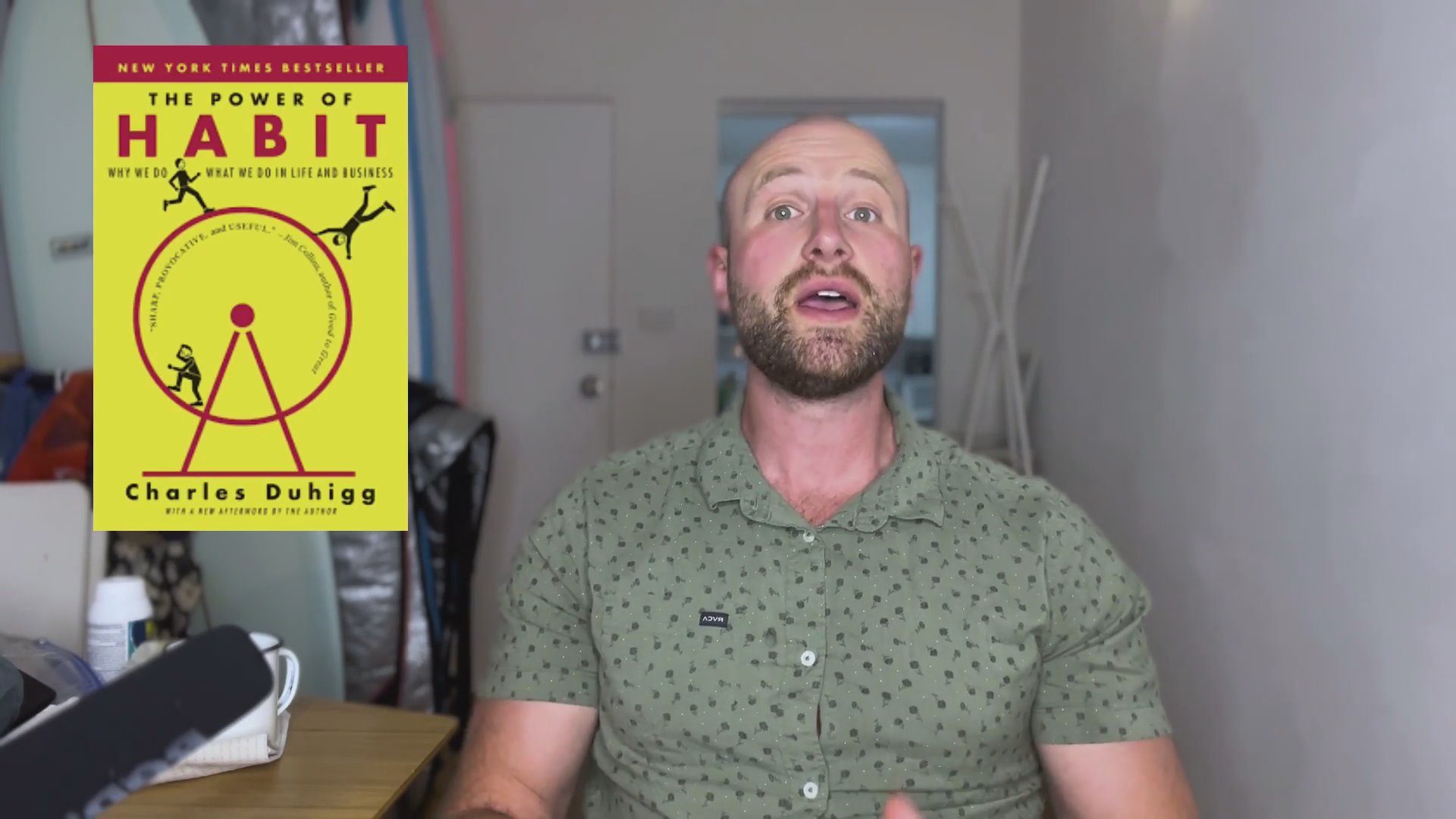
In part 2 of "Change O'Clock," I delve into the fascinating topic of how and why our brains form habits and the way they shape our daily lives. Here we draw on the insights from Charles Duhigg's best-selling book, 'The Power of Habit', and my experiences as a therapist and human who has had to quit many bad habits. With these insights, I talk about some of the most effective ways to change and how we will use my "Tripod Method" to take advantage of these. So, join me as us I unravel the mysteries of habits and learn how to harness their power to improve our lives.
Alright folks, it's that time again. It is change o'clock. This is my series on how to change any habit in the most effective way and how we form new routines. In today's video, before we jump into the model of change and really start to dive in, I wanted to talk about the science of what a habit is. Because if we're trying to change something, if we're trying to change this habit, we ought to know the mechanisms behind how habits are formed and the reasons why our brain is so prone to forming habits.
So sometimes we like to view habits as bad and good. So you often hear me talking about that. Okay, this is a bad habit. This is an unhealthy habit. And that very well may be the case. However, in our minds, our brains don't really know the difference between a good and a bad habit. A habit is just a habit, right? It is a routine. It is something that becomes ingrained. And there's some really good reasons why that is, which we'll talk about in a little bit. But first, when I'm working with clients on whether it's addiction or any other sort of habit that they're trying to change, I asked them the simple question.
And it's a little bit of a trick question, but I'm going to throw it out to you anyways. And that is, what is the difference between an addiction and a habit? So stop, think about it for a second. And when I talk to clients about this, when I ask them this question, you should mean they'll give me all sorts of different answers. But at the end of the day, really, a habit and an addiction are the same thing, right? An addiction is a habit. So maybe not all habits are addictions. But all addictions are habits.
They're just, they just tend to be unhealthy and more deeply ingrained. And they provide a lot of consequences. And addiction essentially means that you continue to do this habit despite the consequences. And that habit is extremely hard to break, right? So for some reason, it's those unhealthy habits that seem to be much harder to break than the healthy ones, right? So let's go ahead. Let's dive into the science around habit forming and what happens in our minds. And we're going to answer all these questions.
Our brains are habit forming machines. And this is really important. So I'm going to give you this example. When you were a baby and you were learning how to walk, it took a lot of mental energy, right? You were trying to form this new behavior, this new skill of walking. However, the more you walked, the less you had to think about it. Now, today, as you walk down the street, you don't think about it. It's not something that takes up a lot of mental energy. It is not only a habit, but it is a muscle memory that you have.
And that works in a lot of different ways. So here's another example I like to give. So think about the first time you had to drive to a new job. Maybe you didn't know where the location is. Maybe it was back in the day and you used a map quest and you printed it out. Or maybe it was a little more recently, you're using Google Maps, right? But you had to think about it, right? Like, okay, I have to turn here. Google Maps is telling me this, right? So again, you put a lot of mental energy, but the more you drive into work, the less you have to think about it.
Now, everyone could probably think about or relate with a time where you just left the house and you're driving and you're daydreaming the entire time. And then you just wind up at your destination and you're like, well, how the hell did I get here? It's like your mind was on autopilot, right? It's used to taking that same pathway. So even when you look at a rat and you put him through a maze, they could even, they could see, scientists could see into the rat's dreams, they could see the rat going through the maze, right?
I can't explain exactly how they do that. You should look that up. But they could see through the electrical impulses that the rat is learning that behavior, right? And so the same thing when we drive to the same place every day. And so we've all probably had that experience where you're driving to a similar location to work, right? Except it's not, right? You're going to somewhere that 's by it. And you're not really thinking about it and you get off with the exit you normally would to get to work.
But you're like, Oh, crap, I wasn't supposed to go there. Right, I'm supposed to keep going. And the reason we do that is our brains are on autopilot. It is essentially automating that task. Because when I'm able to do that, when I'm able to automate that, then I'm able to think about other things. And this is extremely key for survival. So essentially, again, habits are extremely ingrained. They're extremely important for our survival. And our brains put a lot of emphasis on them. And we're going to talk about why right now.
One of my favorite books on this topic is called The Power of Habit. It was written by a journalist named Charles Duhigg who wanted to learn about why and how we form habits in the way that we do. And also, what are the most effective ways to quit a bad habit? So he went and spoke to a lot of different researchers and neuroscientists. And he broke it down in his book. And I'll go ahead and summarize the main findings for you. But basically, he broke down the habit changing process or the habit forming process into three distinct variables.
So these three variables make up what he calls the habit loop. And the first variable is the queue. And essentially, a queue is a prompt. It's a trigger. It 's a stimulus. It's anything in your environment that tells your brain to tell you your consciousness to partake in that behavior. So I'm going to use the example of quitting nicotine. And in my case, and a lot of other smokers or nicotine users will tell you, one of the times you crave the most is after a meal. Why is that? Well, I don't know, it settles your stomach a bit.
You get a little bit of a buzz after. But for whatever reason, you tend to crave after a meal. So in this case , the queue is simply a full stomach. So once your stomach fills up, the meal is done, your brain goes time for a cigarette, and you start to crave it. Right. So that is the power of the queue, anything in our environment that tells us to do a certain behavior. The next variable in the habit loop is the routine. And this simply is the behavior itself. It's partaking in the behavior. It's having the cigarette, it's eating the cookie before bed.
And it's interesting in the book, Charles uses the example of him gaining weight from eating cookies on his break at work. So for him, the queue was every day at three o'clock, he would crave a cookie. So we'd go to the break room, and he would talk with his friends and he'd have a cookie. Right. So essentially, the routine is the behavior. It is the act that you are performing after you are stimulated by the queue. The third and probably most powerful variable in the habit loop is the reward. So we have the queue, it prompts us to do a behavior.
And we talked about smoking or doing nicotine after a meal . The routine is ingesting nicotine one way or another. And then you have the reward, which I mentioned before, it helps settle your stomach. It gives you a buzz. And maybe even it's social. There's a lot of reasons why we do behaviors, especially if they are unhealthy and comforting. There's a lot of reasons, there's a lot of rewards we get. And that's why we do it. And we often get that in the form of dopamine, we won't go too deep into the role of dopamine.
But essentially, it's a brain chemical that provides a reward for doing something that is pro survival. Essentially, it's actually just the anticipation of a reward to come. You get that release of dopamine that prompts you to do that behavior. And you get the reward for doing so. So again, it just comes back to survival. Now, I want you to think about that game, when you play as a kid, when you close your eyes and you're trying to find something, and they say, hotter, colder, hotter, colder, right?
That is essentially our brain with pain and pleasure. Our minds are telling us, the universe, our environment is telling us that we should be doing this because it is pro survival. Now, I give my clients this example, I say, you're on a desert island, you're starving, maybe you're Tom Hanks and cast away, right? What would you rather have? Would you rather have a bowl of steam broccoli? Or would you rather have a big old slice of cake? Like, you're really hungry. Now, you may say, well, probably the broccoli for vitamins.
No, you're going to much more, you're going to be much more likely to eat that slice of cake, just like if I put those two things in front of you right now and you're hungry, you probably more likely go for the cake. Because actually in that situation, it is more beneficial for your survival because you 're getting the fat calories sugar for your muscles, these things that you need for survival, right ? That is why eating chocolate cake tends to be better than steamed broccoli, except for some of you veggie heads who are probably like, well, no, I love steam broccoli, I like it too.
But you got to admit that in general, you get more of a reward, just like for foods that are fatty, salty, you know, fat sugar, salt. That is why they're so pleasurable. And that's why it's so hard to give up because our brain is telling us we need these things for survival. So now that we understand how that loop works, let's talk about how we hack the system in order to make change in the most effective way possible. So one of the main findings in Duhigg's book, when it came to the habit loop, is that the people that are most successful in making a behavior change have this one thing in common.
So when they have a queue, instead of doing the old routine, they do a new routine that gives them the same reward. So what do I mean by that? So in my case was smoking. What would happen was I'd get the full stomach, and then I would use the nicotine, and then I get the reward of a settled stomach and a buzz. So in this case, I have to ask myself, what is it that would help settle my stomach and maybe give me a little bit of pep? And so I thought, you know, what would do the trick coffee, right?
If you drink a warm beverage after a meal, and yeah, that would work. The problem was I'm kind of sensitive to caffeine. And if I'm doing that after dinner, I'm probably going to be up and I'm just going to be a little too much. So I thought, okay, tea, how about tea? The problem was I didn't like tea very much, but I'm like, okay, I went, I found a tea that I hated the least. And I was like, okay, this is pretty good. So after breakfast, after lunch, well, after breakfast, I could drink coffee.
But after lunch, after dinner, when I was really craving nicotine, I would drink some tea, and it would help settle my stomach. And it would give me a little buzz. Now, you may be saying, well, okay, is tea that rewarding, like a cigarette is? No. But our brains are really good at habituating. Basically, if I'm used to nicotine, I'm used to this really high level of stimulation. And yes, it is difficult to go from nicotine to tea. But it's much easier going from nicotine to a tea that is giving me a very similar reward than doing nothing.
And that's where I find most people get it wrong is they just try to quit and they don't replace it with anything. Essentially, what he's saying is we need to find a replacement behavior. Now, I read this book way after I'd, you know, done a lot of these change processes and it quit smoking. And you know, but I was like, yeah, that makes sense, right? Because when you think about like community based 12 step meetings, right, those are replacing those times that you were drinking. A lot of times drinking gives you this sense is false sense of connection.
It gives you something to do , something to wind down, right? Whereas going to a meeting and often they're at a certain time for a reason, like around seven o'clock, eight o'clock, when people would normally start drinking, you were replacing it and you're getting a similar reward. And so for those who do that, you are much more likely to find success. So interestingly, to this day, I still drink tea. I literally have a his is not just as a prop. I literally been doing this after I finished dinner.
So I drink tea. And I also use these toothpicks, these cinnamon tea tree toothpicks are really intense. And I find these are helpful, you know, for the oral fixation. And for me who's doing pouches, you get a little burn in the cheek and you start to learn to like that. Right. So again, I quit cigarettes way back in 2008. And I have not had a cigarette since, but at times I've picked back up nicotine in a stupid way. And we'll talk about that and relapse and how that kind of happened. What I call the relapse and negligence.
But anyway, so I use these after a meal as well, I drink tea and then maybe pop one of these in or whenever I'm kind of getting that oral fixation, I throw one of those in. And those cravings go away. But the interesting thing is what happens is you stop craving eventually stop craving the target behavior nicotine, let's say, and you start to crave tea. So literally what happens now is in the exact same way I crave nicotine, I crave tea, or I crave one of these toothpicks. But guess what? There's no consequence.
In fact, there 's probably health benefits to me drinking that tea. Right. So that is the power of behavior replacement. Now, we talked a bit about that in preparation. We talk about that in action, right? So the preparation here is that by the tea about the toothpicks, right? That's just one example in the action is I start to implement that change. And that's what's so important, right? And again, in this series, when we talk about my tripod method, we talk so much about replacement behaviors and some of the most effective ways to find replacement behaviors and implement them so you actually follow through with them.
So you definitely want to stick around for that. But let's go ahead and wrap this up about the science of change right now. The last thing I wanted to hit on is another variable. And this is one I kind of added to the habit loop. And that's what I call preventative behaviors. So I noticed that when I quit smoking, I would have the cravings, I would find the replacement behavior. And that would be very helpful. However, I realized that there were other behaviors that were not necessarily associated with the times that I was craving that I found helpful.
And the reason is they prevented me from having cravings in the first place. So when I quit smoking, I was very out of shape. I hadn't worked out in quite a long time. And so I said, okay, well, I'm going to quit smoking. I'm going to put some of that energy into exercising. So I started going to the gym every day. And when I did that, I realized I had much less cravings throughout the day. Right, I got these positive brain chemicals, serotonin, nor pronoun for all these ones that you get from working out.
And it made me less likely. So that's something to ask yourself as well, what are some other behaviors? What are other things that could do to not just replace at times of cravings, but things that I could implement in my day to day that are going to make me just feel better and less likely to want to fill that gap with something unhealthy. Now you have a better understanding of the fundamentals of how change works through the stages of change model and understanding the science around forming new habits.
So now we get to jump into my tripod and method of making changes. And the first leg of that tripod we're going to talk about is motivation. And this is extremely important because we're going to learn how to build enough motivation to take the first few steps. But also how to sustain motivation when times are tough, how to sustain motivation to get you from the action stage to that desired maintenance stage of change. So you don't want to miss it. Go check it out.
Reactions and comments are for members. Joining is free and takes a minute.