In Part 3 of "Change O'Clock, I introduce my Tripod Method of Change while covering its first leg, motivation. Though it appears obvious that we need to be motivated to change, motivation is on a continuum. Our desire to let go of new habits and start new ones is ever-shifting, depending on how we feel in that moment. Therefore, in this video, I provide strategies to enhance motivation so that you are ready to start the change process and maintain your motivation once you have formed your new routine(s).
The host welcomes viewers back, summarizes the series on habit change, and introduces the tripod method, outlining its three elements: motivation, a plan, and accountability. It sets up the focus of this episode on motivation and mentions an additional variable to be covered later.
This section clarifies that motivation isn't simply present or absent but often ambivalent; the speaker describes how motivation varies over time and the internal push-pull that affects behavior change. It frames the question of how much motivation is needed to move from inaction to action.
The speaker introduces motivational interviewing, a researched therapeutic method, explaining its purpose to enhance motivation and resolve ambivalence without arguing. It outlines how the approach uses selective questions to draw out the individual's own reasons for change.
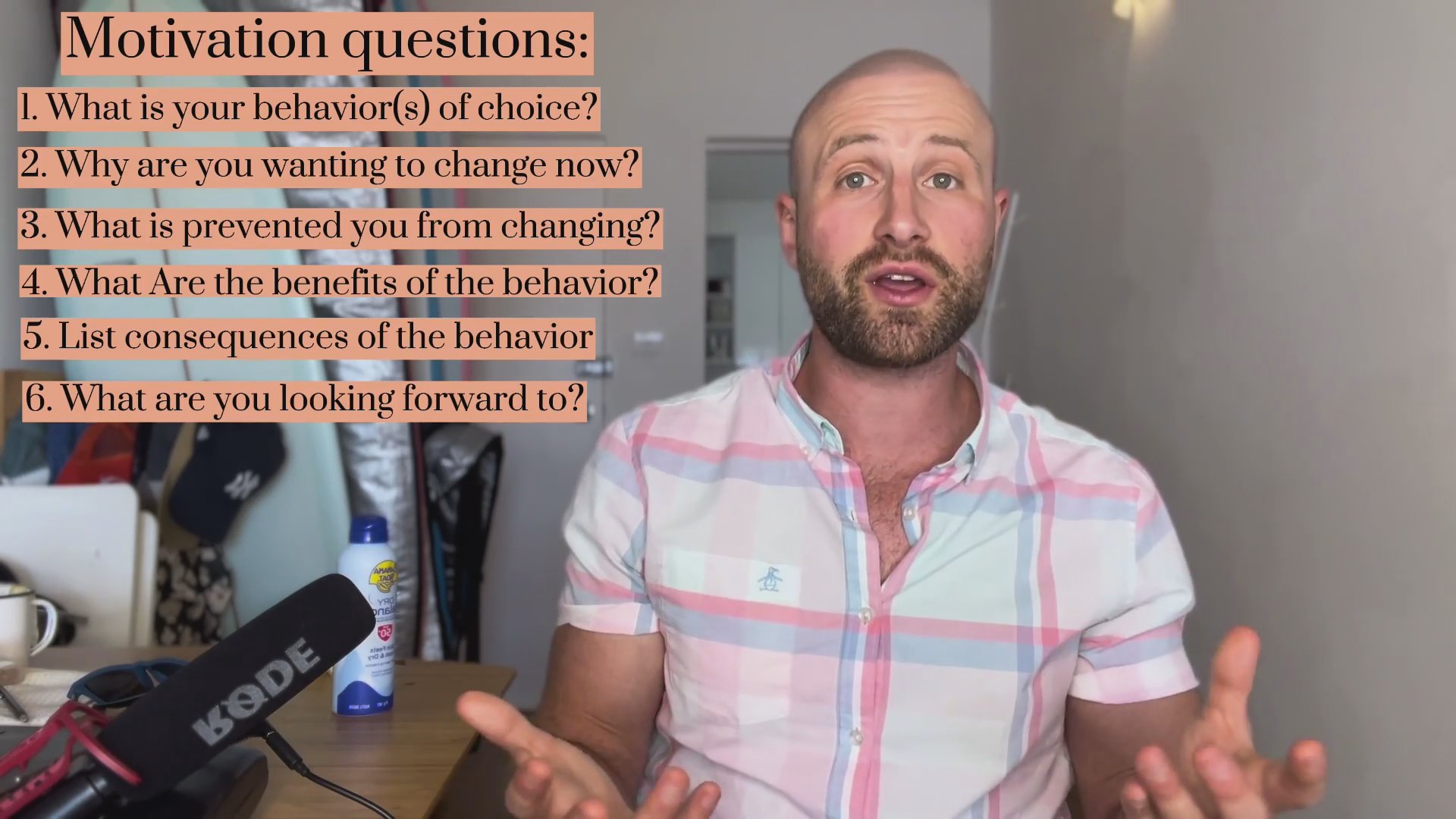
Viewers are guided to rate their motivation and answer a series of structured questions about the behavior they want to change, reasons for change, past barriers, benefits of staying the same, consequences, and future outcomes. The exercise is designed to increase insight and raise motivation.
The host explains that completing the exercise often increases momentary motivation and recommends using it regularly to sustain motivation; the episode closes by directing viewers to the next video about taking action and planning.
Welcome back to Change A Clock. This is my series on how to most effectively change any habit or form a new routine. And if you've been watching this whole time, which I assume you have, we've learned all about the foundations of making changes, like the stages of change model and the science around habit forming. But now we're going to jump into my model of how to most effectively make a change that encompasses all of those things. And that I call the tripod method. In working with hundreds, if not thousands of people struggling with severe addictions, I started to notice some of the variables of what allows some people to be more successful than others.
And that's where I came up with the tripod method because I basically found three of those. So in the tripod method of change, the three main elements are number one, having motivation, #2, a plan, and three, accountability. And there is one more variable that sits on top of the tripod and we're going to go over that towards the end. One final thing I'm going to have you do. Now today we're going to dive into motivation and how we use motivation to successfully begin to initiate a new behavior and eventually maintain it.
As I mentioned before, knowing that we're going to talk about motivation, you're probably thinking, well, no, dud, dummy, of course you need motivation to make a change. You need motivation to do anything. However, I think it's so important to realize that motivation is not necessarily black and white. I want to or I don't want to. Most of the time, for almost anything we do, we have ambivalence, which means part of me wants to do something, but part of me doesn't. So it's a constant push and pull between interests in our own mind.
I want to do something that's healthy for me. However, I know it's really difficult and I'd rather sit on the couch and do nothing. So what does it take? What level of motivation do you need to go from couch to doing whatever that behavior necessarily put a number on it. But what's important to know is our motivation is constantly waxing and waning. 7 and now it's a 9 and now it's a 2. Based on where we're at, based on how we're feeling, are we tired? How motivated am I based on the fact that I just had a lot of consequences, let's say from addiction, now I'm more motivated.
So it's a constant push and pull. So One of the things I do with clients is using a tool called motivational interviewing. And this is extremely well researched therapeutic intervention. And it's used primarily for the purpose of resolving ambivalence, right? We talked about ambivalence, meaning I want to, but I don't. And there's this whole method we use for working with clients so that they could resolve that and really go from that contemplation stage of change into action. So I'm not going to go through every single tenet of motivational interviewing.
I could do 100 videos on that. However, at the same time, it's very simple and it's very intuitive. What motivational interviewing does, it tries to enhance the part of you that wants to make a change and move past the resistance, right? So if you're going back and forth in your mind, I should break up with them or I shouldn't, right? And if I start arguing, let's say as your therapist or as a friend, I start arguing, here are the reasons why you should break up with them. What are you going to naturally do?
You're going to start to argue the other side because as human beings, that's how we make decisions. We don't just have one influence. Otherwise, we would just go on every single whim. We wouldn't need to think about anything because we would just go and do what that one voice in our mind tells us to do, right? So again, back to survival, it's pretty important that we're able to work through problems in our mind by taking both sides. So I want you to do this experiment and you're going to laugh because it works every single time.
So I'm going to go and I'm going to argue that this individual, my friend or my client should break up with their significant other. And what's going to happen is they're going to start arguing the other side. So I'm playing the role of 1 voice so they're going to start to argue the other side. But there are certain questions because at the end of the day motivational interviewing, right, the word interviewing is a series of very selective and effective questions for enhancing motivation which you and I are going to go through.
So these are to reduce the resistance in others and yourself and enhance your motivation to take that first step into action. you through this exercise that I do with my clients that is essentially a list of questions in order to enhance motivation. So let's start. So before we jump into the exercise, I want you to think about that behavior you want to change, your behavior of choice as we've been calling it. I want you to think about what level. a 0 to 10 scale of how motivated you are to make this change as it sits right now in this moment.
Now once you think of that number I want you to write it down and as we do this exercise you can do it in your head and answer these questions in your mind. Maybe pause after each question but I think it would be really helpful to write it down. So go ahead grab a piece of paper or type it out as I go through the questions and give me your answers in as great a detail as humanly possible. First question is simply what behavior or behaviors do you want to discontinue and form new habits around? Number two is what are the reasons that are prompting you to want to make this change right now?
Number three is what has prevented you in the past from making these changes? Number four is what have been some of the benefits of staying the same and not making the change? Number five, what have been the downsides of staying the same and continuing the behavior? What have been the consequences from it? Number 6 is what are you looking forward to in making your change? What are the benefits that are gonna come from doing it? Number 7 is describe what you believe your life's gonna look like in five years if you continue going the way you are and continue the behavior that you're wanting to discontinue.
Number 8 is describe what you believe your life's gonna look like in five years if you successfully make that change. So once you complete this exercise and really internalize what the consequences of this behavior are and the benefits of making a change, I want you to write down your level of motivation after completing the exercise. So I bet if you gave that assignment your all, your motivation number will increase. Now, again, remember, it's always on a scale. It's going to change. So all it took was thinking about those consequences of staying the same and the positives of making the change to immediately increase your number.
Now, I could ask you again tomorrow and I could go back down. Remember, it always changes. However, doing something like this, doing something like this exercise that makes you think in this way is going to be very beneficial, a tool that you could use throughout the process, especially when it comes to having the motivation to take action, which is what we're going to do right now. So go check out the next video where we're talking about taking action and making a plan.
Reactions and comments are for members. Joining is free and takes a minute.