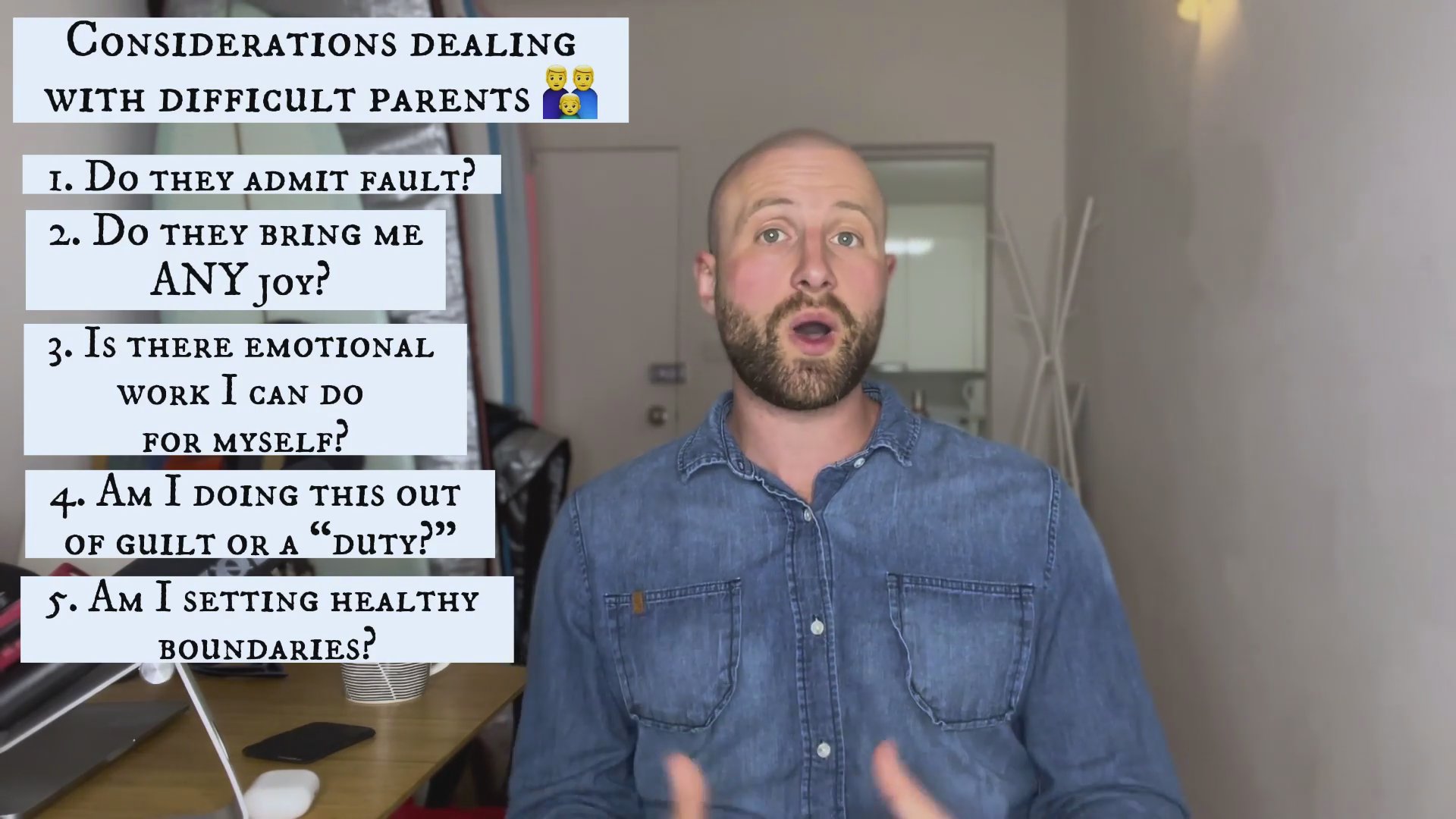
In this video, Evan Lieberman, MSW LICSW LADC, answers a question from a member of the Cadre family. Today he responded to a question that many of us ask ourselves during the holidays, "How do I deal with my (insert expletive here) parents?" Many of us have complicated relationships with our family of origin. This leaves us in a place where we have to ask ourselves how much we want them in our lives. Or if we want to be around them at all! So join us as Evan breaks down five considerations to ask yourself when stuck in this dilemma.
How do I respect my parents, even if they kind of suck? Is there a way to strike a balance? How do I know when to keep engaging with them? Or when do I pull back or even cut the cord fully?
A lot of clients internalize this sense of guilt that they aren't being good children now. It's up to you if you want to have that conversation with your parents. If you set some boundaries with them, for example, that could lift a weight off.
Hey, Cadre fam. Evan here, your resident mental health and addiction therapist. And today we have another question coming in from a member of the Cadre family. One of our creators asked a pretty awesome question, and that is, how do I respect my parents, even if they kind of suck? I think this question is so pertinent, especially with the holidays coming up. So many people have found themselves in situations in childhood where there was potentially abuse or. Or there were areas their parents fell short and perhaps were neglectful.
And it leaves these folks in a really difficult place, because it's like, well, I wanna spend time with my parents. These are the only parents I have. But at the same time, it's really difficult based on what I've been through with them or potentially some of the more toxic behaviors they still exhibit. So the question is, is there a way to strike a balance? Also, how do I know when to keep engaging with them? Or when do I pull back or even cut the cord fully? So many folks in this situation, unfortunately, had parents, for whatever reason at the time they were growing up.
They were just not equipped to be great parents, or they weren't able to live up to their potential. Like, for example, maybe they were struggling with mental health disorders or addictions, just basically had a lot of things they were preoccupied with. Perhaps they were quite selfish at that time. And often it left my clients who are in these situations, or friends or family members who had to raise themselves in many ways. And there was a dynamic that formed where they actually, as children, became more mature than their parents, often pretty early on.
So it's really difficult to say for sure what level of engagement is appropriate or reasonable, given your situation and given your past. But when I have clients in this situation, these are a few of the things we talk about and consider. So one of the questions I ask clients is, have your parents acknowledged what they put you through? Do they take ownership? Do they take responsibility now? And sometimes that can be difficult when they do or if they don't. But I think that is a big factor if a parent is able to admit, hey, I fell short.
Here are the reasons. Yeah, maybe it's not an excuse, but it's an explanation. But either way, it's still up to you what level you are at as far as willingness to forgive them. And there's no right or wrong answer. And another consideration is just to ask yourself, what kind of joy does it bring to me to be around them? Am I harboring resentment unneedingly? Am I. Are there things that I'm holding on to that maybe I should work to let go. And even if that's the case, even if you're like, look, my parents have made a lot of changes.
They're in a better place now. Maybe they weren't great parents, but they've been better grandparents, asking yourself, okay, what work do I need to do? Are there some things that are unprocessed that may help me move past this and be able to have a relationship with them again? And I have a really close friend of mine. I think here's a good example of having a really complicated family situation with abuse and his parents neglecting that. And he finally started to work on it and realized that it wasn't healthy for him to be around his parents.
However, he went for about a year and did some really intensive trauma therapy. During that time, he set a boundary with his parents, which was really difficult for them because basically for a year he did not talk to them. However, by the end of that year, after he was able to process through some of that, he was able to slowly allow them back into his life. However, one of the contingencies for that was them acknowledging their role, taking ownership of what they did in that abuse cycle. His parents were divorced and his mom was not able to do that, and he was closer with his mom.
Before all this, he was actually harboring more resentment at his dad, but his mom was not willing to do it. But his dad did some therapy of his own, and he was willing to do that and acknowledge his part, and that lifted a lot of the weight of the situation. My friend was able to then build back that relationship with his dad. So that's just one example of how doing your own work can help give you clarity in the situation and help you forgive or help you move away and set further boundaries. One really big consideration is a question I ask clients, which is, well, why do you feel the need to continue having a relationship with them?
Is this based out of guilt? Because I find a lot of clients internalize this sense of guilt that they aren't being good children now. Respect given is respect earned. And even though their parents didn't respect them, or they didn't acknowledge the damage, they did take ownership of their behavior and are even continuing to do some of those toxic behaviors, they still feel this sense of guilt. They hold themselves to a much higher standard than they hold their parents. A lot of this is just that old dynamic of them being more mature than their parents.
For them having to take more responsibility and alter their behavior to make them feel comfortable. And that's not okay. You probably have your own family now. Maybe you can't come for every Christmas. Always around this time, the holiday seasons. It's always, I'm always working on boundary setting skills with families because there's that expectation of, like, where do you go for the holidays, right? So it churns up all this old, you know, trauma, baggage, whatever you want to call it. And one of the reasons why this could be crucial as well is because maybe you've never had these conversations with your parents, right?
And if you set some boundaries with them, for example, it's like, how often do I call them? How often do we go for holidays? Like I mentioned, how much time do my kids spend with them? Right? All of these things are your decision. And so if your parents then really push the action, well, why aren't you calling me all the time? Why aren't you doing this then? It's up to you if you want to have that conversation with them, just like my friend did, and it could be really uncomfortable. But to sit your folks down and say, well, here's why.
I engage to the degree in which I do. Maybe I harbor some resentments, and here is why. And a lot of that, I find, comes down to, you know, you never acknowledged some of the hurt that you caused me with these behaviors, and there are some of these behaviors that still continue. It's not necessarily your job to make them aware you don't have to do this, but a lot of times when you set those boundaries and you explain why, that actually gives them an opportunity to finally acknowledge what they did, and that could lift a weight off and maybe even that holds a mirror up to them and they become willing to change their behavior in the end.
Just ask yourself, what is going to bring me the greatest sense of happiness and contentment in this relationship? Do I find that having a relationship with my parent I've had a complicated relationship with, is Annette positive, or is this something I'm continuing to do because I feel guilty or out of some kind of sense of duty that at the end of the day, I don't have? So, again, this was a great question. I hope you got something out of this, and be sure to leave me any other question you have, and we could do this again.
Take care.
Reactions and comments are for members. Joining is free and takes a minute.