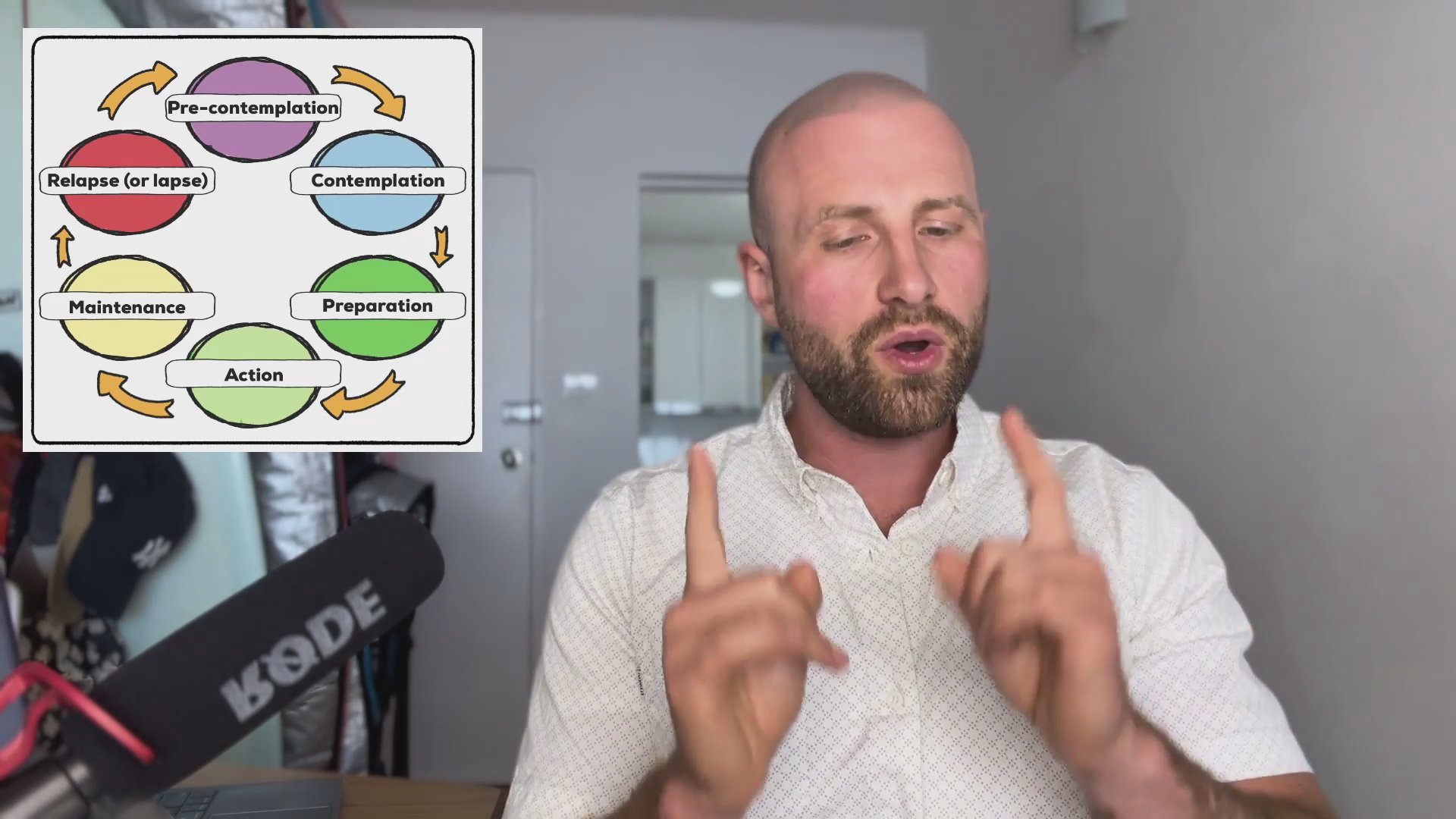
In Part 5 of "Change O'Clock," we move on to the final leg of the Habit Tripod, Accountability. In this video, we discuss one of the essential variables to succeeding in any behavior change: allowing others in on your journey for support and as a means to keep you motivated when times are tough. Accountability is largely about the consequences of our actions, both good and bad. However, it's best to focus on the positive reinforcement of our changes.
The host welcomes viewers back to the Change A Clock series and explains that this episode will cover the third and final leg of the tripod method: accountability. This orients the viewer to the episode's focus.
This section explains accountability as inviting others into your change process so they can support and hold you responsible. The host emphasizes how people often try to go it alone and miss helpful support.
The host introduces a thought experiment about Charlie, who finishes treatment with good intentions and a discharge plan but returns to living alone with few supports. This illustrates how low accountability leaves gaps that make long-term change harder.
A parallel version of the patient, Chuck, arranges multiple layers of accountability—from therapy and sober living to exaggerated punitive measures—demonstrating that more accountability increases the likelihood of success. The host uses the extreme examples to underscore the principle that layered accountability matters.
The host describes how he recruited friends to check in, publicly announced his quit date on social media, and used those commitments to motivate follow-through. This practical example shows how to create accountability even when you live alone.
Viewers are asked to write down specific layers of accountability, consider pros and cons, and favor positive reinforcement while recognizing consequences. The host challenges viewers to set up these layers before taking action and teases the final element (commitment) in the next video.
Alright folks, welcome back to Change A Clock, my series about forming new healthy habits and ditching some of the old ones that aren't serving you. Anyways, today we're going to be covering the 3rd and final leg of of the tripod method of change that I've been using to help clients most effectively make changes. And that final leg is accountability. And this serves many different purposes. Essentially, accountability is letting people in on your change process and letting them hold you well accountable.
I'm trying to think of another word for that. But anyways, you're letting them in. You're letting them know your intentions. and therefore they're able to support you. Because one of the reasons why I find people often fall short of their goals in making changes is they try to shoulder it all on themselves. They don't want to burden other people and they want it to be just something between them and themselves, which really is leaving some valuable opportunities on the table to have help and to have folks be there with them in the change process.
So accountability can take many different forms. For example, there's some accountability that we may not always want, kind of like we're driving down the highway and there's police to hold us accountable to go the speed limit. Otherwise, we get a ticket or like your boss looking over your shoulder to make sure you're being as productive as you can be for the company. But then there's also forms of accountability that may be we are more accepting of. Maybe we hire a coach to help us on a goal or even just seeing someone like me as a therapist is a form of accountability.
As I briefly mentioned, having forms of accountability are a high predictor of success in any behavioral change. There's so much research to back this up. So in order to show you how this process works and why accountability can be so helpful, we're going to do a little thought experiment. So I want you to imagine a guy named Charlie and Charlie went to substance abuse treatment for 30 days. He did really well in treatment and he's ready to return home and he really wants to be clean and sober. He wants to do the right thing and he's ready to have his last meeting with his counselor before he leaves.
However, right before he walks into the door, he splits into two people. Let's call the other person Chuck. Now these are the exact same people. They've had the exact same experiences. Now we just have two alternate universes. Right, so let's start with the first with Charlie going in to meet with his counselor. Now Charlie goes to meet with his counselor and they talk about his discharge plan for how he's going to be successful after treatment because it's a really big jump to go from living in a treatment setting with a ton of accountability with counselors there not being allowed to leave the facility.
And it's really difficult, but a little bit easier to stay sober in that environment because of the accountability. But anyways, it's a big jump and so they're talking about how Charlie could be successful. So the counselor says, all right, you and I have worked on this. Here's a list of three AA meetings that I want you to go to. Charlie says, okay, sounds good. And here's a list of three therapists and when you get home, I want you to call one of those therapists and set up a meeting. Okay, that sounds good.
And they say, all right, Charlie, where do you want to go? He says, I want to go live at home. Okay, well, the issue is Charlie lives at home and he lives by himself. He doesn't really have anyone else there and that's where he did most of his drinking. So Charlie takes all the information that was given to him. He has every intention of following through with the plan. He waves goodbye to his counselor and all his peers and he goes about his merry way. Now let's take a look at the meeting Chuck had with his counselor because it's quite different than the one Charlie had.
So Chuck and his counselor sat down and they made a therapy appointment. So he already had the appointment lined up and he also had an AA home group and sponsor ready to go. Further, Chuck agreed that he would go live in a sober living environment instead of at his apartment alone. In this new sober living environment, there's a manager and there's a lot of other people who are in a similar position, holding each other accountable to stay sober. Further, Chuck told all his friends and family of his intention to be sober and asked for their support.
All right, now here's where things get a little crazy in the experiment. In that meeting, Chuck agreed to take all of his life savings and put it in a single bank account that his counselor would have control of. Now, if Chuck relapsed at any point in his life, all that money would be taken out of his bank account and even worse, that money would be going to the political party that he is most opposed to. And if that wasn't enough, his counselor hired a 6 foot 5, 300 pound bodyguard that would be with Chuck at all times, 24 hours a day.
And if Chuck tried to drink, this bodyguard would deal with him. Now, even worse, this bodyguard was given a cattle prod, one of those electric shocker things. And any time that he had a drink, boom, he would get shocked immediately. All right, Evan, that's enough. Oh, is it? We are going to take this thing one step further and it's going to be extreme, so trigger warning. For his counselor's final act to help him, he bought a bomb and this bomb was strapped to Chuck at all times. And what would trigger the bomb to go off was the fact that this bomb could measure his blood alcohol content.
1, the bomb would go off and that would be the end of our friend Chuck. You may be thinking, okay, Evan, that's enough. Well, okay, I promise I'm done now, but here's the point. What you probably noticed in that thought experiment is that Chuck had significantly more accountability than Charlie. Now remember, they are the exact same person with the same past experiences and the same desire to be sober, but that is where their circumstances diverge. So the question is, who is more likely to stay sober in the long term?
Is it going to be Chuck or on the other hand, Charlie. Well, you're probably thinking, well, Chuck, because he has a lot more to lose and you would be correct. Even though they're the same person, Chuck has significantly more accountability and a lot to lose. But you're probably thinking as well, Evan, that's not that realistic. Who in their right mind would go to that distance, douche wrap a bomb to themselves? Well, no, we know that they wouldn't do that, but that's just a way to exaggerate this principle so you could see how accountability works.
So if we back up Chuck's situation, he agreed to everything except giving up his savings account and everything after that, right? He agreed to go to the sober house. He already had the therapy appointment set up. He had a sponsor. He had all what I call layers of accountability. And my belief from what I've seen and what the research shows is that the more layers of accountability you have, the more likely you are to achieve success and your behavior change. So let's use a real life example of layers of accountability to make a behavior change.
Now, for myself and my situation, well, I didn't have a ton of accountability really built in. I live by myself. I mean, I have my dog and she's probably not going to hold me accountable. So I had to get creative. I had to go out of my way to bring people in, which can be quite uncomfortable. So in this case, what I did was I told my friends of my plan and I asked them, please check in with me to make sure that I did it. So I told them when I was going to quit. And when I did have that slip up, I was honest about that.
I told them and then I told them about my next quit date and my next plan and they supported me and I knew that I was going to check in with them. And really deep down, okay, if I slipped up, I'm not going to beat the crap out of myself. I know better at this point. I've done this before. But I really wanted that positive reinforcement. I really wanted to be able to go to my friends and say, guess what? I did it, right? And get that little pat on on the back and feel good about myself. Because at the end of the day, this is about us and how we feel and how we feel about ourselves.
Anyways, the other thing I did was I went to a little bit of an extreme measure, right? Kind of like Chuck, not as extreme, but I decided I'm going to try something out. So I actually went on my social media account and I did a little video similar to this where I basically did like a one minute video about making behavior changes. And I talked a little bit about accountability and I told everyone of my plan. And so this was before I did it. So this was before I even stopped. I told everyone of my plan.
I told everybody my quit date online for the world to see. Because at the end of the day, I knew that I really wanted to make this change and I was really committed to doing so. So I did that and it was something that's really helpful because it was in the back of my mind. I want to be able to tell my followers that this was successful and I wanted to put my money where my mouth was for them and for you all knowing that I was going to do this series. I wanted to be able to show you that this method really does work and gives you a better chance of effectively changing that behavior of choice.
So now we're at the part of the video where we're going to be doing an interactive exercise like we've done on the other legs of the tripod where I'm going to ask some questions you to grab a pen and paper or maybe type it out if that's what you want to do. And the first question is simply what layers of accountability are you going to put in place? Is that telling other people? Is that getting a therapist and checking in? Is that taking money and giving it to someone else to donate to a political party?
Okay, right. That's extreme. But honestly, I have heard people do that. I heard a presentation once with somebody who runs a sexual compulsivity clinic where some of his male clients would give his wife a lot of money to donate to the other political party because if they did, their reputation could be ruined. I don't recommend doing that. That's a little bit extreme, but I'm just trying to tell you that I have seen that done before. But again, when you're writing these layers of accountability At the end of the day, yes, it's about carrots and sticks, right?
Positive reinforcement versus punishment. And I always gear towards positive reinforcement because it works better, right? But there is inherently going to be downsides. So writing that down, what are going to be the downsides in the accountability realm if I I go back to that use, like I'm going to have to tell my friends, I'm going to have to tell my family that I didn't succeed. And again, we don't want this to be shame based. We want this to be based in primary positive reinforcement because that shame cycle reinforces the negative use.
But sometimes that is okay to have some consequences in there. Because you've been experiencing consequences up to this point from the behavior itself. So those are inherently baked in. But a famous dog trainer once said, well, he was asked, why don't you use punishment in your techniques? Is it just because it's ethical? And he said, well, no. It's not primarily because of ethics. It's just that positive reinforcement is so much more effective than punishment. He said punishment does work to a degree, but positive reinforcement is more effective.
So then writing down after your layers of accountability and the negative consequences, what are the positive consequences, the positive outcomes for having accountability and following through with the new behaviors and giving up the old behavior of choice. Therefore, I challenge you to implement these layers of accountability that you came up with. It's best to do it before you go into the action stage of change and discontinue your behavior of choice. It's better to have it done ready to go beforehand.
And again, these layers of accountability minus dropping a bomb to yourself is going to be extremely helpful and increase your odds of success of changing the behavior. And one of the ways it does that, just like everything else up until this point, the goal is to make the action stage of change, the one after preparation, as easy as possible because that is the most difficult stage of change. But again, there's always that light at the end of the tunnel as you go from action to maintenance and that could happen pretty quickly.
But beforehand, we're going to to take one more final step, which is the last element of the tripod. And you're probably thinking, Evan, tripod, it's three legs. You already talked about three things. However, something must sit on top of the tripod and that thing is making a commitment to change. So go watch the next video and you can see what I'm talking about.
Reactions and comments are for members. Joining is free and takes a minute.