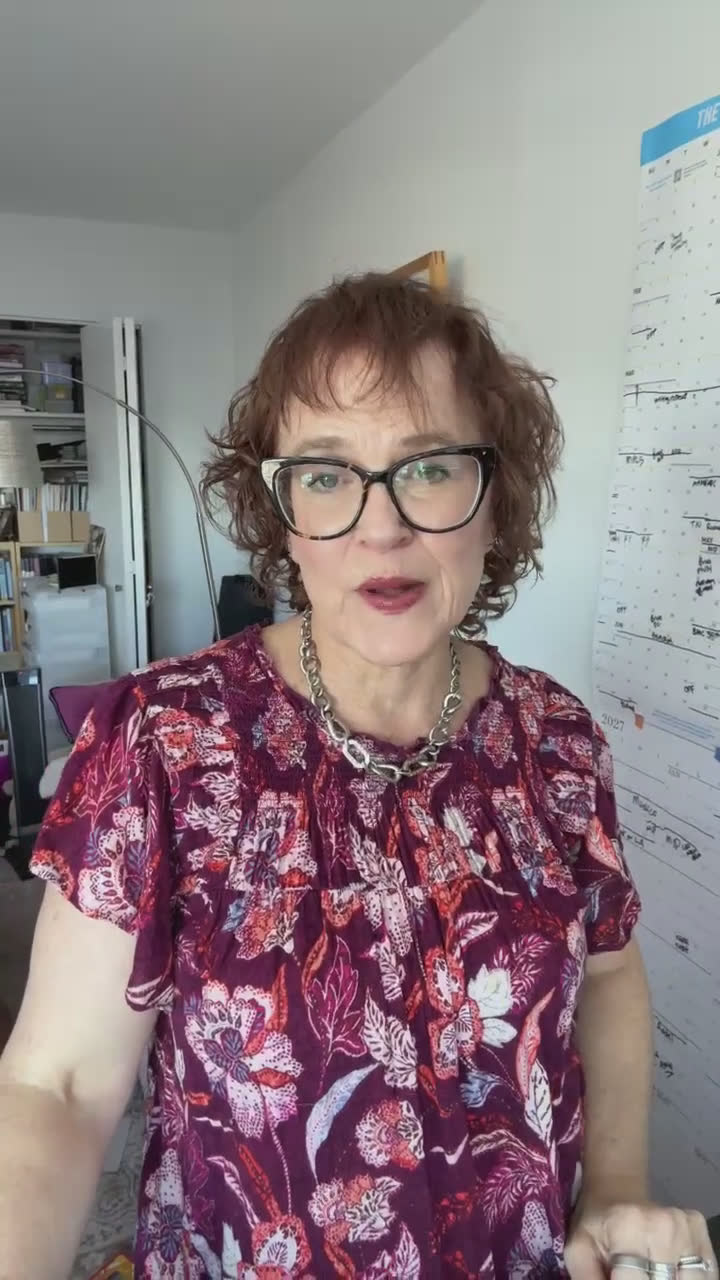
Thoughts about creating a life you want to live in, from someone who has had to do it herself.
The host opens the video with greetings, mentions watching America's Got Talent and The Voice, and reflects briefly on why those shows inspired her, setting a friendly tone.
She talks about taking voice lessons for five years, how performing in public affects her, and ties that to the broader theme of people pursuing dreams despite fear.
The host issues a brief content warning about mentioning past childhood sexual abuse, clarifies she will not go into graphic detail, and transitions to introducing the topic of the freeze state influenced by her current work on a fellowship application.
She outlines the fight or flight model, adds freeze and fawn, and begins explaining how the freeze state manifests for her, including shutting down when overwhelmed and contrasts with being 'scared active'.
She recounts childhood trauma and later recovery efforts, including sobriety, therapy, reading The Body Keeps The Score, working the 12 steps, and the impact of public service and life transitions on her nervous system.
The host discusses how success and good feelings can trigger anxiety and the freeze state, explains physiological reactions, and relates this to current projects like a fellowship application.
Good morning, cadre. Good morning, good morning. I hope you are all doing well. I'm going to start today with a little pro tip. I have been watching competition shows on television. I spent the summer watching America's Got Talent for the first time ever, and then now I am watching The Voice for the first time ever. And why am I doing that? Because, well, America's Got Talent because I walked in one day and my husband was just in the middle of an episode randomly and I got ensorcelled. I got drawn in to the drama of it.
But I kept watching it because I realized it is like a whole show about people going after their dreams and doing their best to make their dreams come true. And I love seeing that because there's lessons on all aspects of it. I think I might be, I think I might write about it at some point. There's lessons. Good morning, speak wonder, so nice to see you. I'm talking about watching America's Got Talent and The Voice because it's about watching people go after their dreams. And Even if they don't advance, even if they don't get selected, it is inspirational to me to see people taking themselves and what they love and their talent and their gifts so seriously that they just put themselves out there in ways that for many of them is clearly terrifying.
And then it's just so satisfying when somebody does so well and when they get a great response from the judges or the audience or whoever. And so when America's Got Talent ended, I had seen a million ads for The Voice, and of course I've seen clips from The Voice over the years, and I sing for me, not for the world, but I've been taking voice lessons for almost five years. Thank you, thank you, thank you for the great, this is a great shirt to wear. I've been taking voice lessons for five years, just so I can love how I sing when I sing in the shower in the car.
I actually don't sing as well when other people are around, including my voice teacher, which vexes him. But my voice, even I can tell five years later how much better, stronger, what a wider range, what more strength I have in my cords and my diaphragm and the whole singing system. I just love watching people go after making their dreams come true. And then when people are not selected, there's a lesson in that too, that it's not bad that they went for it, and they get feedback. And then I realize, are they capable of taking that feedback and using it well or no?
just a reminder to myself that setbacks aren't losses. I think about Morgan Wallen, who is like, He's essentially Garth Brooks was in the 90s. He's just so dominant in country music right now. And he was eliminated on The Voice 10 years ago. You know, he was eliminated. I mean, he got on a team. I didn't watch any of this, but I've learned it since. I'm a country music fan. He got on a team. He was eliminated, I think, in one of the early rounds. And he's gone on to be a country music superstar.
Like there's a lesson in that about persisting and such. So I wanted to start with something bright like that because I am going to talk about the free state, which means it's story time if you want to get like a little blanket and wrap yourself up. But I will do a little bit of a content warning because I am going to reference the fact that and talk a little bit about being the survivor of pretty significant childhood sexual abuse. I'm not going to go into details. I'm going to share from the scar of that, not from the wound of that.
I promise you, I don't need anybody listening to be my counselor about it, but it is reality in my life and I'm going to mention it. But if that is not great, feel free to turn it off and get the resources that you need right here on CADRE. There are plenty of resources and access to resources right here on CADRE. But I was thinking about the freeze state. Why am I thinking about that? I am busting ass to do an application for a fellowship. That would be right inside the work I love most, my dream work.
I'm writing a book about white people and race. It's actually under contract. It took seven years to get that contract. And I live near Howard University, historically Black college. And at that university, Dr. Ibram Kendi, who wrote the book How to Be an Antiracist, has his Institute for Advanced Study. And next fall, for the first time, they're going to have a fellowship program. They're bringing fellows onto campus for the school year. You have to live in the area, and I already live in the area, and I do this work from an anti-racist perspective and would love to be part of that fellowship experience, if it makes sense.
Depending on what their vision for the program is, I may or may not fit it, but I would love to do it. So it's very useful. One of the gifts of this is noticing how useful it is just to write this 2,000 word essay about the project I'm proposing to do for the fellowship year. That in and of itself is useful to articulate my work and my vision in a much shorter way than I'm usually able to do. And I didn't freeze on it. I haven't gotten frozen on it. But the temptation has been there. And I've seen myself actually lock in.
I get in a flow state. I use all these resources that I've learned over the years, but it made me think about all the things I've learned about my free state and what it means to grapple with it. And what do I mean by free state? You know, they say, you know, for a long time it was fight or flight. when something happens, you either fight, you go in there and get scrappy or you flee, which is one of the reasons I lift weights so I can get rid of those fight chemicals and I run so I can get rid of those flea chemicals.
But there's also freeze and fawn. Some people when something terrible has happened, the response is to really try and placate, support the person who's doing the negative thing. That is an understandable response. It's not really part of my repertoire. I'm more fight, flight, and freeze. And the freeze state is when you just, your entire, you're so over, I've learned all this and I could be wrong. You know, I'm not a doctor, I'm not a professional in this, but this is what I've learned as a, just a regular person on the street.
The free state is when things get so overwhelmed that I just shut down. And most of my life I was scared active. Most of my life I was scared active. If I was freaked out about something or if my, you know, I had chronic anxiety, my anxiety activated me. It got me into motion. You know, action is an antidote to anxiety. But I was doing it on top of the fact, the things that gave me the anxiety in the 1st place. which was this number of years of essentially being trafficked as a young person outside my family.
I always specify that. My family had its own significant dysfunctions, but that was not one of them. But those dysfunctions, you know, allowed for a lot of unkind mischief to come my way as a young person from these adults who meant me harm. And that left me with, I think what we would call it now is CPTSD. but scared active. I was scared active. And part of the reason I could be scared active on top of all of that was because, once I got sober, was my life, I kept my life busy enough and difficult enough and challenged enough that the complete activation of my nervous system corresponded pretty well to what was going on in real life.
Highlights of this is being Mayor. that there was no daylight between an activated nervous system and being mayor of Minneapolis from 2014 to 2018. Like the things that happened would activate anybody's, anybody, I think. I'm going to turn this lamp on. It seems dark in here. So I didn't know exactly that I was operating so much on top because by that point I had done 20, 25, 30 years of healing work. You know, I've been at this since I was 19. I became mayor when I was however old in 2014, that was 12 years ago, 45.
You know, I've been doing healing work for a long time. But something happened. I left office. I didn't want to, but I didn't win my bid for re-election. And I had, for the first time in my life, one, a professional heartbreak like that. But 2, I had downtime. I had downtime. And for the first however many months, it seemed reasonable to me that I slept 10 hours a night for at least six months. I mean, I was tired, legitimately. My body was just worn out from what I had been grappling with, but it became over time more and more difficult for me to have vim and vigor.
Now some of that is perimenopause and then menopause, right? The hormonal chemical system in my body changed altogether and so some of that fatigue is just, I hear it from a lot of women who are in perimenopause. But that wasn't all of it. That wasn't all of it. And I started, I used to be able to just get myself to go, get myself to go, get myself to go. And I couldn't anymore. I just couldn't. And I would just, I was working for myself that would probably, I want to say it was part of the problem.
It was actually part of the solution because it gave me the space and room I needed to both notice the pattern and then the space and room I've needed to heal from it or learn how to grapple with it in healthier ways. I don't know that I will ever heal fully from CPTSD and anxiety and the free state that happens if That's, I learned so much, the free state that happens, but I would slow down and I would notice that I was scared of doing well, I was scared of having something go well, that I wasn't putting myself out there the way that I used to.
I was in this chronic free state, is basically, I was just shutting down all the time, my nervous system, and I got things done. I got things done, but it just took a lot more time and a lot more energy. And some of it was good that I just gave myself that time, but some of it wasn't because I was not spending my time in what I call upward trend activities of my choosing. I was spending time completely shut down. And that's what I identified that the free state is the most extreme form of my anxiety.
And then, so what did I do? So glad you asked. One thing that happened was I was inspired to read the book, The Body Keeps the Score, which I'm guessing a lot of people have read because it remains on the bestseller list after years and years and years. I could only read that book three pages at a time. It's so well described my experience of early trauma and my reaction and response to it that I would read three pages and I would shut it. And sometimes I would throw it across the room and say, F you, Bessel van der Kolk, the guy who wrote the book because I felt so exposed and called out and got a little defensive.
There's no one else in the room. I just shouted F you to the sky wherever Dr. Van der Kolk would find himself at that moment. But it really helped me because it gave me an avenue to pursue somatic strategies as a healing mechanism that I had taken some of my head based and talk based strategies as far as I was going to take them without other assistance. And that was really so crucial. The other thing I did as a person in recovery is I worked the step, my sponsor was great and we worked the 12 steps on anxiety.
And that was one of the most profound things I'd ever done in my life. But I figured if the thing that was bedeviling me most was this anxiety and the freeze state that I consider an extreme form of it for me, why, and I have access to the most transformative tool I know of and one of the best gifts the universe gave the world in the 20th century, which is the 12 steps. The transformation power of those steps, why wouldn't I apply them to the biggest problem I was facing? And indeed, it has been transformative.
The social anxiety that I didn't I think I actually did have while I was mayor, but I just on top of it all the time was talking to people, interacting with people, doing all of that, as you might imagine a mayor does. It started to get worse when I left office. I was noticing it, the awkwardness. All of that was getting worse and is now gone. That is one of the things. My anxiety doesn't seem to go away, but the gift I got from And I think I'm going to do a little short video series about anxiety.
Let me, you know, what I learned about anxiety step by step. Because one of the, you know, one of the things I learned, one of the things I did is I wrote down every way that my anxiety shows up. And by doing that, I could understand that The freeze state extreme form of my anxiety starts way upstream by some things that I can recognize earlier on and do things to remedy. I can talk to somebody about it. I can get help. I can just put my brain in a different spot. I can do some somatic practices.
I have a whole list. The reason I'm looking over here, as always, is because it's written on my wall what I can do in those moments when I recognize it. The freeze state was very scary for me. For someone who'd been scared active for most of my life to become scared passive made the fear worse. Because of course, I feel like in those moments, if I'm not thinking and if I can't take action, my life is at risk. Because in my young life, my life was at risk all the time. So I see Speak Wonder, you've said, it's really interesting, the part about fear of succeeding.
Yes, My personal body system, makeup, I've realized does not distinguish, believes that things going well are a threat because when things go well, I sort of lose myself and I get really happy. And in my young life, that was a dangerous state to be in because I might accidentally reveal secrets I was keeping about what was happening to me because I believed that revealing those secrets would literally have deadly consequences. for me and my family and my dog. So I was just very tight around experiencing.
I mean, I had a lot of success in school. I got good grades, all that sort of stuff, but like really going for something I wanted and feeling joyful about it. My body really worries that that's a threat and that something terrible is going to happen to me. And so I am aware now that when good things are happening, you know, like getting the book deal or whatever, that I am likely, my anxiety will likely spike. And I'm also aware that if I'm in a period of really going after some things the way I've been the last six or eight months, that my anxiety will likely spike.
And like right now today, why am I talking about the free state? I choose to go all in and do a great job on this application for Howard. It's due on Thursday. I've been working on it, but I'm very anxious about it. I'm excited. My body also, excitement and anxiety code the same in my body, so I'm gonna reframe that. I'm actually very excited about it, but I just said excitement also feels like a threat, so it's not that much of an improvement, except I'd rather be excited than scared. Even if it leads to the same consequence, it's more fun to be excited than it is to be scared.
So yeah, I've decided to go all in. Do I long for the ability to just sit around and park my brain in neutral? That's what I call my free state is very obvious is if I'm brain is parked in neutral. If I'm scrolling, if I'm reading beyond the point where it makes sense to read, if I'm, if I'm just parked my brain in neutral, if I'm not present, if I'm not actually actively making decisions about my life. So we're coming to the end of time. I could go on a long time about what I've learned about Free State, but if you're out there and you're in one, you're not alone.
If that is a regular MO, you're not alone. I'll leave you with this rule of engagement that has been one of the key things that I learned from working the steps, which is when I am in that state, I am not choosing between doing the most important thing and the second most important thing. I am choosing between doing anything and doing nothing. And so when I'm in that state, the first thing I think is just keep moving, even if it means I'm still scrolling, but I stand to scroll. That is just something, move a muscle, change a feeling, another rule of engagement.
So that's what I got for you. That's what I got for you. See, I was just wringing my hands. That's another sign of anxiety. I can tell I got a lot going on right now with this application. So thanks for joining. Thanks for coming along. It's great to see you. Speak wonder. And anybody who watches this later, I'm so glad you're here. And if you've ever been in the free state, I'm with you. My heart goes out to you. And if you can just move your big toe right now, do it. Just some upward trend activity of your choosing that you choose to do.
Whatever it is, move your arm. Whatever it is, go ahead and do it. You can do it.
Reactions and comments are for members. Joining is free and takes a minute.