Sail on in for encouragement during this voyage called Caregiving.
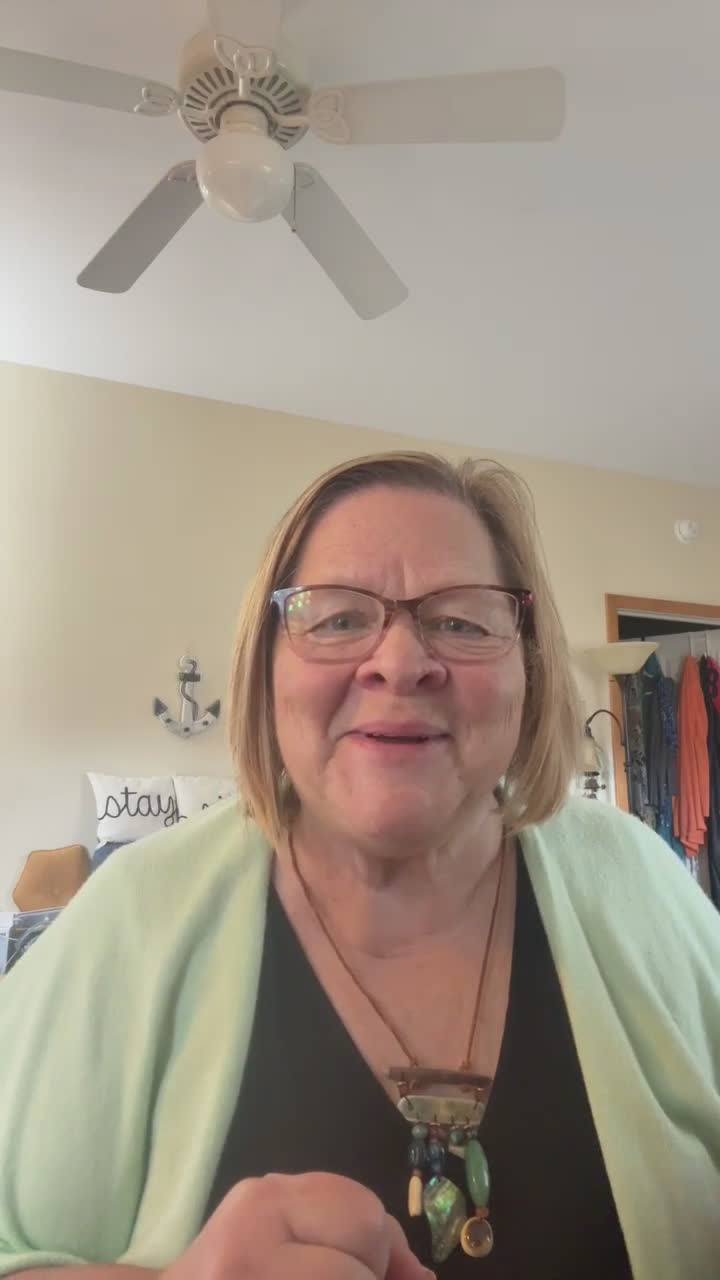
Kathy opens the live stream, welcomes viewers to Caregiver Day in the Cadre Sphere, and briefly explains her persona 'Speak Wonder' and love for encouraging words.
Kathy describes harbor pilots as guides who steer larger vessels to safety and relates this to caregiving. She shares that she advocates for her mother in a nursing home and brings moments of joy and support.
Kathy outlines the many forms caregiving can take—from post-hospital support to caring for children or strangers—and tells a story about comforting a grandmother in a grocery checkout to illustrate listening and empathy.
Kathy announces she'll read a poem titled 'Petal by Petal' about forgiveness, talks about her side hustles including typewriter poetry busking, and sets context for the reading.
Kathy reads her recent poem line by line and discusses how forgiveness unfolds slowly 'petal by petal', connecting it to caregiving and relationships, encouraging patience in mending.
Kathy thanks listeners, plans to show her vintage typewriter next week, affirms the value of caregiving, encourages doing the next right thing, and signs off until the next Harbor Pilots session.
Hello. Hello, hello. There's Randy. Thanks for joining. Come on in. Come on in. It's a Thursday. And it's Caregiver Day in the Cadre Sphere. My name is Kathy. When I come on the Cadre, my handle is Speak Wonder because I love to speak wondrous words into your life, over your heart and mind. The thing I love to talk about is harbor pilots because harbor pilots by nature in the real world are people who are good at steering a small boat out to the harbor and guiding in the larger vessel, the cargo ship, the bigger vessel into safe harbor.
That's what we do for each other when we care for the caregiver and when we care for our loved one, whether it's so many realms. For me, it's in the elderly realm. It's in the context of a nursing home where my mother is a resident and I am her emotional caregiver. She's in good hands there. She's in skilled, capable, caring hands there. And so I represent her. I advocate for her. I visit her. I bring her food from the outside world, as she calls it. Please bring me food from the outside world. And she has a great sense of humor.
My mom, June, nickname is June Bug, is funny and resilient and caring to the other residents there. to her roommate, to the staff there. If you're new to my live stream, I reside in Erie, Pennsylvania, and I'm next to one of the Great Lakes, and I like to visit there. I like to collect jewels from the beach. Some of this has been collected from the beachfront. I live up in the northwest corner of Pennsylvania, and I know a lot of the cadre contributors are from Minnesota, but not everyone. We're all from different places and we're all from different, different and differing emotional places in life, seasons of life, if you will.
I have to tell you, I am unprepared today and sometimes doing a cadre live stream on the fly is kind of a good thing because I completely speak organically from what's going on around me. I'm in the third week of harboring or giving safe shelter to a dear friend whose husband is in the hospital post-surgery. He is improving. It was back surgery and he's getting better and he is actually responding to physical therapy, occupational therapy, all kinds of measures to make sure that he's safe to go home and continue his recovery.
and gain mobility and achieve better core strength. And that will enable her, his wife, my friend, to feel confident in giving her husband the care he needs while he continues for weeks still of recovery. Caregiving can be post-hospital, it can be nursing home, it can be living with and caring for a child on the spectrum. It can be a brief time. It can be a long time. It can be an elderly. It can be a small child. Caregiving seems to flow into our lives in many ways. It can be casual. It can be a one time.
I've done caregiving, as we women do, in grocery lines. I love to meet a stranger and emerge from the grocery store learning to know a new friend. And we can do that while we're waiting for our groceries to be checked out. That's why I'm not a big fan of self-checkout. Clearly, from my age, you can see I'm not a millennial. I don't do things the quick way, the convenient way, the most expeditious way. And I guess I'm now the old guard among us where I savor the old way of doing things. And one of those is to take your time and not be on your phone or in a hurry to get out of the store.
Now sometimes our schedules come in that we're needing to stay on task. I was able to talk to this woman. I've shared this on CADRE before. I'll share it again today. We sometimes as humans unknowingly and unwittingly make assumptions about other people. And the checkout lady was talking about her grandchildren and the woman getting her groceries checked out, a woman of about my age, was nodding in agreement and delighted with some of the stories. And I looked at her and I said, oh, you must be a grandmother.
Her demeanor became a very quiet and thoughtful and she said, I am, but I don't have access to my grandkids. And again, naively, I said, oh, they must live far away. Oh no, she said, oh no, they live right here in town. I don't have access to them. I've been denied time with my grands because my children made a decision that shut me out and I could see the hurt and the pain. and even tinges of envy that there are grandmothers walking around who have full access to their grandchildren. In those moments to come, I cared for this grandmother in a way that leaned in and listened.
That's all I did. I hope that I showed empathy, concern, and care. and even a little bit of hope that her story might turn around at some point. I do believe that those who are in a season of giving care to another have their antenna out and we are a little more aware of what's going on in the world around us. I think when we lay our feelings bare, others do so as well in a way that's appropriate and healing. I debated about this, but I'm going to read to you an unfinished poem. I love to write poetry, and next week I'll talk about my new side hustle as a retiree.
I have a few side hustles. One is I'm an author of books and I'm working on a memoir. Another is, this is brand new, I have a business card. See this old style typewriter keyboard? That's the front of the card. The back of the card has my name and contact information. And on the card it tells you that I am a poetry busker. If you know what a busker is, that's an entertainer, usually a musician or maybe somebody who juggles or rides a unicycle and they show up at events and festivals and they entertain.
There are lots of street buskers in New York City. I remember standing with a saxophone player and he played stuff from The Sound of Music. It was lovely and spontaneous and a memory. that lodged in my heart. So I write haiku and free verse on a vintage typewriter, which I'm going to acquire next week. It's from the World War II era and it's a royal. And it clicks and it clacks. It comes with extra ribbon. The owner says it works beautifully. So I'm going to take that to events and write poems for people on an old typewriter.
It's called Typewriter Poetry. But I think I'm going to bend it a little bit into my niche and call it poetry busking, where I literally go to events, weddings, receptions, festivals, craft fairs, and write poems for people on an old typewriter. It's very specific and very unusual. I told you I'd mention it next week, but I think I gave you an overview. Maybe next week. I should have my new typewriter, my new old style typewriter by then, and perhaps I could show that off. Today I want to read you an unfinished poem.
It's called Pedal by Pedal, and it's about forgiveness. And forgiveness is a topic that could take up a whole cadre. I'm just going to visit this poem and let it sit with you. In the doing of caregiving, we sometimes are at odds with family members. It's not intentional. It simply happens. There might be a miscommunication or there might be an injustice. And forgiveness is paramount, but it's difficult. This is titled Petal by Petal, and I wrote this three days ago. I believe it needs a second stanza.
Here's the first. Forgiveness, like the rose, has left its fragrance. Once fisted, clenched, unyielding, a kind word coaxed it out. Petal by delicate petal. A warm voice unfurled the layers patiently, painstakingly, gently pulling. Petal by delicate Petal, whispering into wordless wounds, unwinding, weary echoes of lost time, warming the chill of practiced restraint, inviting an unfolding, summoning splendor, a vigil untethered to the clock, unhindered, By waiting, wanting only mending. Are you in the middle of an unanswered question?
Are you in the midst of a still unfolding story of bitterness and unforgiveness? Are you struggling through an unresolved conflict? Perhaps forgiveness will come petal by delicate petal, not in a moment, not in a singular conversation, not in a hug, but in the waiting, in the vigil, in the willingness to mend no matter how long it may take. That's a specific kind of forgiveness that is not spontaneous. It's not always understood. And it's a lesson in patience. It's a lesson in waiting, waiting out the silence.
Maybe you have a situation like that and perhaps it's not in the caregiving picture. I had a college professor say once where two humans are in one room, there will be conflict. Curiously, he was talking about marriage and he was preparing us young, idealistic, fresh out of school college kids for marriage, for the difficulties of it, for the layers of growth and maturity that we would be working through one day where two people are in one room, there will be conflict. He didn't say that in a negative way or even a sad way.
It was a fact. We will bump heads. We will go toe to toe in marriage, in the office, in the public. in different arenas, there will be conflict. And the ones that we care about, the ones we care for, are the ones with whom we want to have a good, solid relationship. And it isn't always that way because there is such an emotional aspect to being cared for. And watching it with my friend, her husband is stubborn, self-reliant, and wants to be well in a day. Not in the four months prognosis he's been given, not prognosis end of life, but prognosis for his gaining mobility is what I'm trying to say.
The timeline is a better word to use. He has a timeline of when he can expect to move more freely in its months. he'd like it to be tomorrow. There's conflict with the team, with the medical team, with his wife, and it is quickly resolved as he begins to realize, yeah, this is going to take time. Forgiveness is the same way. I could tell you personal stories. They're not necessary. It is universal between you and me. It is a recognizable fact that there's somebody with whom we'd like to mend. If not now, it will be that way.
And if you think of that relationship, the one that's precious to you, the one that matters greatly to your heart, if you think of it symbolically as a delicate rose, I have one over on my table. If you think of it as pulling the petals that are fragile, slippery to your fingers, you do it carefully with intent, kindness and tenderness. Petal by delicate petal, we pull the layers back. Wanting only mending. And that can be a silent want. Doesn't have to be a declaration or a speech or a confrontation.
Where are you, friend? Where are you in the mending process? Stick with it. Keep a silent vigil. Because I do believe forgiveness is a big part of the picture of caregiving, whether it's ongoing with a loved one or it's incidental in the grocery line with somebody who's grieving. There's so many ways we can have a positive influence on other people, ways that we don't know and cannot measure sometimes. I do thank you for being here today and thank you for actually listening to my unfinished poem.
I do believe it needs a second stanza. Next week, if I remember, and I'm sure I will, I will show you my newly acquired old royal typewriter and tell you more about the poetry I'll be doing in the marketplace. Cadre is my blanket fort and my launching out. It is my place to come in as a consumer of the other speakers on here to learn what they're learning and to share in conversation in the chat. It's also my launching out place where I gain strength and encouragement and can take that into my circle of friends and loved ones.
I could take that into my mom's nursing home with renewed assurance that all I really have to do is the next right thing. I don't usually look at the longer view. What's the next right thing? If it's forgiveness, it's not always something you check off your list. It's something you keep a vigil with and you wait petal by delicate petal. To the degree that you are walking somebody home, helping somebody stand up, feeding someone, teaching them to read, hearing their heart to those human degrees you are caregiving.
You're doing good work. Keep it up. And I'll see you next week in Harbor Pilots.
Reactions and comments are for members. Joining is free and takes a minute.