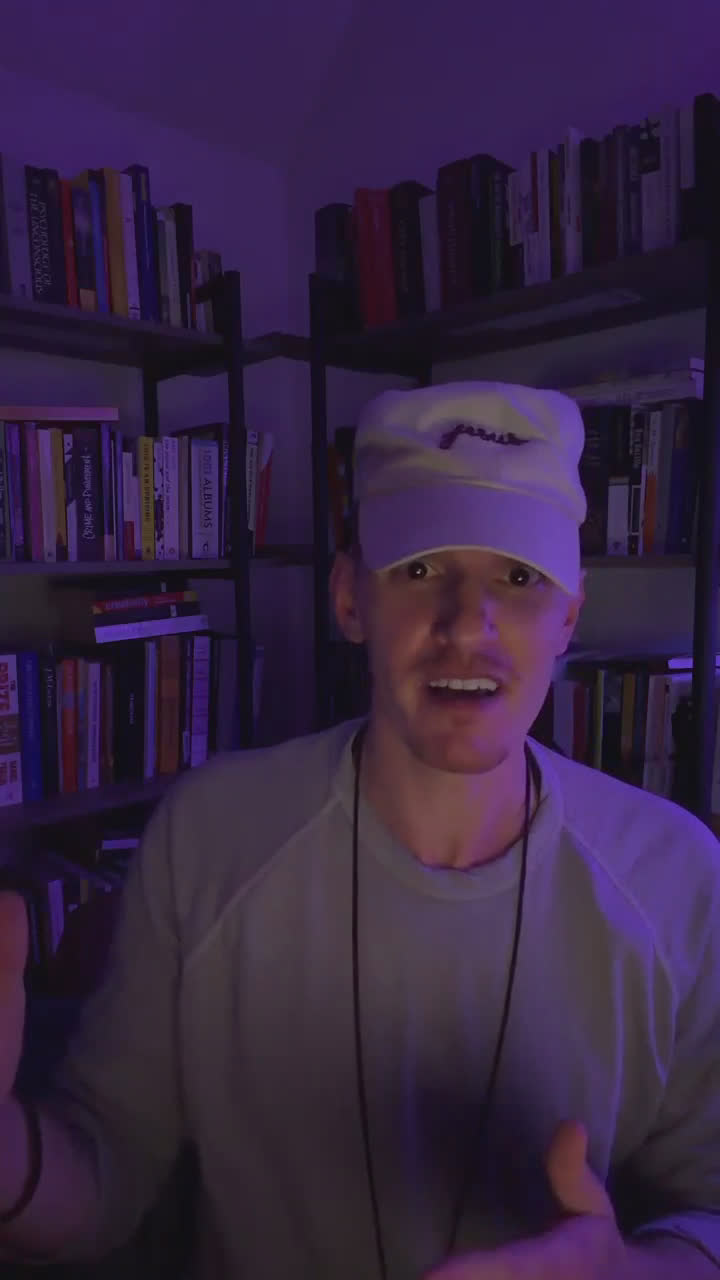
What happens when your emotions arrive at a conclusion before your rational mind has even finished asking the question? There’s a peculiar experience in knowing intellectually that something isn’t an emergency while feeling, with every fiber of your being, as though it absolutely is. An unanswered message. An ambiguous interaction. A passing criticism. A conflict left unresolved. What seems insignificant from the outside can become an all-consuming emotional experience. For ADHD Awareness Month, I'll be leading A Different Kind of Mind: a candid, provocative four-part series exploring how it feels to live with ADHD. In our third conversation, I’ll explore one of the most misunderstood dimensions of living with ADHD: the extraordinary intensity of our emotional lives. We’ll examine the neuroscience of emotional regulation, the relationship between stress and cognition, rejection sensitivity, and the sometimes overwhelming need for certainty and resolution. We’ll also confront a fascinating paradox: how the very actions we take to escape emotional discomfort can become the things that perpetuate it. But emotional intensity isn’t simply a burden. It can also enrich our capacity for passion, enthusiasm, empathy, and connection. Because perhaps the challenge isn’t learning to feel less, but learning that we can feel everything without having to act on everything we feel.
The host opens the conversation, names a less-discussed dimension of ADHD — the felt experience of intense emotions — and previews the topics to be covered including neuroscience, rejection sensitivity, and how emotion can drive unhelpful actions.
The speaker recounts building a pricing tool at a solar company and witnessing an executive's meltdown, using this story to show how intense emotional reactions can occur even in career contexts and to introduce his own later experiences.
He admits to historically over-intellectualizing and avoiding emotions, explains recent growth through therapy, and contrasts his ability to perform under stress with struggles when situations become emotional.
The speaker explains how perceived rejection or ambiguous social signals can hijack focus, narrates a shift from flow to crisis, and sets up the topic of rejection sensitivity and its roots in ADHD.
He shares a detailed story about sending multiple messages, escalating into embarrassment and reactive attempts to fix things, illustrating the cycle of urgency, acting, regret, and further escalation in relationships.
The speaker describes rejection sensitivity, how childhood experiences shape it, the preemptive strike behavior to avoid hurt, and how that pattern damages close relationships despite being protective in intent.
He reviews strategies like urge surfing, naming emotions to gain perspective, and reclaiming emotional agency to choose long-term actions over short-term relief, plus a personal rule to take a pause before reacting.
The speaker reflects on the beauty and burden of feeling deeply, reiterates distinctions between feeling and action, emphasizes learning to live fully while not being governed by impulses, and previews the next conversation.
Welcome back. So I've spent much of this series of conversations talking about the extraordinary contradictions of ADHD. The ability to solve complex problems while struggling with simple ones, the intensity with which we can become fascinated by another person and the difficulty of translating that fascination into consistent intimacy. Ro, great to see you, man. Always, always feels good to have a little support on here. But there's another dimension of ADHD that I want to, that I think deserves far more attention.
What it actually feels like. There's a particular experience I find fascinating, knowing intellectually that something isn't an emergency while emotionally experiencing it as though it is. An unanswered question, an ambiguous interaction, a perceived rejection, a conflict that remains unresolved. Sometimes the most difficult part isn't understanding the situation, it's navigating the extraordinary intensity of the feelings surrounding it. And when those feelings become overwhelming, the desire to resolve the situation can become almost indistinguishable from the desire simply to escape the discomfort.
Tonight, I want to explore that experience. The neuroscience of emotional regulation, the relationship between stress and cognition, rejection sensitivity, the way our interpretations can amplify our emotions, and the sometimes surprising ways our attempts to find relief can work against us. Because perhaps one of the most important things we can learn about ourselves is that feeling something intensely doesn't necessarily make our interpretation of it accurate or impulse to act on it wise. So I remember back when I was working at that solar company I've mentioned, Sunrun, shit.
We're still here. We are here. All right. Back when I was working at that solar company, Sunrun, and this was about a decade ago, and I remember the first time in my career I had witnessed someone go through something like this. And I had basically just started with the company. I had just met an executive who had become a significant mentor of mine over my career. And at that time, he had this hypothesis that the company was hemorrhaging cash, that essentially the way we were pricing our solar installations in our different markets was too rudimentary and therefore we weren't maximizing the margins and it was resulting in us being a cash flow negative company.
At the time, though, a handful of the other executives had their identities rooted in matrix pricing is what it was called. And when I met my mentor, I suddenly brought to him the tools of being able to code in a basic sense. But what that meant was that for the first time, he was able to actualize and make real the theories and the hypotheses he had. And so we had built this thing called contribution pricing, and it would bring the whole cash and expenses down to the unit economics of the solar system, and it would show which markets were hemorrhaging the most cash.
And at the time, we thought it was super cool. We were super pumped. We were like, who wouldn't want this? Who in their right mind wouldn't want to use this? Like, FP&A is going to be able to like just take a scalpel and carve out these markets. So we had a meeting with the C-suite. We were gonna be presenting in front of the board, in front of CEO Lynn Jurich. And right before then, we decided, let's go tell the head of product pricing. Let's show him. Let's just show him how cool this is. And so we go and we show him this basic, basic app.
And I remember just sitting there, fly on the wall, silent, as he had a full out meltdown in front of the room. And I remember him just going, sitting there staring at us and saying, I feel like you have shackled me. I feel like you have shackled me. I feel like you have shackled me. I had never seen anything like that in my career. I myself would experience some of these sorts of situations, though, as time would go on. And whether it was just being outraged in the middle of the night at a project manager who's on the project and I get on the meeting and I'm just railing against him to the point that he's in tears.
And I would go home that night thinking to myself, I just became the bully. To then these sort of overwhelming emotional reactions that would occur under misunderstandings or not a misunderstood, but a well understood slight or act of disrespect in the course of a relationship. And I would suddenly find myself in this visceral, immersive, physical and overwhelming emotional experience. And that's really what I'm trying to, I'd like for us to talk about and explore tonight, because I think it's a really interesting idea.
And I'll be honest, I have almost talked with no one in my life about any of the things we're about to be talking with about tonight. I'm someone who loves to intellectualize and overthink away his emotions. And so it's really been in the last year that I've through therapy, through these certain things, have just been challenged to let myself be with a given emotion. And that's a very weird, strange place for me to be in. I'm the type of person who I'm used to when I'm feeling something, I figure it out, I resolve it, I get to the solution, and I eliminate the feeling.
And so what I'm really trying to get at and over the course of these four conversations, this has really been my goal. If I'm able to understand this last area of myself and of my own psyche, of my own cognition, I feel as though I will have full control over myself. And so today, as I've been thinking a lot about this conversation over the last two weeks, today I'm planning on sharing some of the insights that I've discovered myself. So I want to take a brief detour and return to some of the stuff we talked about in our first conversation, particularly the neuroscience of ADHD the prefrontal cortex, the dopamine, norepinephrine and cortisol.
Because I think it's a really interesting interplay of neurotransmitters that ultimately result in the deficits that we with ADHD experience. And so you can think about the prefrontal cortex of your brain as being essentially like the CEO of yourself, of your own mind. It's again, it's what drives and allows you to regulate those things we talked about in that first conversation called executive functions, things like inhibition, things like task initiation, getting started, things like time management, things like context switching.
And it is in this part of the brain that people with ADHD, I wouldn't call it a deficit, but they struggle to regulate it. And in particular, the three chemicals that go into that and make and allow for that operation to happen are dopamine, norepinephrine, and cortisol. Dopamine we can think of as essentially the reward, meaningful portion of this cocktail in that it is what tells your brain what is important to be focusing on in any given moment. And so dysregulated amount of dopamine means dysregulated focus on what's important.
Then you have norepinephrine. And norepinephrine, you know, I've talked with people before about, you know, I used to joke that a little bit of anxiety, everybody needs a bit of anxiety. If you didn't have anxiety, you wouldn't get up and eat a meal. If you didn't have anxiety, you wouldn't drink a glass of water. You wouldn't do the basic functions that you need to survive because it takes a baseline, low level amount of anxiety to get you there. That's the role of norepinephrine. Norepinephrine is about alertness and it's about control.
And so if you're alert, if you feel in control, if you know what you're supposed to be focused on, you're golden. And then you get to the neurotransmitter or chemical of cortisol. And cortisol is what allows you to sustain the fight. It's super stress, super toxic sort of chemical that is what releases when you're in that fight mode and you have a challenge and you're going to get through that challenge. And what's interesting about this is that for someone with ADD, you can almost think of it like the stress curve is like that.
I'll do that again. In that if you have just the right amount of stress, you can actually get more done and be more productive than you ever would have any other time. And so this is what accounts for why someone like myself can be told that the entire company rests on their shoulders and instead of feeling like I'm overwhelmed and crumbling, I'm rearing and ready to fucking go. I feel confident in that zone. I feel like I know my tools. I know what I need to do. I know how to do it. I know how to think about it.
I know how to design it. I know how to lay it out. I know how to execute on it. There is nothing I cannot do when I'm in that situation and I will steamroll anything, anybody that gets in my way. Fortunately, that doesn't always help. And when you find yourself suddenly overwhelmed with too much of that stress, too much cortisol, too much norepinephrine, you can quickly go down the other side of that slope and finding yourself in rapidly diminishing abilities to actually function or reason about your situation.
And so that's where suddenly especially in my case, when it gets down to the emotional aspects of things. I can handle an enormous amount of pressure and stress, but then when the intellectual becomes emotional, that's where things become difficult. So what if the same urgency that helps me perform under pressure can make it harder to think clearly when the stakes become emotional? What does that look like? I want to talk about for a second when rejection and uncertainty feel like an emergency. So if you can imagine for a second, you know, you're hunting, you're locked in on something you've wanted for forever and you're going to get it.
And everything else in your life has sort of become like this blurry backdrop as you're just locked in. And then you receive a bit of information that is totally unrelated to anything you were just doing and is a sign and a signal that something really important to you, like your significant other who's unhappy, who is suddenly It's not connecting. There's something wrong. That experience can be one of having been totally in that zone to then suddenly this thing that in the large, broader scape is actually more important to you, most important to you, just didn't think that you needed to attend to it in that moment.
And suddenly that comes shattering down around you. In my experience, I remember this was about five years ago. And I promised in our introduction that I would share this story. And so I'll share it, here goes nothing, but it's the first moment that I felt for the first time in my life like I had a disability, like I was handicapped. And I was maybe 32 years old. Most of my life I had known I had ADHD and I sort of considered it a superpower. I liked how I was. I liked the way I think. I liked the way I approach things.
I liked how I did my life. I liked the room I designed around myself. I didn't really feel like I had an issue. And then I was sitting, living up in a penthouse in North Loop, founder, future model, founder and CEO, future model, funded. grinding away, building, building, building. And one afternoon, I'm sitting there, and I break away for a second from the coding I'm doing, and I'm messaging this girl that I was sort of into at the time. I wasn't even really that into her. This wasn't, if you had asked me, like, do I care?
No, not at all. And in this moment, we're messaging back and forth, and it's one of those times where it's like we're both in it, It's kind of what we talked about in our last conversation. I'm more into the fascination around this new person, getting to know them, and we're going back and forth, you know, in this, in this, in a great, in a good way, for lack of better words. And she says something, I don't remember what, I say something And then she just suddenly drops off the map. And I'm sitting there, I'm like, okay, no problem.
I'm coding away, doing my thing, thinking about my business. And I'm waiting for her to reply and the reply doesn't come. And I'm like, that's weird. We were just like, we were just in it. And I'm waiting, nothing. So I send another message. and I'm waiting, nothing, and I send another message. Shortly later, I'm sitting there coding, coding, coding, and I'm like, God, I can't believe I sent like 3 or 4 messages. Like, I look like such an idiot. So I think about, okay, my mind's just kind of going, it's going, you know, it goes quickly, comes up with 1000 ideas in a minute.
And so I'm just like riffing, riffing, riffing. I think of something funny, makes me laugh. So I send it trying to curb the edge. A few minutes later, I'm like, oh God, that was really dumb. I'm overthinking it again. So I send another message and I send another message. And before I know it, I had sent this wall of messages with each message trying to ultimately address and be the savior of the entire thread. And I remember just suddenly having this as this was building, as this experience was building, having this just sort of meltdown where I'm like, what is wrong with me?
It's like, I've never been an insecure person. I have no doubt in who I am socially. I have no doubt in who I am professionally. I have no doubt with who I am artistically. And I'm suddenly being just, I'm just falling apart. over nothing. And so as I think about that experience, there's something extremely immersive and physical, like I said about that. And so then the question becomes, what if the thing we're most afraid of isn't rejection itself, but the unbearable uncertainty of not knowing whether we've been rejected?
And so, there's a lot of different things that can go into this thing, whether it's criticism, shame, perceived abandonment, or in the ADHD world, what is often known as rejection sensitivity dysphoria. And rejection sensitivity dysphoria is one of these things, it's not technically a diagnosis, it's not technically a, but it's more like a overwhelmingly shared experience those with ADHD have developed over their lives. A lot of that comes from a very young age, knowing there's something slightly different about you.
Maybe you're just kind of hyper. Maybe you're just a little distracted, just kind of not entirely present in that moment. And so as you grow up, you experience social experiences you're socialized to essentially begin to fear or anticipate. In my case, I have a tendency to provoke. I have a tendency to wear my edge on my shoulder, on my sleeve, whatever you want to call it. And one of the things I've been realizing recently is that I think a lot of that comes down to a sort of A bomb first approach to rejection.
A, what's the word? A preemptive strike, if you will. It's the preemptive strike. Look, if I piss you off, if I can provoke you, if I can dig into you, well, hey, I asked for the rejection. That's safe. I can anticipate the rejection. That's safe. Now I don't do that with those who I like love most and I respect and who are closest with me. Those, the situations I get in with them are the far more destructive where those who are closest to me are also the only ones who can truly hurt me in a way that causes me to go to let loose, to go off.
And it's those who I then hurt with my words more than anybody else And therein lies the paradox. I am hurting the people I love the most the most, and often you can't roll that back. And so what that looks like is something like, As for me, what this looks like is I can feel, I can feel this expansion happening in my chest. It moves up from my stomach into my chest and I can just, I can feel it, feel it pushing, pushing, pushing. It's almost like a chest nausea, if you can imagine it like that.
And at a certain point, the emergency becomes the discomfort with this pressure, with this tension in my upper body, in my chest. And when that builds high enough, I want nothing more to relieve that, to relieve that pressure. And so I take an action. If I'm offended, if I feel like you've just thrown dirt on me, I'm going to take the shiv and I'm going to stick you with it. And in that moment, it feels good. It feels like relief. It feels like everything just let loose. And then in the moment after, it's, oh fuck, I did it again.
Or it might be trying to reconcile, trying to, trying to, trying to understand what it is with my partner that I've just, that's caused her to become so upset, so distraught, so, whatever. And so I start reaching out. I start reaching out. And I just think I'm just trying to solve the problem. I'm just trying to connect. If we can talk it through, if we can level, get on the same page, all is going to be good. Why wouldn't we be able to? We love each other. But what I don't realize, what I don't fully appreciate in that moment is that they may need their own space.
They may need their own ways to process. They may not be ready to go there with me yet. And so in that moment, the very actions I'm taking to relieve my own feelings, emotional distress, are the very actions that push them further away. when that results in something like, suddenly I find myself blocked. Suddenly I'm like this. I'm like, well, that just suddenly it just throws fuel on the fire. That initial perhaps sensor signal that there's something important in my world I need to address goes from something important I need to address to boom, full emergency.
And at that point, I might suddenly, cortisol kicks in, I'm overwhelmed, I begin, and all I want is to alleviate that feeling. And so I reach out, I reach out, I reach out over here, I reach out over there, I get blocked there, I get blocked there. And at that point, things are just spiraling. Obviously, the fact is the whole entire time I'm aware of these things. Intellectually, I know it. I know. Look, I just got to give some space. I got to chill out. She'll be back. But that's, there's a big gap.
And that's what, as we've been talking about today, the difference and the distance between your feelings, what you're feeling, and with the the ways you should be actually handling the situation. And in those moments, then it's like, because I know this, I then can realize that moment, like I mentioned that day that I was coding away and I'm like, God, I look like such an idiot right now. Like that was so dumb. Why did I just say that? And why did I say this? And then it's like, I might try, you know, a message that is genuine of reconciliation.
You know, come on, babe, let's just talk this out. It's A misunderstanding. I didn't mean it like that. Or that can quickly turn and flip into resentment and contempt and irritation at the fact that I've just been blocked. They know what this does to me. They know how I react to that. Why have they now put me in this position? So I'm deflecting the blame at that point, right? I'm deflecting responsibility. And And at that point, it becomes, I send a message of resent, and I send one of conciliation, and I send one of love, and then I send a joking message kind of making it playful.
And on the other side of this, I just look unhinged. It's like, it just looks like the guy can't keep his shit straight. And again, I know that, which then leads into embarrassment. It leads into feelings of shame. It leads into feelings of just frustration at the entire situation, which then fuels another cycle and another cycle and another cycle. And so that's, and so I think what's interesting about that though, is that, and here's a question for everybody on the call. I would love to love to know is Would you rather know something definite and negative or be kept in a state of uncertainty and possibility?
And what I mean by that is what would you, and I'd love for people to answer in the comments, what would you rather have? somebody being straight up reject you with a definite rejection or have the possibility of staying together, but the uncertainty of not knowing. And for me, the most difficult place I can be is that place of uncertainty. Even when I'm in my work life and I'm in the professional world, I'm constantly scanning the surface, scanning the planes, if you will, the long African savanna grass.
And I'm on high alert for possible threats, for possible risks. And then everything I do behind the scenes is about me de-risking the area that is most unknown at that time. So often when I come out with solutions that no one had anticipated, when I come out with ideas or suddenly a way to solve this or that, it's actually usually because I've actually been on top of that. I had already POC'd proof of concept did out some ideas. I de-risked that area to myself. I had enough of an idea that I knew the moment it would come time to employ that idea, to implement that idea, it would be right there and I could just boom, hit it.
The moment I've done that, I move on to the next big unknown and I hit that. I steamroll that. I steamroll the next. And I'm always sort of then staying several moves ahead of the unfolding game. Unfortunately, you can't always anticipate things like that within a relationship or with your friends, with your family. And it's in those situations where that emotion comes in and I struggle personally with the uncertainty of it all. I would rather have someone say, look, you aren't for me. Look, you're an asshole.
Look, fuck off. And me be on my way than I would sitting here in this never-ending place of uncertainty. And so what do we do about that? What do we do? How can we get through that? And I would encourage everybody to check out live streams from Mary Ann. So Mary Ann's been going live lately. And I was listening to her the other day, and she was just talking about just some real straightforward elementary emotions. She was like, you can feel shame. You can feel grief. Be with that. Feel that. It's okay.
And I was listening to Mary Ann, and I was just thinking about that. is my core issue. I don't allow myself to sit with the emotion before immediately deciding and judging and characterizing it as something that needs to be resolved. And therefore, I become reactive and I become beholden. I become a slave to my emotions. There's an idea that I've personally, one of the ideas my therapist introduced to me a year ago, and I personally just didn't I didn't have a lot of success with this one. I just, I think I felt like it was just, it just doesn't, it doesn't accurately capture the experience, but that's of urge surfing.
And I really appreciated the idea then, you know, this idea of when you have the urge, instead of acting on the urge, surf the wave, surf the urge. And if you can just surf the urge, surf it down, eventually the urge dissipates. It goes away. it subsides and you find that the urge becomes less and less. It doesn't really happen with me so much in that I think people think, oh, he's only going to do this for like a day. But it's like at that point, I'm in challenge mode, I'm in fight mode. And then there's another aspect to that, which is that like when I'm feeling resentful, when I'm feeling that sort of like, I can't believe you just blocked me, I can't, whatever, there's a feeling inside relic of my adolescence that says, if I just sit here and wait and peacefully wait for you to finally decide to re-grant me access, then I don't think you should have access, but I want you to have access.
I love you. And so I reach out and then I'm like, dude, unblock me, whatever. And And it's this feeling of like, I need you to unblock me from my demands in order to make up for having blocked me. Like I can't just let it go. I can't just take the high road. Well, and that's another lesson that I'm learning through this, right? It's like, what do I want more? Do I want the relationship? Do I want the beauty in that experience and that connection? Or do I want to be right? Do I want to win the argument?
I love to win. So it's a tough one. But going back to what we were talking about in terms of ideas urge surfing. So urge surfing to me, it's like I just, the urge grows. It will grow, it'll grow, it'll grow. So an idea I just came upon and stumbled upon recently that really, really stuck with me. And it's It's kind of like naming or labeling it, which I think is a really powerful, powerful technique. I mean, it's what Genesis 2, one of the first things God tells man in the book of the Bible is when you create things, you go out and you name your creations.
You give them an identity. And that's an extraordinarily powerful pithy concept because that you find everywhere. You find it everywhere from the world of data modeling in which every table needs to have a primary key, which is a unique value that represents that row. And if you don't have an identifier, you have almost nothing. To then the world of cognitive behavioral therapy or dialectical behavioral therapy and this idea of naming the emotion. Because when you name it, you have something you can conceive of it with.
You have a symbol that represents an amorphous fluid reality. And the moment you can do that, you can start to do things like meta analyze it. You can take a step back, you can explore it, you can observe it, you can say, that's interesting that I feel that way. And you can begin to use emotions not as the driving force behind the things you do, but instead as simply pieces of data on how you're operating and what you're running at that time, and then decide what you want to do with that. And that brings us to this idea of, that I love, emotional agency.
The big thing that I struggle with when I'm in that situation of having been blocked off, closed away, is that I feel like I have lost all agency. I feel like I have just been put in this box, I've been put in the cage, and I can't even demonstrate to my partner the respect I love to show for their boundaries. And I really struggle with that feeling of being locked up, locked away. And What this idea behind emotional agency says and does is it sort of shifts and flips the whole thing around. And it says, instead of being enslaved or imprisoned to the emotion and being a subject of the emotion, what does it look like to have agency over that, to take the power back, to rise above that emotion and to say, great, I feel that way.
Now I'm gonna do the thing I need to do to maximize the long-term results, the long-term relationships, the long-term outcomes that I really wanna have. When I was young, my dad used to tell us growing up, he used to say, you know, whenever you're thinking about doing something dumb, think ahead to 30-year-old Davis. Would 30-year-old Davis be happy that you did that? No, probably not. Don't screw up life for 30-year-old Davis. And I remember that was a really, really powerful idea I would hold in my head as I would go through the first 30 years of my life.
And then I turned 30 and it's like, well, six-year-old Davis just flew out the window. It was years. It was years before I remembered that. And I'm like, wow, I've really been messing things up for six-year-old Davis. So I think this idea of being able to name, be able to label, being able to reclaim emotional agency is a powerful one for me at least, because I I put a lot of importance on self-control. I put a lot of importance on executing with a ruthless disposition. And ruthless, as I'm sure you're aware, doesn't mean being mean.
It means to operate without emotion. And when times are hardest, when everything's on your head, you have to be ruthless. You have to be able to operate without emotion. And in my case, the emotions are one of the greatest places of risk for myself. So really, as we talk about learning to feel without obeying, not obeying the feeling in that moment, instead of just being able to sit with that. And then in addition, the last thing that's kind of been helpful for me is just, and structure is really great for me.
Whenever I can lay down structure, I like to build in layers on top of a foundation of a bedrock. And so I'll layer structure on structure. And when I'm in that mode, again, I'm one of the most effective that I can be. And to me, this is a new layer of structure that I plan on laying in. And that is setting a rule for myself, which is that as I feel that that emotion inflate my chest as I feel the nausea move from my stomach into my chest to just set a hard rule. Look, I got to take 30. Let's come back.
Let's revisit this. I got to go take a walk so I can just calm down so I can collect my thoughts and then move forward from a place of wisdom, move forward from a place of of justice, of rightness. And for me, I personally, I value, I've always been somebody who values truth over kindness. And those aren't necessarily mutually exclusive. You can be kind with the truth you deliver. I'm not the best at that, as you can imagine. But for me, I care far more about truth and about knowing than I do about being nice, being kind to me.
Don't manage my emotions for me. Tell me the truth. Say it how it is so we can both move on and take the right moves. And I think sometimes people on the opposite side struggle with that. They struggle with just being direct. They don't wanna hurt someone's feelings. They don't wanna risk what is their reaction going to be if I tell them I'm not interested in them. I mean, there's a lot of unhinged dudes out there, right? A lot of unchanged ladies out there. And so It's that, I think a reasonable thing to be cautious of, but I think that in the end, one of the most destructive things we can do is to ghost and to leave people hanging.
If you've spent any meaningful or significant or reasonable amount of time with another human, I personally feel we owe it to them to tell them the truth, to tell them how it is, and to not deflect that on God, on, this or that external, you're not into them. You just don't, you don't see it. You're not compatible, whatever it is. And maybe you don't know that either. Maybe that's the difficulty. Maybe you don't quite know what it is, but you just feel it's off. Let them know. You know, that's how, that's my two cents at least.
So moving on into the ending here, the beauty and the burden of feeling deeply. In Crime and Punishment, Fyodor Dostoevsky writes, I think life is truly, for anyone with a deep, with a large heart and a large intelligence, life is deeply, deeply sad. I think the truly great men or women must have great sadness on earth. And so the thing about feeling deeply is that it actually has a really beautiful side to it. On the flip side of that coin, it's what drives the passion. It's what drives creativity in creating great, memorable, unique, novel, new experiences for the person I love.
It's the thing that gets me excited about a breakthrough or an invention or building something awesome. The depth in the feeling when I'm fascinated with a partner, the depth in that feeling when I'm fascinated in a project I'm working on, it's euphoric. The flip side of that is when that depth in feeling goes the opposite way. And for those of us with ADHD, regulating what it is you're focusing on in that very moment, regulating the intensity with which you've just gone from zero to 100 in a given emotion, regulating that ability to separate the facts from the interpretation, separating What do I truly know about what's actually happened here?
Because I didn't share much on it tonight, but yeah, I've misread, I've made assumptions, I've made an ass out of you and me more times than I can account when I'm in the situation. We're almost there. We're almost through, guys. And so all that to say, I think one of the most consequential distinctions we can make is between what we feel and what we do with those feelings. Intensity isn't inherently a flaw. The capacity to experience excitement, affection, enthusiasm, disappointment, and longing deeply is part of being human.
But the intensity of emotion isn't a measure of its accuracy. And the urgency of an impulse isn't a measure of its importance. Learning to regulate ourselves doesn't mean learning to feel less. It means developing enough freedom between the emotion and the action to decide who we want to be in that moment. Because perhaps the goal isn't to quiet a different kind of mind. It's to learn how to live fully within it without being governed by every feeling that passes through it. We spent three conversations now examining what it's like to live, work, love, and feel with ADHD.
Next time I want to ask a different question. What if some of these difficulties tell us as much about the world we've built as they do about the minds trying to navigate it? So join us on Thursday as we flip ADHD on its head and we try to make the ultimate sense of this experience. Take care. Have a good night. Thank you for joining me.
Reactions and comments are for members. Joining is free and takes a minute.