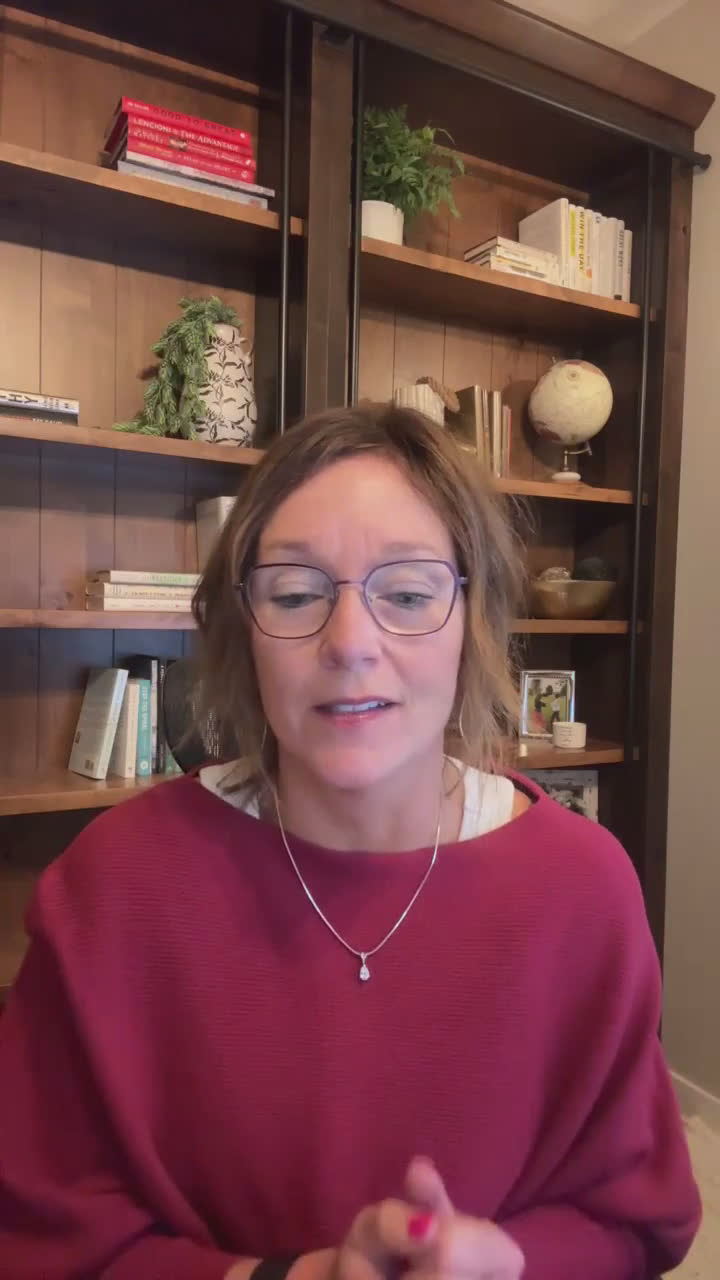
Carrie Heimer explains how people confuse facts with the stories they tell themselves, uses examples like unread texts or impromptu meetings, and shares practical ways to notice, name and reframe those internal narratives.
Carrie greets viewers, briefly explains her background and mentions the livestream title The Stories We Tell Ourselves. This segment sets up why the topic matters and that she plans to share helpful practices.
She defines facts as camera-capturable events and stories as the meanings and motives we attach to them, giving everyday examples like unread texts and workplace assumptions. She also explains why our brains fill in blanks and tend to assume worst-case scenarios.
Carrie shares a recent experience where a contact declined a meeting, and how she spiraled into self-doubt and catastrophic thinking. She then reveals the actual fact—that the contact took emergency caregiver leave—demonstrating the gap between story and reality.
She invites viewers to replace certainty with curiosity by asking what they actually know, what else could be true, and what information is missing. She encourages writing down the facts, the story, and alternative explanations to break negative spirals.
Carrie offers encouragement, asks viewers to share topic suggestions in chat, thanks attendees, and signs off. This brief closing reinforces connection and suggests future dialogue.
Good morning, everyone. Thank you so much for joining. I'm sorry I'm about a minute late. I had a little bit of technical difficulty on my end. So good to see you. My name is Carrie Heimer and I have been a part of CADRE for about the last year and a half in different capacities. My background, if I haven't met you yet, is I was in HR for 30 plus years. And most recently, I've started a new business with my husband called Elevate Potential. I hope I'm finding you this Wednesday morning doing well.
And if not, that is OK too, because you are not alone. And thank you for tuning in. You saw the title in my live stream called The Stories We Tell Our The Story I'm Telling Myself Is. And for me, that's an all too familiar concept. And so I thought I'd talk a little bit about it today. So how often do you find yourself when something happens, you start telling yourself a story? So maybe an example that is probably relatable to many is you send a friend a text message and they don't reply. hours go by and still no reply and suddenly you've started to tell yourself a story about their interest in being your friend, the value that you bring to the relationship and the list can go on and on.
So we can move very quickly to what we call kind of the fact they haven't responded to your text message to a whole narrative of what that means about you. And so that's kind of what I wanted to talk about today and share some things that I practice that helped me in the hopes that they'll maybe be helpful to you as well. So let's talk about facts versus stories. So facts are something that a camera could record, they could capture it. It is a fact, it is there. The stories are the meaning and the predictions and maybe the motives that we assign to those things.
So basic examples that can happen in everyday life. I share the one about the text message. Maybe your boss schedules an impromptu meeting and you're telling yourself a story that I've done something wrong or I'm in trouble. Maybe you didn't finish your to-do list that you had for the weekend and now you're telling yourself that, well, I'm not enough. I never do enough. Therefore, I am not enough. And so the interpretation we have of those facts are not the same. as the stories that we are telling ourselves.
So why does our mind do this? I mean, our brains naturally look for patterns and whenever there are blanks, we try to fill them in. And the challenging thing is we usually fill them in with the worst possible outcome that there could be. We might be triggered by old experiences or things that happened to us in our past. And so we attach that to the narrative we have going. And before you know it, we found ourselves catastrophizing, which I am very familiar with the concept of that. And so I have over the years had to work really, really hard to make sure I acknowledge that story I'm telling myself, but create some distance and space from the story versus the facts.
Let me just give you an example from this week. And this one is I'm extra sensitive these days as I'm working to build something new. And so I was really excited to meet with somebody that I have had in my network for a long time to share more about what we're doing with our little business Elevate Potential. And it took a while to get the meeting scheduled and we finally got time on the calendar. This was last week and all at once I noticed that the, the, that she declined and there wasn't any, um, information as to why she declined.
And it seemed very uncharacteristic of her because we had had so many great conversations. And so because of where I was feeling in that moment about other things going on in my life, I formed a whole string of stories. It started with, you know, she canceled because she's thought about it and she's not interested in what I have to offer. She's not interested. Maybe other people won't be interested. Why am I even doing this anyhow? Why am I putting myself out there and creating this discomfort? Maybe I should just go back to getting another full-time job.
And so I had had myself in such a spiral of thinking based on one fact, she declined the meeting, but I attached an entire narrative that was about me and my value and my worth. The reality is I did reach out to her and just said I you know I noticed that you declined our meeting. I hope you're doing OK and if the time is better later, please let me know. She followed up and said she had had to take emergency caregiver leave to be there for somebody who is critically ill. That was the fact. That was not the story that I was telling myself so.
My invitation for you this week is to shift from certainty to curiosity. And this is just a simple practice that I try to do. What do I actually know? What I actually knew in that case is she declined my meeting. What else could be true? What are some other alternative scenarios that might be why this happened? And What information am I missing? Well, clearly in my example, I had one fact and I had a lot of missing information. So my invitation for you this week, just one simple practice. When you find yourself going down that path, my invitation is write it down.
Maybe the example is my boss hasn't responded to something I sent to him three days ago. It must not have been good work. I'm not good. Maybe I'm going to get fired. Write it down. What do I know? What story am I telling myself? And then ask yourself, what else could be true? My hope for you is by the time you get done with that exercise, you have come up with other ways to fill in those blanks than the ones that you have most immediately in your mind. I hope that's helpful to you. I'd love to hear from you.
And if there are topics that you would like me to talk about, please share in the chat. And I want to make sure this is meaningful time for you. Thanks for showing up. Thank you, Emily. I appreciate that. Hi, Davis. So fun to see you all this early morning. I hope you have a good day and be good to yourself. See you next week.