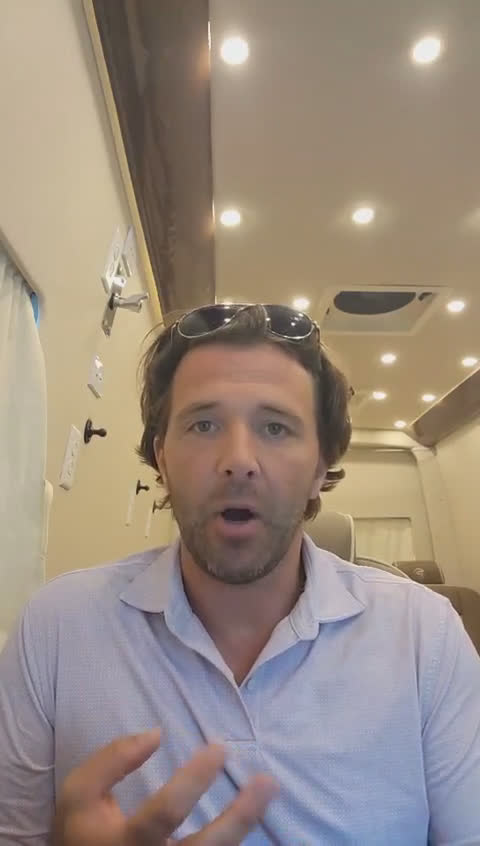
Luke Wendtlandt is founder of Cadre, in the behavioral health and mental health space. He talks about endurance, inspiration, motivation, building businesses and leadership.
Your goal is to always have meetings that are collective, where, you know, it's harmony. The meeting purpose should be well known prior to go in, or there's a culture of understanding what the purpose is of the meeting. If you're the leader and you're running this meeting, this isn't a time that you're talking down to.
As a leader, there's one quick trick that you can do to see what kind of harmony you have in your meetings. Individuals need to feel something when they're in a meeting. Are you inspiring people? Are you motivating people? How do you build the engagement within the teams?
What up, Cadre? Amazing Thursday, right out the gates. Have you ever been, have you ever been to a meeting before? And it's been the same two people talking when there's six or eight individuals in a meeting. Has anybody ever been there? I sure have. And it's been like an hour, hour and a half long meeting, and it just seems like it's a dialogue between two or three people because. But yet eight individuals are there. Raise your hand. I sure have. I've been there. I've done that before. My name is Luke Wendtlandt.
I'm been at Cadre since day one. I'm founder of Cadre, founder of another business as well, in the behavioral health and mental health space. I'm so excited to be here. I talk about all things, endurance, inspiration, motivation, building businesses, leadership, going through the heartaches of the good, the bad, and everything in between. So I'm excited here to talk to you about this one. But number one, I'm going to give you three tips throughout this goal. But your goal is to always have meetings that are collective, where, you know, it's.
It's harmony. It's. It's a group. The, the group think idea of six to eight individuals truly working together. And so the first. The first wave is, number one, setting up these meetings. Right? So if you're going to set up these meetings, this is the very first tip I want to give you. The meeting purpose should be well known prior to go in, or there's a culture of understanding what the purpose is of the meeting. So, example, if you have something on your calendar on Monday, something on your calendar on Wednesday, something on your calendar on Friday, you should know exactly why you're going to that meeting and what the goal or the agenda is from that meeting.
Excuse me. What the agenda is coupled with the goal. Right? So always keep that in mind. Number one, do you know the purpose? Do you know why you're showing up? Number two, the meeting isn't for you. Let me say this again. The meeting isn't for you. It's for them. So if you're the leader and you're running this meeting, this isn't a time that you're talking down to that you're communicating down, but you're communicating with. So again, let me say that again. We're not talking down and messaging out from the perspective of, like, I need to make sure my people get this.
The team that work for me, I'm the leader of. But rather, we're sharing this together. We're sharing this messages together we're bringing harmony as a team and aligning accordingly for the meeting. Right. As a leader, there's one quick trick that you can do to see what kind of harmony you have in your meetings. And I do this all the time. In fact, give me 1 second. I know we're on a live here, but I do want to show you this and I actually took a picture of this and I have it in on LinkedIn. So here is an example of meetings that I've had before and the individuals that have spoken, right?
So you kind of see with every tally line of how many times Tom Doe, Jane Doe talks and you look at the difference of the two meetings. Look at the meeting on top, it's basically dominated by two people. Look at the meeting below. You have, you know, everybody's within a few tallies of each other. I can only imagine which meetings went well and which meetings didn't go so well. So that's just a little tool in your toolbox as a leader that you can always ultimately just have the initials of everybody and just put a little check mark every single time somebody talks.
And if you have a bell curve like that, that's awesome. You know, maybe one or two people on each side that may be talking a little bit more or talking a little bit less, but then the majority of individuals flow in the middle. But if you don't, then, you know, you have something going on culturally within your meeting and not too many people are either willing to share or interested in sharing or otherwise. So how do you build that engagement? Right? How do you build the engagement within the teams?
I would argue there's two major things that people need to feel, right? So if I'm a part of a group and I'm a part of a team, I should feel that I can voice my true opinion, that I can open up factually about how I feel with something. I have psychological safety about what I'm about to share. So ask yourself as a team, ask yourself, do we have that and do we feel feel that way amongst our team and our partnership amongst the group? So if individuals aren't sharing, probably the psychological safety is not all the way on your team and you got to get there and you got to earn that right.
Or if it is that individuals feel like they have that psychological safety can share, open and willing and might even hurt somebody's feelings or might bring something up that might cause conflict, strife or otherwise, people will still voice it because it's the right thing to do and it's the right thing to open up in the meeting. Right. So think psychological safety. And number two is, you know, as far as transformational leadership, inspirational leadership, motivational leadership, or otherwise, individuals need to feel something when they're in a meeting.
They need to feel something from people. And are you inspiring people? Are you motivating people? You know, my wife always says, like, are you filling up the air? Are you taking it out? So let me say that again. If you're in meetings where individuals are stealing the air out of the room or filling up the air in the room is probably going to have a lot to do with your engagement in the group. There are some people that immediately, when they start speaking in a meeting, it's just. It's like a matter of time.
It just deflates the room. It just pulls all the air out. It's no different than walking into a room. Right. And meetings are otherwise, like, oh, they're back again. They're going to say something that just deflates us. And then there's other people in the room that always bring a different spin that inflates the group, and it might not. It might not even have to be positive information, but it's still. It's inflating the room, and it's bringing in the group. Right. So do you have psychological safety, and are you inflating or deflating the room when people talk and speak up?
Like, I mean, I've. I've done it before where I've, you know, brought messaging or otherwise that's obviously been deflating. And I can see it, and I walk out, I'm like, ugh, I just totally ruined the vibe. Right. But if it's a consistent thing amongst team members or otherwise, number one, I check to say, are they the right person on your team? And number two is, how do we change the narrative so it becomes inflating? So, Amy, I hope this helps for you. Thank you so much for showing up. Thanks for being here today.
Risa, your leadership journey is, like, going, like, this exponential ten x. Risa is going to be an unbelievable leader when she continues to grow her business and her teams. Make sure you show up tomorrow for making my dreams come true. I guarantee she's gonna have a wicked ten live. It's gonna be awesome. So continue to evolve and develop as not only a teammate, but as a leader. Ask yourself, when you're watching these things, specifically me, on tales of leadership, is this something that we do?
Is this something I do and really self reflect through that? Right. So when you walk away today, am I filling up the room or am I taking air out? Have an amazing week, you guys. For tales of leadership, this is Luke. Can't wait to come back next week. Let's go.
Reactions and comments are for members. Joining is free and takes a minute.