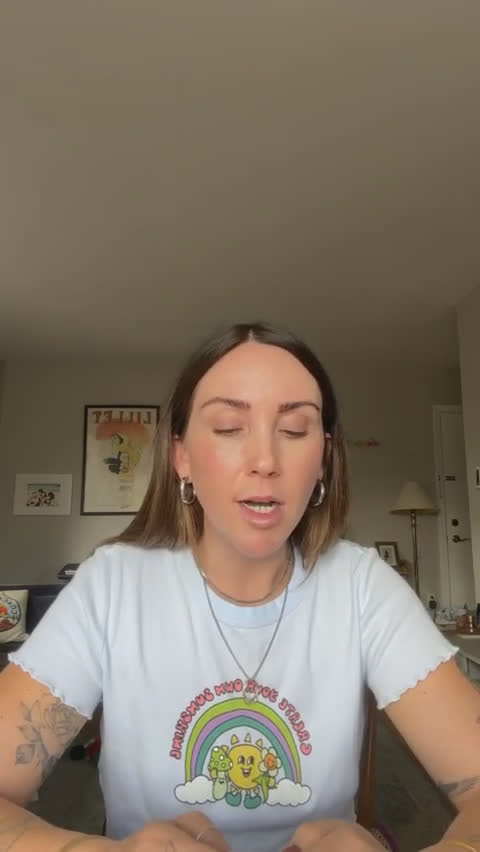
Content Warning: mention of suicide and eating disorders.💖 To kick off my first live with Cadre, I'd love to tell you my story and get to know you. I'll be sharing my journey with my mental health, therapy, hospitalization, eating disorder treatment, and ultimately how I decided to start sharing my story and connecting with people who might feel alone in their experience. Bring your beautiful self, a fuzzy blanket, and your questions 😊
Rachel Havocost is going live on the Cadre app. She will be talking about eating disorders, sexual trauma, and suicide. Just a trigger warning. I just want you to make sure that you're taking care of yourself.
Rachel Alec is a writer, a mental health advocate, and now a wellness expert with Cadre. She's passionate about destigmatizing all mental health diagnoses, but specifically eating disorders, suicidal depression, and grief. These are topics that are still difficult for people to experience, talk about.
Kept herself in a loop of shame because she couldn't finish what she started. She realized it wasn't a me problem that a lot of other people experienced the things she was experiencing. She went to treatment and learned how to name her emotions. Now she wants to pay it forward and become a therapist.
By reducing shame around my story and telling it, my mental health has improved so much. I want this to be a safe space for you to show up and feel like there isn't something that we can't talk about. If you have questions, you can leave them in the comments.
Hello, Cadre fam. I'm Rachel Havocost. I'm so excited to be here. This is my first time going live on the Cadre app, so I thought it would be a good opportunity for me to introduce myself and tell you a little bit about my background, my story, and why I'm here, and what I hope you can get out of this space so quickly. Just some housekeeping before I get started. I have a one year old puppy named Milo. So if you see a little furball running around, that's Milo. Or if you hear the sounds of chewing or squeaky toy, it's Milo.
He might make an appearance at some point. So then the other thing I wanted to mention is just a trigger warning. I am going to be talking about eating disorders, sexual trauma, and suicide. So if that's something that you're not in a headspace to listen to or hear about, that's okay. You can scroll away. This video will be saved on my profile. I just want you to make sure that you're taking care of yourself. I do not take it personally, so I honor and respect whatever it is that you need today and every day forward.
Hi, Kels. So, okay, so now that housekeeping is sort of taken care of, quickly introduce myself. My name is Rachel. I'm in Seattle today. We are lucky to have a little bit of sunshine after some rain. Hi, Katie. Thank you for the welcome. Hi, Alec. And I am a writer, a mental health advocate, and now a wellness expert with Cadre. And I'm really excited to just share my experience and hopefully connect with all of you here on this app. So, I have been writing about mental health for about four years now.
I've struggled with my mental health since I was 15, and I'm really passionate about destigmatizing all mental health diagnoses, but specifically eating disorders, suicidal depression, and grief, specifically grief from divorce. These are topics that I feel like are still difficult for people to experience, talk about, and there's a lot of shame associated with them, and they're really complex. So it's important to me to create stories and narratives where we can reduce that shame and have more language.
Hi, Peggy. Thank you for being here. So, a little bit about my story. I was diagnosed with an eating disorder when I was 15, and the year this was 2005, so there was no social media. Mental health was still incredibly stigmatized. People in my circles and my family did not go to therapy, did not talk about feelings, did not talk about struggles. Everything was very, very surface level. And so I struggled with my eating disorder quite privately for about ten years. And I really believed that it was a me problem.
I thought I was the only person experiencing what I was experiencing. So I tried to navigate it all on my own. And when I went off to college, I really struggled with my eating disorder because I was away from home for the first time, I was introduced to whole new social scenarios. There was a lot of pressure in my program. I was studying to be an actress, so I was in class from nine to five, five days a week, while my peers were in class only a few days a week. And there was a lot of pressure, and I really struggled.
And I started to experience depression for the first time. And then in the summer between my freshman and sophomore year of college, a good high school friend of mine was killed in a boating accident. So then I was introduced to grief for the first time. And as a 19 year old, I had absolutely no idea how to. How to deal with grief. I had no tools. The same way I had no skills or tools to navigate the stress of school, to navigate social relationships, to navigate my emotional world. I had no tools to navigate grief.
So the only tools I had were my eating disorder and isolating. And so those three components, my eating disorder, my depression, and the grief, started to weave themselves together. And I really, really struggled for the next six months or so. And I did so privately. I didn't talk to my friends or my family about how I was doing. And then for the first time, I introduced alcohol into my set of maladaptive coping skills. And I started to really wrap myself around this belief that I was broken, that there was something wrong with me, that things would never get better, and that everyone would be happier if I didn't.
If I didn't exist anymore. And I attempted to take my life in the. In the winter of my sophomore year of college, and I was hospitalized. And I remember the psychiatrist saying to me, you know, Rachel, we need to call. We need to call your parents and let them know you're here. And I remember saying, no, like, you cannot call them. I don't want them to know I'm here. I just want to leave and never talk to anyone about this ever again. And he said, you know, unfortunately, for insurance reasons, we have to call them.
So what's the number? And I remember my mom came to visit me at school, and we went for a walk together in a park near my campus. And she said, you know, rachel, if you wanted to take a leave of absence and take some time away from school, your father and I would be okay. With that. And I remember just feeling such a wave of relief because for the first time, someone said to me, you know, I can see that you're struggling, and you don't have to do it alone. So I went home that summer, and I worked, I lived with my parents.
I saved up some money, and I started writing for the first time. And I started writing about my anxiety. I started writing about the thoughts I was having. I had a lot of ruminating, repetitive thoughts that kind of went in circles and circles. And writing was a way for me to get those thoughts out of my head onto the page and then observe them as a second party and. And start to make sense of them. And I was able to, through writing, start to rearrange the thoughts in my head. And I was able to start to rearrange some of the beliefs I had.
And it created a level of self awareness about what was happening in my internal world that I hadn't ever experienced before. And it really, it allowed me to stabilize in a lot of ways because I was learning more and more about myself and about the ways I was thinking and about some of the maladaptive ways I was thinking and some of the. The beliefs I had about myself as a human being. And one of those beliefs was that I just did not believe I was worthy of anything. I thought I was a really worthless human being.
I really did not like myself. And my eating disorder was a way for me to try and make myself likable. I thought that if I changed my body, I would somehow then be good enough. I would be a likable human being by myself and maybe by others. And I placed a lot of emphasis on that and attached it to my worth. And about a year later, I met my now ex husband, and he encouraged me to go back to school. And so I did. I went back to school and I finished my degree, which was a big deal, because I had to stop for my mental health.
And I was finally in a stable enough place to finish my degree. And I was in therapy and learning cognitive behavioral therapy and starting to work, rewire some beliefs and get some support. But I still was not really. I was not really. I wasn't really bought into therapy. I just. I had this belief that therapists didn't understand me, that I was an unsolvable problem, and that I was one of a kind and just the kind of client that was never going to get better because everything I was experiencing was just a racial problem.
And after I finished my degree, I decided to go back into acting. I thought okay, I'm. Well, I'm ready. I'm going to try this acting thing again, because it was what I had studied in my undergrad and what I wanted to do. And very, very quickly, I relapsed to my eating disorder. There was a lot of pressure on how I looked, a lot of rejection, a lot of volatility and insecurity in whether or not I was going to have work. And I relapsed to my eating disorder quite heavily. And I remember my ex husband sitting me down for dinner one night and saying, you know, Rachel, I think you've relapsed in your eating disorder, and I really want you to get some help.
And I remember thinking it was exactly like when my mom had come to visit me in college. I remember experiencing the exact same relief of, oh, my God, here's someone who loves me, who sees that I'm struggling, and they're telling me that I don't have to do it alone. So I did. I went to treatment. I went to eating disorder treatment for four months. And I had been in therapy, but that was the first time I'd ever been group therapy before. And I remember that I sat. I sat in group therapy for about three weeks, completely silent, dead silent.
I did not say a word. And all these people in the group around me were just talking about their experiences, talking about their upbringing, talking about their symptoms, talking about their day. And I just remember thinking, how. How are you all so comfortable talking about yourselves? How are you? How do you not feel like you're taking up too much space? Or how do you not feel like, you know, your story is too much or too big? And I realized how much I was projecting my own insecurity about my own voice and my own experiences onto these people who were comfortable and willing and eager to share their internal world with the room and to seek support and offer it.
And at the same time, as I was navigating, trying to understand, you know, where their comfort came from in sharing their stories, I was hearing myself in all of them. And I remember thinking, oh, my gosh, that's what my relationship with my mom is like. I thought that was just me, or, oh, my gosh, I had that experience with a man once, too. I thought that was just me, or, oh, my gosh, you've experienced binge eating or these kinds of thoughts about food in your body. I thought it was just me. And for the first time in my life, I realized it wasn't a me problem that a lot of other people experienced the things I was experiencing.
And that opened me up to therapy. That allowed me, that gave me the buy in that I needed, because I fully then believed if this wasn't a me problem, then the solution that was being offered to me might actually help because it's helping all these other people, too. And so I really committed to treatment. I committed hard to treatment. And I learned so much. I learned how to name my emotions before treatment. If you had asked me how I was feeling, I would have said good or bad. I didn't know that there were words for emotions.
And I learned how to regulate my emotions. So when I was having a big feeling, how to calm myself down, I learned how to set boundaries, how to communicate what I needed, how to ask for what I needed and ask for support. And I was just so inspired when I left and I felt so well that I thought, okay, you know what? I want to pay it forward. I'm going to go to grad school, and I'm going to get my master's in mental health counseling, and I'm going to be a therapist. So I did. I studied and I started school.
My ex husband and I moved across the state. And about a year and a half into school, I relapsed again. I relapsed in my eating disorder, and I relapsed in my depression and my suicidal thoughts. And for the first time, I started experiencing panic attacks. So I was having, you know, roughly three or four panic attacks a day and having a lot of thoughts about dying. And I really just had a lot of shame. I felt a lot of shame that once again, I was in a position where I might not be able to finish something I started because of my mental health.
And ultimately, I did take a leave of absence. I withdrew from my program about four months before graduating because I was. I was so unwell. And I just. I started to have this story in my head that this was going to be my life forever. I started to have this story in my head that I was always going to be someone who got this close to something I wanted. And then because of my mental health, I wouldn't be able to finish what I started. And that, and that felt like a trap that, that kept me. Kept me in a loop of a lot of self sabotage for a really long time.
And a lot of shame. So much shame. I just. I felt like such a failure. And I felt guilty for moving my ex husband across the state and then not being able to finish what I started and for not being able to work. I mean, I could barely get out of bed most days, I couldn't. You know, I got a job at a yoga studio and worked a couple hours a week because that was all I could do. And so I started writing again. This was a time that I started writing again. And this time, I was getting more honest with myself.
I started to get more honest with myself about my self beliefs, about my perfectionism, about my need to perform and prove something to people and the ways that all of those were getting in the way of me surviving. And it was also the first time that I started to write down affirmations and mantras and gratitude, and I started getting more into journaling. And so I started to increase my toolbox during this time through a lot of writing. And I thought to myself, maybe this is a way that I can still help people.
Maybe I need to have those energetic boundaries that I clearly don't have for one on one work. But maybe, maybe storytelling is a way for me to help people. Maybe I can bring back in all these tools I learned as an actress, as an artist, and a creative person, and the ability that I have to use writing as a tool for myself, to share these things with people around me and maybe, hopefully, make other people feel less alone. And so I remember telling my ex husband, I think I'm going to start writing about my mental health.
I think I'm going to try and help people feel less alone by sharing my story. And I remember he said to me, you know, Rachel, I think that's really noble, but I'm worried that if you write about your mental health, you'll always have to be unwell. Otherwise, you're going to have nothing to write about. And that comment really stuck with me because in some ways, I believed him. In some ways, I thought, maybe he's right. Maybe I won't have anything to write about unless I'm unwell. But at the same time, I didn't want to believe him because I wanted to believe that there was a future for me where I was well and where I could still write.
And a year later, we got divorced during the pandemic. And I thought, you know what? I have nothing else to lose. F*** it. I'm gonna start writing. And I did. I started sharing my story online. I started blogging publicly for the first time. I started posting things on Instagram. I ended up writing a book about my eating disorder and my mental health. And. And I've been doing that for the last four years. And so my hope has always been to make one person feel less alone. My hope is that now that I feel comfortable sharing my story, I can provide for you what the women in that group therapy provided for me so many years ago, which is an opportunity to hear yourself in my story or an opportunity to show up somewhere and go, oh, I'm not the only person that thinks or experiences this an opportunity or space for you to show up and see that there is life after recovery and that, yes, you can be well and still have things to create and write about and talk about.
And I'm happy to say that I am incredibly stable and that I'm doing really well and that I experience a lot of joy and peace and ease in my life. And I know that that is due to all of the tools that I've learned in therapy. It's due to the fact that I now feel comfortable sharing my story and sharing my internal world, and I don't have shame about it. So when I have a hard day, I call a friend, or when I'm struggling with my internal thoughts, I text someone I love and I say, hey, I'm having this weird thought.
Can you help me fact check this? Like, I think that maybe this is coming from an insecurity. Can we talk about it? So by reducing shame around my story and telling it, my mental health has improved so much. And so my hope is that if you are somewhere along the road of recovery or therapy and you're at a point maybe where you're feeling like, you know, there's a new version of yourself that's emerging that is different than the past you or the. Or the part of you that once experienced a lot of symptoms, that you can be here and see yourself on the other side and get recognition for, yes, it's okay for me to experience joy.
Yes, it's okay for me to experience peace. And, yes, it's normal for me to sometimes rely on old coping mechanisms. And that doesn't mean that I've gone backwards. Or if you're someone who. Who has relapsed, who has been through therapy or recovery and is experiencing relapse, I hope that this space can be a reminder that that doesn't mean that you've moved backwards, because life is like this. And so if you're in a dip, it doesn't mean that you've gone backwards. You're just still along the way, moving forward.
Or if you're someone who's just starting out in therapy or healing or recovery, or you're on a path to wellness, reducing stress, my hope is that this can be a space to offer you hopefully that there is something at the end, that there is an opportunity for things to be better and change, because there is. And I promise it does get better. And yes, it's a lot of work and I hope that there are so many tools that you can learn from me and the dozens of other incredible creators on this app along your journey.
And I'm just really excited to share more stories with you and to provide you with some of the lessons that I've learned along the way and to talk about things that are hard to talk about sometimes. I want this to be a safe space for you to show up and feel like there isn't something that we can't talk about. And I, and I, you know, as always, I will say this to you, you know, every time that I come on alive, if you ask me a question and I don't know the answer, I'll tell you I don't know and then I'll help you find an answer.
I'm so, so, so grateful that you all showed up today. Thank you for letting me tell you my story. If you have questions, you can leave them in the comments. I love your feedback and you know, my plan is to show up with a topic each week for a live and if there's something that you want me to talk about, I'm so happy to try and make that happen. So let me know. Have a great rest of your Wednesday and I will see you next week, same time.
Reactions and comments are for members. Joining is free and takes a minute.